- Book info
- Sample
- Media
- Author updates
- Lists
Synopsis
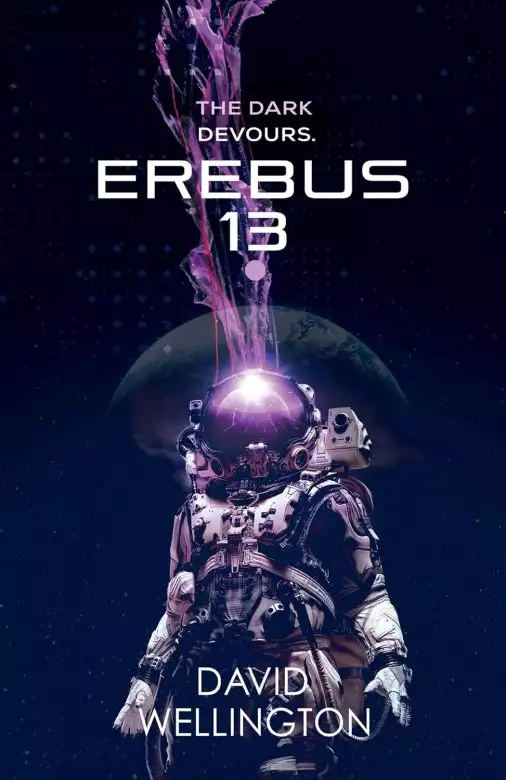
The crew of the Artemis has escaped the nightmare of Paradise-1, but at great cost.
Parker is gone. Petrova’s past continues to haunt her. Worst of all, Erebus—a timeless entity of pure darkness—has been released from its prison.
Now it’s headed for Earth.
Petrova must rally her crew for one final mission. Somehow, they must find a way to unite the disparate factions of the solar system—the United Earth Government, the Lunar colonies, and the outer planets—and find a way to stop Erebus.
The fate of humanity—and the galaxy—is in their hands.
Release date: July 14, 2026
Publisher: Orbit
Print pages: 684
* BingeBooks earns revenue from qualifying purchases as an Amazon Associate as well as from other retail partners.
Reader buzz
 Please log in to recommend or discuss...
Author updates
Erebus-13
David Wellington
In the beginning of that thawing time there was sleep, true sleep. No tossing and turning, no rapid eye movement. Not even the slow desperate quietus of the hibernating bear. In her glass coffin Petrova’s body ticked over one day-long heartbeat at a time. Her fingers lay relaxed by her hips; her chest neither rose nor fell in a way anyone could see. Her eyes were closed.
She passed a certain threshold of neuronal activity. Impulses jumped across synapses; ions flowed through old, long-accustomed channels. Something like thought began, inside her silenced brain. At first only disordered flashes, sparks. In time they began to coalesce. To take form.
One by one her senses came alive. She dreamed.
The dream was not at first coherent in any way. It was just a bundle of sense impressions, with no organization to them. She saw sunlight, white sunlight slanting through Zhang’s hairline, saw beads of sweat roll down his temple. She saw the toxic green of Rapscallion’s robotic bodies, no shape really, just the color. She felt her own lips smiling, as a hard light hologram pushed an impossible tongue between her teeth.
She felt the bones of her left hand start to bend, felt them slide inside the soft tissue of her arm, felt them snap.
Broken glass, broken glass and blood and a scream, a scream as shrill and loud as a hull breach siren—
(in another place, very far away, her mouth moved, but only a tiny fraction of a millimeter. It would take hours for her to lift her tongue to her lip, days, perhaps, but in dreams things move at their own pace)
The last time—
The last time she’d woken from cryosleep, her ship had been broken beyond repair, its hull torn open in a dozen places by flying debris. The last time she’d woken in a cloud of her own blood and broken glass, in a shattered cryotube. The last time, her ship had woken her too fast and she’d woken up screaming – screaming for air, for light, for heat—
(breath began to gather in her lungs, a sketchy stratus cloud of carbon dioxide clinging to the collapsed cavern of her throat, preparing to escape sometime next month)
“Hi,” Sam Parker said.
He was there – beside her. She couldn’t see him, only feel him, his skin touching hers, his mouth near her collarbone. His arms wrapped around her.
Petrova tried to scream. She tried to get away as he snuggled closer to her.
Sam – Sam was dead. He was a ghost. Her lover, once. A tall, gangly space pilot with an easy smile and kind, long-fingered hands.
Now he was something else. Something terrible.
(a twitch ran through her left arm, the faintest stirring of muscle fibers. Her fingers curled into the start of a fist. Moving faster now. She was nearly awake)
“Sam, why are you here?” she asked.
He didn’t answer at first. He just smiled, eyes closed. Stretched out his long limbs like he was luxuriating in bed, rising slowly from an excellent night’s sleep. Then he opened his eyes, that dreamy smile still plastered on his face, but one of his eyes was bloodshot, horribly red. Like an artery had burst inside his head.
“Hey,” he said. He reached for her.
His hand was terribly burned, the bones sticking out of cracked and blackened skin. Even as she watched the tiny, long fingerbones separated, came loose in the absence of gravity and floated around her—
“Time to wake up,” he said. His voice soft, kind.
(inside the tube her body started to move in slow motion. Her eyelids flickered open but her eyes were rolled back in their sockets. Her limbs twitched and her chest heaved, her lungs sucking in oxygen, suffusing her cells with new life, new energy)
Sam’s body disintegrated in fire and heat and energy, and all she could do was watch as his cells tore apart from one another, as tissues dissolved into vapor, into plasma, his floating bones clinking as they struck the sides of the tube, a piece of his pelvis caroming wildly back and forth, smacking into her shoulder hard enough to hurt, hard enough to draw blood—
(the scream finally worked its way out of her throat, noise building and echoing inside the glass tube, a shrill horror of a noise that bounced back and forth off the walls of her prison. She had to get out! She had to get out!)
The glass tube melted and flowed away from her. Cold air washed across her sweaty face and Petrova lunged forward, sitting up and grabbing at her shoulder, her jaw. She touched her own hands, studied them, uncertain how her left hand looked so perfect, so undamaged. Hadn’t it been broken, chewed by a machine until it was just pulp?
And where was all the blood and broken glass? The last time she’d woken from cryosleep everything had been wrong, everything had been broken.
She stopped screaming, forced herself to swallow the last of her wailing cry, and looked around, looked at where she was. The room was dimly lit, but that was how it should be. When you first came out of cryosleep the lights were kept low because your eyes needed time to adapt. The room around her was cold, yes, but not the cold of the vacuum of space. She shivered but then a fan whirred to life and blew warm air across her naked skin.
She blinked her eyes. Forced herself to focus.
A clear plastic tube wrapped around her right arm. Cool fluid pushed through the tube, into her arm. Nutrients and saline, that was all. Rehydrating her tissues after the long sleep.
That tube was supposed to be there.
She was okay. She was unharmed. Her left hand was fine, just as it had been when she climbed into the tube.
She listened but she didn’t hear any alarms, no computer voice warning of imminent disaster. She licked her lips, intending to speak, to ask for an update. Even though she suspected that she knew what she would hear.
She was alive. She was safe. She had successfully woken from cryosleep, and this time she was in no danger, had nothing to fear.
The door of her little room opened and she automatically pulled her knees up to her chest, hiding her breasts.
“Are you under the impression I’ve never seen you naked before?” The woman standing there was dead, as dead as Sam Parker. Another ghost. “I used to bathe you, child. Get up and get dressed.”
Petrova licked her dry lips. “Mother,” she said.
Ekaterina had been a tall woman in life, tall and slender. She had a massive pile of white hair atop her head that made her look even bigger. She was just a hologram, now, an image of the woman she’d been, but still just seeing her made every muscle in Petrova’s body tighten up, just a little.
“What. Where,” Petrova said. She was still too woozy from cryosleep to form meaningful sentences. She struggled, forced herself to be coherent. “Where are we?”
“We’re in orbit around Earth,” Ekaterina told her. “About twelve hundred kilometers up. Right where we should be. It took us sixty-four days to get here.”
“That seems fast,” Petrova said. They had traveled nearly a hundred light years from Paradise-1. In her mind they had left the planet only minutes ago. Time was strange.
“I want you on the bridge as soon as possible – there’s much to discuss.” Ekaterina turned to go.
“What’s going on?” Petrova asked, as she climbed off her cryobed and reached for a jumpsuit. “Is everything okay? What about Zhang and Rapscallion?”
“Is everything okay?” Ekaterina repeated, and seemed to think about it for a moment. “The ship seems to be intact and we haven’t died yet. That may change soon though, especially if you keep wasting time.”
“What? Why?”
“We’re under attack,” Ekaterina said, as if she was sharing some particularly dull bit of gossip. “Half the UEG’s home fleet is coming for us. Don’t forget to tie your hair back, Sashenka. It’s quite a mess.”
Petrova was still zipping up her jumpsuit when she reached the bridge. Polyhymnia, the ship, was tiny, little more than a shuttle grafted onto a faster-than-light singularity drive. There was barely room on the bridge for three people. Zhang Lei was bent over a console, studying a grouping of dots on a black background. Ekaterina sat in the captain’s chair, the only real furniture in the room. That left one member of the crew missing. Petrova looked up and saw what looked like a bright green spider crouching on the ceiling, its starburst of limbs at least three meters in diameter. It looked like it was about to drop down and grab her, pull her up toward its maw.
Then it did just that.
When three of its legs wrapped around her and pulled her into a tight hug she breathed to calm herself, forced herself not to panic. Rapscallion wouldn’t understand why she might find the gesture so unnerving. “Glad to see you, too,” she told the robot. “How do things look out there?”
“We dropped out of singularity space two hours ago,” Rapscallion said. “Just a perfectly normal, by the book maneuver. Except that we re-entered normal space right between Earth and the Moon. In the middle of a restricted zone.”
Petrova scowled in annoyance. “I assume the local authorities weren’t pleased.”
“Earth Orbital Security hailed us and asked what the hell we thought we were doing, of course,” Rapscallion went on. “Ekaterina refused to answer their calls.”
“You just left OrbSec with no answer? No wonder they’re moving to intercept us,” Petrova said. “Zhang? What kind of opposition are we looking at?”
The doctor looked up from the console. He’d never been formally trained in space combat but the events of the last few months had been an education of a sort. “We’ve got three fighter craft heading our way, fast, and a heavy cruiser backing them up, coming in on a tangential orbit. I think they’re trying to cut us off before we can land on Earth.”
Petrova nodded. “Mother. Did you think about at least reassuring them that this ship has no weapons?”
“I didn’t see any reason to speak to them at all,” Ekaterina said.
She tapped at a console in front of her, magnifying the view through the bridge’s main screen. A fighter appeared there, its weapons glowing in the infrared. Judging by the stars streaking past in the background, the fighter was moving very, very fast.
“What, precisely, would you want me to say?” Ekaterina went on. “Hello, yes, we’re coming from a haunted planet full of zombies and my daughter accidentally released the zombies and now the zombies are on their way to Earth, but don’t worry, we’re perfectly trustworthy people? Other than the psychic parasite she’s carrying in her head and the fact that the current director of Firewatch has almost certainly given orders for us to be executed on sight?”
It had been a long few months.
“Revenants,” Zhang said, looking up from his screen. “Not zombies. They’re revenants.”
Petrova nodded. She knew the difference but now wasn’t the time. “How long before the fighters arrive? If we’re going to survive this we need to think of something, now.”
“Ahead of you, there,” Ekaterina said. She tapped at a virtual keyboard and a new screen appeared before her. It was labeled ‘WEAPON STATUS’, and it showed a line of green status lights. “You asked before if I had considered telling OrbSec we were unarmed. I didn’t want to lie to them, you see.”
Zhang tapped his temple and entered a virtual representation of the volume of space around them. He could see the Moon off to his left, its silver crescent blaring light where the sun touched it, craters dark and endlessly deep where they lay in shadow. Below him, Earth wheeled blue and white, far too big for comfort.
He studied the three fighters coming up behind them. They didn’t look like vehicles. Instead they looked like enormous spears, thin and sharp-nosed. Weapons were hung around their midsections, rocket pods and particle beam accelerators. As he studied them, text windows opened all around them, listing out the model numbers and specifications of all those weapons. He didn’t need the data to know they could easily tear Polyhymnia open like a food pouch and spill its human cargo out into the airless void. He read the specs out loud anyway, because he knew that Petrova would want the information. Not to help her make a decision, of course. She was just one of those people who needed numbers and details to feel like she was in control of a situation.
Zhang was a doctor, a surgeon. He understood that you were never truly in control. That you could train and study for a lifetime and still, when you were faced with a burst artery, the only thing you could do was clamp it down to stop the bleeding and get to sewing and hope, against all logic, that you had a chance to save the patient.
“The nearest fighter is at four thousand kilometers and closing,” he read out. “The computer suggests it’ll wait until it gets within three hundred kilometers before opening fire, which gives us… seventeen seconds. Our weapons aren’t effective at long range, so we won’t be able to shoot until the same time they do. What do you want to do?”
Zhang tapped his temple again and the virtual view disappeared. He looked up at Petrova expectantly.
Behind him, Ekaterina cleared her throat. “Forgetting something, are we?”
He twisted around to stare at the hologram. She stared at him haughtily down the length of her nose. She might be dead, a ghost, but her eyes gleamed with disdain.
“What? What is it now?”
“Chain of command,” Ekaterina said. “I am the captain of this ship.”
Zhang sneered in disgust. “We don’t have time for games—”
He felt Petrova’s hand on his shoulder. It squeezed his flesh gently. Zhang hated being touched, normally, but he had learned to rely on Petrova for social cues. He shut up.
“Mother,” Petrova said. “Captain. Requesting authorization to take over tactical control.”
“Granted,” Ekaterina said, with a slow nod.
She never broke eye contact with Zhang. She didn’t even blink.
“Twelve seconds to firing distance,” he said, quietly. He shuddered and looked down at his console.
“Taking manual control of ship’s weapons,” Petrova said, as she dropped into a crew chair next to Zhang. “If we die now, like this…”
Zhang looked over at her, wondering if he should reach for her hand.
“… at least it’ll be over fast,” she told him.
“Six seconds,” he replied.
“Firing,” Petrova said. She tapped a virtual keyboard and high energy particle beams lanced through space. One pierced the fighter like an arrow but it kept coming. “Brace for impact!” she called, as the fighter’s weapons discharged. A split second later the Polyhymnia shook as a beam grazed its engines. Petrova grabbed at her console and watched on a floating viewscreen as rockets burst all around them, briefly whiting out their external cameras so she couldn’t see anything.
“Rapscallion, did they hit anything vital?” she asked, even as her screen rebooted to show her more rockets were incoming.
“We took the brunt of that one on the singularity drive,” Rapscallion said. “It’s big and pretty solid. Makes a pretty good shield back there at the rear of the ship.”
Zhang looked up in terror. “But – there’s a mini black hole inside that drive, right? What happens if they breach the hull?”
The robot shrugged with multiple green arms. “Either nothing at all, or, and I’m just saying this to be thorough—”
“Brace!” Petrova called again, as the second wave of rockets exploded off their bow, shaking the entire ship.
“—and I mean, there’s a very low chance of this,” Rapscallion went on, “but it’s a non-zero chance, that the singularity’s containment field could fail, in which case—”
“Rapscallion, forget I asked,” Zhang called, but it was too late.
“—in which case, tidal gravitational forces would stretch us all out into a kind of molecular taffy that would be sucked down the gullet of the black hole at relativistic speeds. I do want to stress that would be fatal. Even for me.”
“Brace,” Petrova said. She squeezed her eyes shut as bright white light washed across all of her screens. The rockets were ridiculously inaccurate at this distance, but hitting them wasn’t the point. The rockets were mostly meant to blind her sensors and allow the fighter to close the distance for a killshot. A distraction from the main offensive. She knew she needed to get clear of the attacker, and soon. Lining up another shot she loosed another particle beam before the computer had even finished building its firing solution.
Her beam raked the top of the fighter, burning a deep furrow through its hull. At first she thought she’d barely damaged the small craft, but then as she watched in mounting excitement its engine exhaust changed color from whitish-green to a hot blue as its reactor went critical. Silently, almost in slow motion, the fighter disintegrated from the tail forward.
A lucky hit, and a good one. She allowed herself a tight little smile once she’d confirmed the fighter was out of action. Then she looked up at the others. Neither Zhang nor her mother looked particularly happy. “What?” she asked.
“The other two fighters are arcing in to cross right in front of our nose,” Zhang said. “We survived one of them attacking us, but two at the same time—”
“And let’s not forget the cruiser headed in our direction,” Ekaterina said, speaking over him. “It’s only about forty-five seconds away. If we live long enough for it to get here, its weapons will make very short work of us.”
Petrova bit her lip and nodded. “Understood.”
“I’m glad you understood me, girl. What do you plan on doing about it?” Ekaterina demanded.
Back on Paradise-1, back on Artemis, when they’d been constantly in terror for their lives, when alien forces beyond comprehension had been trying to kill them, at least her crew had listened to her orders, Petrova thought. She’d forgotten what living around her mother was like. Petrova had asked for tactical control, to take the lead on this battle. Now her every move was being scrutinized and if she didn’t come up with an excellent plan soon, if they all died, it would be her fault.
She could barely think under all the stress, could barely imagine what her options were. It occurred to her to wonder what Parker would have done in this situation.
Sam Parker. Friend, former lover. Former ghost. He was as dead as her mother was. He had, for a while, been a talking ghost just like her. Now he was something much worse.
That wasn’t what had brought him to mind, though. Parker had been, above all other things, one hell of a pilot. He’d gotten them through scrapes just as bad as this. She tried to remember what he’d done when the Basilisk’s fleet had chased them all the way to Paradise-1, how he’d solved that particular problem.
“Diverting power from the weapons,” she said.
“Wait – what?” Zhang shook his head. “You’re shutting down our guns?”
“They use a lot of energy. We need to save that for our engines.”
Ekaterina scratched herself under the chin. “What are you thinking, Sashenka?”
“We came here intending to land on Earth,” Petrova told her. “That’s what we’re going to do. The descent is just going to be a little bumpier than we expected.”
Zhang watched in horror as the blue curve of Earth waxed larger in the viewscreen. Polyhymnia’s artificial gravity generators prevented him from feeling their acceleration but his body knew that they were screaming downward, straight at the ground as fast as a bolt of lightning.
Petrova had thrown them into a steep power dive, the nose of the ship pointed right at a corner of North America, the engines straining to pour on more and more acceleration. Zhang couldn’t stand to watch the ground come up toward him at that kind of speed. He couldn’t stand to look away from the screen, either, terrified that impact would come and he wouldn’t be ready for it.
“We’re going to die,” he whispered to himself.
His console lay forgotten before him. He forced himself to glance down and give a status report. “Both fighters are following us down. The cruiser is almost on top of us.”
“Got it,” Petrova said. She sounded strained, like she was just as terrified as he was. That couldn’t be possible, though. If she were this afraid she wouldn’t be doing this.
With every second that passed, Zhang could see more and more detail in the screen, could see rivers and lakes dotting the brown and gray landscape, the weird geometric patterns of robot-controlled farms, the glittering mirrors of solar power plants. Cities rose, tower by tower, like fingers of concrete and steel reaching up to grab the offending spaceship out of the sky. A cloud streamed up toward them and suddenly they were in the middle of it, the camera view stippled with drops of condensation, white streamers of water vapor lashing at them like striking serpents.
“We’re about to hit the stratosphere,” he said. “Hull temperature is rising. Do we have the thermal shielding for this?”
“I’m sure we’ll be fine,” Petrova told him.
“I wish I had your confidence,” Ekaterina announced, for the benefit of no one.
“The fighters are right behind us. Looks like their weapons are having trouble locking on to us, which is good,” Zhang said, “but—” He stopped short. “What is that?” he asked.
He’d heard something.
It was a strange sound, a kind of hissing, a grating kind of abrasive noise. He thought of the little boat they’d used back on Paradise-1. The sound it would make when it ran aground on a sandbank, the almost rhythmic hiss and scratch of sand grains against the aluminum bottom.
It took him a second to realize he wasn’t hearing the sound through the viewscreen. That sound was coming from outside the ship – and only then did he realize what it was. That sound, that noise like fiendish rain, was the sound of air molecules striking Polyhymnia’s hull. They had passed a boundary and were no longer in space, but had entered Earth’s deep atmosphere. The air was hitting them so fast it sounded like someone had taken a sandblaster to the hull.
“Our temperature is rising fast,” he said, and realized he was shouting to be heard over the noise. Maybe just shouting out of fear. “We can handle this, right?”
“We’ll have to,” Petrova said.
“The fighters are pouring on speed, trying to catch us before we get any closer to the planet,” Zhang told her. “They’re not firing, they’re—”
He watched the screen. One of the fighters was slightly closer, almost directly behind them. Its hull changed color as he watched and he wondered how that was possible. It started out as a sort of dull orange that turned the color of a vibrant sunset, then a deep and angry cherry red. He looked at its rocket pods and beam weapons and watched as they changed shape, softening like they were made of paste that was melting in warm rain. He realized that the metal weapons were actually melting, dissolving in the fierce heat of atmospheric entry. Then the fighter itself started to melt, metal flowing backward in thick waves from its nose. Suddenly the entire spacecraft broke up, pieces of it shooting off like meteors, fireballs streaking away into the thick clouds.
“The fighters – the fighters are gone,” he said.
“One less thing to worry about,” Petrova told him.
“Sashenka,” Ekaterina said. “You’re coming in too fast. Sashenka, we’re not actually trying to hit the ground. Pull up now, please, daughter.”
Petrova didn’t reply, except to let out a little grunt of frustration.
It scared Zhang far more than the fact that the air on the bridge was starting to get too hot for comfort.
The air on the bridge was so hot it hurt to breathe. Zhang kept calling out warnings and dire predictions, saying that their hull was starting to melt, that they had only seconds left before the entire ship broke up.
Petrova tuned him out. Focused on what she could control.
Polyhymnia plummeted like a dart, thrown with incredible force, straight at the ground. Bringing it up out of that dive was more than the ship’s tiny altitude jets could accomplish. Sweat broke out on her forehead as Petrova shunted power from every system she could find to the stabilizers, even as the atmosphere buffeted them, even as her screens showed nothing but plumes of fire racing across the ship’s hull.
There was only so much power she could steal. They needed some kind of basic life support, they needed minimal sensors just so they could see how close they were to the ground. They needed artificial gravity.
The AG kept them in their seats and not smeared across the back wall of the bridge in a fine red paste. If she switched it off to pull more power for the engines she would kill both Zhang and herself instantly. AG used an astonishing amount of energy every second, especially as it fought against the massive gravity well of Earth. But maybe she could siphon off just a little of that power—
“Rapscallion!” she shouted. “Hard maneuver coming up. Secure Zhang!” Then she reached up and grabbed an emergency seat harness and pulled it down hard over her torso, cinching it so tight she couldn’t breathe.
She just had time to glance over and watch Rapscallion’s eight green limbs grab up Zhang in a tight hug. She heard the doctor protest for a moment, then heard his voice grow muffled as the robot shoved him down onto the floor, pinning him in place.
Collision alarms started to sound from the bridge’s speakers, then stopped abruptly as something shorted out. The air was so hot it felt like her face was drying out and shriveling up.
Now, she thought, and hit a virtual key.
For a second it felt like she was in freefall, like she had stepped into an elevator shaft with no car in it. Maybe like she was floating in the microgravity of space. Then her stomach shot backward, through her spine, through the massive crew seat behind her – at least, it felt that way. A massive hand pressed down on the front of her body so hard she thought she was going to break into pieces, that every bone in her upper body was going to shatter.
The ship bucked underneath her, fighting back against the power she was using to rein it back. Petrova couldn’t reach the console to cancel the power shift, much as she wanted to.
Her vision narrowed to a dark tunnel and she could hear nothing but her own heartbeat. She expected it to be racing but the thing sitting on her chest had slowed her circulation down to a dull, leaden rhythm.
Was Zhang screaming? She couldn’t hear if he was, but she felt it, like some kind of psychic connection. Maybe it was just empathy, human emotion welling up at a time when she absolutely needed to be cold, precise, logical—
Oh God.
Oh no.
A blood vessel burst inside her eye and for a second she could see red, nothing but the red of blood. She felt like her teeth were cracking in her mouth, her chest collapsing like a staved-in barrel.
And then something impossible, and terrifying, happened.
Her body started to heal. It was not the achingly slow healing of a living system. This was alien technology at work. She could literally feel the artery inside her eye knitting back together. Feel her bones stretch and grow as they fought back against the desperate weight on her chest.
Oxygen flooded into her lungs and she suddenly had strength in her arm again. She reached forward and tapped at a virtual key, brought up a viewscreen, coaxed it close enough to her face that she could see it.
Outside, the ground was still rushing up to meet them. It was coming at an angle, now, though. They weren’t flying straight into death’s maw, or at least, not with as much force as they had been before.
She reached for the ship’s controls. Raised her flaps and felt the ship shudder in annoyance, but for the first time it truly responded to her direction. The nose came up a little more. Jets in the fore of the ship fired hard and their airspeed started to slow.
By the time she felt she’d regained full control, when she could give the AG its power back, her body was fully healed. She didn’t even ache.
It was pretty useful, having an alien artifact bonded to your system. Hidden inside the flesh of her left arm was the Key, a billion-year-old machine that had once given the gift of immortality to an alien god. She hadn’t been sure how well it would perform when paired with a human body but so far it was getting high marks.
She ran through her screens, checking the ship’s systems. They’d been badly damaged by the fight and the subsequent maneuvers but they were still airborne. It looked like she could even make a safe landing.
Outside, the hills of Earth rolled past, spotted here and there with the mirror flash of a lake or stream. They were flying just below a thick cloud deck that would give them some cover from attacks from above.
“That,” Ekaterina said, “was reckless.”
“It worked,” Petrova said. She didn’t bother turning her head. She knew her mother’s ghost would be right next to her, cheek lined up next to her cheek. Intimately close, as if they’d ever had some kind of loving or affectionate relationship. Her mother loved to test people’s boundaries. “Rapscallion,” she said. “You still there, buddy?”
We hope you are enjoying the book so far. To continue reading...