An imaginative, moving collection of stories infused with the magic and enigma of the human condition and drenched in Texas heat, from the best-selling author of We Burn Daylight.
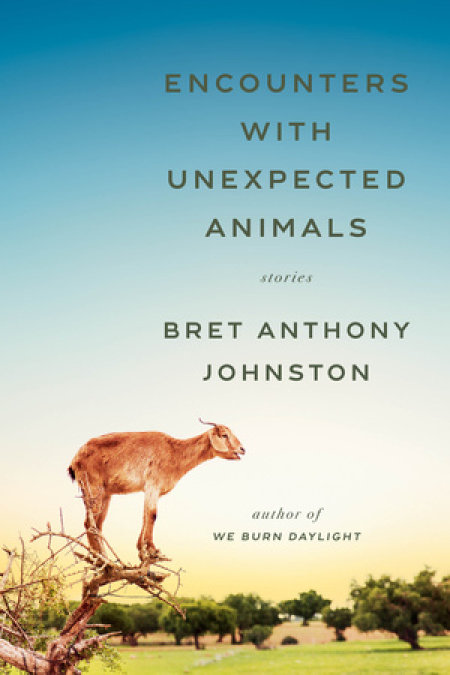
Encounters with Unexpected Animals takes readers deep into the heart of bestselling author Bret Anthony Johnston’s home state of Texas, where teenagers search for love, parents grasp at connections with their children, and animals—real or imagined, familiar or unexpected—are reminders of the mystery, danger, and beauty of being alive.
In “Caiman,” a father buys a baby alligator in hopes of keeping his family safe. In “Soldier of Fortune,” a teenage boy dog-sits for his neighbors after tragedy strikes, and his innocent snooping uncovers the family’s most guarded secret. And in the luminous “Half of What Atlee Rouse Knows About Horses,” an elderly man’s heart is laid bare with the raw and breathtaking power of wild horses.
Johnston’s humor, empathy, and mastery of prose ring out through each story, bringing every finely-drawn character to radiant life. Individually, the stories are by turns suspenseful, poignant and exhilarating. Taken together, they reveal the abiding connections that lead us from sorrow and impermanence back to ourselves and, ultimately, to each other.
Release date:
February 24, 2026
Publisher:
Random House
Print pages:
224
* BingeBooks earns revenue from qualifying purchases as an Amazon Associate as well as from other retail partners.
Serious clowns have their faces painted onto blown-out goose eggs. My son tells me this on the drive from Corpus Christi to Houston. The custom began in the sixteenth century, a method of remembering makeup patterns, but now it serves as copyright. The eggs are done up with acrylic paint and accented with felt and glitter, with tiny flowers and ribbon and clay, and the records are preserved in the Department of Clown Registry in Buchanan, Virginia. He says a clown’s makeup is called his slap, and whiteface clowns rank highest in the hierarchy. Then the augustes, with their red cheeks and ivory mouths. Then character clowns, then hobos. The first known clown appeared in a pharaoh’s court during Egypt’s Fifth Dynasty—he was a pygmy. Clowns in Russia carry the same clout as pianists, as ballerinas.
It’s a tepid Friday in March, and we’re going to a clown convention at a Marriott by Hobby Airport. On Sunday he’ll compete in a contest hosted by Clowns of America International. Asher is thirteen. He’s a hobo.
“Fear of clowns is called coulrophobia,” he says. He’s paging through one of his clown books in the glow of my truck’s interior light. Outside, the dusk is particulate. We cross the Brazos River, rust tinted with sediment. A megachurch’s illuminated cross, as tall as the mast of a great ship, rolls over the horizon. My son says, “The fear stems from how the heavy makeup conceals and exaggerates the wearer’s face. Also, the bulbous nose.”
“Do ballerinas carry a lot of clout in Russia?” I ask.
“It’s like being a football player in Texas. Like being one of the Cowboys.”
“Hot damn,” I say because it sometimes gets a laugh. Not tonight. He’s too wound up; he’s been x-ing out days on his calendar for two months. “Are we talking Landry years or Johnson years?”
“Landry. No question.”
That Asher knows his Dallas Cowboys history always calms me. I’m suddenly more comfortable in the truck’s cab. My wedding band catches the light of the low moon, reminding me of thrown copper. I say, “A lot of wide receivers study ballet. It helps with spatial awareness.”
“Besides Santa Claus,” Asher says, “Ronald McDonald is the most recognized figure in the world.”
At the hotel, two giant plywood clown faces command the lobby. From chin to crown, they’re eight feet tall. Asher stands in front of them while I check in—he’s so enthralled that I half expect him to kneel—and only moves when a long-haired woman asks him to snap pictures of her posing between the clowns. The desk clerk hands me breakfast coupons and keycards, Asher’s welcome packet and lanyard. Our room’s on the sixth floor. As we ascend in a glass elevator, Asher tells me the long-haired woman has been here a week and she estimates there are over a hundred clowns at the hotel. “Tough luck for coulrophobics,” I say, and he smiles like I’ve passed an exam. It fills my every cell with breath. My mystifying son—the boy can send a tight, arcing spiral forty yards, but he’d rather hole up in his room with Red Skelton videos. After showering, he emerges from the bathroom wearing a shirt that reads Can’t Sleep, Clowns Will Eat Me and orders room service. Throughout the night, the hotel trembles when the nearby planes take off. I wake up often, confused as to how we got where we are.
I work in oil and gas. I’m a geological technician, which means I spend my days pulling well information. I study maps generated by geologists and run numbers to track which wells are still producing and which need to be plugged and abandoned. I like knowing what’s burning beneath our feet, the black oil and farther down, the clean effervescing gas. The knowledge makes me feel simultaneously large and small, and in that I find comfort. After I blew out my knee during a college scrimmage, I switched my major from communications to geology. I wanted, I think, to encase myself in rock, in hard things that last.
Geo techs don’t make a lot of money; we leave that to engineers and landmen. This trip to Houston is a stretch, and although I could’ve saved half a month’s pay by booking a room in the motor court across the freeway, I didn’t want to skimp on what Asher’s taken to calling the most important weekend of his “career.” I want him to feel fussed over. I want him to know I’m on his team. As the convention approached, I imagined moments we might share: father and son splitting their first can of Lone Star, talking about the birds and bees, or maybe passing the pigskin, analyzing the pitiful seasons the Cowboys have been suffering, the injuries and heartbreaks that now define a once-great team. (Before we left Corpus, I aired up our old football and dropped it into the truck bed, just in case.) I also thought it might be a chance for us to finally talk about his mother. Jill’s been gone two years. She was forty, and the first time she visited the doctor, the tumors lit her X-rays like a distant constellation. Three months later, the images were blurred with metastases. “Like a snowstorm,” Jill said, sounding oddly pleased. She didn’t make it to Thanksgiving. Asher and I avoided turkey that year and ordered pizza, then we went to a movie full of explosions and rooftop chases. “We’ll make new traditions,” I said. That Christmas he asked for his first makeup kit and a foam nose.
On Saturday morning, at the breakfast buffet, I realize my son will likely get thumped in his contest. He’s just outmatched. Even with their painted faces, these clowns look severe and cagey. Purposeful, I think. Ornery. There are probably thirty of them in the restaurant, and another fifty mingling in the atrium. Their costumes are elaborate and expensive—billowy and silken and intensely colored. Pigment assaults me. They wear patent leather shoes as big as rural mailboxes. Two of them walk on stilts and can rest their elbows atop the plywood clown heads in the lobby. Some are bald. Others are neon geysers of hair—red and orange and purple, Afroed and spiky and twisted into formidable braids. One clown wears goggles and flippers and a small inflated pool around her waist. They’re all adults, I’d guess mostly in their sixties, and they’ve come from as far away as Quebec and Maine. Seriousness radiates from them like heat from asphalt. They have swagger and business cards.
I’m embarrassingly relieved Asher didn’t come to breakfast. He’s awake but wanted to rehearse his routine alone in the room. His event is Paradeability. He’ll be judged on the originality of his act and how many times he can complete it while moving through a gauntlet of would-be parade spectators. We’ve practiced in our backyard with a stopwatch. We record the sessions with a video camera propped on our propane grill, then Asher studies the footage and makes adjustments. As I eat my omelet, I catch myself hoping they give out ribbons for participation, something he can at least hang on his wall.
A clown in the hotel atrium starts squeezing a bicycle horn while another skips in circles, tossing confetti. His limberness surprises me. In a high falsetto, they sing, “We’re having a hoot, an absolute hoot!” It’s easy to imagine Jill here, trailing Asher, snapping candid pictures of him with the clowns. At home, framed photos of him hang on almost every wall—Asher selling raffle tickets, Asher feeding a brown pelican on Padre Island, Asher sleeping. Photography wasn’t her hobby—watching Asher was. She was rarely in front of the camera, something I realized too late. Her absence blitzes me everywhere. The way the sheet and pillows on her side of the bed stay undisturbed, regardless of how I toss in my sleep, is menacing. The junk mail that still comes addressed to her leaves me as cored out as a cantaloupe. Lately, on Sunday mornings, I’ve been hitting open houses in different neighborhoods in Corpus, trying to wrap my head around moving. I tell Asher I’m going to church. Maybe he believes me.
“Here’s someone who knows eggs-actly what he likes for breakfast,” a woman says. She’s beside my booth, but a beat passes before I realize she’s talking to me. She’s in a pinstripe suit, wielding a clipboard and walkie-talkie.
“Do what?” I say.
“Professor Sparkles got me with that one earlier this morning, but when I say it, people just seem baffled,” she says. She extends her hand. “I’m Dayna. With a y.”
“I’m—”
“Asher’s daddy,” she says.
I shake her hand, puzzled, wondering what kind of information is on that clipboard. Then I remember her: the woman from last night, the one Asher visited with while I registered. Her hair is up this morning, and she looks like a pretty librarian, drab amongst all the color. I say, “Are you a clown parent, too?”
“I wish,” she says. “Mine’s a cheerleader. She’d walk five miles to avoid a clown.”
“I suspect that may be an epidemic among cheerleaders.”
“Asher’s a cutie. What kind of clown is he?”
“Hobo,” I say.
“I would’ve guessed auguste.”
“He likes thrift stores,” I say.
We hope you are enjoying the book so far. To continue reading...

 Please log in to recommend or discuss...
