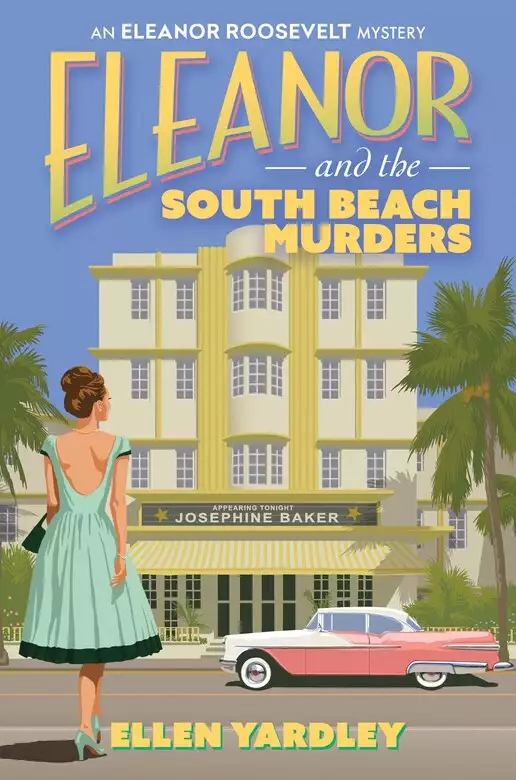
For fans of Colleen Cambridge, S.K. Golden, Jacqueline Winspear, and Ashley Weaver, a brilliant 1950s Cold War historical mystery featuring the former First Lady Eleanor Roosevelt’s indispensable assistant as an equally resourceful sleuth. As the duo become entangled in a deadly international mystery connected to famous performer Josephine Baker, can Kay trust her own instincts before it’s too late?
Miami, 1951. With a flurry of UN engagements bringing Mrs. Roosevelt to vibrant South Beach, Kay Thompson is thrilled to escape the post-Christmas blues in Washington, DC—and distance herself from the sting of her recent breakup with private investigator Tim O’Malley. The dizzying sights and sounds of Miami reach their peak at the Copa City Club, where a late-night meeting with singer Josephine Baker reveals a troubling truth: Baker’s bold stand against segregation has made her a target.
Josephine dismisses the threats. But Rosaleen—her cautious young assistant with big dreams—is deeply afraid. That’s why it’s a stunning shock when a dead man turns up in Josephine’s dressing room and Rosaleen is the one arrested for his murder. Determined to exonerate her new friend, Kay realizes it will mean facing conspiracies and prejudices that reach into the darkest corners of American society still haunted by the horrors of World War II.
Now, tangled in a high-stakes murder case with lives and legacies on the line, Kay joins forces with Mrs. Roosevelt and her former flame to confront the sinister forces lurking just beneath Miami’s glittering Art Deco surface. But when a killer’s scheme comes into sharp focus, Kay must act swiftly in a quest for justice that proves far more dangerous than she ever bargained for . . .
Release date:
February 24, 2026
Publisher:
Kensington Books
Print pages:
288
* BingeBooks earns revenue from qualifying purchases as an Amazon Associate as well as from other retail partners.
Marilyn Monroe’s candy-cane-striped bikini lay in Kay Thompson’s suitcase, waiting to be worn on South Beach.
It didn’t really belong to Marilyn, but it was a match for the strapless, two-piece bathing suit that Marilyn wore in a famous photo shoot. It was the skimpiest thing Kay had ever considered wearing in public.
She had planned to wear it today. As she sleepily pushed aside the bikini and searched for her girdle, Kay knew she would not make it to the beach today. Her job came first.
A soft knock sounded on the connecting door between her room and Mrs. Eleanor Roosevelt’s suite. “Are you awake, Kay? If you wish, I could meet Tim’s flight.”
Despite the early hour—not quite four o’clock in the morning—the former First Lady sounded refreshed, alert, ready for her day. Kay went to the door and opened it. “It’s okay, Mrs. Roosevelt. I should go. You have a packed agenda today.”
“I was worried it might be awkward,” Mrs. Roosevelt said. She was dressed for the day in a light blue dress with three-quarter length sleeves, her hair arranged in a smooth chignon. Kay was still wrapped in her bathrobe. “After what happened.”
“I won’t let it be awkward,” Kay said. She knew the first of Mrs. Roosevelt’s requirements for herself was inner calm. ER, as she had been known at the White House, said: “One of the secrets of using your time well is to gain a certain ability to maintain peace within yourself so that much can go on around you and you can stay calm inside.”
Kay loved her job with Mrs. Roosevelt. She wanted to keep it. That meant not allowing her personal life (a breakup on Christmas Eve day) to interfere with her job (Mrs. Eleanor Roosevelt’s temporary secretary).
“I’ll be ready in just a moment,” Kay said. “I just need to use the bathroom.”
She closed the door behind her. She snapped on the light and groaned at her reflection. Her red hair looked like a bird’s nest and her eyes and cheeks were puffy from sleep. She had no idea why. It wasn’t as if she’d slept. She had tossed and turned all night.
Kay turned on the tap and doused her face with cold water. Her bathroom in her room in the Delano Hotel had the same Art Deco styling as the hotel’s famous exterior. Chromium fixtures, a geometric mirror, lots of white marble.
She heard a soft creak. The sound of the balcony door opening. Mrs. Roosevelt must be looking outside while she waited for Kay.
The sun wasn’t up yet, but the breeze wafting in was already warm. Suddenly, Kay could smell the salty tang of the ocean. It was so quiet at this hour, she heard the soft roar of the waves.
Mrs. Roosevelt’s suite and Kay’s adjoining room were at the back of the Delano, overlooking the gardens, the dazzling swimming pool, and the endless stretch of the azure ocean beyond.
Kay had begged Mrs. Roosevelt not to wake up so early. With her packed agenda, Mrs. Roosevelt needed her sleep. At eight a.m. Mrs. Roosevelt was to give an important speech at the conference for the AAUN, the American Association for the United Nations, being held downstairs in the ballroom.
But she should have known Mrs. Roosevelt would be concerned that she had asked Kay to wake up before four.
Even so early, Kay had planned to put on her makeup. From giving her skin a porcelain look with her new Revlon Touch-and-Glow in Creamy Ivory, to drawing on Elizabeth Taylor eyebrows with Revlon’s tortoiseshell-plastic swivel-stick eye pencil. She was not going to meet Tim without “her face on.” But she didn’t want to make Mrs. R (as Mrs. Roosevelt was known) wait.
She yanked a brush through her hair. And decided she should put on her eyelashes. Wouldn’t Tim notice if she suddenly had short, stubby lashes instead of the long sweeping ones he thought she possessed?
With tweezers, she picked up one long false eyelash.
Peering close to the vanity mirror, she directed the flimsy thing toward her eye. It would only take a second—
Loud pounding sounded on the door of Mrs. R’s suite.
“Eleanor! Are you awake?”
Kay jerked her hand. The eyelash was gone. She held a set of empty tweezers.
“I need you!” the woman exclaimed.
Kay recognized the voice. It belonged to Josephine Baker, the famous singer. Four hours earlier, Kay and Mrs. Roosevelt had returned from a private party in Josephine’s dressing room at the Copa City Club.
Why was Josephine at Mrs. Roosevelt’s door?
Kay heard the door open.
“Eleanor!” Josephine cried. “I need your help. There is a dead man in my dressing room. And when the police found a dead white man in a locked room with a Black woman and a gun, the first thing they did was arrest the Black woman!”
Dear God, please make Eleanor a little tired.
—Franklin D. Roosevelt
Two days earlier
Miami, Florida
Kay peered out of the tiny window as the airplane approached the Miami International Airport. Below she could see a stretch of sparkling lights, a patch of darkness, then a strip of more lights that ended abruptly at an endless expanse of velvety darkness that had to be the Atlantic Ocean.
The airplane made a steep bank. Kay clutched her armrests. “What’s happening?”
“I believe the pilot is circling toward the runway to land,” Mrs. Roosevelt stated.
Kay could not even fake inner calm. Her heart raced, she heard roaring in her ears—either from pressure or the fear of an inevitable crash.
Kay tried to twist the armrests, as if she could override the pilot and level the plane herself.
Captain Dan Williams and his copilot had been seated in the cockpit when she and Mrs. Roosevelt boarded the plane in New York. Both pilots had cut very attractive figures in their uniforms. Captain Williams’s voice over the intercom had sounded deep and reassuring.
Now that they were almost vertical, Kay feared that calm and reassurance was for show.
She could see the city below—a grid of twinkling lights in the inky black—through the window across the aisle.
In the seat beside her, Mrs. Roosevelt calmly secured her paperwork in place on the small tray table. She had spent the flight carefully studying paperwork in preparation for the AAUN conference.
Kay wished she could be like ER. If these really were the last moments of her life, shouldn’t she be thinking about important things? Her big regret right now was that she had eschewed a pair of adorable scarlet sandals with three-inch heels and had bought a staid, demure white pair instead.
“Oooh,” she gasped as they seemed to tilt even more.
Just when she was certain the airplane would spiral to the ground, Captain Williams straightened them out.
Turbulence jostled them. Suddenly the plane lifted and fell, then shuddered side to side, like a toy kite being thrown around in the wind. Or marbles rattled in a tin can.
Kay stopped breathing.
Mrs. Roosevelt laid her hand lightly and reassuringly over Kay’s. “Not to worry. I have flown many times. Pilots are experts at handling turbulence.”
“Th-thank you, Mrs. Roosevelt,” Kay stuttered. “I’m fine. Really.”
Mrs. R patted her hand. “I know you are very courageous, Kay. Many people are troubled by flying.”
How Kay wished she could have impressed Mrs. Roosevelt right now with strength and stoicism. She was working as Mrs. R’s temporary secretary, accompanying her to Miami because Aunt Tommy, Mrs. R’s regular secretary, was not well.
Then, by a miracle, the shuddering stopped. They began to drop in a gentle descent.
With a crackle, the loudspeaker came on. “This is your captain. I apologize for the last few minutes. We hit some unexpected turbulence on the approach. Smooth sailing now, folks. We should be on the ground in Miami in a few minutes. Local time is 4:05 a.m. Weather today will be clear and sunny with a high of seventy-five degrees.”
Seventy-five degrees? In December? This time of year, Kay usually trudged to work through snow and sleet.
Now that she knew she would live to wear her sandals and bikini, Kay’s faith in handsome Captain Williams was restored.
And she could admire Captain Williams. After all, she was single again.
With a jolt, the wheels touched ground. Captain Williams hit the brakes. The deceleration made her gasp.
“Safe and sound,” Mrs. Roosevelt said, sliding her papers into her attaché case. Knowing they would arrive at four in the morning, she had sensibly slept before reviewing her notes.
Kay had been too excited to sleep, despite having nothing else to do for several hours.
She was going to Miami. She would be staying at the glamorous Delano Hotel on South Beach.
The airplane taxied to the terminal. Men in uniforms hastened toward it, pulling the rollaway stairs. People began to stand.
From the airplane’s rounded window, Kay could see the runways with a half dozen airplanes lined up for takeoff. Ahead was a sprawling yellow building that must be the main terminal. Now Kay’s job would begin in earnest. As secretary, she would collect the luggage. Hail a taxi. Ensure Mrs. R made it safely to her suite at the Delano Hotel in South Beach.
It was her job to ensure everything went smoothly.
They emerged out of the airplane into the dark.
It was not even five o’clock in the morning, but as Kay stepped out onto the stairs, warm and humid air wrapped around her. Much nicer than the frosty cold she’d left behind but instantly, she was perspiring in her wool skirt and sweater, the clothes she had needed to brave the New York winter on the way to the airport.
“I will help retrieve the luggage,” Mrs. Roosevelt said, as they reached the metal shelves where airport employees manually placed the bags.
“No, no,” Kay said quickly. “It’s my job.”
“Mine too.” Mrs. R smiled.
True to her word, Mrs. R grasped the first case. Kay took the second and the typewriter case. They piled the baggage on a wheeled cart. Mrs. Roosevelt led the way to the taxi stand.
“Of course,” Kay said, “you have been to Miami Beach before.”
“Oh yes. Most recently in March of this year, for my son Elliott’s wedding. I came during the war to visit hospitals. Franklin survived an assassination attempt here, in 1933.”
“What?” Kay had no idea. She had been a child in 1933. And she had only begun working for Mrs. Roosevelt in the autumn.
“Yes, a disturbed man attempted to shoot him,” Mrs. R said, her voice controlled and unflustered. “It was February, just over two weeks before his inauguration.”
Kay stared in shock. “And you weren’t afraid to return?”
“Oh no. And in March of 1934, I flew from Miami to Puerto Rico via Cuba and Port-au-Prince, Haiti. Before leaving, I met with three Miami policemen who were guarding my husband that day in Bayfront Park.”
Kay was still amazed by the danger Mrs. Roosevelt had faced, and how she stood up to fear with strength, calm, and grace.
“It should be easy to get a cab,” Kay said. “After all, how many people are arriving this early in the morning?”
She was wrong.
A large group of men milled around the taxi stand. There were at least two dozen of them. It must be a convention, for they almost all wore business suits and fedoras.
Kay usually noticed men. And now that she was single once more, she had every right to size up other men.
But something about this group sent a prickle of unease down her spine. The fine hairs on the nape of her neck literally stood up.
“Are they here for the AAUN conference?” Kay mused, frowning. Somehow that didn’t feel right.
In a voice devoid of emotion, Mrs. Roosevelt said, “I do not believe so.”
Now Kay realized why she felt apprehension.
The men’s conversations had stopped as they saw Mrs. Roosevelt. Silently, they glowered in her direction. Usually, in any large group, some people would recognize Mrs. Roosevelt, approach her, and ask to shake her hand. Not this time.
“I believe those men are members of the KKK,” Mrs. R murmured in a low voice. “I recognize several. That one is a senator from the South. I believe that gentleman is in politics in north Florida.”
For all the members of the KKK wore hoods and cloaks that looked like they were draped in bedsheets, their membership in the organization was not all that secret. While working with Mrs. R, Kay had learned that members of the KKK were in politics and law enforcement. In fact, one of the men in the taxi lineup wore a sheriff’s uniform.
The KKK had sent threats to Mrs. Roosevelt. Aunt Tommy, Mrs. R’s regular secretary who now lived in Hyde Park, told how she often answered the telephone to gruff-voiced men who threatened awful things.
Aunt Tommy simply hung up on them.
“We should get out of here,” Kay whispered. “We could wait and get a cab later.”
But Mrs. R went to the end of the line and calmly waited. Kay joined her, but she could feel hatred emanating from the men. She tried to look unaffected as they moved along the line.
Finally, she and Mrs. Roosevelt reached the front. But as the next taxi drove up to the stand, a large man pushed in front of them.
“Excuse me!” Kay said sharply.
He scowled. “We’re in a hurry, sweetheart.”
“I am not your sweetheart, we are in just as much of a hurry, and we were here first,” Kay said.
The man was big, broad, and built like a bull. A bull that was overweight. His white suit strained at the buttons. He was accompanied by a lean, good-looking black-haired man who was only an inch taller than Kay.
They reminded Kay of the “Fat Man” and “Mr. Cairo” from the film The Maltese Falcon. Kay had a girlfriend who’d had a huge crush on Humphrey Bogart, and they saw the movie six times.
The “Fat Man” shoved his way past them, whistling to the next taxi. His companion followed, but had the decency to look sheepish, but not the courage to stand up to his friend.
Kay stepped out from behind them, right to the edge of the curb. She put her leg forward to fiddle with her stocking. Just like Claudette Colbert in It Happened One Night. That had been a favorite movie of her mother’s. Thinking about it made her miss her mother—who would never have guessed her daughter would have traveled to Paris and now to Miami with Eleanor Roosevelt.
The taxi screeched to a halt in front of her. The cab driver jumped out. He was a tall young man, tanned, with curly black hair. He flipped open the trunk, grabbed Mrs. R’s big suitcase first, and placed it in with ease.
As he loaded the rest, he said cheerfully, “Where to, ladies?”
The “Fat Man” swiveled around and glared at Kay. “We were at the front of the line, young—” Then he looked at Mrs. Roosevelt as if he hadn’t noticed her. “Is that Mrs. Franklin Delano Roosevelt?”
“It is,” Kay said. She doubted he hadn’t seen Mrs. R. He was trying to save face, she thought.
“You gentlemen may have this taxi,” Mrs. Roosevelt said briskly. “We shall take the next one.”
“Ladies first for me,” the cabbie said. “Besides, I’ve got your cases loaded. All right, ladies, where are you going?”
Feeling the big man’s anger begin to boil, Kay smiled sweetly and said, “Don’t make me believe chivalry is dead with you fine gentlemen.”
The big man and “Mr. Cairo” stalked away, hailing another taxi.
Then Kay heard the words that chilled her to her bone.
“You’d better be careful, Mrs. Roosevelt,” said one of the men who remained in the group. “Wouldn’t want to see the same thing happen to you as happened to that Harry T. Moore up in Mims on Christmas Day.”
Harry T. Moore was a Black civil rights activist who had founded an NAACP chapter in Florida. A bomb had been planted under the Moores’ bedroom, and it went off on Christmas Day. A monstrous and cowardly attack. Mr. Moore had died, and Mrs. Moore was in the hospital.
Kay looked back toward the group of men, but Mrs. R said gently, “Ignore that man. He wishes to get a rise out of us.”
“Aren’t you worried? Maybe we shouldn’t be in Miami.”
“There have been several bombings in Florida,” Mrs. Roosevelt said thoughtfully. “It is being called the Florida Terror. I think it is important to be here. But I don’t want you to feel unsafe, Kay. If you would like to go home, you may return to Hyde Park. I can manage alone.”
To work for Mrs. Roosevelt meant stepping toward trouble and taking a stand, not running away. Mrs. Roosevelt had once said, “Every time we shirk making up our minds or standing up for a cause in which we believe, we weaken our character and our ability to be fearless.”
“I’m staying right here,” Kay said.
After three hours of sleep and a breakfast of eggs, toast, grapefruit, and coffee on the balcony, Eleanor Roosevelt was ready to tackle the opening day of the conference.
For Eleanor, this included a press conference, attendance at meetings, television and radio interviews in the afternoon, and giving a speech at the opening cocktail party.
The American Association for the United Nations was important to her. In a few days, it would be a new year. 1952. An election year. Of course, she hoped Harry Truman would win. But if the Republicans won, she expected this would be her last year as delegate to the United Nations. Governments wished to appoint people who were faithful to their party.
Her children, Anna, James, Elliott, Franklin Delano Jr., and John, might be relieved to see her retire and slow down. She was, after all, sixty-seven. Eleanor suspected the younger generation could not quite believe a woman her age had more to offer.
But Eleanor felt there was work to be done—for world peace and human rights—and she was eager to carry it out.
She had breakfasted with Kay on the balcony of her suite, enjoying the view of the ocean and the golden sunshine. Kay had asked if the Delano Hotel, where they were staying, had been named for Franklin.
The tall white hotel was famous for its distinctive geometric Art Deco façade, with beveled edges grouped in threes, topped with soaring fan-shaped finials.
“I have been told that it was,” Eleanor answered.
She was pleased to see Kay had color in her face and looked in good spirits after breakfast.
Eleanor was accustomed to receiving death threats. When she toured America during Franklin’s presidency, her security detail had discovered someone had strapped dynamite to her car tires.
Kay was not used to being threatened. Kay was brave—Eleanor had learned that while they had investigated the murder of beautiful Susan Meyer—but it was always shocking and frightening to discover that some people meant you harm.
As Kay helped her on with the light blue jacket that matched her linen dress, Eleanor gave an encouraging smile. “I am not worried about the threats. The most stressful part of today will be giving my speech.”
Despite her years of experience, she still felt a flutter of nerves before public speaking. Even today, so many years later, she focused on the exercises Louis Howe had taught her to modulate the pitch of her voice and eliminate a nervous giggle.
Kay smiled. “You will be great. Are you sure you want me to attend the cocktail party? I am just a secretary.”
“You are very important to the work I do. I feel you will find it interesting. There will be many young people your age as well.”
“They will be much younger than me. The young people involved in these organizations always are. They make me feel old and make me realize I haven’t accomplished very much in my life,” Kay admitted.
“You are only twenty-five.”
Kay winced. Eleanor smiled indulgently. Kay did not like to admit to her age, whereas to Eleanor, twenty-five was exceedingly young.
“You have accomplished a great deal,” Eleanor said. “And there is always time. I became a delegate to the United Nations at an age when many people thought I should retire from public life and slow down.”
“Those people were wrong. Without you, I doubt there would be a Universal Declaration of Human Rights.”
“That is very kind. But I was simply one person amongst many with hope for peace in the future,” Eleanor said. “Now, let us begin our day.”
The day proved as hectic as predicted. Eleanor was pleased at the way Kay kept things on schedule, confidently stepping in to remind the newspaper reporters and television interviewer of the time allotted. When things ran late, Kay got them back on track.
The favorite part of Eleanor’s day came at the end, at the afternoon cocktail party when she was able to speak directly with the young members of the AAUN. Eleanor often convened youth leadership summits and listened intently when these young people expressed their ideas, hopes, and concerns.
They asked thought-provoking questions which proved very difficult to answer.
“What did you think of the Soviets with whom you worked on Committee Three at the U.N.?” asked a serious-looking young woman named Alice.
Eleanor said, “It is possible that Westerners never fully understand the complexity of the Russian character, but I have constantly kept trying to do so throughout my service with the United Nations.”
A young man asked, between sucking on his pipe, “Do you think we can prevent World War Three or it is inevitable?”
“World peace is something all of us want, but none of us know the answer,” Eleanor said. “Everyone knew it would be a slow process, a process of education and of gradual understanding of the world and the people among whom we live.”
“How can America preach about human rights at the United Nations when segregation still exists in this country?”
The last question came as a demand from a young, attractive Black woman who wore a smart gray suit and had just joined the group gathered around Eleanor. She looked older than the others, perhaps close to thirty.
Eleanor sadly shook her head. “Yes, the Soviet delegation asked about our treatment of Black people in my country. I was asked: How about your Ku Klux Klan lynchings? I had no answer,” she conceded softly. “What do you say, standing before a committee of a world organization, when you are asked about the Ku Klux Klan?
“But I, for one, will continue to work to have such laws put in place. And to end segregation and discrimination. For as long as it takes to happen.”
The young woman gazed directly into her eyes. Eleanor felt as if her soul was being examined, but she did not fear giving the truth to this direct young woman.
“My name is Rosaleen Davis. I am Josephine Baker’s assistant. She is staying here in the Delano. You might be surprised to hear that since Miami Beach is a segregated city. Black performers are supposed to stay in a hotel in Overtown, but Josephine wanted to stay on South Beach.”
“I am pleased that she is,” Eleanor said.
“She is performing at the Copa City Club,” Miss Davis continued. “She insisted she would only perform if the audiences were not segregated. Josephine has enough clout to get what she wants. When Josephine heard you were staying here too, Mrs. Roosevelt, she sent me with an invitation. She would like you to attend her show tonight.”
“To see Josephine Baker perform would be a wonderful opportunity,” Eleanor said. “Miss Thompson and I will be happy to attend.”
“Josephine Baker is hot stuff,” breathed the tall young man who had asked her a question. He had introduced himself as Benny. He affected a blazer and a pipe, even though he had revealed he recently graduated high school. “She is known as ‘La Baker’ in Paris. Can I come as well?”
“It’s a free country,” Rosaleen answered. There was a cutting edge of sarcasm in her words that touched Eleanor’s heart.
… neither will it hurt the young people of today if they speak out their convictions and write from their hearts.
—Eleanor Roosevelt, My Day, July 4, 1944
The spot-lit marquee on one of the sleek, curved white walls of the Copa City Club announced that Josephine Baker was performing three shows a day. Palm trees lined the street, swaying gently in the warm breeze. A long queue of people waited under the awning to get in. The Copa City was on a road filled with nightclubs, known colloquially as “Swing Street.”
Kay frowned but Rosaleen Davis moved with brisk confidence toward the head of the line. Miss Davis had flawless skin and ebony hair pulled back into a tight bun. She wore no makeup, not even a touch of color on her lips. Kay had touched up her makeup when she changed into a new evening dress.
Kay was still marveling that she was outdoors at night, at almost the end of December, wearing a strapless cocktail dress of white satin, a light silk shawl, and white sandals (with the too sensible heels). Back in New York, she would be freezing. And standing in ankle-deep slush.
Mrs. Roosevelt looked elegant in a blue sheath dress topped with a small bolero jacket. She wore a tiger tooth necklace, a treasured gift from her father. When Mrs. Roosevelt was a child (but still a Roosevelt), her father Elliott gave her that necklace, which was made from the teeth of a tiger he shot on a hunt in India.
Benny and two young women from the conference, Alice and Neeve, had gone ahead by taxi. Kay turned back and scanned the line to find them. But in the crush, she couldn’t pick them out.
Miss Davis approached the big man who guarded the door. He was built like a bull, so large it would be impossible to push around him and get through the door. He filled the whole frame.
“This is Mrs. Eleanor Roosevelt, Hugo. She is Josephine’s special guest.”
Hugo nodded.
“And this is her secretary who accompanies her.”
Kay winced a bit at the description. But she knew as a secretary, she was an add-on. It was an honor to be included in events with Mrs. R.
With a flourish, Hugo stepped aside. “What about Benny, Alice, and Neeve?” Kay asked.
Rosaleen Davis shrugged. “They will make their way in. Josephine wanted Mrs. Roosevelt as her guest.”
But Rosaleen had a quick word with the doorman, and Kay overheard her describe Benny, Alice, and Neeve and direct him to send them to Josephine’s guest table.
The theatre space was huge, with a soaring ceiling and streamlined design. Every table had a view of the stage. “The capacity is seven hundred and fifty,” Rosaleen said.
There was a circular music bar, but the main attraction was the large stage. Josephine’s guest table was in front of center stage.
Once seated, Kay glanced around. At the next table, a Black couple chatted excitedly. The woman wore a gorgeous deep purple dress with a glittering silver scarf, the gentleman looked elegant in a tan suit. They shared the table with a white couple, the woman in an unnecessary fur and the man in a seersucker suit. Throughout the lounge, Black and white patrons intermingled.
“I’m impressed Josephine Baker was able to insist on a nonsegregated audience,” Kay said.
“She fought hard for it,” Rosaleen said. “The worst part is that there is a curfew in Miami. Black people must be back in their own neighborhoods by nine p.m. Even though the Copa invited all people to come—white, Black, red, or green was what the owner said—Blacks were too afraid to be stopped by the police after curfew. In her whole tour of the U.S., Josephine has refused to perform unless it is an integrated audience.”
“I am so impressed that Josephine has fought for change,” Mrs. Roosevelt said. “For change begins with people of conviction and integrity.”
. . .
We hope you are enjoying the book so far. To continue reading...

 Please log in to recommend or discuss...
