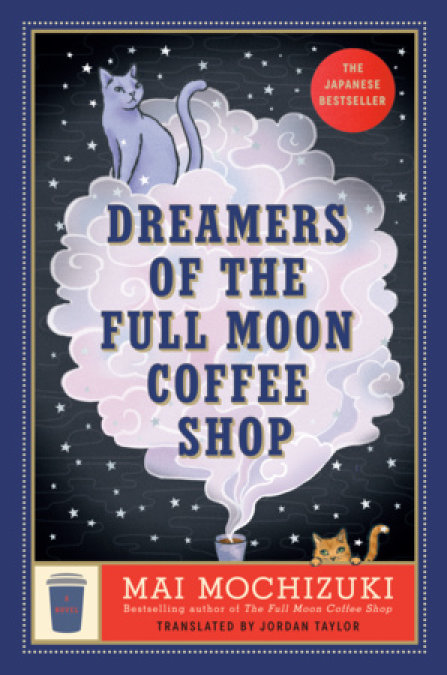
From the bestselling author of the Japanese sensation The Full Moon Coffee Shop, this charming and heartfelt standalone novel brings more lost souls to the enchanted café—where they might find some help from the cats who run it.
Under the energetic star of Neptune the doors to people’s hearts are opening...
In Japan, cats are a symbol of good luck. As the myth goes, if you are kind to them, they'll one day return the favor. And if you are kind to the right cat, you might just find yourself invited to a mysterious coffee shop under a bright moon.
Under one such moon in August, Neptune pays the Full Moon Coffee Shop a visit, taking the form of a beautiful human called Sala. Sala’s special talent is giving people dreams and helping them to open their hearts. As the cats work with Sala, they find new ways to guide people as their customers face personal conflict.
When Satsuki, returning home after she spent three years away with minimal contact, decides to introduce her new boyfriend to her mother Fujiko, she learns an unexpected truth about her family’s past.
Meanwhile, Fujiko is struggling to come to terms with her true feelings about her place in life and author Wataru is facing writer’s block after years of success. Can Sala and the cats help Fujiko and Wataru open their hearts?
Beautifully weaving together three people in a story about love in all forms, this heartwarming novel in the USA Today bestselling series highlights the importance of being true to oneself and recognizing one’s innermost feelings.
Release date:
August 25, 2026
Publisher:
Ballantine Books
Print pages:
224
* BingeBooks earns revenue from qualifying purchases as an Amazon Associate as well as from other retail partners.
When people say, “There wasn’t a cloud in the sky,” they’re talking about days like today. Beneath the perfectly clear, blue sky was the blue ocean and the white line of the Akashi Kaiko suspension bridge, which links Kobe with Awaji Island.
Lately my days had been filled only with views of buildings, but now I was sitting in the passenger seat of the car looking out at a scene that belonged in a painting.
For Mum, though, things were the same as always. She was still leading a modest life in that little house by the sea. The thought pained me. It had been three years since I’d been back home to visit. I kept making excuses about being busy with work, and she let me get away with a lot. She never criticized me, just watched over me with warmth and said it was a sign I was living a full life.
Still, I stared out of the passenger side window feeling awful about having stayed away for three whole years. She was right about my life being full, though.
A quiet sigh next to me brought me back to the present. I turned to look at the driver. His expression was tense. Maybe he was nervous.
“Don’t look so scared,” I said with a little laugh.
“It’s just . . .” he said, scratching his head. He did that when he was feeling vulnerable. “I’m nervous about meeting your mum for the first time. What do I do? Go up to her and say, ‘I’d like to ask for your daughter’s hand in marriage,’ like in the movies? Why would she ever think someone like me is worthy of her precious girl?”
His face was so pale it made me want to laugh again. I couldn’t help thinking how helpless he could be at times, despite being older than me; that was one of the things that had made me fall in love with him. He was always honest and not ashamed to let me see when he was struggling. I liked that.
Actually, my mum once said she liked people who could be open about their weaknesses like that too.
“It’ll be fine,” I said. “Mum’s pretty understanding.”
“You sure?” he asked, as if seeking reassurance.
“What have I always told you? She respects me.”
He nodded uncomfortably.
We finished crossing the bridge and arrived on Awaji Island.
“I forgot you have to cross Awaji Island when you’re going to Shikoku via the Akashi Kaikyo Bridge,” I said. “I’ve never gone home by car, so this is new for me.”
“It’s a long drive. Maybe it would’ve been better to fly.”
I shook my head. “I’m the one who said I wanted to drive here.”
He was right though. It was a long drive from Tokyo to Shikoku, where my mum lived. We’d made overnight stops in Shizuoka and Kobe on the way.
“We never went on long trips when I was a kid because my mum was on her own. But I always wanted to,” I said.
“You moved to Shikoku from Kyoto after your parents got divorced?”
My actor bio said I was from Kyoto. It wasn’t a lie, despite the fact that my so-called childhood home was in Shikoku—I was born in Kyoto and lived there for a while.
“My dad was already gone by the time I was born,” I said. “I went to elementary school in Kyoto. Shikoku is where my mum’s from. When Grandpa died, we moved in with Grandma, but she died four years later.”
“Oh, okay. So, you lived in Shikoku when you were in high school?”
I nodded. “I never really fit in, though. It was your average local school, so everyone in my class already knew everyone else. More importantly, I was super self-conscious about my weight at the time, so I didn’t make much of an effort to interact with the other kids.”
“Is that why you worked so hard to lose weight?”
“Well . . . I happened to see this film. I can’t remember if we rented it or if it was on TV. It was Bridget Jones’s Diary.”
It was a British romantic comedy about a woman in her thirties.
“That’s an oldie,” he said. “I saw it a long time ago. It’s good.”
“It is.” I nodded. “A lot of the lines in it and the sequel hit me hard.”
“Like what?”
“I don’t remember the exact words,” I said with a shrug, but that wasn’t true. I truly believe that happiness is possible . . . even when you’re thirty-three and have a bottom the size of two bowling balls. Bridget may have been a chaotic thirtysomething who was unhappy with her weight, but the things she said were always hopeful, and they stuck with me, almost flipping a switch in my head.
“I was absolutely shocked when I heard Renée Zellweger put on ten kilos for the film,” I said.
“I heard about that. Movie stars are incredible, gaining or losing weight for a role like that.”
“Definitely. I was super impressed. That’s the kind of sacrifice a pro makes for their work.”
“Is that the film that made you want to be an actor?”
“Yeah.”
He nodded like it was all starting to make sense.
“It made me decide to become an actor,” I said.
“Decide to become an actor? Not want to be an actor?”
I went quiet for a moment, not having expected him to catch that. I thought back to that version of me and how I felt back then.
“No. Not want to be an actor. To try to be an actor. And I thought the first step toward that was losing weight, but joining a gym was expensive. I only had my grandma and my mum, so I didn’t want to put extra pressure on my mum. The first type of exercise I could think of that didn’t cost any money was power walking.”
“Did it work?”
I shook my head. “I don’t think it hurt, but it didn’t give me the slim, toned body I had in mind. But joggers would pass me when I was out walking and they’d have the sort of body I wanted. I decided I had no option but to start running, so I did, going at my own pace, every day by the sea. It made me happy to see my body slowly changing. Then I got into strength training.”
“And now you’re about to publish a book on strength training and dieting.”
“Yep,” I said with a smile. “Although diets don’t actually help you lose weight.”
His eyes widened a little at that. “What you mean?”
“Sorry,” I said, with a hand to my forehead as I tried to decide how to explain it. “It’s just that it’s misleading. Your body is a result of the life you lead. But a diet tends to be temporary, right? You might lose weight while you’re on the diet, but once you stop, it’ll all just come right back. Take a woman who weighs sixty kilos, for example. Her lifestyle equals a weight of sixty kilos. It makes for that body. If she wants to lose five kilos, she can’t just do something temporarily, she has to change her lifestyle for good.”
“Huh. But that sounds pretty intense. Changing your lifestyle means changing your life.”
“It does,” I said as I turned to look out of the window. I’d taken up jogging and started a part-time job when I moved to Shikoku. It was true that my life had changed.
“I don’t think that’s easy for most people,” he said.
“It’s not,” I said with a laugh. “It’s hard to completely change your life without changing the environment you’re in, but you can see big changes by making tiny changes.”
“Like what?”
“Like, you could eat twenty percent less at meals. And if that’s too hard, you can start with ten percent. Don’t use escalators, work on your posture, try not to lean on things when you’re standing, do ten squats before bed, or some light stretching. They’re all tiny things, but once they become the new normal, you’re not living that ‘sixty-kilo lifestyle’ anymore. It’s like a bunch of little atoms building up to something big. The choices you make in every moment change your body.”
“Huh,” he said, sounding impressed. “Trust the beautiful, charismatic Satsuki Ayukawa to know something like that.”
“Oh, stop,” I said, shooting him a sideways glance. “You know people have been bashing me, telling me to go look in the mirror because someone like me shouldn’t be publishing this kind of book.”
“Anyone who puts themselves in the public eye will end up getting attacked to a greater or lesser extent.”
“Don’t I know it.”
We hope you are enjoying the book so far. To continue reading...

 Please log in to recommend or discuss...
