I’m contemplating the imperfect perfection of the apple fritter when Mateo della Penna walks into Delicious Donuts and ruins my life.
Again.
For a moment, I’m merely irritated at the universe. Of course Mateo would show up on the first day of my first-ever summer job. Of course! It’s like when my uncle Dave tells the same joke over and over, even when it’s long ceased being funny.
Mateo della Penna appearing in Delicious Donuts at 5:40 freaking a.m. is the worst Uncle Dave joke ever told.
God, I hope Mrs. Arshakyan doesn’t force me to serve them as my first Delicious Donuts customer. Or that if she does, we can get it over with quickly and painlessly. I can focus on learning the intricacies of the POS system instead of their face and thereafter return to my regularly scheduled Mateo-less summer.
Clearly, Mateo feels the same. They freeze the moment they see me, eyes widening and then closing, as if they’re preparing to pray. They mutter something under their breath that sounds a lot like “You have got to be kidding me.”
Which seems a tad much for having to survive ordering a donut from me, but whatever. Mateo being annoyed at my existence is nothing new; I experienced it for the entirety of last school year. Said annoyance just . . . wasn’t how I’d pictured kicking off my summer employment.
But then Mrs. Arshakyan—or Elen, as she’d asked me to call her when I walked in this morning—smiles and says, “Mateo! Good to see you. Let me show you where you can put your things, and then I’ll grab your apron.”
I blink.
Those were the first words she said to me too, ten minutes ago. When she’d grabbed my apron.
I watch in horror as Elen and Mateo walk into the kitchen.
Elen had mentioned there’d be another new employee coming in, that she’d be training us both this morning, but there is no way—no way—
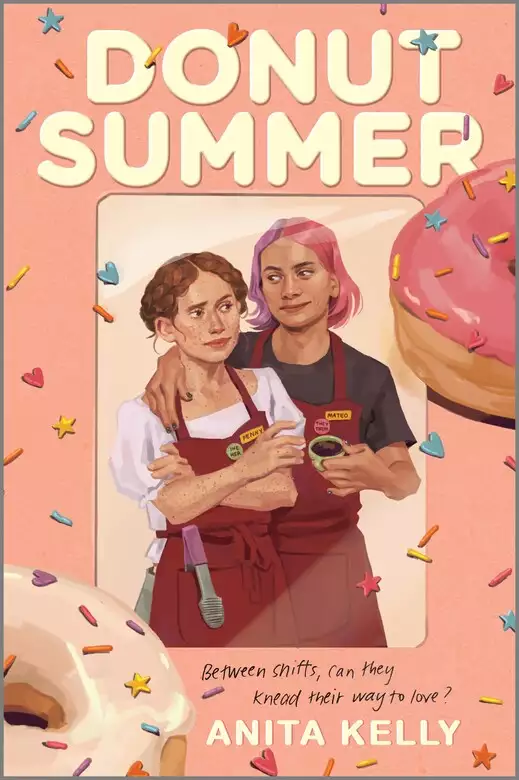
Mateo emerges from the kitchen and walks behind the counter. Ties on their very own maroon apron. Tries, and fails, to keep the scowl off their face.
You have got to be kidding me.
“Penny, this is Mateo! Mateo, Penny.”
“Yeah, we . . .” Mateo clears their throat. “We already know each other. From school.”
“Perfect!” Elen claps her hands once. Elen is tall with shiny black hair and the most flawless eyebrows I have ever seen. Not to mention her cheekbones. And perfect posture. She’s friendly while maintaining an aura of unquestionable badassery. She is everything I want to be, and I cannot believe she’s doing this to me. “I thought that might be the case. Now, Mateo, before we get started, I was just asking Penny the most important question of all. What”—she holds out an arm to the racks of fresh donuts behind us—“is your favorite donut? Penny has already chosen the apple fritter.”
“Oh, uh . . .” Mateo glances at the donuts in their metal trays. “Boston cream, probably.”
“Oh my God,” I burst out before I can stop myself.
“Boston cream is the worst.”
Both Elen and Mateo turn to stare at me. And I know, I know, disrespecting one of Elen’s products is not a particularly intelligent way to begin the morning, but my short-circuiting brain needs to fight back somehow against Mateo wrecking my summer before it’s even started.
“The whole point of donuts is that they’re easy to eat, but a Boston cream is not easy to eat, because the moment you bite into it, that awful custard goes everywhere. And then it’s a race to make it stop going everywhere, and the frosting on top is so rich and gets stuck to the roof of your mouth. It’s all too much.”
It is possible I have been gesturing with my hands too emphatically for 5:45 a.m.
Mateo’s right eye twitches. They stare at me hard before pointing at my selection.
“And an apple fritter—the most extra donut of all the donuts—isn’t too much?”
“No,” I rebut immediately, clamping my hands on my hips in an effort to make them control themselves. “An apple fritter has the most satisfying texture of anything here. While a Boston cream is a gloopy mess, the fritter has substance. It has a slight crunch, and”—my right hand escapes, darn it—“softness inside. The glaze is sweet, but the cinnamon makes it not too sweet. It’s easy to hold. It’s perfect.”
“It’s a pastry,” Mateo bites out. “It’s not even a donut, really. It doesn’t count.”
My mouth opens, but Elen cuts us both off.
“Okay!” She’s holding out her hands, eyebrows raised. “I am . . . glad? I think? That you are both so passionate about our products. Although maybe don’t expound on your feelings to the customers.”
My stomach plummets. I really want Elen to like me. “Sorry,” I mutter to my fingernails, stopping myself from digging too harshly into the cuticle on my thumb, a nervous habit.
Even though I’m not truly sorry. A Boston cream is gloopy as hell.
Elen waves a hand. “Let’s move on. Allow me to introduce you to the most important part of the shop. Even more important”—she glances at us again as she pauses, and I think she’s trying to hold back a smile now, which I tell myself is good. A smile means she won’t fire me. Probably—“than apple fritters or
Boston creams. Say hi to Mr. Bun-Bun.”
She pats the top of the ancient Bunn coffee maker with affection.
“Hi, Mr. Bun-Bun,” Mateo says, and when I glance over at them—how could I not, after hearing Mr. Bun-Bun escape their lips—they’re smiling now too. I also fully process that they have redyed their hair in the week since our sophomore year of high school ended, because of course they did. They are always redyeing their hair. They let it get long this year too; it falls past their chin now. One side is a rich purple, the other a bright, shiny pink. Perfectly symmetrical, split down the center of their scalp.
It is so ridiculous and cool I could scream.
Instead, I force a smile. Because we are all smiling now. Because Elen is going to like me. Because I am going to get through this.
Because, while it might just be in a donut shop, this job is important for me. Not as capital-I Important as, say, the Hatfield Marine Sciences Bridge Internship, which would have given me hands-on scientific experience and college credit and made me feel like I was doing something to further my future career and help our entirely screwed planet—but I am not thinking about Hatfield. I am thinking about donuts! Donuts that translate into a chance to earn money I very much need. For a future I very much want. So that I can do something Important someday.
“The extra bags of coffee beans are down here.” Elen opens the cabinet under Mr. Bun-Bun, then shows us how to work the grinder and which buttons to avoid if we don’t want to give ourselves third-degree burns.
And then the small gold bell above the glass door starts to jangle.
Soon, it doesn’t matter that Mateo is here, at my summer job, because that little bell doesn’t stop jingling, and Elen, Mateo, and I don’t stop moving for the next two hours. There is a lot to learn: the donuts (regular and specialty), the bagels (and the fixings), the drinks (hot and iced), and how to unfold and fold the donut boxes (how am I so bad at unfolding boxes?).
Speaking of the boxes (which are covered in a shiny pink film I am certain is not recyclable), the amount of waste we send out the door—the plastic drink cups alone!—is a bit alarming, but I try not to let it get to me. Maybe I can convince Elen to invest in more compostable materials. You know, further down the line, when I’ve convinced her I’m competent and she shouldn’t fire me.
, both behind the counter and in the kitchen. Learning how to not take it personally when customers are grumpy.
That one is . . . difficult.
And while I can never exactly avoid Mateo, being that it’s a small space behind the counter and their hair is incredibly bright, my brain does eventually start to focus in, like a comforting laser. It pauses in its New things to learn! New things to learn! happy hum only when Elen lays a hand on my arm at eight o’clock and tells me to take a break.
“But—” I stare at the steady stream of customers still walking through the door.
“But it’s the law for employees to take breaks.” With a gentle shove of her hip, she pushes me away from the register. “Grab a donut and go relax for fifteen minutes. You’ve been doing great. Hey, Sunny!”
All morning, Elen has been greeting customers like this—by name and with a smile—even if some return her salutations with only a grunt. It shouldn’t have surprised me that she knows everyone; Delicious Donuts has been a staple in Verity, Oregon, for years. It’s plopped right at the end of tiny Main Street, across from the library and next to the run-down park. Still, this level of familiarity has been unexpectedly fascinating to me. Take, for instance, Sunny, an old hunched-over white man who’s about to pay for exactly one donut, which makes me irrationally sad. Does he come in every single day and order that same solitary donut? I bet Elen knows his deal. Does he—
“Penny.” Elen lifts a perfectly sculpted brow. “Go.”
I am defenseless against that brow. I would do anything Elen Arshakyan told me to do.
I go.
I walk through the doorway that leads into the kitchen, where Elen’s son, Alex, started making donuts at some ungodly hour in the middle of the night. I passed him on his way out this morning, a quiet blur of golden skin and curly black hair.
Across the scuffed brown tiles of the kitchen is a tiny office, where my purse now hangs next to Mateo’s messenger bag. I sit in one of the two possibly structurally unsound office chairs and attempt to relax.
Fun fact about me: I am superbad at relaxing.
I feel it almost as soon as my butt hits the seat. I was good when I was behind the counter, constantly moving, mind occupied. But now that my body’s still, it descends: The slight tightening in my chest that makes it hard to take a deep breath. The sinking knowledge that the sensation might not go away for hours. The way my thoughts scatter and then simply disappear, leaving my brain blank and fuzzy. Slowly, steadily, I become adrift.
Except not in a fun way. Not in the way I imagine bros who live by the ocean feel adrift: bobbing over waves on surfboards, drinking fresh smoothies, smoking weed.
My brain feels adrift in the sense of floating helplessly into space. Untethered and directionless, my feet grasping for purchase.
I hate it. I hate it, I hate it, I hate it. I hate that I can’t control it, that it never seems to make sense, that somehow my anxiety takes me by surprise every time even though I’ve been living with it for almost as long as I can remember. I hate that it is happening now, on the first day of a job that is supposed to be simple and fun, before it’s even reached 9 a.m.
I take a (limited) breath. Try to consider reasons my brain might be having a hard time.
There is the fact that I woke up at 4:30 a.m. today, a not-normal occurrence. And I slept horribly before my alarm went off, my stomach full of nerves about donuts. And embarrassment about being nervous about donuts. What a ridiculous summer already.
And then—and then!—Mateo della Penna, the one person in Verity who I know hates me, showed up unexpectedly before the sun had even risen in the sky. It’s an intimate thing, being around a person that early. I’ve felt half naked all morning.
Looking back now, I should have predicted I would be working with someone I knew. Verity’s a small town.
But why couldn’t it have been someone like . . . Roman Petroski, maybe. Roman would have been perfect, actually. Or if not Roman, one of my friends from Knowledge Bowl, or band, or iTuna (International Teens Upholding Nature Association), or even the ever-fledgling Spanish club. Sure, it was rare I actually hung out with most of these friends outside of school or school-related events, because friendship was weird and hard, but this could have been the perfect opportunity to finally change that! Why didn’t I convince Swapna or Julian or Lani to apply to Delicious Donuts too?
And while the actual job part seems to be going relatively well, people have dramatically sighed at me more than I would like. I’m terrified of the espresso machine. Honestly, even Mr. Bun-Bun makes me a little unsettled.
These are all rational reasons to be stressed, I tell myself. As opposed to the other reasons I often get stressed, like not being able to stop climate change or eliminate gun violence or fix antibiotic resistance. Or just thinking about the general existence of Facebook. My therapist, Hannah, tells me these things are outside of my control and I should focus on what I do have power over, but it’s
hard when my brain’s in space.
I tug on one of my braids, the braids I practiced for almost an hour yesterday, that I executed far more poorly this morning at 4:45, my eyes dry with non-sleep. My exceedingly boring brown hair is thin and stick-straight and doesn’t easily stay in a braid, but with enough precision, hairspray, and positive thinking, I can sometimes make it happen. And as I lack the gumption to go for a pink-purple duotone, braids are the most interesting thing I have to work with. I figured my hair should be off my face in any case, to comply with OSHA regulations.
Mama D would have done a better job.
But she and Mom were still sleeping this morning when I left, even though Mom had promised she’d wake up to see me off.
And Mama D hasn’t braided my hair in over six years.
The strands are already starting to unravel in my hands.
A thought slithers into my brain, pulling the air in my lungs tighter still: If I can’t even handle an espresso machine . . . I mean, I probably couldn’t have handled Hatfield anyway.
I need to distract myself.
I scream inside my head as I look at the clock above Elen’s desk. Somehow, only four minutes of my break have passed.
Wait. Okay. The clock.
That could work.
I remember the centering exercise Hannah taught me, and I stare at the clock—something I can see. It’s a little dusty but cute, with different illustrated pastel donuts for each hour of the day. I breathe in the slightly stale but somehow comforting scent of cardboard that permeates the office—something I can smell. I listen to the distant murmur of Elen and Mateo talking to customers out on the floor, the slight buzzing of the lamp over Elen’s desk—things I can hear. I run my hands over my jean shorts—something I can feel.
By the time I return to my place behind the counter, the constriction in my chest has eased the tiniest bit.
Elen has me stay on the register, and the more I get used to it, the more competent I feel, the more the tightness behind my breastbone
dissipates. Whenever there’s a lull in customers, Elen has more to show us. Working with Mateo continues to be capital-F Fine. We ignore each other when we can, are cordial to each other when we need to communicate.
The only time I get thrown is when a young kid—seven or eight, maybe—smooshes their face up against the glass barrier that separates customers from the specialty donuts on the counter. Their dad straggles in behind them and gently pulls on the kid’s shoulder to remove their nose from the glass. As he does, the kid looks up at Mateo, who’s waiting to take their order, and gasps.
“Whoa,” they breathe. “Your hair is so cool.”
Mateo smiles at them.
And it’s this that does it.
It’s a quiet moment in the shop; the kid and their father are the only customers in line. I’m waiting at the register. I have nothing to do except watch Mateo’s smile.
It’s an almost shy, entirely adorable thing. Different from the polite one they’ve been throwing Elen and other customers all morning. The last time this smile was actually directed at me was the first time I met Mateo, when they moved here from California in eighth grade. I was their student ambassador on their first day of school, walking them to their classes, eating lunch with them, explaining the ins and outs of Verity Middle School. I loved being a student ambassador, but sometimes it was awkward, depending on whether the new kid actually wanted my help.
Mateo, though, looked at me that day like they are looking at this kid now. Open, kind. Like they were entertained. Like they wanted to be your friend.
Eighth grade feels like a century ago.
“Maybe you can ask your dad if you can dye yours when you’re older,” they say.
The dad ruffles the kid’s hair. “Maybe.”
When Mateo turns toward me to hand off their donuts, the smile fades away.
Just as I knew it would.
I take my lunch in my car, whom I call Dolly, while listening to my “Be Better, Brain” playlist, which is mostly full of up-tempo pop music I always hope will make me happier. I’d say it works 36 percent of the time.
I got Dolly this spring from Uncle Dave after I passed my driver’s test; he insisted that he was ready for a new car anyway. He wasn’t necessarily lying; Dolly is twenty years old. She’s not the prettiest girl on the road. But she’s perfect for me. I almost always feel okay in Dolly.
I watch customers stroll in and out of the shop as I eat my Uncrustable. Watch cars drive away from the downtown strip along Main Street, toward Route 72 beyond.
Route 72 is where most residents of Verity actually spend the majority of their time, shopping at the Walmart and stopping for fast food or, on special occasions, eating at the Olive Garden.
I used to be on Main Street a lot when I was a kid, though, back when Mom still had her stationery store, Rosemary & Time, at the opposite end of the block. I still remember the smell of it—the vanilla and cinnamon of the candles Nancy Jo Cummings made that Mom sold by the front counter, the slightly earthy smell of fresh cardstock, the tangy mineral of ink. Before opening the store on Saturday mornings, Mom would give me a five-dollar bill and send me down here to get a donut for each of us.
But ever since Rosemary & Time shut down six years ago, it’s rare for us to come downtown. (Calling it downtown always feels a little hilarious, since it’s so tiny and, you know, Verity-ish. The tallest building is three stories high.) It’s something of a miracle that I was here a few weeks ago, when Mom got a hankering for takeout from Golden Sun Chinese Food Palace, and I saw the Help Wanted sign in Elen’s window. I’d applied to lots of places this spring—after my dream of applying to Hatfield died—places where I thought I could still make a difference while also collecting a paycheck: Treehuggers, the tree-planting nonprofit where I already volunteer. The Nature Conservancy. The Audubon Society of Corvallis. The Oregon Department of Fish and Wildlife.
Sure, it was possible I wasn’t completely qualified for a lot of these positions, being as I was a sixteen-year-old with no employment experience, but—yeah, no one had gotten back to me. (Well, James from Treehuggers had said, “Penny, you realize hardly any of us are paid, right?” and then handed me ten Douglas fir saplings to plant.)
Donuts it was.
g down Main Street through Dolly’s passenger-side window, this funny wave of nostalgia washes over me, sudden and vivid. Even though I haven’t been down here much lately, I still know it all so well: Antiques ’n’ Stuff, the library, Golden Sun. The corner store, Goldie’s Flowers, Olivia’s Books & Tea. The empty storefront at the end of it all that used to be my mom’s. The bank and the real estate office.
It’s like one of those moments where you blink and all the things that normally blend into the background come into focus.
Anytime we drive up to Portland or even over to Salem, all the neighborhoods I thought I knew are shifting like salamanders—growing new skin, shedding the old. It’s kind of nice that so many of the businesses on Main Street that have been here since I was a kid are still here. Like they’ve watched me grow up.
And for just a second, sitting there in Dolly, I feel almost . . . content. That I’m here on Main Street again instead of at the Hatfield Marine Science Center on the coast with barnacles and seaweed, datasets and strangers—real-life scientists ready to share their expertise.
Maybe it’s okay that I’m surrounded only by things I know.
I try to take a deep breath. It flows through my throat a shade easier.
When I get back, the rush has continued to die down; Mateo takes their lunch next and sits in one of the seven orange booths that make up the Delicious Donuts dining area. There’s a cup of black coffee from Mr. Bun-Bun in front of them, half a glazed old-fashioned. (I notice, conspicuously, that they did not choose a Boston cream.)
They hunch over one of their sketchbooks, the pencil in their hand blurring back and forth. They break only to occasionally punch something into their phone.
I try not to look at them while they draw. I really do. But it’s such an odd feeling, seeing their colorful hair flopped over their ears, that familiar wrinkle of concentration on the bridge of their nose, here, where I didn’t expect to see it.
I’ve seen some of Mateo’s work. There was always at least one of their pieces rotating through the display boards in the art hallway at Verity High. They work mostly in black-and-white, sketches in pencil and charcoal. Still lifes of what I assume are various parts of their world: mangoes on a kitchen counter, a messy stack of books with a used coffee mug balancing precariously on top, a cup filled with paintbrushes in Ms. Fuentes’s art room. Occasionally, a scene I recognize: a bike leaning against the corner store, underneath the board full of flyers and business cards.
Despite myself, I’m always curious what they’re working on. They have their sketchbook out constantly during the school year, except for when a teacher makes them put it away. I want to protest whenever it happens. It just feels . . . mean. Like it should be as obvious to teachers as it is to me that the sketchbook is simply an extension of their body. That they need it.
It is very irritating, this strange protectiveness I have for Mateo’s sketchbook.
“Hey, Alfredo!”
I jump as Elen greets a new customer. She throws a rag over her shoulder and walks around the counter to hug him. “How’s Shelly doing?”
I study the buttons on the POS screen I haven’t used yet.
“Oh, fine, fine.” Alfredo shuffles toward me, Elen’s arm still wrapped around his shoulder. “The treatments are hard. But she’s having a pretty good appetite day. Thought she might like a treat.”
“This treat’ll be on me, okay?” she says as she joins me again behind the counter.
I step back, watch Elen do her thing. There’s half of a lump caught in my throat, even though I only know Alfredo vaguely, the way I vaguely know everyone in this town. I have no idea what’s happening with Shelly. But if she’s sick . . . Mama D works at the local hospital. She actually knows everyone and everything. I bet she would understand this interaction.
Elen gives Alfredo another hug before he goes. Whispers something that makes him squeeze her hands for an extra-long moment.
I avert my eyes. Until I realize I’m back to staring at another set of hands—Mateo’s, again. Their skin is light, but has just enough clicks more melanin than mine that I bet they tan well in the summer. As opposed to turning into a supercool lobster at the barest hint of sunshine.
I have seen the tips of their ears turn pink, though, sometimes. When they’ve been particularly upset with me.
espresso machine.
By the time Mateo and I reach the end of our shift two hours later, I’m exhausted. My feet hurt, my left arm is sticky for reasons I can’t remember, ...
We hope you are enjoying the book so far. To continue reading...
Copyright © 2026 All Rights Reserved

 Please log in to recommend or discuss...
