
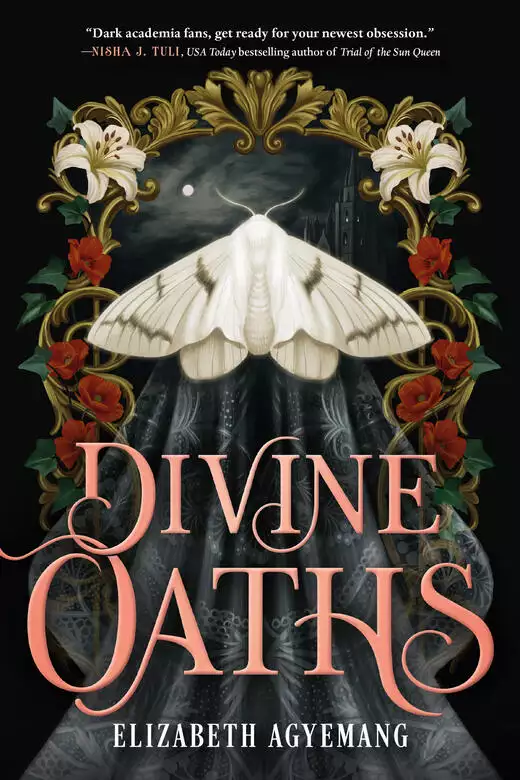
Divine Oaths
- eBook
- Paperback
- Audiobook
- Book info
- Sample
- Media
- Author updates
- Lists
Synopsis
"Dark academia fans, get ready for your newest obsession."—Nisha J. Tuli, USA Today bestselling author of Trial of the Sun Queen
Ninth House meets Legendborn in this thrilling dark academia novel following a new student fueled by questions about her prestigious university and the haunting answers she uncovers as her heart pulls her in two different, dangerous directions.
Westfield University was supposed to be Sianna Adu’s dream school. But just when she’s on the cusp of attending the elite academic institution hidden in Virginia’s swampland, an unexpected tragedy changes everything. In one day, Sianna loses her family and gains an extraordinary power—the ability to see lifelines and witness other people’s pasts and futures.
With all she’s lost, Sianna puts her college dreams on pause and spends her days navigating dead-end jobs and a not-so-secret crush on her coworker. But when Kasem Saint James, the undeniably handsome heir to Westfield, approaches her with a strange request, the future Sianna has long deferred becomes a dangerous new reality. Worried that her powers are now tied to Kasem, she has no choice. Fate has called her to Westfield.
At an academy where secret societies abound, connections are everything, and an ominous history—stretching back centuries—determines the future, Sianna and Kasem must piece together the past to undo a curse that binds them to each other.
With a swoony romance and jaw-dropping twists, this layered dark academia novel introduces a university where nothing is quite as it seems.
Release date: September 1, 2026
Publisher: Requited
Print pages: 384
* BingeBooks earns revenue from qualifying purchases as an Amazon Associate as well as from other retail partners.
Reader buzz
 Please log in to recommend or discuss...
Author updates
Divine Oaths
Elizabeth Agyemang
ONCE AGAIN, I REGRETTED SHOWING up for my morning shift. It’s not that I was ungrateful. I liked window-shopping on the clock and perfecting my deadpan stare with customers at the register. But I’d only taken this job because it was in the most remote, neglected corner of Center City Mall—the kind of place most of Richmond’s college students wouldn’t be caught dead in.
Yet fate was cruel. And even after all these years, still, I couldn’t escape Westfield University.
“I told you. People want things from famous people. Not washed-up child stars.”
Gus leaned over the counter to examine the latest artifact I’d brought him: a two-piece matching set with adinkra symbols on it.
The wax print skirt was embellished with heart iconography whose mirrored, rounded edges swirled toward the center. Across every inch of the fabric, the heart pattern was infinite, its shape sprawling along the dark expanse of textiles that had been sewn together into the skirt. And for the top piece of the set, the symbol was repeated again, but this time as a bird with its head craned over, retrieving a nugget from its back.
Sankofa, it said. Learn from the past. Go back and retrieve it.
I’d been late because of this. Even though the mall and Gus’s Rare Artifacts Pawnshop was only two stops over from my apartment, my indecisiveness about selling the outfit had brought me here an hour past our usual morning openings. And by then, we already had customers.
There were three of them, all guys, all dressed in that insipid navy-and-green plaid blazer with Westfield’s lily emblem. They looped through the store, cracking jokes with arrogant voices, their laughter steeled with liquid courage from the silver flask they passed around.
Once upon a time, I’d longed to be a Westfield lily myself.
But that was in the past, before my powers manifested; a dream so scorched and burned that its fumes had left nothing but smoke and embers in the darkest parts of my memories.
And now here I was, selling the last remnants of my family and heritage for a few bucks while these elitist heirs from Westfield ransacked our store.
“Five hundred dollars,” I offered, trying to keep my attention from wandering back to them.
Gus laughed. “As if it’s worth half that much.”
“It’s traditional African wax print,” I said. “Ankara like this isn’t cheap to come by. Besides,” I added, “it’s the last thing I wore in public before the fire.”
The two-piece set, as mixed and matched as it was, had been a favorite of mine growing up—one that had belonged to my mother at one point, back when I was Baby Mozart.
At the time, piano was my first love. From the early age of four, I’d shown incredible aptitude for the instrument, and my parents saw an opportunity. It started with auditions that became well-paying performances, which turned into a whirlwind of publicity. I was no longer Sianna, but the “Baby Mozart” stage persona that articles hailed as the second coming of Hazel Scott and Wolfgang Amadeus—except, second-generation African.
So, from the age of five all the way to fourteen, I traveled the country and abroad with my parents. At some of my biggest shows, my mother had worn this very set while I’d performed for hundreds of thousands of people. Eventually, after my fame had dimmed, she’d passed it down to me.
I’d worn the set once—I was fourteen and appearing on yet another daytime talk show. Of course, I hadn’t quite grown into the set yet and wound up using safety pins to secure it. But as my hands graced the keys in front of an eager audience, I decided then and there that it would be my last performance in the entertainment world. I wanted to retire, to attend college, to do anything but parade as a show pony. That performance had come and gone, and it was only by chance that I hadn’t worn the printed set to my Westfield audition. Which meant that now, it was one of the few items I owned from my parents that didn’t remind me of tragedy.
“If you can’t sell it—but trust me, you will—I’ll buy it back. And yes, I know. You’ll upcharge for it,” I said, speaking the last bit in my low-pitched imitation of Gus’s voice. “I just need the money, Gus. Like, now. I know you paid me already last week, but this is an emergency. And when have I ever sold you anything you can’t make a buck off?”
On the other side of the store, one of the guys from Westfield separated from the group. He meticulously browsed the shelves of used merchandise, taking multiple swigs from the flask that was now in his possession. His tall frame and lean build made his drunken movements seem both careless and graceful. When he turned the corner and glanced in my direction, my heart raced and, despite myself, I couldn’t stop the flutter of wings in my chest.
He was handsome, dangerously so. Like the kind of guys who were plastered on high fashion magazines or walk runways because someone, at some point, had deemed them too useless, tall, and good-looking to actually be a functioning member of society.
On his third loop through the shop (that I’d counted), he picked up a broken pendulum clock and discarded it back on the shelf. Then he grabbed another item that I couldn’t quite make out. Then another. And another, and another. A lamp with a winged putto flying across its gilded shade. Surely this was what he was looking for? An ottoman woven of silk, yet half eaten by moths? No, not that either. A lantern with colonial embellishments? Of course not.
His curly ebony-black hair had been styled into a low taper fade, and his dark brown skin was a sharp contrast to his friends’ pale complexions. But like them, he was dressed in designer—top to bottom—from his trousers to his shoes to his Westfield blazer with the university’s crest embroidered on its chest pocket.
I was staring. I knew I shouldn’t. I should have kept my attention on Gus and sealed the deal with this set. But I couldn’t help it. He’d been staring at me too. I’d caught him sneaking glances at my interaction with Gus over the past few minutes.
This time, when our gazes met, his deep brown eyes bore into mine like embers. His friends whistled, hooting and hollering as they shoved him playfully in my direction.
I looked away.
Their presence here at Gus’s shop was an interruption, not a sign. If I could convince Gus to buy the set, then I’d have nearly enough for a deposit on an apartment come the end of summer, when Aunt Louisa moved to Rhode Island and Jojo started his new job.
I cleared my throat and turned back to Gus, trying a different tactic.
“You know you owe me back pay, right?”
It was a low blow, sure. But I was desperate.
“First, you come in late. Then you try to pawn something off instead of starting your shift. And now this?” Gus scoffed.
“You’re the one who makes the schedule.” And it wasn’t like this was my only job at the mall. In the afternoon, I’d head down to Louisa’s psychic stall, and people there paid way more for readings than Gus ever did for my hourly wage.
I held out my hand, trying to give more “savvy negotiator” than “desperate beggar.” But the gloves I wore said otherwise. The elbow-length fabric was riddled with holes, a reminder that even as I tried to sell my mother’s set, my own clothes were deteriorating rapidly.
“I’ll take the back pay. And eight hundred for the set.”
Gus laughed. “If you want to quit, Sianna, you can just say so.”
“I’d rather you fire me. I need the benefits.”
“You’re part-time.”
“Which you should be paying me overtime for. But do I say anything to the state when you don’t?”
We did this dance every time I tried to sell my stuff to him; he’d pretend it was worthless, and then I’d remind him that if it wasn’t for me, he wouldn’t be selling half of what he did at the prices he charged.
“I need more than just your old stage name and some vague information to sell this,” Gus said. “Where was the fabric woven? How long ago can you date it? Is it original, hand-dyed, or one of those cheap factory reproductions?”
I rolled my eyes.
“Fine,” I said.
Then I unrolled the sleeve of my gloves, pulling them off entirely before reaching for the two-piece set with my bare hands.
The burnt flesh of my fingertips brushed along the waxy fabric, lightly but just enough that I could still see Gus standing in front of me, even as in my mind, a vision of the past came to life.
The world around me spun into a spectrum of color and time. Silver veins caked against the back of my eyelids and a burst of cold gnawed at my cheeks as the images of the past raced through my mind. My view of the present eroded completely, like a thin layer of film falling over my eyes.
It was jarring channeling my powers, even after all these years since the fire at Westfield—when they’d first awakened.
Most psychics would take your hand, trace the lines of your palm, and claim to see into the threads of time. Yet unlike them, I wasn’t a charlatan. I didn’t rely on the whims of Ouija boards, spirits, or lesser gods. Through touch alone, I could access the lifelines of a person or thing, living or dead. I could even control how long and how often my visions happened. All because of that fateful day of my Westfield audition, after a fire tore through the auditorium. I lost everything: my parents, my connection to music, my hopes for my future. And most of the money was gone too, squandered away by my parents rather than placed in a trust. The only things I gained were these strange abilities to see into lifelines through touch, and the permanently scarred and burnt skin on my fingertips.
As I touched the printed fabric, the sustained contact allowed me to see the last person who had held it. In this case, that was a past version of me, shoving the two-piece set in my canvas book bag as I left my aunt’s home for Center City Mall that morning. I delved back to two weeks earlier, when Louisa had first come across the set in her attic. Folded within the set, she had found an addendum to my acceptance to Westfield University—the first of many I’d received over the years.
Sianna Grace Adu,
I’m writing to you upon learning of the tragic news of the passing of your family. We here at Westfield send our deepest condolences. I’ll keep this letter brief, as I’m sure you’ve heard enough from strangers who couldn’t know or understand the extent of your grief. I spoke with the Board. Requested it of them, actually. They’ve decided that we are able to extend your acceptance to Westfield. If within the next five years you determine that you would like to attend, the Board will be holding your spot, your scholarship, and your place among Westfield’s garden of lilies.
Yours truly,
A concerned member of the Board of Westfield University
The first of the letters had been handwritten, and the official notices from Westfield came not long after.
It’s your last year of the extension, Aunt Louisa had said before tossing the letter on a stack that had built up over the years. Are you sure you don’t want to attend? You don’t have to come to Rhode Island with me. But going to Westfield would be better than staying here by yourself.
I pulled against the invisible threads of time in my head, venturing deeper into the past to when my mother, wearing the two-piece set, had taken a six-year-old me to my first piano recital. The sight of her, even simply in my own mind, choked me up.
The vision unfolded like a film reel rewinding at triple speed the more I retreated.
In my mind, a scene played out of my mother, fresh in her youth in the ’90s, buying the dress during a trip back home to Ghana. At the vendor stall, she’d met my father, an African American student studying abroad for the summer.
Time rewound more, to the moment the top part of the set had been sewn together in the capable hands of a local seamster. He’d been trained in the craft of weaving kente only to find himself selling Ankara dresses to foreigners as the wax prints surged in popularity. I watched him work, muttering softly to himself about the foreigners who were convinced that the Dutch connections to the cloth outweighed its other origins, from its Indonesian batik heritage to the artistry of the Indigenous Africans who had crafted a language into its pattern work.
And then I channeled back to the 1950s, where I witnessed the fabric first being woven, stamped, dipped in resin, and submerged in reams of gold dye to create the patterns across it.
I let go of the fabric and blinked the vision away. The images of the past faded from my mind and the present returned—Gus frowning and waiting for me to explain what I’d seen, and behind me, farther off, the student from Westfield watching our interaction, his brown eyes bright with curiosity. He took another swig from his flask, waiting now too.
“It’s from the fifties,” I said. “Handcrafted, no machinery. And yes, it’s original. Not reproduced.”
Gus examined the fabric like a vulture perched in front of a carcass; his greasy hair clung to his balding head, the last few strands rippling from the force of the mall AC bearing down on us.
When I’d started using my powers to see into the timelines of merchandise, we’d been able to sell the secondhand items here as more than just “junk keepsakes.” I’d been the one to come up with the idea of including authenticity certificates with purchases from the store. Because of my abilities, we could market them as one-of-a-kind purchases with real historical significance. But of course, he’d taken credit for it.
Even now, Gus’s teeth, most of which had been replaced with fake gold, gleamed bright with greed as he smirked at me. “Things from the fifties don’t sell for much.”
“Are you buying it or not?” I snapped.
“Fine,” he said.
“Fine?”
“I’ll give you an advance. But you’ll have to pay me back. You already borrowed more than I owe you in back pay.” He folded the two-piece set, grabbed an empty certificate from the bottom shelf of the counter, and started writing the details that I’d relayed to him from my vision.
“Now get to work,” he said, gathering the fabric and certificate and skulking to the back of the store, where he’d add it to the catalog and then, later, to the shop’s stock.
I crossed the threshold to the register. When I took a seat, footsteps approached the front. Suddenly, I found myself staring up at the student from Westfield.
He shot me a wry smile, and heat burned against my cheeks as he ran a hand through his hair and glanced between me and his friends. They were still watching us and drunkenly snickering, even four aisles away.
When he spoke, his voice was deep and rich, the sound of moonlight and honey melting together.
“Hi,” he said.
I glanced behind me, hoping that Gus would be back quickly. He always liked being the one to deal with rich customers. Not me. I hated having to interact with them, let alone one from Westfield.
“They think I want to ask you out,” he said. “So, could we pretend for a little bit?”
“I’m working.”
“Oh, so now you are?”
I raised an eyebrow and he at least had the decency to look embarrassed.
“Sorry, I was just teasing.”
“I don’t know you,” I said simply.
He ignored my assessment and trudged on. “I heard you talking to the owner, about how you need money. I have money. A lot of it. My family owns Westfield.” He paused at the look of surprise in my expression. “Yes, the university.”
I’d heard rumors about Westfield University students, but this was my first real interaction with a current one. Of course, it just happened to be with the literal heir of the institution—that is, if he wasn’t lying to my face. Even so, I got the sense that, despite reeking of liquor and nearly stumbling his way to the front, he was calculating every moment of this encounter, planning what he would say or do, even as his body struggled to keep up.
“I want to hire you,” he said eventually. “And I want you to come with me to Westfield.”
I scoffed.
“I think you’re at the wrong corner for that.”
That earned me a smile from him, a real one, and not the sneering kind he and his friends had been flashing all morning.
“I’m being serious,” he said. “You’re a psychic, right? Well, I need you to use your powers on me and the university grounds.”
“This is a pawnshop,” I said, raising my voice, hoping Gus would somehow intervene or the guy’s friends would take the hint that him “asking me out” wasn’t going well. “I don’t do readings until the evening, when I’m at my aunt’s stall. So unless you plan on buying something, you and your friends should take your nepo baby asses from our shop.”
“Did I do something to piss you off?”
“You’re from Westfield, and apparently the university’s heir. Which, if I did believe you—and I don’t—makes this situation worse. But day drinking in the mall? Embarrassing. And the fact that you’re propositioning me while I’m at my other job? Cornering me like this and forcing me to listen to whatever nonsense you and your friends came up with for this… this prank? I mean, it’d be fair if I could at least curse you out. But I don’t want to lose this job. So, congratulations on ruining my shift. Now leave.”
That made him pause for a moment.
“It’s because of the fire, isn’t it?” he said.
The cool, dismissive way he said the words was a knife to my chest.
He knew who I was, who I’d been before the fire and my fame had burned out. And more likely than not, this offer wasn’t because he needed my psychic services. It was for a photo op, or to brag to his friends that he’d gotten the once-famous Baby Mozart to relive the most traumatic night of her life.
“Either buy something,” I repeated, “or go.”
He glanced over his shoulder, a nervous tic to his movements.
“All right. I’ll buy the dress you just sold. My girlfriend’s birthday is in a few months, and I want to surprise her.”
“You have a girlfriend, but you told your friends you’re asking me out?” Clearly, Westfield University wasn’t just filled with stuck-up elitists. There were assholes enrolled too.
“She cheated on me,” he said.
“So you’re cheating back?”
“Only to even the playing field. I don’t want her to feel bad about what she did.”
That earned him a chuckle from me. But only one. His eyes lit up and I swallowed against the lump in my throat.
“You can’t buy the dress,” I said, killing whatever impasse we’d come to.
Instead of responding, the guy reached into his blazer, and I caught a glimpse of something gold and flashy on his wrist; a watch, likely. Or one of those expensive smart devices. For a second, I thought he was going to take the flask out again. But instead, he pulled a crumpled sheet of paper from his wallet, ironed it out with his palms, and passed it to me.
Baby Mozart becomes psychic extraordinaire!
Get your fortune told by the child musical prodigy who ignited the world ablaze with her magical touch, from the piano keys to palm readings.
Private readings and services available on demand.
“I called the number at the bottom of the flyer. The person hung up on me every time. So I’m here for a private reading, and I’m asking if I can book your services for just a few days while I’m back on campus at the beginning of the semester. I’m not trying to play games or screw you over. I’m in genuine need of a medium.”
I cringed at the sight of my photo at the bottom of the flyer, where Louisa had awkwardly edited the picture to crop out my parents from the frame.
“There have been accidents on Westfield’s campus, and things have been… escalating. None of the other psychics or soothsayers could help me. But the reviews online say your visions are legit. So if you could kindly, just for this moment, entertain what I’m asking here, then I’d appreciate it. Greatly.”
My memories of my audition to Westfield curdled at the back of my mind; the screams from the audience, my parents at the back of the stage, encased in smoke and separated from the fleeing crowds by a barrier of flames.
“Everything in the kitchen aisle is twenty percent off,” I said, forcing a smile.
The guy leaned over, his eyes searing. Behind him, his friends grew restless, chanting for him to go in for the kiss, as if he’d really been asking me out, as if from their view of everything, I was returning his affections.
“Nothing’s going to change my mind,” I said.
But then he pulled out a wad of cash.
I counted nearly two grand. More than enough for what I needed for the rent deposit.
I licked my lips, trying to stay calm, yet knowing how much this amount, in this moment, would fix everything.
“It’s always money, isn’t it?” he said, reading the hunger in my eyes for what it was.
Shame burned against my cheeks. “You’re the one who needs it to get what you want.”
“But you’re the one who needs it,” he said. “Isn’t that worse?”
I held out my hand, ready to take his palm and end this interaction as soon as possible.
“I need a date of some kind,” I told him. “And something from your past if you want a specific reading from a certain place or time period. But if you want me to just look into your lifeline, I can do that too. Just give me your hands and don’t move for a few minutes, and I’ll tell you what I see.”
He hesitated.
As the self-proclaimed heir to one of the oldest institutions in the country, he was probably used to getting what he wanted. But now he seemed unsure. Nervous, even.
“What about Westfield?” he said. “Will you come?”
“I’ll give you a reading now, for the next five minutes. That’s it,” I said. “So, what do you want to know?”
Again, there was that hesitation. He glanced at his friends and then to the exit of the store, as if, at any moment, some mystical force or entity might drag him from Gus’s shop. When he spoke this time, it was in a whisper.
“I need you to look into my future,” he said. “I need to know how I die.”
AT FIRST, I WASN’T SURE I’d heard him correctly. When people asked for readings, it was usually for one of two things: to learn about their future or to commune with a lost loved one. Who will I marry? Will I get the job? Can you speak to my deceased grandmother? The normal musings. But death? Learning how you’ll die? That was… different; tragic, even.
I drew away from him, my mind racing.
“Are you—sick or something?”
He seemed to consider that.
“Something like that,” he said finally. “But it’s—let’s just say it runs in my family.”
“And you want to find out when you’ll die?”
“Not when I’ll die,” he clarified. “How. I already know when. It’s going to be this year. It’s going to be soon. So I just need to know how it happens.”
He was serious.
“But if it’s an illness—shouldn’t you… know?”
“I never said it was one.”
“But it runs in your family?”
He sighed. “Look, will you help me or not?”
To be honest, I wasn’t sure myself. As much as my powers easily let me see into the past, the future was more nebulous. Whenever I tried to do readings of a timeline beyond the present, I’d get migraines and glimpses of shadowed figures and forms.
Except for the fire.
That had been the only time I’d seen a concrete vision of the future. And a moment after I saw flames in my mind, that horrific scene played out before me.
But since then, I usually just cobbled together my predictions of the future from what I could see in a person’s past. If someone asked whether they’d get a raise at the end of the year, I’d look into their past and glean what I could from their history. Which, in my opinion, made me better than a charlatan. At least my readings of the future were informed by some sort of real visions.
Behind us, the shop bell rang, its cheerful chimes an eerie contrast to what was unfolding between me and the Westfield heir. An older man in his forties approached us. Against the dark gray of his suit, a lily was stitched, just like the ones on their blazers.
“Mr. Saint James,” he said, discreetly flashing a holstered gun at his waist. “I suggest you and the others leave. There’s been a report of disorderly conduct.”
Saint James. Anyone who knew Westfield recognized that family name. This guy—the Westfield heir—he hadn’t been lying. He was actually going to inherit Westfield University and the man speaking to him was his bodyguard.
“We’re in the middle of something,” the Westfield heir said. “Can you give us some time?”
“Sir, I wouldn’t advise that.” The bodyguard gestured behind us, and we followed his gaze to the back of the shop. Gus was hiding, but he peeked out from behind a curtain with a phone pressed to his ear, like he could tell he’d been caught.
The Westfield heir laughed, his voice tinged with irony.
“I guess money can’t get me everything after all,” he said.
Even I, as combative as I was, had no answer to his words.
“My offer stands,” he said. “If you’re ever at Westfield, find me.”
He, his friends, and the bodyguard swiftly left. Moments later, security entered the store. They took a few moments to question me, and I made up some story about how Gus had dialed by mistake.
“Are they gone now?” Gus asked, retreating from his hiding spot.
“You shouldn’t have done that,” I snapped, frustrated. I grabbed the two-piece set from where he’d placed it on the counter and shoved it in my bag with the rest of my things.
“Your shift isn’t over yet,” Gus complained.
“Yeah,” I said. “Well, I quit.”
By the time I left the shop, though, the Saint James heir and his friends were gone.
I was never early to Louisa’s psychic booth. But as much as I searched through nearby stores and combed through aisles, I couldn’t find the Saint James heir or his friends anywhere. So, with two grand short and nothing but time on my hands, Louisa’s stall it was.
It’d been raining all day, so the mall was more crowded than normal for a Sunday so close to June. Shoppers streamed in and out of stores, jostling one another and leaving tracks of rainwater and mud in their wake. And then, there was the smell. On the upper levels of the mall, the fragrant, oily scent of the food court always clung to your clothes, making everything reek of hot dog sweat and grease. My stomach growled, but as starving as I was, my mind couldn’t wander to food.
All I could think about was him.
None of what he’d said had made any sense. He was going to die. He knew when. At least, he’d claimed to. But even if I had tried to see into his future, could I change his fate?
I mean, it hadn’t stopped the fire. Even when I’d warned the crowd during my audition, the flames consumed the auditorium moments later.
Yet a part of me felt guilty. As arrogant and entitled as he was, he’d genuinely been asking for help. My help—to the point that he’d offered to bring me to Westfield.
That place was inescapable. From my looming scholarship deadline to his request, something was pulling me to Westfield. Something I fought with every fiber of my being.
I took the escalator to the third floor, scanning the vendor booths until I found one displaying a whiteboard with the word Psychic written in colorful marker.
As expected, Aunt Louisa hadn’t arrived yet.
But Jojo Charles, Louisa’s newest hire, sat in my aunt’s regular seat next to an empty chair meant for me.
My Jojo.
“You’re early,” he said.
The sound of his voice made me act completely outside of myself. From the ridiculous puppy dog grin that stretched across my face, to the very non-platonic thoughts swirling in my head, he had a frustrating effect on me, despite the fact that we were just “friends.”
When we’d first met last fall, Louisa and I had been coming up on four years of living together following my brief stint in foster care. Jojo was finishing a graduate program, and Louisa, like she’d always seemed to do when the college students new to our building wandered our way for free food, adopted him as her own. She’d feed him home-cooked meals when he was cramming for classes, and the two of us would check on him. His own family wouldn’t. Louisa even offered him some shifts at the psychic stall to help him stay afloat. She didn’t have a ton to spare, but he became like family.
And in the weeks leading up to his classes ending, Jojo had started taking more shifts at the booth. His inadvertent smiles and the jokes he cracked at some of our more unsavory customers had sparked the beginning of my terrible crush on him.
“Am I?” I answered, trying to play coy. “What do I win? Employee of the month?”
“Technically, I think I won that, since I’m not supposed to be on the schedule today.”
“Okay,” I said. “What do you want?”
Jojo leaned forward, a twinkle in his eyes. “Guess.”
He was teasing me. He always teased me.
Normally, I’d have a better retort for him, but words escaped me with his body so close and my heart thumping in my chest. It was times like these when I found myself wondering if he felt something from me too.
New Year’s Eve had been a turning point for us. There’d been a party in our building, and somehow, Jojo and I had found ourselves together moments before midnight. We’d shared a kiss as the year ended and this new one began.
We hope you are enjoying the book so far. To continue reading...
