
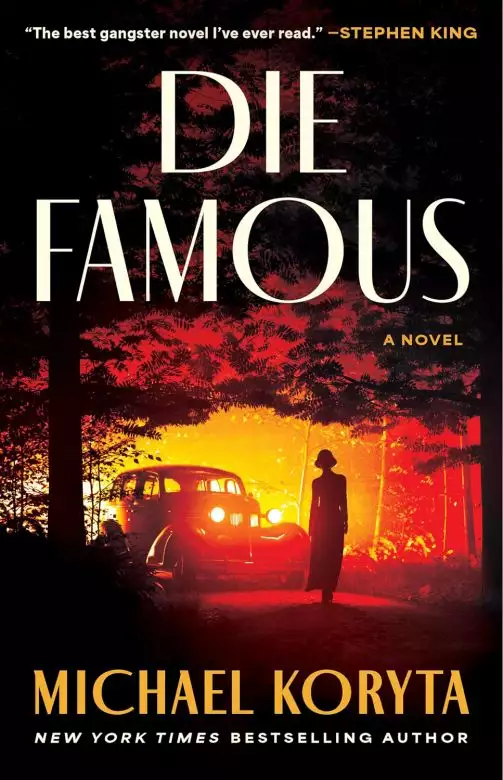
Die Famous
- eBook
- Paperback
- Audiobook
- Hardcover
- Book info
- Sample
- Media
- Author updates
- Lists
Synopsis
A mother and her son set out on a treacherous journey to find the boy’s father, one of the nation's most wanted criminals, in this vivid and emotional epic, perfect for fans of Kristin Hannah, Chris Whitaker, and Amor Towles.
On the day she spots her first gray hair, Savannah Cody declares her intention to murder her husband.
Edward “Nickel” Terhune isn’t just any deadbeat—he’s the getaway driver for the infamous Brady Gang, whose exploits have placed them at the top of the public enemy lists while capturing the nation’s imagination.
Savannah is no gangster—at least not in her telling—just a single mother with a grudge and her own private grief. There are some, though, including J. Edgar Hoover, who have their doubts about that.
Twelve-year-old Alford Terhune has never known his father, only the legends and the warnings, and he finds his mother to be a mysterious force, fiercely proud, always charming, but exceptionally unreliable.
With her reputation and possibly her own freedom at risk, Savannah embarks on a quest to find the man she once loved, and the nation now fears. Together with Alford and his grandfather, a retired detective, she sets out across the heartland to track Nickel through an America marked by the Great Depression, from rural Indiana farms to posh Saratoga Springs resorts and north to Maine as summer edges toward fall.
A multilayered tale of misadventure and self-discovery, populated by an unforgettable cast of characters—from gangsters and FBI agents to farmers and novelists—Die Famous is a sweeping testament to American dreams and heartbreaks, and a novel that showcases why William Kent Krueger has said “Michael Koryta is simply one of today’s finest authors, period.”
Release date: September 22, 2026
Publisher: Little, Brown and Company
Print pages: 416
* BingeBooks earns revenue from qualifying purchases as an Amazon Associate as well as from other retail partners.
Reader buzz
 Please log in to recommend or discuss...
Author updates
Die Famous
Michael Koryta
Heat haze on the highway, warm west wind, the kind of day that called memories to mind, first loves and stolen kisses, a girl named Savannah Cody. The first time he’d seen her was more than a decade ago on a day like this; the last time was mere weeks ago, at her mother’s funeral, which Nickel was forced to observe from a distance, being by then one of the most-wanted fugitives in America.
Things changed fast in the land of what could have been and almost was. There was a version of life in which he might’ve still been called Eddie, might’ve been driving a legally purchased car with Savannah at his side and their son, Alford, in the back seat. Instead, he was known as Nickel and driving a stolen Studebaker with two gangsters for passengers, headed back to rob the same jewelry store for the second time in two weeks.
The return to Lima was foolish, and he knew it, and so did James Dalhover, though Dalhover didn’t much care, because it had been nearly a week since he’d last held a gun on anyone, and the man got off on terror in a way Nickel had never known. It was Al Brady who made the call for all of them—Brady always did—and for him the latest visit to the Kay Jewelry store in Lima was a matter of pride. The last time through, he’d gotten nearly seven thousand dollars’ worth of jewels, but he’d also been shot at by a member of his own gang, and the papers had a hell of a time with that.
Al Brady was unamused.
They’d been holed up in a boardinghouse in Wheeling, West Virginia, when he read the account aloud, his eyes bright with whiskey and rage.
A heroic employee of the jewelry store, Bernard Brender, engaged the notorious Al Brady directly, leaping bravely into action, unafraid of the man’s weapon or those of his evil acquaintances. One of the other gangsters opened fire, shooting wildly, shattering glass cases. Brady, rising from behind the counter, nearly bit a bullet fired by one of his own goons.
“Stop that, you idiot,” the gangster cried. “It’s me.”
“Me who?” the other bandit replied.
“Me-me, you crazy fool!” Brady bellowed.
Although the gang escaped, Brender’s heroics and the criminals’ comedic incompetence caused them to leave the most valuable of the jewels.
Brady lowered the paper, glowering at the other men as if to ensure that they were properly offended. There were only the three of them by then, as the gunman who’d taken the wild shots, Jimmy Cummings, had been pistol-whipped and left on the road.
“Can you believe that bullshit?” Brady snarled. “I mean, can you fucking believe it?”
Nickel allowed that he certainly could not, although he was privately impressed with how much the newspaper reporter had gotten right. An employee had indeed wrestled with Al Brady, and Jimmy Cummings had indeed opened fire, and most of his bullets had gone toward his boss. Even the dialogue exchange was close to accurate, the exception being the language. Al Brady had bellowed plenty of things, but nothing as sanitized as “You crazy fool!”
Still, you had to sell newspapers to churchgoers, so one had to anticipate some creative license when it came to quoting Al Brady. The story sounded funny because, up to a point, it had been funny. Hell, Jimmy had damn near shot off his own boss’s head. Who couldn’t laugh at that?
Al Brady.
That was the trouble.
That was why they were back in Lima, car windows cracked, warm spring air blowing in like hell’s breath on Nickel’s neck.
“By the time we’re done,” Al Brady said, “we’re gonna make Dillinger look like a fuckin’ piker.”
He spent a lot of time comparing his work and reputation to John Dillinger’s and loved to point out that for all the attention his fellow Hoosier commanded, he’d died with three dollars in his pocket, gunned down in a Chicago street. How it was supposed to end differently for any of them, Nickel didn’t know. The number of dollars in the pocket, maybe.
Anyhow, Dillinger was dead, and they weren’t.
Fuckin’ piker.
Nickel saw the jewelry store waiting just up the street. He parked. They popped the doors, climbed out of the car and into the windy midwestern Wednesday. It was too warm for overcoats, but the jackets hid the guns. Nickel followed Brady and Dalhover up the street. A Black man with a broom was working out in back of a dime store; a woman on her knees pulled weeds from a flower bed. The sidewalk was empty.
“Hard and fast and make ’em remember we were here,” Brady instructed.
They turned right, went up four wide stone steps, and entered the jewelry store.
The salesclerk was the same woman who’d been there the last time, and when her scream roused the jeweler from the back room, he hardly seemed startled, only dismayed—This again? He had his keys in his hand almost before they said a word.
“You must be one dumb son of a bitch,” Al Brady told him, “to think I’d trust any stone in that front case.”
Nickel, Al, and the jeweler went into the back room while Dalhover kept his weapon on the employees and customers in the front. Nickel put his gun in the jeweler’s back as the man turned the tumblers with trembling fingers. Jewels were inside the safe, yes, but not many. Probably because they hadn’t had time to restock the inventory. The ink had hardly dried on the last insurance claim. There had been better eras to be a jeweler in the Midwest.
“Where’s the rest of it?” Brady demanded.
“That’s all there is!” the little man said, thinning strands of hair shining with sweat and pomade.
“Bullshit!”
“You already stole the rest!”
Fair point, Nickel thought.
Out in the front room, Dalhover was breaking glass just because he liked to hear it shatter. The sound pleased him, always had. Nickel holstered his gun, raised the pillowcase he’d brought in, and swept the jewels into it. Not much weight to the pillowcase when the safe was empty. Almost like this had been a bad idea.
Still, he was calm enough. Adrenalized, sure; it was hard not to feel some juice when you had the glass breaking and the women screaming and the weight of the pistol heavy in your belt, but he was far from panicked. That was what practice did for you.
“No, no, no, please, no!” a woman wailed out front, and Dalhover answered, harsh, telling her to shut up or eat lead. He liked to talk the way folks claimed Dillinger had, but it never rang true to Nickel, sounded like a comic book. He had jailed with Dillinger and Homer Van Meter and Jack Hamilton and the rest of that poor, dead bunch, and he’d never heard any of them talk about eating lead.
“That’s all of it,” Nickel told Brady, swinging the safe’s door shut, clang. “Let’s go.”
But Al Brady had returned to Lima to make a point, and so he made it with the butt of his gun, battering the jeweler’s balding scalp once, twice, three times, until the man was down and bleeding and silent.
Bad dogs and mad dogs.
Different.
They made it back to the front room. The sidewalk waited in the sun, blissfully empty, no sound of sirens, escape there for the taking, but still Al wasn’t satisfied, needed to join Dalhover in smashing some glass, kicking a floor-length mirror over and stomping it, all with a disturbing blend of fury and indifference, a fighter punching without purpose.
“Let’s go,” Nickel said again. They were a man down because Al Brady had been so offended by the newspaper accounts that he hadn’t waited to replace Jimmy before they robbed the store again. That left only three, which meant no wheelman. They’d have to run for the Studebaker—only a block, but still a run.
“We’ll see you again soon,” Dalhover told the trembling brunette clerk who lay on the floor with her arms over her head.
She slid away from him on the floor, a shard of glass opening up a crimson line on her leg just below the hem of her yellow dress. Her eyes were on Nickel. He turned, pushed the door open, and stepped outside. Saw the police car.
Shit.
He slammed back against the wall, trying to clear out of the firing line, knowing he was too late.
No shots came.
No sound.
He leaned forward. The police car wasn’t flashing lights or blaring sirens, wasn’t moving, was just parked there, which was almost comical, considering the circumstances. There was one cop behind the wheel, head down, like he was lighting a smoke maybe, sitting there between the robbers and their ride, oblivious.
Brady came out of the store, saw Nickel’s lifted index finger, and looked down the street at the police car. He raised his gun quickly, then lowered it.
“He’s not even paying attention,” Brady said.
“No.”
Now Dalhover was outside too, pulling the door shut behind them, sealing the soft sobs of the women inside. A discarded newspaper skittered down the sidewalk, riding the western wind. The only sound. It was blown into the shadows and then out of sight.
“Walk by,” Brady said. “Just walk on by.”
It was running time, not walking time, Nickel’s body wanting speed while his brain demanded calm, but he stayed steady as they started down the street. The pillowcase with the jewels thumped against his thigh. It seemed impossible that no one was screaming. The folks in the jewelry store were still hiding; the rest of the town was unaware. The cop looked up, a fresh cigarette pinched between his lips, just as Nickel had suspected. His eyes drifted to them, still indifferent.
Which means we just keep walking, Nickel thought even as Al Brady stepped into the street and lifted his gun.
“Get out of the fuckin’ car!” Brady bellowed. His gun was leveled at the wide-eyed cop’s head, nothing separating them, not even glass, because the cop had the window down. Twenty paces away, the Studebaker waited.
Should be two cops in that car, Nickel thought. He’s parked with the engine running because he’s waiting on someone.
A part of his brain felt validated when the first shot came from the door of the five-and-dime beside the car. Everyone else seemed to think the bullet came from Al Brady—including maybe Al himself. Nickel knew it was from the missing partner, though, so he was moving for the Studebaker when the second shot came, the bullet spanking off the police car’s roof like a struck match. The officer’s partner was coming out of the dime store firing high and wide.
Brady answered with a blast that missed and blew out a panel of the dime store’s front window, and then Dalhover was shooting too, and Nickel was running, had the Studebaker in sight when his leg jittered sideways and he fell and rolled across the pavement, ripping the shoulder seam of his jacket.
Tripped, he thought, because the pain seemed to come more from his bruised shoulder than anyplace else. It wasn’t until he tried to rise that he felt the bullet wound. Low on the calf, hot blood, scarlet streaks on the street. The one from the car had shot Nickel. He’d gotten out and drawn his gun and fired from his knees. Brady kicked the cop to the ground but didn’t shoot him; instead, he raced for the Studebaker, and as he passed Nickel, he said, “Run!”
Running was all that Nickel had wanted to do back when it was a thing he could do. Now he limped, geysering blood with each step, and wouldn’t have made it to the car if Dalhover hadn’t caught him. Dalhover got the doors open and dumped Nickel into the back seat. The only thing between them and escape was a driver, but Al Brady ignored the wheel and went for the trunk.
A moment later, the machine gun chattered.
Screams were all around now, everything in the once still, silent afternoon coming alive to either shout or shoot. Al Brady swept the street right to left and then back, bullets fired without targets, but even heedless bullets did their jobs well when there were enough of them.
The cops stayed down. That was what the big gun could do for you. Horsepower. The Thompson machine gun was the John Deere of crime.
“Let’s move!” Dalhover said, clambering behind the wheel. Brady got in beside him, and Nickel curled up on the floor in the back, holding the pillowcase to his leg, the weight of the jewels resting on the wound like ice cubes. Dalhover turned the engine over and pulled a hard U-turn, and Brady put the window down, hoisted himself up, and sprayed another remember-me round at the heart of Lima, Ohio.
They were on the highway before the sirens came.
Agent Toland: Describe the first time you met Al Brady.
Ha! You should ask him that question. It was more memorable for him, because I was in the buff. Nickel had left for cigarettes before I got out of bed, and the day was hot even though it wasn’t yet noon. We’d been up late, and I’ve never been one who thought you had to put on a certain kind of clothing just because of a given hour. Or any clothing. Now, Al Brady wasn’t expecting to find anyone in the bedroom except Eddie, considering that Eddie rarely had women, despite being by far the best-looking man of that whole gang. He didn’t have the knack for small talk or easy charm, that was all. He was happy to keep his own counsel, you know? So here came Al, shouting that it’s time to wake up and hit the road, daylight’s wasting, and then he opened the door. I was standing in front of the mirror doing what I call an assessment, so thanks to the mirror, Al Brady got both a front and back view. I suspect that day ranked high on the best of his sorry life.
Toland: Your association with Terhune goes back a long time, correct?
I love how you ask questions you already know the answers to. You federal agents sure are clever. Yes, at that point I’d known the man who fathered my child for a long time.
Toland: How long?
Well, I was sixteen when I met him, so you do the math. Eddie was nineteen, which isn’t so much of a difference now, but age gaps are all about proportion. When I was still in school and he was a hired man on my father’s farm, our “association,” as you call it, would’ve been scandalous. Dad brought him on for common labor and kept him despite my mother’s objections because Eddie had such remarkable mechanical aptitude. He could fix anything. That became a problem for him later on, you know. It was that skill that got him introduced to Brady and Dalhover in the first place. They were stealing cars and stripping them for parts and neither one of them had Eddie’s gifts. He could take apart a whole car in the time it took Al Brady to loosen a radiator cap.
Toland: What were your mother’s objections to him?
Sorry, I don’t mean to laugh. It’s just such a long list I don’t know where to begin. I suppose we can make it as simple as family. Hers had a certain puritanical reputation, beginning with the famous novelist the Reverend General Jacob Winter himself. She was a Cody by name but a Winter by blood, and that family was just about as warm as their name suggests. An Old Testament kind of worldview, if you know what I mean. Pious. She had righteousness and book royalties; the Terhunes had moonshine and cockfighting. Different sides of the tracks and all that. She missed the good that was in Eddie. There was plenty of it, in the beginning. You were the ones who squeezed it out of him, first at the jail down in Frankfort and later up in Michigan City. I’m not saying he was innocent, but those places changed him. Such cruelty occurs behind those walls. You’ll pretend it isn’t part of the infection in this country, but a smart person knows better. Reformatory is a silly, sad word. No one is coming out of those places reformed; they’re coming out angry and alone. They’ve been marked by the experience, and polite society won’t welcome them in, so is it any surprise that the friends they take up with are the ones they met inside, fellow inmates? Of course not. You all taught him to be mean and introduced him to the people who could exploit that. Eddie knew cruelty from his own father, but at least at home, he had his escapes. The woods, the river. Me.
He was so handsome! Tall and lean and with those muscles in his arms like a deep V under the shoulders. When it got hot enough for him to roll his sleeves all the way up, a girl could swoon.
What’s that—am I boring you or embarrassing you? Yes, I know, there’s an electric chair to keep warm. I understand. Excuse me for not wanting to rush through the tale this one last time. You’d be wise to slow down yourself. There won’t be any more questioning of Savannah Cody tomorrow, will there?
Toland: Just explain your relationship with Nickel Terhune, please.
That first summer, he was building a new fence. I would follow him when he worked. He pretended not to like that. He wasn’t good at pretending, though. He was a quiet man, and a calm one, and the only sure way to fluster Eddie Terhune was with a pretty smile. He could never stop blushing when I caught him looking at me, and I caught him plenty. Even then, though, I had to be the one who made the first move, so I finally kissed him. He might’ve worked for years and just kept on looking, because he was a gentleman at his core. You can roll your eyes if you like, but he was. Brady and Dalhover and Shaffer and those others were good at fake charm, but Eddie was sincere. My father saw that in him too.
Dad almost never went against my mother—it wasn’t worth the lectures and the scripture quoting—but he bucked her when it came to hiring Eddie and keeping him on, and she never did let him hear the end of that. I doubt even her death saved him; she had one of those voices that trailed after you. Always making this little sound with her tongue on the roof of her mouth, not quite a tsk, but close. The perfect sound of disapproval. Poor Dad; he lived with that sound. He’d been a detective, of course, and he was a good judge of people. Don’t let him know I told you that. But he really is a fine judge of character, and he saw all the potential in Eddie that most people in our area refused to acknowledge simply because of his family. When you look at it that way, I guess I’m the problem, aren’t I? I was the one who kissed Eddie. You can blame me for everything that happened next.
Savannah Cody’s poison kiss.
Make sure some reporter uses that as a headline when this is over, would you?
ON THE DAY my mother discovered her first gray hair, she announced that she was going to murder my father.
I’m not sure if the gray hair led her to make the choice or if it was coincidental. She didn’t seem angry about the insurgent’s presence, merely dismayed.
“Look at this bold little bastard, Alford!” she said, pinching the gray strand between two fingertips and lifting it clear from the dark shoulder-length hair that always seemed to hold the light. “Didn’t even have the courtesy to let me make it to thirty.”
She faced the mirror with a thoughtful expression, then said, “The time has come for me to kill your father. I trust you understand that.”
Then she yanked the hair free without so much as a wince. I cringed on her behalf—and a little bit, maybe, on my father’s behalf, although the idea of people wishing him dead was hardly a new one. My mother was the latest entrant in a competitive race. On that day in the spring of 1937, my father had been on wanted bulletins for months. I didn’t think the police presented more of a threat to him than my mother, though—and at that point I’d lived with her for only three weeks, a tumultuous stretch following the death of my grandmother.
I’d spent my childhood at the Indiana farm of my grandparents. My father hadn’t visited since his first prison stay. My mother came and went, always with a promise to return one day and collect me for good, a day my grandmother assured me would never come.
Then my grandmother died, and my grandfather was so distraught that he told my mother to take me away from the farm. I’m not sure who was more shocked, me or my mother. The decision was announced on the day of the funeral, when mourners surrounded my grandfather with outstretched hands and tearful eyes and parted around my mother as if she were Typhoid Mary, even her gaze contagious.
They all knew the story of Savannah Cody and Nickel Terhune and, of course, me, the bastard son. They pitied my grandfather and scorned my mother. I think it was recognition of that, even in his haze of sorrow, that led Grandfather Cody to announce—in public, no less—that he wanted her to take me north.
He had never supported her choices, but he refused to condemn her. His voice was the last one on the matter of my mother. Entrusting her with me was his quiet rebuke to all the locals who pitied him for his living daughter as much as they did for his dead wife. It suited him.
My mother had never sought my company, but she wasn’t about to argue, certainly not there in the church with my grandmother stretched out in the casket up front and all those judgmental locals looking on. We boarded the train for Huntington together and passed three uneasy weeks in her small apartment while she read classified ads and smoked cigarettes at the tiny kitchen table and handed me pulp novels that were unusual offerings for someone my age. I enjoyed the books but dreamed of returning to the farm with its orchard and mill pond and hayloft with a view of the Ohio River. I’d been named Alford as a nod to the Old English word meaning “river ford” and I took great pride in that, the name holding a quality of adventure. I loved the farm and had wanted for nothing during those Depression years—except, of course, parents. I hadn’t felt their absence acutely, though. They were more legends than losses in my life.
As the days passed, I began to fear I’d never leave Huntington, let alone return to the farm. Then my mother was inspired to commit murder.
“We will need Dad’s car,” she said, squinting into the mirror, tilting her chin left and right, up and down. “The Lincoln, I’d hope, but I’ll bet you a dollar he won’t part with it, and we’ll end up with that old truck.”
She leaned closer to the mirror, her blue eyes narrowing as she studied hair that—now that the gray intruder had been vanquished—shone like raven’s feathers, with the high gloss that came from careful care.
“If she’d studied her books the way she studied the mirror,” my grandfather had observed more than once, “she might’ve seen the son of a bitch for what he was.”
The son of a bitch in question was my father, Edward “Nickel” Terhune, a national villain but a sort of disappointment even in that regard, a subordinate in a pack of gangsters led by Al Brady. While my father made it into newspaper articles frequently, he never made the headlines. That was a strange thing to find vexing, perhaps, but once you grew used to the burden of infamy, you at least wanted to earn the boldface type. It was like having a father who played for the Yankees but as a utility infielder. More exciting than most careers, sure, but still privately discouraging. He would never be Gehrig, not even the Gehrig of gangsters.
“Yes,” my mother said, her sentry’s eyes alert for another strand of gray, “it is past time to kill him. Why, I should’ve done it years ago.”
“I don’t think he’ll be easy to find,” I ventured hesitantly.
“We can’t be pessimistic right out of the gate, Alford,” my mother said. “It’s easier to talk yourself out of goals than into effort.”
I was fascinated by the way she talked exactly like my grandfather while living in opposition to his every worldview. It was as if she’d memorized the text but misunderstood it. He would’ve said the same thing about mending a fence that she’d just said about murder.
“Besides,” she said, smoothing her hair with one palm, then the other, evidently satisfied that all gray had been eradicated, “the rent’s due Monday, and I’d rather not pay it.”
And so we were off, packed by sundown. It didn’t take long. My mother lived light in the way one had to when one might take off for another town on a whim. The belongings we took to the train station fit in a suitcase and one ancient steamer trunk that we held between us. My mother held the trunk with her left hand; her right was occupied with a typewriter case, which seemed an odd accessory for a woman of meager possessions and unknown employment. Holding the suitcase in my left hand and the handle of the trunk in my right was about all my puny twelve-year-old frame could bear, but I was determined not to look weak in front of my mother, who historically had commented on little about me beyond my lack of stature.
“Feed the boy more,” she would tell my grandmother, the conversational equivalent of lowering a lit torch to a dry wheat field. My grandfather’s dialogue with her was equally spirited but left me with the sense that beneath their arguments lurked affection. My grandmother was ashamed of her; my grandfather was disappointed in her. There was a difference.
“Some people find trouble and some people hunt for it,” my grandmother would say. “Savannah is a trouble hunter.”
“And you don’t know where that came from. You just found her, I suppose,” my grandfather would respond. “Like Moses in the bulrushes.”
That would usually buy him both a sour look and silence, and I think he was happy to accept one if he got the other.
The idea of returning to the farm even in pursuit of a vehicle to kill my father was welcome. I missed the place terribly and my grandfather even more. He’d always told me that his daughter was an impulsive creature, and I was not to blame him for her or seek to understand her behavior, in that order. As with most of his advice, I took it to heart. He’d been a detective with an outfit called the Burns Agency in his younger years, before that private-investigations business shifted to strikebreaking, at which point his appetite for the work dissipated. He returned to his hometown and married my grandmother, his childhood sweetheart. He was the antithesis of my father in every way, known and respected in our valley as a gentleman of the highest character.
If I could simply make it back to him, I knew I could convince him to keep me.
We rode the swaying train south from Huntington, across the National Road, out of the flatlands north of Indianapolis, and on into the steep wooded hills that had been scoured by the advance and retreat of glaciers. Beneath us was cave country—there were four on my grandfather’s property alone, and once he’d taken me across the Ohio River to see Mammoth Cave. The caves had also been important to my father’s family, though for different reasons; it was an ideal spot to hide moonshine. The Terhunes lived fewer than ten miles from the Cody farm, but I’d never spoken to any of them. They were famous for their whiskey, which they distilled on the Ohio or Indiana side of the Ohio River, depending on the enthusiasm of the police in either state at the moment. The liquor business in those years had been illegal, and yet the whiskey runners were not regarded as criminals by anyone except the devout, such as Grandmother Cody. Grandfather Cody never missed a Sunday service but couldn’t help snickering when the minister got on about some of the Old Testament stories, Noah’s ark being the one he found most amusing.
“Now, that man was a shipbuilder,” he would say, and chuckle, and my grandmother would shoot him a look that carried none of Christ’s lessons.
I also knew that during Prohibition, Grandfather Cody hid a flask or two of Terhune family whiskey behind a false wall in the barn, a fact he’d shared with me one day as if to allow some greater understanding. It clearly mattered to him to tell me that it was Terhune liquor, the implication being that while he couldn’t publicly endorse the business of my other bloodline, he could appreciate it. Grandfather Cody was judicious when it came to the use of my last name and opposed my grandmother’s effort to rename me Alford Cody due to my father’s infamy.
“Men have sins and men have sons, and if we’re going to acknowledge the first, I’ll be damned if I don’t acknowledge the second,” he said, and his voice was low and loud, a timbre I’ve tried to match my whole life without success, soft thunder that conveyed command.
When my mother called him from the train station in Madison and told him of our unsolicited arrival, I could hear his booming “Not interested” in response, the words so loud I blushed, sure that others had heard our rejection from family. My mother, however, took it in stride.
“Now’s no time for joking, Pa. Alford is here, and he’s in positive despair without you. Don’t forget, he’s still young enough to believe some of your stories.”
His beloved Lincoln-Zephyr arrived an hour later, and he unfolded from the driver’s seat and surveyed the scene with his customary assessing gaze. He was well over six feet, stood ramrod straight, and had snow-white hair and a mustache cut crookedly, longer by a full inch on the left side than the right. This was intentional, as he loved nothing more than for someone to ask him about it, at which point he’d explain that he was left-handed and “the mustache helps me recall my dominant side.”
“This is what passes for humor to Cody,” my grandmother would say with a sigh. Even she called him Cody. I once asked if she’d ever called him Wendell, his first name, and she’d thought ab
We hope you are enjoying the book so far. To continue reading...
