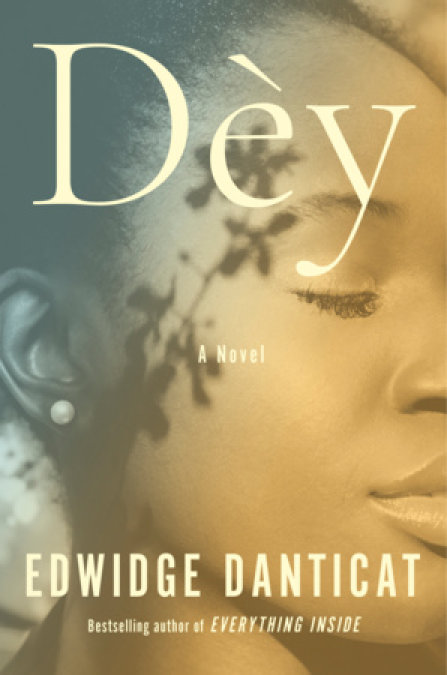
From the bestselling author of Everything Inside comes a vivid, timely story, moving from Haiti to Brooklyn to Miami, of a woman whose sense of self and family are called into question when she gets caught in a random act of violence one sunny Florida day.
“Is home the place where we are born? Or is it the place where we die?” These questions haunt Magnolia, a successful Haitian American real estate agent in Miami. When she hears gunfire while at a shopping mall, she takes shelter in a nearby restaurant, cowering with fellow shoppers and diners. Once she’s safely home, Magnolia keeps this traumatic event from everyone. But given her life back, she begins to see everything clearly: her extraordinary bond with her daughter, Zoë; her nearly broken relationship with Zoë’s father; the challenges of her mentally troubled mother, whose unraveling patterns Magnolia worries she’s spiraling toward herself; and her father’s affair with a woman who has borne him a child. While struggling through the labyrinth of her past, Magnolia must also come to terms with the losses sustained that life-altering day, and nearly every day by her parents and sibling in Haiti.
Can love or family protect us from harm? Does optimism or fear win out in one’s heart? Which side will prevail for Magnolia? Pulled between these questions, each of which involves a high-stakes choice—Miami or Haiti, single or married, mortal or ghost, before or after—Magnolia is a narrator who is “yon pati koukouy, part firefly”: flitting and shimmering between different worlds.
Taking as its title a Haitian Kreyòl word for mourning, Dèy is a profoundly warm and moving novel about the importance not only of sharing grief but also of inseverable family ties. Brave and striking, Dèy is one of Danticat’s most powerful and deeply affecting works yet, told with her signature “unfaltering voice and evocative beauty” (The Boston Globe).
Release date:
August 25, 2026
Publisher:
Knopf
Print pages:
256
* BingeBooks earns revenue from qualifying purchases as an Amazon Associate as well as from other retail partners.
I dive to the restaurant floor as gunfire rips the air outside. The concrete is warm and sticky, the kind of gluey surface that would slow your step even if you were wearing rubber-soled boots, let alone flip-flops, what my mother calls sandal Jezi Kri, Jesus Christ sandals. The restaurant is named Oasis, probably because the word can be understood by English, French, Spanish, and Haitian Kreyòl speakers. Since it opened in the mall a year ago, offering a Caribbean-fusion menu, I have walked past dozens of times but have never gone inside. The place looks “mall-fancy,” as Harrison, my daughter’s father, once said. A mural of an indigo-blue sea frames the wide glass front door, which offers a full view of the crystal chandelier hanging over long dining tables and black leather booths. Now on the floor, among dozens of panicked diners and shoppers, I hear a sobbing elderly man ask, “Is this a mass grave?”
The blasts sound even closer than before. We crawl under tables and chairs, about forty of us. Some of us curl into fetal positions, others with arms and feet reaching out toward family members, friends, strangers. Screams, tears, and prayers are temporarily muffled, silence, prematurely playing dead, having been collectively and wordlessly decided as the best course of action. At least for now. I turn my head toward the front door and see people running in clusters outside, a few children being carried. One or two adults with limited mobility are supported by the waist or shoulder while being nudged and urged to move along. Some scurry by, screaming, “Run!” even as they’re running. I grab the base of the table covering me and flatten myself even more. Thankfully my legs are short. There are some advantages to being one of these women who will one day be asked if she and her adult daughter are sisters.
It sounds like bombs are going off beneath us. A whiff of sulfur wafts in from under the door or possibly from the AC vent, blowing cool air throughout the room. The smell dissipates as some around me rise from their hiding places, having likely decided that playing dead may not work against a gas leak, smoke inhalation, the next explosion, a mass murderer, or the several mass murderers who could be heading our way. It’s time to run again or find other nooks or cubbyholes that might better assure our survival.
A man’s voice booms out from behind me. “Is the front door locked?” He’s kneeling near the kitchen’s aluminum swinging doors. Someone must have secured the entrance. Crouching in the dim light, I can see a belt knotted around the knobs.
The stream of people rushing by abruptly stops. I reach for my phone and car keys. But then I remember a woman, another Black woman, telling us moments ago how we had to stay down and turn off our cell phones so their lights and sound wouldn’t draw attention. In the pouch attached to the back of the phone are my driver’s license and credit cards. I want them on my body rather than in my work bag, a black cork-skin leather tote, which I pull against my chest like a bulletproof vest.
The same Black woman with a head of golden box braids slides out from under one of the tables. Her white T-shirt and apron, with the word oasis printed across her chest, makes her rounded frame visible from every angle in the room.
“We should get the hell out of here!” the man who asked about the door calls out.
“No, we’re sheltering in place.” The woman tries to whisper but ends up hissing at him. “Stay down, please. Remember, run, hide, fight.”
“Run, hide, fight” is clearly a phrase she’s retained from training she and her co-workers had received to prepare for something like this. I imagine the words chiming like a jingle in their ears. I make the dictum my own. Run, hide, fight. I’d already run. I am hiding. Will it soon be time to fight? But, like the man, I want to run again. The September 11 terror attacks on the World Trade Center flash through my mind. I remember hearing days, or was it weeks, later how some survivors walked down narrow stairwells though they were advised not to. Some even crossed paths with first responders going up as they descended. I was sixteen and in the eleventh grade and that morning was listening to an admissions counselor from SUNY Albany in my high school auditorium. Five years earlier, my period came for the first time on another September 11. This, too, was an anniversary I wanted to forget.
Where else is left to run to now? We are on the mall’s top floor, near the escalator and back stairwell, which I’ve used now and then when I’m in a hurry. Each stairwell’s landing has a picture window with views of blue skies, terracotta-tiled roofs, yachts, sailboats anchored in bays, and beaches on the edge of the Atlantic Ocean. All good reasons to live and sell real estate in Miami.
In the distance now, sirens. They grow sharper and louder, approaching from several directions. Around the restaurant dining room, a reassuring hum moves from one mouth to the next, buoyant sighs of relief. The flaxen-tressed Black woman sits with her back against one of the booths. She covers her face with her hands and repeatedly exhales as if harvesting her breath.
Listening to the encroaching chorus of even more sirens, I think of my daughter, Zoë. I’m in the mall because of her, buying a cell phone for her tenth birthday. Too soon, I know. Still, how will she feel if I’m killed while trying to buy her this thing she’s been begging Harrison and me for all year? How will she celebrate her birthday in a few days if I die? The guilt. Her guilt. I can’t imagine. Her father and I held off on buying her a cell phone or tablet until now. As her birthday approached, we gave in. She’s been spending a lot of time on my phone, texting her volleyball teammates about practice and classmates about homework, while grumbling that she’s the last child on her team, in her classes, her school, in the United States of America, who does not have a cell phone. The brand and model she wants is ridiculously expensive. I have seen families who could have been sharing a meal, or watching a movie together at the second-floor theater, who were instead sleeping outside the electronics store here to be among the first in line to buy one. Zoë won’t be getting that phone. The one from two years ago is still pricey enough to be worthy of being her only birthday gift from both her father and me. That is, if I make it out of this mall.
The sirens continue blaring. Some pick up when others stop, as though on relay. The stomping of what must be dozens of boots marching toward us merges with the sirens. A controlled stampede? Hammer drills rattling the chandelier that now sounds like wind chimes. Another man, older and taller, and wearing a black Oasis apron, hops toward the golden-haired woman. He leans down and strokes her ring-shaped face. They appear to be friends, or romantic partners. They crouch closer to the ground, even as they move their heads back and forth to inspect the room. I push down farther into my clammy spot, curling into a ball while still clinging to my bag.
The public address system, through which instrumental versions of popular tunes are usually piped, crackles as though it is the apparatus that is clearing its throat rather than the man using it.
“This is an official announcement.” The gravelly voice is shaky at first but becomes more commanding as it proceeds. “Gunshots have been fired on the third floor of Building A, in the food court.”
A communal moan passes through the room, along with gasps and breakouts of “Oh God!” leading into Hail Marys and other liturgy being recited in more languages than I recognize, all with this cadence between desperation and hope, the oral version of rocking oneself. The shooter has been located, in the food court, at the bottom of the escalator, only a few hundred feet away. I was just there, eating a hot dog and drinking a Diet Coke. We, Oasis, would be his first stop off the escalator.
“If safe to do so, move to a secure area immediately, or find the nearest place to barricade.” The announcer has arrived at the part of the script that doesn’t require specificity. He continues in a monotone. “Do not open any entrances until instructed by responding authorities or until you receive the all clear.” He repeats this in Spanish, then someone else, another man, takes over in Haitian Kreyòl. After he’s done, the opening bars from Gloria Estefan’s “Rhythm Is Gonna Get You” rings out. The song is hurriedly cut off. The PA system crackles once more, then silence.
The golden-haired Black woman and her man lace fingers. She buries her face in the crook of his long neck and caresses his shoulder-length locs. A teenage boy mirrors his father’s jumpiness and shivers as though he were freezing. A toddler’s parents, their faces dripping with sweat, take turns cradling their somehow still sound-asleep daughter. One woman is whispering what seems to be a lullaby in a whimpering little boy’s ear. One tween girl, her face ashen, moves from biting her fingernails to nibbling at her brown knuckles and then furiously texting on her phone. Despite the warnings, many whisper, sob, and then bark instructions into their phones, list errands, pets, and people who should be taken care of, describe the location of important documents, relay passwords and safe-combination numbers. Before silencing their phones, they say, “I love you.” As often happens, seeing others reach for their phones makes me reach for mine. It’s out of juice, uncharged. How could that have happened? Uncharged is not a word I would normally use. I think of all of the times I have said to Zoë and Harrison and to my parents in Haiti, “My phone is dead.” Or, “My phone was dead.” My heart is racing along with a persistent loud pounding on my eardrums. The hot dog I’d eaten in the crowded food court a few minutes ago, around noon, wants to expel itself from my stomach. I swallow hard to keep it down.
What would Harrison do, or say, if he were here?
He’d remain calm while narrating everything to me.
“You hear the sirens?” he’d ask.
“I hear the sirens,” I’d say.
“The police are here. You are fine,” he’d say slowly, very slowly.
“I am fine,” I whisper to myself now, mirroring the steady pitch and neutral cadence of his voice.
The sirens keep blaring. The boots start up again, this time at a much faster pace. Now there are new voices. Voices upon voices. Commanding. Directing. Another volley of bullets, then, “Down! On the ground!”
Someone must not be obeying, so the voices keep shouting. Louder. Faster.
“Stay back! Stay the fuck back!”
“Take cover! Take cover!”
Other voices follow. “Fire! Fire!”
A single penetrating scream echoes throughout the mall. That person is howling like a banshee, I think. Banshees, I somehow remember, are omens of death.
A thin sheet of white smoke rises from under the front door. Most of us jump to our feet, wobbly though our legs might be. I release my bag, hearing a startling thump as it hits the ground.
We hope you are enjoying the book so far. To continue reading...

 Please log in to recommend or discuss...
