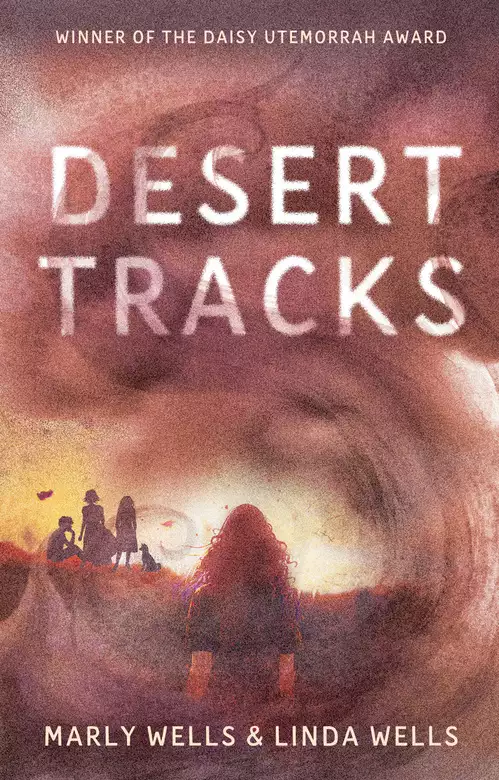
Have you ever gotten lost in a book? Entranced into the world of a mysterious old story, Millie, a Warlpiri teenager, is sucked up by a willy willy and transported to Alice Springs in 1924. Here she meets a crew of oddly familiar young people, Sonny, Beryl and Spike. As the group continue to find each other in time, they realise the Alice Springs of the past and the future are not as different as they seem... Desert Tracks is a time travelling novel about young people in central Australia, the historical legacy of racist policies and the relationship between history and the present.
Release date:
March 11, 2025
Publisher:
Magabala Books
Print pages:
256
* BingeBooks earns revenue from qualifying purchases as an Amazon Associate as well as from other retail partners.
Millie barged through the front screen door and dropped her bag. She had run from the bus stop. Millie enjoyed the tangle of school and her little town in the desert but it was good to get home to her safe space. She stood, catching her breath, as the door swung behind in smaller and smaller bangs until it hung closed.
‘Hey-ho Mill,’ her mum called from the corner where she stood splashing paint onto canvas.
‘Hey-ho Leni,’ Millie puffed in reply. Their house was an older style Alice Springs place, airy and light. Walls were painted in the bold bright shades of the desert: the blue of the sky, the rusted orange of the land, the dull gold of dried spinifex. Even though it was not as sleek and shiny as some of her friends’ houses, Millie felt embraced by the art and comfort and character of her home. She liked that it was a painting day for Leni too, rather than one of her ‘busy important days’ which is how she referred, facetiously, to the days she went to work. Millie liked it when her mum was there to greet her when she got home from school.
‘Don’t leave your bag in the doorway. It’s about the worst place on earth you could leave it.’
‘What about if I dropped it in the toilet?’
‘Mmm, I suppose that would be a step even further in the wrong direction.’
Millie laughed. Not only did she move her bag, but she opened it and took out her lunch box which she put in the dishwasher, then the school newsletter that went on the table where her mother would read it later. You could get the newsletter as an email but Leni opted for a hard copy. She said she liked the feel of the crisp, recycled paper in her hands and that too much screentime was turning humans into zombies.
‘How was school? Any news?’ Leni asked, still painting.
‘Ummm,’ Millie replied, thinking back over her day. ‘It was fine … pretty good. Shania Macelroy’s pregnant, Simon Godfrey made the Territory swimming squad, Grace and Annie went off by themselves at lunchtime so I went to the library with Xander and found this interesting book.’
‘Did you borrow it?’ asked Leni who seemed to be half listening but also distracted by her painting.
‘No I just left it there with a big sign that said “interesting book alert” … What do you reckon?’ Millie pulled her latest acquisition out of her bag and sprawled on the couch, adopting her favourite reading position. Leni grinned and shook her head while Millie turned all her attention to the book.
Desert Tracks: Growing up together on the Central Australian frontier by EJ Newton. The cover photo was in sepia. It showed three young people, about Millie’s age, at a stockyard in the desert. Around the periphery of the stockyard were some gnarled old trees. Off to one side was a squat, mud brick homestead. On the other was a collection of humpies made of branches and bark. There were figures in front of the shelters – human silhouettes too small and distant to make out in any detail. In the distance were jagged mountain ranges.
Millie read her books from front to back, every word and image. They were treasure maps, and she wasn’t going to miss one clue. What struck her about this one was that it felt like home. The country on the front cover, the bush shelters of the Central Australian landscape, even the old homestead like the crumbling ruins she had seen out bush, were as familiar to Millie as the young people at the stockyard in the centre of the story.
Millie read books about young people in London and Melbourne and Afghanistan, books set by oceans and in cities, about conflict and adventure, about kids alone and happy families. She didn’t usually choose books about history. Leave the past in the past, she thought, and let’s get on with looking forward. But it was so rare for her to come across a book that seemed like part of her own world that she had decided to give it a go. She opened the cover.
First published by Colonial Press 1943.
All rights reserved.
Cover photograph by James Ellington 1924.
Spike glanced up at the clock, then through the shutters to measure the clock time against the position of the sun in the afternoon sky. These were her two ways of telling the time. It was twenty minutes to four. She knew this time of day, when the sun shone down at a particular angle, slanting in across the shutters, past the lacy curtains and splashing around the room. Time is nearly up, the light was saying, come on outside.
Spike was aware of Sonny out there, even though she was trying not to look. He would be observing the shadows and waiting for her. There were no clocks in Sonny’s life. Time was measured in a different way. Sonny loved to hear about Spike’s house: how they set the wooden table and ate their dinner there. How they washed the dishes afterwards, had sing-a-longs around the piano, and brushed their teeth before bed. Normal things like that fascinated Sonny who didn’t think they were normal at all. One day Spike would like to sneak Sonny inside to show him around. The way he got excited about things that seemed quite dull to her shined them up for Spike as well.
Spike liked Sonny’s life – that way of living on the ground, in touch with nature. She liked the humpies people built for shelter. They were amazingly comfortable and weatherproof in their simplicity. They weren’t big and solid like her house, but they weren’t prisons either, so solid and permanent that you were trapped there. People didn’t buy and sell humpies like they did cattle and cattle stations and homesteads. You could just leave humpies and move on to a new location. If anyone else came along needing a humpy, there would be one there for them. And you might find another where you were going, or you could make one once you got there.
Spike was amazed at the things that Sonny found normal, like the attitude to humpies. Maybe that’s just the way things are, always getting more excited about things that don’t seem normal to you.
When he looked in her direction, Spike waved at Sonny, a quick gesture while Miss O’Connell wasn’t watching. Sonny smiled his shy smile and waved back before disappearing out of view. Miss O’Connell wouldn’t be pleased to see Sonny out there, in sight of the window. She might say he was distracting Spike from her lessons. This governess from the city would love to stop Spike from seeing Sonny.
Miss O’Connell moved over to stand at Spike’s desk. ‘Emily Jane, how are you going with your mathematics?’
‘Good, Miss.’
Spike did her sums. She knew if she worked hard and got them right, Miss O’Connell would have trouble thinking of a reason to keep her back. Spike was bright and she liked the challenge of the lessons. She thought it might help her one day to get a job away from the cattle station, perhaps in a town or city, and look after herself.
‘You’ve done very well, Emily Jane, you may go.’ Miss O’Connell was leaning her smooth puffy face over Spike’s work, nodding at her sums all neatly set out with correct answers. Spike felt like pressing one of those soft pink cheeks to see if the imprint would remain as a dimple like in scone dough, or puff back out like sponge cake, freshly baked.
Miss O’Connell could not find one thing wrong with the work of this bright girl with her freckled face and tufts of blond, scruffy hair. Spike cut her own hair in a way that made it stand up in spikes. Miss O’Connell disapproved of how the family encouraged her by continuing with that absurd name. How would she ever train Emily Jane to be the young lady her father must surely want her to be, when he would not give permission to guide her properly? And the way she ran with that black boy from the camp. They were practically young adults. She must speak to Mr Ellington again.
Spike hid a few papers and a pencil in her pocket and headed for the door. She was nearly through the doorway before the shrill voice grabbed her and halted her progress. Spike hesitated then turned around.
‘Emily Jane, be back by half past five. We are having early dinner tonight and you are to be washed and dressed, ready for your father’s return.’
‘Yes, Miss,’ Spike replied.
‘And do not go running around …’
‘No, Miss.’
Miss O’Connell sighed as Spike slipped off through the kitchen, shrugging off her instructions and helping herself to afternoon tea treats on her way out the back door.
Millie slid a bookmark in and leaned over to put her book on the rug. She needed to digest the beginning of that story. Emily Jane – Spike – with her chopped-off hair and freckly face. Miss O’Connell and her powder puff face. Maybe she was like Miss O’Shae. None of the students liked Miss O’Shae much. Millie grinned, imagining pressing Miss O’Shae’s cheek. It would probably pop back out. And then you’d probably have to pop into the principal’s office. Sonny was a bush kid, maybe like Dominic or Vic, her bush brothers, but they went to school.
She remembered her mum over in the corner. She was usually handy for a bit of clarification.
‘Mum.’
‘Millipede,’ Leni replied, dabbing on bits of paint as they talked.
‘Do people still live in homesteads?’
‘Sure they do.’
‘Where?’
‘Oh, all over the place. On cattle stations.’
‘Out bush?’
‘Yes. Across the wide brown lands. Away from the cities. I used to work in a homestead.’ She dropped that last bombshell in like it was no big deal and kept on with her painting.
‘How come I don’t know this?’ Millie demanded. ‘What were you doing out there? Why did you go?’
Leni set her paintbrush down and looked right through the wall, to a different place and time. She had that here-comes-a-story look about her. ‘I’d just graduated as a teacher, and I wanted to do something different. There was a position advertised in the paper to work as a governess on a cattle station. That seemed different enough, so I figured I’d give it a go. There were four kids who lived on the station and another two who used to come over from the next station.’
‘Were there any Aboriginal kids?’
‘No. Aboriginal kids lived away from the homestead at their community. They had a community school of their own. After a while I got sick of the homestead, and I went to work at the community school.’
‘Why did you get sick of the homestead?’
‘Oh.’ Leni considered that with her faraway look. ‘I didn’t like the attitudes of the cattle people.’
‘What sort of attitudes?’
‘Mmm, arrogance I suppose. Like they knew better than the people who’d lived successfully on this land for thousands of years. And they couldn’t acknowledge the pain and trouble that colonisation had caused the original people. Or reimburse them for the work that they and their forefathers had done in building up the pastoral industry. White people got rich on the back of black people’s labour. I think if they’d listened to the original people instead of thinking they were better than them, this country would be a lot better off.’
‘Why didn’t they, Mum? Why didn’t the first white people do that?’
‘Colonisers don’t listen to how the locals do things. They wouldn’t be very successful colonisers if they did.’
‘Did you like the Aboriginal school better?’
Leni nodded and smiled. ‘Yep, that suited me much better. But it was hard work too, trying to teach those kids to read and write and understand whitefella stuff. And wondering what the point of it all was.’
Millie thought for a while. ‘That’s cos they had a really different way of life until then and their parents and grandparents and all that couldn’t read either, could they? So, they couldn’t read to their kids and help them with their homework and all that?’
‘Spot on, Mills. Their parents taught them different things, like how to live in the bush and how to carry on the ways of their ancestors that had kept those people going for such a long time.’
‘So why did they need to start going to school?’
Leni thought. ‘Their lives had changed. Aboriginal people couldn’t keep living that old way. Cattle stations had taken over people’s traditional hunting grounds so there wasn’t as much bush food for people anymore. There was conflict between the pastoralists and the bush people. Missionaries turned up to protect the bush people by making settlements for large groups to live in. Some of the bush people preferred to live on the stations and work for rations rather than living on missions. Life was just changing and there was no going back.’
‘Did the kids want to go to school?’ Millie asked.
Leni smiled, faraway again. ‘They loved coming to school and they’d come bowling in all ready and excited and they tried so hard. But school wasn’t a priority so if there was something else going on, like if their families were going hunting or off to town for shopping or maybe visiting relatives in another community, then the kids would do that with their families and miss school. You’d never know each day who was coming to school and who wasn’t.’
‘What about way back, before Aboriginal children and young people were allowed to go to school?’
‘I guess they were just learning the bush ways from their families.’
‘What about if someone who went to school, a white person, could teach an Aboriginal person and help them to learn whitefella stuff?’
‘That sounds like a good idea,’ Leni replied, ‘but I don’t know if young white people were friends with young Aboriginal people very often back then. Is that what happens in your book?’
Millie nodded. ‘It’s history …’
‘Ooh,’ Leni exclaimed, surprised.
‘But it’s set in Central Australia,’ Millie continued, ‘so I’ve made an exception.’
‘Sounds reasonable,’ Leni grinned and went back to her painting.
Millie felt something in her pocket. It was the sharp little stone-knife her aunty had given her a while back. Millie recalled the way her aunty had handed it to her, solemn and deliberate, not long after her father had passed away. ‘Your father wanted you to have this,’ Aunt Gem had offered quietly. Millie knew that sometimes the most important things were whispered. This stone-knife that her father had wanted her to have was one of Millie’s most treasured possessions. She stroked it absent-mindedly now as she read.
Spike followed Sonny’s tracks, the way he had taught her, across the dusty ground that surrounded the homestead, down the rocky path and into the dry riverbed. He had made a small fire on the sand, in the shade of a big old river red gum. Sonny was sitting cross-legged at the smoky mound, poking at something in the ashes.
‘Goanna,’ he told her as she approached. ‘I bin get one Lewajirri’. Spike loved the way Sonny went straight into telling her things as soon as he saw her. He never greeted her with hello or how are you, he just launched straight in like they hadn’t been apart at all. Sometimes when he first saw her, he just spoke her name and that was the closest he ever came to a greeting.
‘Ngurrju,’ she said, the way he had taught her to say ‘good’ in Warlpiri, his language. She sat down beside him and pulled the papers and pencils out of her pocket.
‘Here,’ she said, handing them to Sonny. He grabbed them, rested the paper on a slab of wood he kept for that purpose, and started to write – the date, the alphabet, his name. Spike taught him as he went, patiently pointing out mistakes and showing him the way things were done. Sonny listened carefully. He wanted to learn reading and writing the same way Spike . . .
We hope you are enjoying the book so far. To continue reading...

 Please log in to recommend or discuss...
