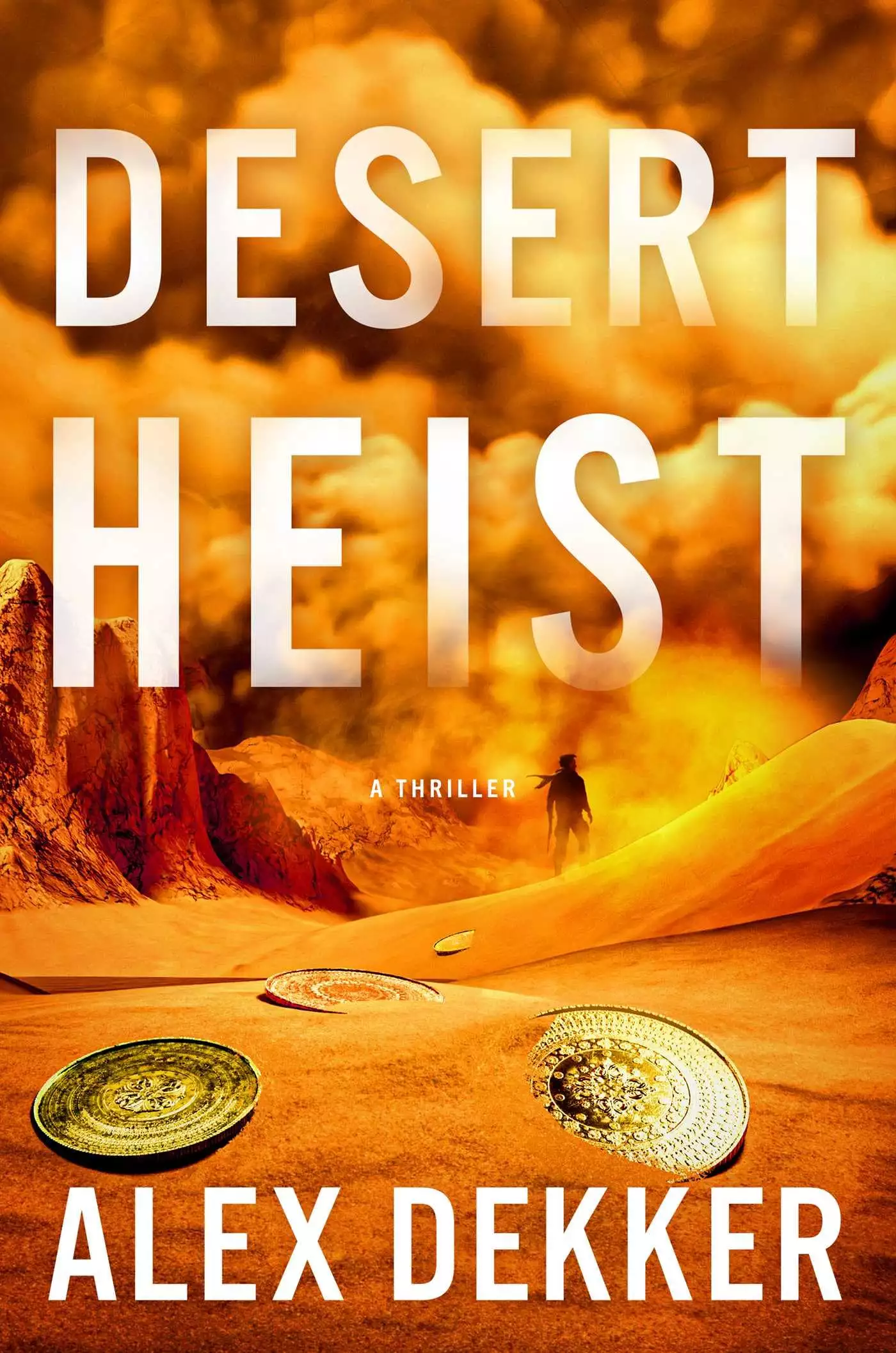
A former Green Beret and aspiring archaeologist’s expedition to uncover a long-lost ancient civilization turns deadly in this explosive thriller teeming with adventure and discovery.
Nate Wilde is a former Green Beret and aspiring Harvard archaeologist. Leaving the military after a catastrophic deployment that ended with most of his team dead or injured, he chooses to pursue his passion for history. When his dissertation proposal to search for the legendary lost city of Ubar in Saudi Arabia is rejected by the Harvard examining committee and his expedition permit is denied by the Saudi government, Nate resolves to continue his research by any means necessary. And the only path left to him is to enter Saudi Arabia’s Empty Quarter through war-torn Yemen, the same sands where his brothers lost their lives years ago.
Knowing he’s going back into harm’s way, Nate turns to the only men left alive that he truly trusts—Sergeant Benjamin “Wally” Walton, a medic formerly with the British Special Air Service; Shane Price, UFC fighter turned Green Beret and an affluent playboy; and Sergeant Tim McBride, Nate’s former best friend and a true warrior. Along the way the group meets Ana Metry, a geologist of Egyptian heritage searching for her missing father, whose research is key to Nate’s quest.
Hunted by a former Spetsnaz soldier who works for a shadowy organization with unknown goals, and chased through the desert by al Qaeda terrorists, the former commandos must utilize the skills of their past profession in a race to discover whether the city truly exists, as well as uncover a deeper geopolitical mystery with resounding global ramifications.
Release date:
July 28, 2026
Publisher:
Atria/Emily Bestler Books
Print pages:
464
* BingeBooks earns revenue from qualifying purchases as an Amazon Associate as well as from other retail partners.
Al Ghaydah was a decidedly nondescript city. Exceedingly average for Yemen, and yet there was a mystical beauty about the place. It was set on the southeastern coast in close proximity to the border with Oman. A large wadi, or dry streambed that filled with water during the rainy season, ran through the northern area of the city, dividing the small provincial capital into two sections. Both housed a population consisting of some of the poorest people in the world.
It was a bleak outcrop in an otherwise open and featureless desert. Dirt and sand extended as far north as the eye could see, unbroken by even a whisper of vegetation. The only sign of civilization was the town itself, and even that was a stretch compared to the more modern cities in the western part of the country. South of the wadi were hundreds of buildings clustered together, mostly brown and white in color. The majority were single- or two-story sandstone structures, with the occasional larger building jutting up from the desert floor and into the sky to create the modest beginnings of a city skyline.
To the north of the wadi was a small village with a few dozen homes, a grocer, two mosques, and a single gas station where residents stopped to fill up their cars with benzene before driving nearly 150 miles northeast to the Oman border, or before setting out north into the great desert wilderness. At the opposite end of the city, far to the south, a small military camp had popped up just outside the regional airport.
It was ironic that the people of this city lived in a coastal paradise with the stunning backdrop of the Arabian Sea that would have topped the list of attractions for many tourists from around the world. But it was the minority of the population that made it otherwise. Al Qaeda terrorists hid among the people and used the lawlessness of war-torn Yemen as a safe haven to train and plot attacks both inside and outside the country. It was this small group of extremists who brought the glaring fixture of a military encampment to the otherwise picturesque shores.
Sergeant First Class Nathan Wilde leaned against a Hesco barrier, casually stroking his beard and staring off to the east. The sun reflected off the Gulf of Aden as it slowly declined toward the western horizon at the end of the enormous Arabian Peninsula. It was a beautiful sight. There was simply no other word to describe the majestic display of nature taking place.
As he gazed at the picture being painted live before him, Wilde contemplated the history of this land. Its roots were ancient. If he’d had the opportunity to speak with the locals about such topics, he had no doubt they would regale him with stories of their ancestors generations past. They would point him toward prehistoric paths that wound their way down to the shoreline to meet up with caves that were used by the local inhabitants thousands of years ago. A small measure of fieldwork would likely uncover artifacts that any modern museum would be proud to count as part of their collection.
Places in the world like Yemen were untouched gold mines of historical significance. Large swaths of the Western world were industrialized, the secrets of their past built over or otherwise lost for all time. In areas such as this, those remnants of history remained untouched for untold generations. A few weeks of anthropological studies and interviews, followed by a few months of excavations, would certainly uncover secrets of the Hadhramaut desert thought lost forever.
But as much as he would have enjoyed delving into the history of his surroundings, that wasn’t why Wilde was here. He was the Special Forces Intelligence Sergeant on an Operational Detachment Alpha, or an “ODA” as it was generally abbreviated. Far from the daydream of archaeological fieldwork he had been conjuring in his head, he was currently assigned to the 5th Special Forces Group, in which he had served for nearly a decade. And during that time, the U.S. Army Special Forces, more commonly known as “Green Berets,” had been at the forefront of the Global War on Terrorism. While this had in fact given Wilde plenty of opportunity to travel to exotic and historic locations such as Iraq, Afghanistan, and Syria, it did not provide many occasions to satisfy his scientific curiosity. And this trip was no exception.
A war was raging in Yemen. The Iranian-backed Shia Houthis ousted the Sunni government in 2014, and there had been open conflict ever since. A coalition of Sunni Arab nations had rallied to back the besieged government forces, led by Saudi Arabia, which had the most to lose by the shift in power. They shared a long border with Yemen and Iran was their biggest geopolitical foe. The coalition was assisted by the United Kingdom and the United States, and Wilde and his team had been tasked to work with the Saudi military, training and advising the Yemeni military forces. Since U.S. foreign policy waxed and waned depending on the political climate back home, their task was to enable the Yemeni military’s defeat of Al Qaeda in the Arabian Peninsula, or AQAP, as opposed to fighting the Houthi rebels.
The same was true of the British military, and a contingent of the country’s premier forces known as the Special Air Service, or SAS, had joined them several months earlier. The British troops had fewer restrictions and operated with considerably more freedom. While the American team could travel outside the wire to advise, assist, and accompany the Yemeni forces alongside the Saudis, the British could go practically wherever they wanted unilaterally without dragging along indigenous forces. It was an arrangement that they all used to their favor in the best way possible, despite the occasional grumblings from the American side.
Fighting AQAP and countering smuggling was the mission that brought the ODA over five hundred miles from the capital of Sana’a and into the hinterlands of the country. It had been five very long months, and they were looking forward to wrapping up their tour of duty in the next several weeks. But the trip had not been a total loss. While not as exciting or kinetic as other trips the team had been on in recent years, it had certainly been interesting. Wilde had made friends with many of the Saudi officers, he’d had the opportunity to gain deeper proficiency in Arabic, and he’d had time to continue his college coursework, albeit over a very slow internet connection.
Wilde heard footsteps approaching from behind and glanced over his shoulder to see a burly, muscular man with tanned skin, shaggy red hair, and a thick red beard walking up. Timothy McBride was the senior weapons sergeant on the team. If it went bang, odds were a Special Forces Weapons Sergeant could take it apart, put it back together, and put it into operation with lethal proficiency. That applied not only to firearms, but to mortars, rockets, and just about anything else that could inflict bodily harm upon another human being. And McBride was one of the best.
“You ready to work out?” McBride asked with a nod of his head, which was adorned with a blue University of Kentucky ballcap. He was dressed in a black T-shirt and black Ranger panties, small silk shorts worn by those in the special operations community. While his legs were bare, his arms were covered in a myriad of tattoos that combined to make sleeves depicting various patriotic-themed images.
“Not yet,” Wilde replied. He was still in his MultiCam Crye Precision pants and matching combat top, not in workout attire. “I need to speak to Captain Ahmed in the JOC and ask what the CT guys found on the targets they killed last night.”
The American team shared a joint operations center, or JOC, with the Saudis and the British, and that was where he was headed. Wilde had personally trained the Yemeni force on sensitive site exploitation, which required meticulously combing through an area after an operation to collect information of potential intelligence value. The locals had learned the basics, though their methods and proficiency left much to be desired. A group of Yemeni Counter-Terrorism forces had been attacked on the highway the night prior, but managed to kill all the attackers and had presumably searched the area for exploitable items. Wilde was interested in what information they may have taken off the bodies.
McBride gave him a hard stare from icy-blue eyes set under a pair of red bushy eyebrows. “You’re not quitting on me ’cause it’s leg day, are you?”
The rough-looking ginger in front of him was not only Wilde’s workout partner but also his best friend. The two had gone through the Special Forces Qualification Course together at Fort Bragg, had been assigned to the same team in 5th Group, and had been on half a dozen deployments together over the last decade. Wilde didn’t imagine that two men could be platonically closer.
He laughed. “You know I never shy away from leg day, although I still can’t keep up with those tree trunks of yours.”
Tim shrugged. “I’m from hardy stock. We grow real men in the great Commonwealth State of Kentucky.”
Wilde rolled his eyes. McBride was a proud Kentuckian who never missed an opportunity to promote his heritage. He was not only born and raised in the Bluegrass State as evidenced by his charming Southern drawl, but after finishing Special Forces training he was assigned to Fort Campbell, Kentucky, a mere hour from his hometown.
“Let me knock this out and then I’ll meet you in there,” Wilde said, turning to walk away. “Some of us still have to work when the sun goes down,” he added with a grin.
McBride shrugged. “Poor life choices, buddy,” he said, before turning around and heading toward the tent that housed their primitive gym equipment.
Wilde shook his head. He had made a friendly jab at his teammate, but there was some truth in it. While he had started as the communications expert on the team, Wilde had transitioned years ago to his current position, which entailed returning to Fort Bragg for a several-months-long course to be trained in intelligence collection, analysis, and targeting. He found the work rewarding and enjoyed solving mysteries and putting the pieces of the puzzle together. In his current role he was still able to kick in doors, but after they cleared an objective he had the chance to exploit the take and produce leads for follow-on targets.
Still, it came with drawbacks. When much of the team was enjoying downtime, Wilde was generally stuck with the team’s leadership poring over data, creating enemy situation templates, or SITEMPS, and constructing what McBride called his “spiderwebs,” which were really link-analysis charts that tracked targets in the region.
He glanced at his watch, figuring the Saudi teams would be back by now, and made his way over to the JOC. The camp was fairly small, and he passed by the tent that served as the chow hall, several living quarters, and tubes of PVC pipe hammered into the ground at an angle that served as urinals. He quickly reached the middle of the outpost that contained the brain center of the camp.
The JOC was a large tent, the same size as the one that housed the chow hall. Unlike the chow hall, the flap to this tent remained closed so that local workers passing through the area did not have an opportunity to gaze inside and begin to figure out what operations the multinational group was planning. The locals were vetted and searched on the way in and out, but were not necessarily trusted.
Had they been able to peer into the tent, they would have seen what Wilde did as he threw back the flap and entered the large space. The inside was filled with laptops sitting on folding tables and standing whiteboards with information written on them in both English and Arabic. Different-colored cables ran everywhere, connecting various electronic components. Papers were pinned to the walls, laminated maps were unfurled on tables with graphics drawn on them with dry erase markers, and television monitors showed live drone feeds as unmanned aerial vehicles, or UAVs, buzzed thousands of feet above the country. Since it was a joint space, the scent of cigarette smoke hung heavily in the air, clinging to the fabric to create a powerful stench of both fresh and stale odors.
The tent itself was designated a General Purpose–Medium, with a metal frame supporting the weight of the tent. There was a flap in the back that remained closed with a zip tie, the one main flap in the front being used to funnel personnel in and out. The Americans and British took one side of the tent, with the Arabs occupying the other. In the middle were several tables of shared space where meetings were held and planning conducted. Toward the back was a table that held coffee and hot water with tea bags and was maintained around the clock, as there was always at least one representative from each command present at any given time.
Wilde looked to the American side and locked eyes with his team leader, Captain Deforest, who was speaking to the team’s interpreter, Ajax, who was in turn speaking with a Saudi major. Wilde walked past Deforest and nodded. The team leader of an ODA was always a captain, and generally spent eighteen months to two years on a team, meaning that Wilde had seen four come and go during his tenure. Oftentimes they arrived full of ambition and good intentions and the veteran sergeants, known as noncommissioned officers, or NCOs, had to temper their expectations and bring them back down to reality. Deforest was an exception, as he had worked several years as a firefighter before joining the army and was a bit older and more experienced than the officers the team was usually saddled with. Though it was Deforest’s first deployment with the team, he was smart and levelheaded, and Wilde liked him.
Wilde continued walking toward the back of the tent, where he spotted Captain Ahmed Malik with a group of other Saudi officers. Ahmed and Wilde had become close over the last several months, utilizing each other to practice their English and Arabic skills, respectively. They were both intellectuals and found a sense of shared satisfaction in their conversations about history, politics, religion, and philosophy. The two were kindred spirits born worlds apart into different cultures, yet still found more than enough common ground to create a solid friendship.
“Marhaban,” Wilde greeted his friend in Arabic. “Kayfa haluk?” How are you?
“I am good,” Ahmed responded in Arabic. “How are you, my friend?” The two men embraced in traditional Arab fashion.
“Jayid jidan, shukran,” Wilde responded. Very good, thank you. Wilde greeted the other Saudi officers in turn, and they made small talk for several minutes before the other officers bade farewell and retired for the evening.
“How is the family?” Wilde asked once the others had left. “Farah and the children?” Ahmed had shown Wilde pictures of his family several times over the last few months, which included his wife and three children.
“Very good,” Ahmed said. “Thank you. Farah says that young Nasir is growing very fast. A good family is its own reward. You should find a good woman and settle down, my friend.”
Wilde laughed. “Perhaps one of these days. When there is no more war and there is peace on Earth.”
“Well, then,” Ahmed said chuckling, “I think you will be an old man before we see this.”
“Perhaps,” Wilde said, changing gears. “Speaking of war, what happened during the attack last night?”
“Ah, yes,” Ahmed responded in English. “The vehicle was ambushed on the highway as they turned north about fifty kilometers outside of town. The attackers appeared to be Al Qaeda.”
“How many terrorists did the locals kill?”
“Three. And the team sustained no injuries.”
That was good news. Wilde knew that if anything serious had happened he would have been alerted, but it was still good to know that there wouldn’t be any minor injuries plaguing them. The Special Forces medics on the team were some of the best in the world at dealing with trauma, but they despised clinical care. As such, bedside manner was not exactly their strong suit.
“Fucking right there weren’t no injuries!” a heavy British accent exclaimed from behind him.
Wilde turned to grin at the owner of the voice. Sergeant Benjamin Walton of His Majesty’s SAS, called “Wally” for short, was smirking nearby. The special operations medic’s tall, lanky frame and shaggy brown hair and matching beard hid a lethal capability that Wilde’s team had first observed in Syria a year earlier when they teamed up with Wally’s troop. It was sheer coincidence that the two elements were deployed together again, to the same location, but one that all parties were exceedingly pleased with.
The SAS was Britain’s highly specialized counterterrorism force. They recruited primarily from the Parachute Regiment and put candidates through a grueling selection process before pumping them through a training course that made the king’s men even more efficient killers. The island nation used the SAS like a Swiss Army knife, throwing them against difficult problems knowing that these extraordinary men would die before failing their country. It was an attitude shared by their American partners and made for a seamless pairing of forces.
“So your guys were out there last night,” Wilde more stated than asked. “I should have known.” The fact that there were zero friendly casualties and all of the enemy were killed was unusual for a purely indigenous patrol. Wilde knew that his team hadn’t been out there, so it could only have been the Brits.
“That’s right, mate. We find it important to keep all our former colonials safe,” Wally said, patting him on the shoulder. “Even the Yanks while they sleep.”
Wilde smiled and shook his head. Wally was trying to coax him into a friendly debate over America’s uprising against the British Empire. It was a near-daily occurrence.
“I’m not taking the bait, Wally,” he said, still shaking his head. “Too much to do today.”
Wally made a tsk sound with his mouth before proclaiming, “You’re no fun at all, mate.”
From across the room a voice boomed out from under a table, “I’ll take that bait!”
Rising from the shadows under the table, Shane Price unfolded his large frame from the small space, closed a crate that he had been rummaging through, and stood up. The team’s senior engineer sergeant was an intimidating sight to the uninitiated. He stood six three, weighed 220 pounds, and kept a closely shaved head and scruffy beard. His size may have been the initial sign that the average ruffian would do well to steer clear of him; however, upon closer examination the misshapen nose and cauliflower ears told a deeper tale.
Price had spent his early years competing in mixed martial arts tournaments and had fought in over a dozen professional fights with the Ultimate Fighting Championship league. In his mid-twenties he had made a career change and joined the army with a contract to try out for Special Forces, the same way Wilde had joined years prior. While Price spent his days as the team’s engineer sergeant either building things, blowing them up, or tracking the team’s equipment, his real passion was long-range shooting. Like McBride, Price had attended the Special Forces Sniper Course. Unlike McBride, he was maniacally obsessed with the finer points of sharpshooting.
Wally held his hands up in mock surrender. “Alright, alright. Take it easy, big fella.”
Wilde laughed. After a minute, a crooked grin spread across Shane’s face. There was a shared history between them, and it was all in good fun. Besides, there wasn’t a man in the room who wouldn’t go toe-to-toe with Price, regardless of the inevitable outcome. It was the reason Wilde enjoyed the special operations community so much and the men who served in it.
Ahmed stood and watched with amusement. After several seconds of suspenseful silence, he remarked in heavily accented English, “You guys are crazy.” They all broke out in laughter.
The tent flap opened, and John Kendall walked in. Kendall was the team sergeant and was charged with ensuring that the day-to-day operations of the ODA ran smoothly. While Deforest was an officer who was technically in charge, the team sergeant ran the show, and everyone knew it. Kendall was tall and lean, running several marathons a year. He was also an avid motorcycle enthusiast. As his assistant operations sergeant, as well as the team’s intelligence sergeant, Wilde worked closely with him and the two had developed a strong friendship over the years. Kendall was a good leader; tough, organized, and friendly. But when he cracked the whip, it was time to get to work. Now was one of those times.
“Shane,” he called out to Price. “Is that monthly inventory finished yet?”
Shane rolled his eyes, out of sight of Kendall, before turning around. “I’m on it, boss man. It’ll be done by tomorrow,” he said, walking past him.
“Good man,” the team sergeant replied as he slapped Price on the back and headed out of the tent and on toward the unenviable task of inventorying all of the team’s equipment by serial number. For every opportunity a Special Forces Engineer Sergeant had to set off explosives, there were ten inventories that needed to be conducted. Kendall nodded at Wilde with a wink and then continued on to engage in conversation with Deforest.
“Right, then,” Wally said. “I’m going to hit the mess and grab some scran. I’ll catch up with you gents later.” He turned to Ahmed and gave him a mock salute.
Ahmed returned the sentiment before turning his attention back to Wilde. “So, we noticed something interesting from the satellite photos of the attack.”
Wilde was immediately interested. The two sides often shared information such as imagery with each other, although the Saudis didn’t always offer it up freely, making him doubly curious. Of course the imagery came from U.S. satellites, but what the Saudi analysis may have discovered was something entirely different.
“What do you mean?” They had switched back to Arabic.
Ahmed waved him over to one of the JOC’s laptops. He flipped through multiple satellite images until he located the correct one. They were stills that were given to the Saudis by the U.S. forces. After scrolling and finding the one he was searching for, Ahmed stopped and zoomed in. “This is where the attack happened.”
“Alright,” Wilde said, waiting patiently for the Saudi officer to reveal the relevant information.
Ahmed zoomed out. “You see the lines here?” He was motioning with the cursor along several dark impressions that ran away from a two-lane road to the northeast. Wilde nodded his affirmation and Ahmed continued. “These are routes the terrorists use to transit the desert. They move between camps, wells, towns, and roads.”
Wilde’s interest was piqued. He knew that Al Qaeda moved freely throughout the desert, avoiding major roads and population centers. In truth, he was envious of their tactics. During World War I the famous British officer T. E. Lawrence had used similar guerrilla tactics with the Arab partners he advised, striking at the Ottomans where they were vulnerable before melting back into the vastness of the desert. It was an effective way to conduct war in terrain such as the desert or the jungle. Controlling powers tended to occupy cities and forts, while the empty land in between was left largely permissible. If a small force utilized guerrilla tactics effectively, they could trap the larger force in their cities and have free rein of most of the country.
“Where do they lead?” Wilde asked, referring to the trails.
Ahmed nodded enthusiastically at the question as he switched to a different panel. It was a map of Yemen represented by a kaleidoscope of different colors. Wilde recognized it as LIDAR imagery from a satellite, or Light Detection and Ranging. It picked up data unrecognizable to the naked eye by measuring the exact distance of objects on the earth’s surface and registering precise geospatial measurements.
“It is a type of picture…” Ahmed began, trying to explain in terms Wilde would understand.
“Na’am, Ahmed,” Wilde said, cutting him off. “I know it.”
He peered intently at the screen. It was imagery provided from a U.S. MASINT, or Measurement and Signature Intelligence, satellite. It used a variety of sensors to reveal information that was otherwise imperceptible, and the lines were much more defined against the yellow and red backgrounds. He motioned toward the mouse. “May I drive?”
Ahmed looked confused at the colloquialism, then it dawned on him. He chuckled at the phrase and moved out of the seat, allowing Wilde to slip in. Taking control, the Special Forces Intelligence Sergeant zoomed in and out and scrolled in different directions along the lines, analyzing the routes as he worked. They ran to the southwest toward Sana’a, and the northeast toward Oman, with intersecting trails breaking off to the north. Continuing to follow the ones to the north, he noticed that they crossed into Saudi Arabia.
“Ahmed, what are these trails?”
“Darab al jamel.” Camel trails.
Wilde was perplexed. “Is there that much camel traffic?” They had not picked up on such activity through the use of ISR, or intelligence, surveillance, and reconnaissance drones.
Ahmed laughed again. “No, my friend. Ancient. Very ancient. Thousands of years.”
Wilde mulled that over. If the terrorists moved along these trails, perhaps the ODA could use them to track their movements and locate their camps. He wondered how long Ahmed had known about this and whether he had neglected to share the information at the behest of his government, or whether he had failed to recognize the significance of it all. It was likely that the truth was somewhere in the middle, but it was best to move on, maintain rapport, and get the most out of the new data. Working with a partner force always had its challenges, and intelligence sharing was usually one of them.
Wilde called Deforest over and explained what they were looking at. The team leader stared at the images for a long while before slowly nodding. “This is great information,” he said. “Could certainly be a game changer.”
Deforest promised to include it in the daily situation report, or SITREP, and request ISR birds to recon the trails. First, however, he needed Wilde to outline the trails in a KMZ file for use in Google Earth and send him the finished product, then type it up in an intelligence information report, or IIR. So much for the gym, Wilde thought. McBride was going to give him hell tomorrow.
As Deforest left to settle into his workstation, Wilde continued exploring the trails on the screen. They ran deep into Saudi Arabia, and he wondered if the Saudis monitored these trails for illegal crossings, either smugglers or terrorists. Up near the northern border of Yemen and extending into Saudi Arabia was the Rub’ al Khali, or Empty Quarter. It was characterized by a lack of water and a lack of civilization. Simply endless leagues of sand. The trails continued north to a point where they seemed to curve unnaturally to the west and then converged with several other, fainter trails coming from multiple directions. The main route then carried on north toward Riyadh, the Saudi capital.
“Ahmed.” He called the Saudi officer back over, who had wandered away in search of a cup of tea. When Ahmed returned, Wilde asked, “What is this here?” He pointed at the convergence of the camel trails. “I don’t see a city on imagery.” He flipped back and forth between LIDAR and the satellite imagery. “Could this be a camp?”
“No, my friend,” Ahmed replied, stirring several packets of sugar into his black tea. “Ubar.”
“Ubar?” Wilde tried to recall the meaning. It took a few seconds before his mind switched gears from tactical operations to historical context and grasped onto the relevant information. “You mean the lost city of Ubar? Iram of the Pillars?” he asked incredulously.
“Na’am,&#
We hope you are enjoying the book so far. To continue reading...

 Please log in to recommend or discuss...
