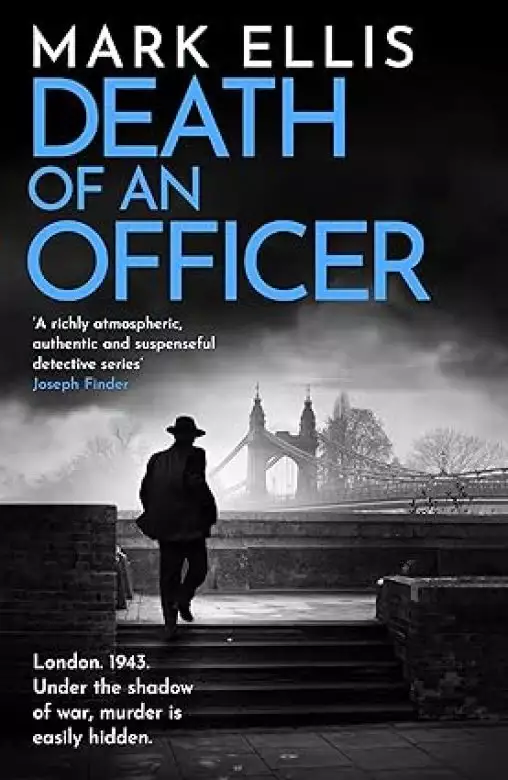
The gripping new book in the acclaimed DCI Frank Merlin series:
Praise for the DCI Frank Merlin series:
'Masterly . . . compelling . . . one of the most attractive characters to emerge in recent detective-thriller fiction' ANDREW ROBERTS, SUNDAY TIMES BESTSELLING AUTHOR
'Against the backdrop of Blitz-hit London, this stylish thriller sees Scotland Yard's Frank Merlin investigate a tangled conspiracy' SUNDAY MIRROR
'This is to my shame the first Mark Ellis book I've read. If the others evoke a vanished London so impressively, are graced with such complex plots and deep characterisation, and, above all, are written so well I shall have to read them all.'THE TIMES
'An atmospheric, compelling evocation of war-torn London in the wake of the Blitz, where DCI Frank Merlin fights against a tidal wave of crime' GEOFFREY WANSELL, Crime and Thriller Reviewer, DAILY MAIL
'Unputdownable' ROBERT LYMAN
'Mark Ellis delivers diamonds - an intriguing, masterly juggling of an intricate plot and an enviable command of detail.' JOHN LAWTON
'Extraordinarily atmospheric and compelling, DEAD IN THE WATER is a wonderfully intelligent and complex story' CHRIS LLOYD, HWA Gold Crown Award winner.
'...historical noir at its best. Mark Ellis's talents as a writer are many; finely embroidered plotting, a meticulously researched historical context and place, and rounded characters whose lives and capers become real for a reader' GARY DONNELLY
'A very satisfying puzzle, expertly crafted' HISTORICAL NOVEL SOCIETY
Release date:
May 29, 2025
Publisher:
Headline
Print pages:
384
* BingeBooks earns revenue from qualifying purchases as an Amazon Associate as well as from other retail partners.
Detective Chief Inspector Frank Merlin took the call at just after nine in the morning. Murder calls were never welcome, but this one had a small silver lining attached. It was going to get Merlin out of a sticky predicament. Assistant Commissioner Gatehouse, his boss, had been insisting that the chief inspector accompany him to a service of thanksgiving being held later that morning at St Paul’s Cathedral. The occasion was to celebrate the Eighth Army’s recent victory. On May 13th, General Montgomery had received the surrender of Rommel’s Afrika Korps at Tunis, and North Africa was now under Allied control. Merlin was naturally happy there was something to give thanks for, but detested grand formal occasions like this. He had done his best to wriggle out of going but the AC had refused to listen. ‘It’ll be wonderful, Frank. At last we’ve got something to celebrate. The King and Queen and the little princesses will be there. Winston’s away, of course, but the rest of the Cabinet will attend. Nearly all the great and the good, in fact.’ Merlin had protested that he had no wish to mix with the great and the good, but to no avail. ‘I’ve got you a ticket, Frank, a good one close to the front, and you’re coming. That’s that.’ Now a murderer was going to give him a last-minute reprieve. On his way out, he asked DC Robinson to convey his deepest apologies to the AC. ‘Tell him that sadly duty calls.’ He just managed not to smile.
There was little traffic and Merlin and Sergeant Bridges made quick time to South Kensington. Onslow Mansions was an Edwardian mansion block in a square on the borders of South Kensington and Chelsea. In the lobby was a porter’s desk, but it was unmanned. Merlin looked around and saw that a uniformed constable was waiting for them at the lift. The officer took the men from the Yard up to the fourth floor, then along a corridor. The familiar face of Inspector Jay, the senior officer at Gerald Road station, the nearest nick, greeted them at the door of number 15. A couple of other uniformed officers hovered behind.
‘Come on in, Chief Inspector, Sergeant. The forensics team have been here for a while, but I asked them not to start until you’d had a look at the scene. Thus there is need for care . . .’ Jay displayed his gloved hands.
‘Don’t worry. We are provided for.’ Sergeant Bridges took out two pairs of protective gloves from his pocket and handed one to Merlin.
The officers followed Jay into the living room.
‘Indian gentleman, I understand?’
Merlin’s question was superfluous. The room was filled with Indian tapestries, paintings, sculptures and objets d’art. On a wall to his right, he saw a portrait of an eminent-looking Indian man dressed in exotic finery.
‘The dead man?’
‘No. His father, I’ve been told.’
‘Told by whom?’
‘By the cleaning lady. A Mrs Patel. Comes five days a week. It was she who found the victim.’
‘And where is she?’
‘In the spare bedroom with one of my constables. Understandably she’s in a bit of a state, but she has been able to provide some basic information. The victim is a medical man. A surgeon. Name of Dev Sinha. Worked out of a practice in Wimpole Street. A women’s doctor, she called him.’
‘A gynaecologist?’
‘I assume that’s what she meant.’
‘I see. Let’s have a look at the body, then.’
Merlin and Bridges followed Jay out into a corridor and past the waiting forensics officers. Through the doorway of the first bedroom they came to, Merlin saw a plump middle-aged Indian woman being comforted by a young female officer. The policewoman looked up as the officers passed, and Jay said, ‘Be with you shortly, Gregson.’
The victim’s bedroom was at the end of the corridor. The room was dominated by a large curtained four-poster bed. The curtains were closed. The room showed clear signs of disruption. Two chairs had been overturned by the window and a vase lay broken on the floor nearby. The furnishings and ornaments had a decidedly more English look than those in the living room. One exception to this was the small statue of an elephant-like creature on a table on the near side of the bed. Somewhere or other Merlin had learned that the elephant-headed god of the Hindu religion was called Ganesh.
A thick white rope hung from the top canopy of the bed. Jay pulled it, and the curtains opened to reveal the victim. He was lying on his back in blood-soaked green silk pyjamas with two large gashes disfiguring his face, one across his forehead and the other along his jaw.
‘Hmm. Nasty. Do we have a murder weapon?’
Jay pointed at the elephant. The foot-high statue was bloodstained.
‘May I?’
‘Be my guest, sir.’
Merlin lifted the statue carefully off the table, then set it back down. ‘Pretty heavy for such a small thing. Jade, is it?’
‘I believe so.’
‘Was it on this table when you got here?’
‘Yes, but the cleaner said she found it there.’ He pointed to a bloody mark on the carpet about halfway along the side of the bed. ‘She picked it up and put it back in what she said was its normal position.’
‘No one else has touched it since she found the body?’
‘Not until you just now.’
‘So we should find the cleaner’s prints, and possibly those of the victim and the murderer?’
‘Yes.’
Merlin looked back at the body. The man’s eyes were open and stared blankly up at the blue and white decorative patterns of the canopy interior. His mouth had settled into an odd lopsided smile. Merlin turned away and noticed that the bedroom windows were wide open.
‘Were the windows open all night?’
‘Not like this. Mrs Patel said she opened them fully on account of the smell.’
‘Blood and dead men never smell nice, do they?’ said Bridges.
‘No, they don’t, Sergeant. Right, let’s see Mrs Patel now.’
Malcolm Trenton was woken by the sound of a curtain flapping in the summer breeze. He always liked to have fresh air in his bedroom, even in the depths of winter. He looked at his alarm clock and swore. It was past 10.30 and he’d set it for an hour earlier. The clock had been a present from Andrew. It was an expensive bejewelled thing and looked beautiful, but the alarm wasn’t loud enough. He turned to his right and realised with disappointment that his friend was not beside him. He remembered they’d had a late night at Grey’s Club in St James’s but had somehow become separated. The young American was probably in his own flat sleeping the evening off.
Trenton was an urbane man in his early fifties. Of slightly less than average height, he had sleek, silver hair, sharp features and the look of someone who was permanently amused. He had much to be amused about, as he was extremely rich, reputedly the richest MP in the Commons. He was annoyed now because he had an important Select Committee in the afternoon, and he’d wanted plenty of time to prepare for it. That time had now been curtailed.
All in all, though, he couldn’t bring himself to blame his sweet friend for his lateness. A little timetable disruption was a small price to pay for the joy that Major Andrew Corrigan brought him.
Trenton got up and made for the bathroom. On the way, he paused to put a record on the gramophone. He loved music first thing in the morning, and his good friend Fred Astaire was a particular favourite. As he stepped into the bath, he began to sing along.
‘Da da da da da da . . . I’m puttin’ on my top hat, tying’ up my white tie, brushin’ off my tails.’
As he lounged back in the water, his singing was curtailed by a disagreeable thought. Had Andrew ended up in someone else’s bed last night? Fidelity was not his strong point. However, such were the perils of being with a much younger man. He’d learned to be tolerant of his friend’s adventurous ways, but . . . He sighed and bent forward to turn off the taps. A more pleasant thought came to him. He had a dinner party at Nancy Cunard’s that night to look forward to. Her parties always went with a zing. With luck, Andrew would be free to accompany him. He reached into the water in search of the soap.
Detective Bernie Goldberg relaxed into his seat with a smile. He had only just made the train in time. If he’d missed it, he’d have had another four hours to wait, as some problem was disrupting services from the West Country. There were still many interesting sights in Bath, but he’d seen most of them on previous visits. The city had been heavily bombed a year before and was struggling to regain its equilibrium. It was as depressing as the business that had brought him to the area.
Goldberg was a tough, square-jawed New York detective who by various odd quirks of fate now held a position in the US military administration in London. In 1942, the British government had ceded to the American military police all legal jurisdiction over American troops stationed in the UK. If a US soldier killed, stole or committed any crime in Britain, only the American authorities could handle the ensuing legal proceedings. It had been anticipated, correctly, that the new arrangements might cause friction between the British police and the US military police. Goldberg had been asked to act as liaison between the two forces to try and ensure, so far as was possible, the smooth operation of the new system. Ironically, the first problematic case he had been involved in was one in which his good friend Frank Merlin had played a major part. In the end, that had been resolved satisfactorily, but there had been other cases that had been more troublesome. He had been in Bath, or more specifically Shepton Mallet, to oversee the conclusion of just such a case.
There had been a prison in Shepton Mallet, a small market town sixteen miles to the south of Bath, since just before the English Civil War. In 1942, as part of the new jurisdictional arrangements, the British authorities had handed the prison over to the Americans for the imprisonment and, when required, execution of their own people. Goldberg’s visit there on this occasion had been to witness such an execution in order to confirm to the complaining British police authority in question, Oxford, that the accused had been dispatched in as humane a way as would any prisoner in a British execution. It was all a bit silly really, as the executioner was British, a member of the infamous Pierrepoint family of executioners, so naturally it deviated not at all from a standard British hanging. The particular concern of the Oxford police arose from the fact that the condemned American prisoner was half English and had strong local ties to Oxford. It also derived from rumours that the Americans had taken to using firing squads for some executions, which the Oxford worthies thought unacceptable. Goldberg, having seen a hanging a few months before, thought he’d take being shot any time. In any event, the hanging of young Private Jimmy Snape for the killing of his shop assistant girlfriend Gladys Albright had been carried out with the customary Pierrepoint efficiency and professionalism, and he would now be able to personally vouch for that as required by General Eisenhower’s office.
He had not really had much to do other than watch, but he was exhausted by the emotional strain of the whole thing. He closed his eyes and, aided by the steady clickety-clack of the train, soon fell asleep. When he woke, he checked his watch and realised with surprise that they were only a few minutes from Paddington. Wartime trains were generally crowded, but he’d had the carriage to himself when leaving Bath. Now he saw that somewhere along the way he’d been joined by two American GIs. One of them had an Italian look about him and was noisily chewing gum. The other, a freckled, flaxen-haired fellow, said, ‘You were well away there, pal. Sweet dream, was it?’
‘I’m afraid I can’t remember.’
The soldier’s mouth opened into a broad grin, and he nudged his gum-chewing friend. ‘Hey, Angelo. The man’s one of ours. He may be dressed up all smart like a fancy Limey on his way to the office, but he’s a Yank. How about that. Where you from, pal?’
‘New York.’
‘Waddya know.’ The GI jabbed himself with a finger. ‘Philly.’ He pointed to his friend. ‘Boston.’
Goldberg didn’t really want to get into a conversation with the two soldiers but felt obliged to contribute something. ‘I’m Bernie.’
‘Artie. And as you’ll already have heard, this lunkhead on my left is Angelo. So how come you’re over here, Bernie, and not in uniform like us?’
‘I work in London for the American military administration.’
‘Wow. Sounds fancy. I guess you’re not in a position to say what you do exactly?’
‘No more than are you to give me details of your posting.’
‘Hah. Well, I guess I’m not breaking the Secrets Act if I tell you we’re just being sent from one shitty country camp in the west of England to another shitty country camp in the east.’
‘The English countryside can be very beautiful.’
‘You can shove the countryside. Angelo and I are city birds. The only good thing about this new camp we’re going to is that it’s within striking distance of London. An hour or so on the train, they tell me.’
Angelo finally ditched his chewing gum somewhere under his seat and said excitedly, ‘Yeah. We want to see some nice girls. Where we were, the cows were the most attractive things around.’
‘Well there’s fun to be had in London, of course. Just take care you don’t get fleeced. There are plenty of crooks around. For English criminals, the war is nothing more than a glorious business opportunity.’
The arrival of the train into the station brought a natural end to the conversation. Goldberg wished the men luck and left the carriage as they were unloading their heavy kit from the racks above. As he walked down the corridor, he could still hear them excitedly anticipating the pleasure palaces of London. Another couple of innocents for the Maltese vice kings of the city to eat up.
Jay called Constable Gregson out of the bedroom to ask her whether she thought the cleaner was up to further questioning.
‘The tears have stopped for now at least, so yes, sir, I think you’re all right to give it a go.’
The cleaner gave her name as Mrs Bina Patel. She had heavy lines beneath her eyes and thick streaks of grey coursing through her untidy hair. She looked to Merlin to be in her mid to late fifties.
Save for Gregson, who resumed her position beside the woman on the bed, the officers remained standing.
‘So, Mrs Patel. Could you please tell me what happened this morning?’ asked Merlin.
‘I already tell other police here.’
‘Forgive me, but I’d appreciate it if you could manage to do it one more time for me and Sergeant Bridges here.’
The woman sighed. ‘So I arrive as normal today at eight o’clock. Came in. Started my work. Did not think anyone in apartment. No noise. Doctor at work, I thought. Cleaned kitchen. Remember this week bed sheets need changing. Had to go in doctor’s bedroom. Went in. Saw poor doctor. Terrible. Terrible. I scream. Had to sit down for while because of shock. Then I manage to make call to police.’ She looked away. Merlin could see tears welling again in her eyes. ‘Can say no more.’
‘You saw something on the carpet, did you not?’
‘Yes. Ganesh. Covered in blood. Terrible. I put back on table. Sorry. I suppose I should not have done.’
‘Not to worry. You opened the windows, too?’
‘Bedroom windows a little open. I open wide. This after I call police. Living-room windows closed but I open them too. Funny smell.’
‘What sort of smell? Blood?’
‘I can’t say. Just . . . just funny smell.’
‘Do you know whether the doctor received any guests last night?’
‘I don’t keep doctor’s diary, sir.’
‘No, but there are usually signs . . .’
‘In kitchen it look like only doctor eat. In main room two glasses. Smell of spirit. Ashtray full of ash. Doctor drink and smoke too much.’
‘Did you wash the glasses?’
‘Yes, when I came in first.’
‘Damn. And the ash?’
‘No, was about to take ashtrays to kitchen then remembered need to change sheets.’
Merlin looked at Jay, who left the room to make sure the full ashtrays were preserved.
‘What was Dr Sinha’s domestic situation? Was he a single man?’
‘No. He married.’
‘And where is his wife?’
Mrs Patel frowned, then slowly tapped her forehead with her forefinger. ‘She not right in head. In hospital long time.’
‘I’m sorry to hear that. Any idea which hospital?’
‘In country somewhere outside London. I don’t know address. He visit sometimes.’
‘What about children, Mrs Patel?’
‘In India. Two sons. Doctor very proud. Have jobs in Civil Service. Very clever boys.’
‘I see. And did . . . did Dr Sinha have any particular friends?’
Mrs Patel pursed her lips. ‘Doctor very respected man. He have many medical friends, Indian friends, English friends.
‘What about . . . lady friends?’
She gave Merlin a prim look. ‘Doctor have no female friends. He married man.’
‘He had no female friendships at all? Not even with wives of friends or colleagues?’
The cleaner’s face softened a little. ‘Yes, perhaps he friends with one or two of them. But no female friends in way I think you mean. Have heard him say many times he loyal husband to Gita until death.’
‘Very admirable.’ Merlin took a moment to look round the room. It was simply furnished and bare of ornaments or pictures, unlike the other rooms. ‘I wonder, Mrs Patel, have you had a chance to notice whether any items of value have gone missing?’
She shook her head. Merlin looked at Gregson. ‘Perhaps, Constable, you could go on a little tour of the flat with Mrs Patel before we let her go. Just to check.’
There was a knock at the door. ‘All right for us to make a start now, Chief Inspector?’ asked one of the forensics men. He was a new face to Merlin.
‘Yes, please commence.’ Merlin turned back to Mrs Patel. ‘Thank you very much. We may have some more questions for you, so I’d appreciate it if you could give your details to the constable here before you leave.’
Detective Inspector Peter Johnson was waiting back at the Yard. Merlin had put the inspector in charge of the major kidnapping case that had been occupying his team for the previous few weeks. The kidnapping in question, which had taken place in March, had ultimately failed thanks to the escape of the resourceful victim, a City banker’s son. The issue now was the apprehension of the culprits. There’d been a number of anonymous tip-offs to the Yard. The first, soon after the victim’s escape, had provided them with three names: Barry Briggs, William Lynch and Richie Marsh. The first two were old lags, the latter a youngster. All were known to the Met as associates of Jakey Solomon, one of the capital’s pre-eminent gangsters. A second call had told them that the men had escaped to the Republic of Ireland. Then a more recent call had said the men were back in London and could be found at an address in Bethnal Green. Johnson had carried out a raid in the early hours of the previous day, but the house had been empty.’
‘You’ve heard we’ve got a new murder on our hands, Peter?’
‘I have, sir.’
As Merlin sat at his desk, he caught a brief glimpse of himself in the mirror on the wall opposite. He wondered whether he really was ageing as well as his young wife, Sonia, told him. He was approaching his mid forties, tall, with dark Latin features thanks to his Spanish father. Bright green eyes sat above an aquiline nose, and his full head of jet-black hair was now speckled with the odd bit of grey. He returned to the moment.
‘I’ll tell you about it in a sec, but first, any luck with the Irish Embassy?
‘Bugger all, sir, excuse my French. Whether or not those men have been in Ireland at any point, it’s clear the Irish authorities don’t give a damn.’
Johnson was from Newcastle, and Merlin had always enjoyed the sound of his lilting Geordie accent.
‘I became very firm with them, sir, but nothing doing. Someone must have put the kibosh on any kind of cooperation.’
‘Well, the establishment over there hate us, don’t they, particularly the Irish prime minister. In the unlikely event Hitler wins the war, de Valera will probably be his first state visitor.’
‘There are a lot of Irishmen fighting in the British army, sir,’ said Bridges.
‘So there are, and thank God for them. But the Irish establishment is a very different kettle of fish to the ordinary Irishman in the street. Well, there it is. I’m guessing we’ve received no more anonymous calls?’
‘We haven’t.’
‘Billy Hill’s men are getting tired of the game, I suppose.’ Hill was one of Jakey Solomon’s main competitors in London’s booming gangland, and Merlin strongly suspected him of being the source of the tip-offs. ‘Let’s update and reissue all the wanted notices just in case these men are still at large in this country.’
Merlin popped an Everton mint into his mouth. He’d once been addicted to the powerful lozenges known as Fishermen’s Friends, but Sonia hated the strong eucalyptus smell and had weaned him off them. ‘So . . .’ he leaned forward over the desk, ‘let me tell you about the new case.’
After he’d heard Merlin out, Johnson stroked his upper lip thoughtfully. A few years back, he had sported a neat little moustache that his wife thought made him look like Ronald Colman, one of her favourite actors. The AC, however, had seen more of a resemblance to Adolf Hitler, and had insisted on the item’s removal. Merlin suspected the inspector missed it still.
‘I suppose, sir, that the use of a bedroom ornament in the murder might suggest a lack of premeditation.’
‘So it might.’
‘It would obviously be very helpful if they could pull some third-party prints off that statue.’ Johnson’s finger returned again to his upper lip. ‘I presume you’re not considering the cleaning lady as a suspect?’
‘A most unlikely murderess, I think, though I suppose we’ve seen stranger things over the years. My initial thinking is a violent act by a visitor. Mrs Patel says the bedroom windows were partially open before she opened them wide, but I think the money is on the front door being the point of entry. If that’s the case, it seems likely Sinha knew his killer. Whether the killer had murderous intent to start with or not, when it came to the deed, I think he must have improvised as regards the weapon.’
‘Has it occurred to you, sir, that there can’t be many senior London medical men of, er . . . of Mr Sinha’s background?’
‘You mean Indians?’
‘Yes. He must have had to battle against considerable prejudice to make his way. Perhaps in the process he acquired some enemies?’
‘You mean someone might have lost out on promotion to him and bashed his head in out of resentment?’
‘One of many possibilities, I should think. I presume your first visit will be to the man’s place of work?’
‘Going tomorrow. Inspector Jay rang the surgery, and the receptionist he spoke to broke down. I’m going to let them have the evening to get over the shock.’
Richie Marsh had landed on his feet, of that there was no doubt. Until the previous day, he’d been in a bad way. After getting back from Ireland, he’d quickly ditched Briggs and Lynch and shacked up with an old girlfriend in Willesden. However, she’d tossed him out two days later after finding him rifling through her purse. In normal circumstances he’d have gone to stay with his gran, but the police were bound to look there first. Solomon too, as he was no doubt angry that Marsh had gone rogue and not returned to Ireland as asked. He’d had to sleep rough a few nights, then done a bit of pickpocketing and stolen enough to stay in a doss house. But things had been looking bleak when he’d popped into a pub in Soho to spend his few remaining coins on a pint of beer. It was here that his luck had turned. He’d met an old friend from his Clerkenwell childhood. Steven Abbott was his name. He’d grown and filled out a little since last they’d met. Now he was a tall, good-looking young man with a passing resemblance to the actor Stewart Granger, and the suit he was wearing was clearly not a cheap one. They’d been good friends as kids, playing truant, stealing, getting into fights and establishing a reputation as hard cases. Marsh had lost his father and Abbott’s dad was a hopeless drunk, so there was little or no discipline at home. Abbott was a couple of years older than Marsh, and when he was sixteen he’d been sent to relatives in the country to work on a farm. That was when they’d lost touch. Now, despite six or seven years having passed, they’d recognised each other almost instantly. Abbott had quickly realised that his friend was on his uppers and had ordered some food to accompany the drinks he’d just paid for. He’d also offered to put Marsh up for a few days.
They’d gone to a swish flat in Pimlico, which Abbott had said was his for a while. It was then that he’d told Marsh the source of his funds. ‘Sell myself to rich men, don’t I?’ he’d said. ‘And no need to look like that, Richie. How the hell d’you think I ended up in a gaff like this. My old fella used to fiddle with me, didn’t he, and I got . . . oh, what’s that fancy word . . . yes, I got inured to it. I got back to London after a year or two on that stupid farm and went on the streets. Quickly realised I could make a good living.’
Marsh had been shocked at first, but soon got his head round it. If his friend was prepared to share a bit of his expensive lifestyle with him, who was he to complain? However, when Abbott had suggested that Marsh might go on the game with him, he’d said a firm no. Abbott had accepted his refusal with good grace and they’d gone off to a local pub for more drinks. There Abbott had explained that the flat was owned by a rich mark of his who wanted him to be available on an exclusive basis. The mark lived a long way outside London, though, and when he was not around, as was the case now, Abbott had no intention of living up to the arrangement.
At around 9 p.m., Abbott had announced that it was time for him to go to work. They’d gone back to the flat and he had changed his clothes and generally spruced himself up. Before heading out, he’d left Marsh a spare key and told him he’d mention to the porters that he had a guest staying for a few days.
Now Marsh was sitting in the kitchen sipping a cup of tea and revelling in his comfortable new circumstances. The only worry he had was that it was past three in the afternoon and Abbott had not yet returned from his night out.
He got up from the kitchen table and walked over to the mirror. Although he had Latin blood in him, it didn’t show in his face. Like his father, he had mousy-coloured hair and a fair complexion. His recent experiences had given him a gaunt look, but he was happy to see that a couple of square meals and a good night’s sleep had made him look more human. He’d not been able to shave for a few days, though. No doubt there was a razor in Abbott’s bathroom. He looked at the stubble above his lip and had a sudden thought. It might be a good idea for him to grow a moustache to cloud the identification issue for the police pursuing him. He’d let hi. . .
We hope you are enjoying the book so far. To continue reading...

 Please log in to recommend or discuss...
