A theatrical murder sends classical Athens into an uproar
Athens, 459 BC: It’s the time of the Great Dionysia, the largest arts festival of the ancient world, held each year in honor of Dionysos, the god of wine. But there’s a problem: A ghost is haunting Athens’s grand theater. Nicolaos and the priestess Diotima, his clever partner in sleuthing (and now in matrimony), are hired to exorcise the ghost, but secretly suspect that a human saboteur is operating behind the scenes.
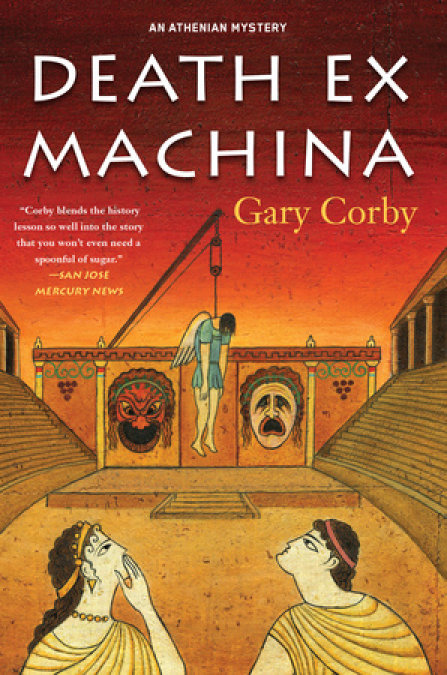
Then one of the actors is found hanged from the machine used to carry actors through the air when they play the part of gods. It’s quite a theatrical murder. As Nico and Diotima dig into the actor’s past, they discover enough suspects to fill a theater. As the festival approaches and pressure mounts on all sides, can they hunt down the killer in time? Or will they simply have to hope for a deus ex machina?
Release date:
May 19, 2015
Publisher:
Soho Crime
Print pages:
336
* BingeBooks earns revenue from qualifying purchases as an Amazon Associate as well as from other retail partners.
In my time as an investigator I had received many difficult assignments, problems that were usually dangerous, often deadly, and sometimes downright impossible. But no one before had ever asked me to arrest a ghost. “You can’t be serious, Pericles,” I said. “Of course I’m not,” he replied. He sounded exasperated. “But unfortunately for both of us, the actors are completely serious.” “What actors?” I asked. “The ghost is in the Theater of Dionysos,” Pericles said. “The actors refuse to enter the theater until the ghost is gone.” “Oh,” I said, and then, after I’d thought about it, “Oh dear.” The timing couldn’t be worse, because the Great Dionysia was about to begin. The Dionysia was the largest and most important arts festival in the world. Thousands of people were flocking into Athens. They came from every corner of civilization: from the city states of Greece, from Egypt and Crete and Phoenicea and Sicily, from Ionia and Phrygia. All these people came to hear the choral performances and to see the plays: the comedies and the tragedies. Most of all they came for the tragedies. Every city has fine singers. Every city has comics who can make you laugh. But only Athens, the greatest city in all the world, has tragedy. “The producers have ordered the actors back to work,” Pericles said. “The playwrights have begged them, even I have spoken to them, but the actors say they fear for their lives.” He wiped the sweat from his brow as he spoke. Pericles had hailed me in the middle of the agora, which at this time of the morning was always crowded. He had called me by my name, so loudly that every man, woman, and child in the marketplace had turned to look. Then Pericles had lifted the skirt of his ankle length chiton and in full view of the people had run like a woman, leaping over jars of oil for sale and dodging around laden shoppers, all to speak with me. That alone told me how serious the situation was. Pericles prided himself on his statesman-like demeanor. It was part of the public image he courted as the most powerful man in Athens. It was easy to see why Pericles was worried. If the actors refused to rehearse, they would put on poor performances. We would look like idiots before the rest of the civilized world. Or worse, the actors wouldn’t be able to perform at all. The festival was in honor of the god Dionysos, who in addition to wine and parties was also the god of the harvest. If we failed to honor the god as was his due, then there was no telling what might happen to the crops. The people might starve if Dionysos sent us a poor year. There was no doubt about it. The actors had to be induced to return to work. Pericles said, “What I want you to do, Nicolaos, is make a show of investigating this ghost. Do whatever it is you do when you investigate a crime. Then do something—anything—to make the actors think you’ve captured the ghost.” “How do you get a ghost out of a theater?” I asked. “How in Hades should I know?” Pericles said. “That’s your job.” I couldn’t recall placing a “Ghosts Expelled” sign outside my door. “Surely there must be someone who can do this better than me,” I said. “You’re the only agent in Athens, Nicolaos,” Pericles said in persuasive tones. “The only one who’ll investigate and then tell the people that the ghost is gone.” Which was true. Though there were plenty of thugs for hire, and mercenaries looking for work, I was the only man in Athens who took commissions to solve serious problems. I pointed out this commission aspect to Pericles. “You may consider this a commission,” Pericles said, through gritted teeth. He hated spending money. The promise of pay put another complexion on it. When Pericles had waylaid me I had been on my way to see to my wife’s property. My wife, Diotima, owned a house on the other side of the city, one in a sad state of disrepair. Repairs cost money. Money I didn’t have. I still didn’t think I was the man for the job. Yet I reasoned it must be possible to remove a ghost, assuming such things even existed. Otherwise our public buildings would be full of them, considering how many centuries the city had stood. Expelling a ghost might prove difficult, but it certainly wasn’t dangerous, deadly, or downright impossible. I made an easy decision. “Then I shall rid the theater of this ghost,” I promised Pericles.
Scene 2 THE PSYCHE OF THE GREAT DIONYSIA
The case was urgent. I abandoned my plan to see to repairs and turned around. I had no idea about ghosts, but I knew someone who would. I went home to ask my wife. I found Diotima in our courtyard. She reclined on a couch, with a bowl of olives and a glass of watered wine by her side. My little brother, Socrates, stood before her, reciting his lessons. Socrates had been expelled from school the year before, for the crime of asking too many questions. Ever since then, Diotima had been his teacher. The arrangement had worked surprisingly well. I interrupted the lesson to deliver my news. “There’s no such thing as ghosts,” Diotima said the moment I finished speaking. She paused, before she added thoughtfully, “Of course, there might be a psyche haunting the theater.” “Is there a difference, Diotima, between psyches and ghosts?” Socrates asked. He’d listened in, of course. I’d long ago given up any hope of keeping my fifteen-year-old brother out of my affairs. “There’s a big difference, Socrates,” Diotima said. “Everybody has a psyche. It’s your spirit, the part of you that descends to Hades when you die. Ghosts on the other hand are evil spirits that have never been people. The religion of the Persians has evil spirits that they call daevas. I think the Egyptians have evil spirits too. But we Hellenes don’t credit such things.” “Then the actors might have seen a psyche?” Socrates said. Diotima frowned. “I hope not. If a body hasn’t been given a proper burial then its psyche will linger on earth. It should never happen, but sometimes it does.” She turned to me. “Nico, are there any dead bodies lying about the theater?” “I like to think someone would have mentioned it if there were,” I said. “If there’s a body, we’ll have to deal with it, but there’s another possibility.” “What’s that?” Diotima asked. “That the actors are imagining things.” I helped
We hope you are enjoying the book so far. To continue reading...

 Please log in to recommend or discuss...
