
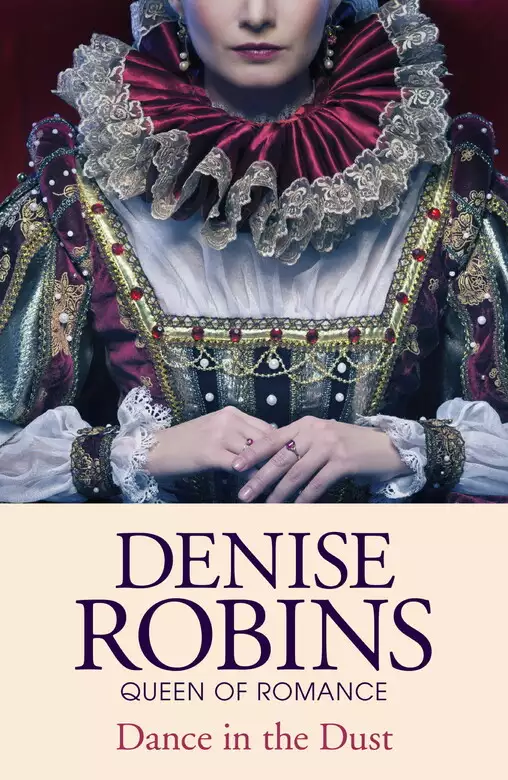
Dance in the Dust
- eBook
- Paperback
- Audiobook
- Book info
- Sample
- Media
- Author updates
- Lists
Synopsis
Set in the reign of Queen Anne, this is the bold yet touching story of Magda, a young girl partially disfigured by a childhood riding accident who grows to an otherwise beautiful womanhood. Her savage stepfather Sir Adam Congrayle tricks handsome young Esmond, Earl of Mornbury, into marriage with Magda without first allowing them to meet. And the night of the wedding, when Esmond sees Magda for the first time, brings its inevitable crisis…
Release date: October 17, 2013
Publisher: Hodder & Stoughton
Print pages: 176
* BingeBooks earns revenue from qualifying purchases as an Amazon Associate as well as from other retail partners.
Reader buzz
 Please log in to recommend or discuss...
Author updates
Dance in the Dust
Denise Robins
“Wilkins! Where the devil are you?”
Thomas Wilkins, his valet, came running into the dark vast bedchamber. Thick brocade curtains were still drawn across the windows. Contrary to all Mr. Wilkins’s beliefs and wishes, these windows were wide open. His young lordship was partial to the night air, which had been thought by his illustrious father and grandfather to hold poisons that could easily bubble in the lungs and chest and set up a hacking and often fatal cough.
Wilkins had orders to leave the windows all open. He shuddered as he did so. It was a habit which, the valet had recently reflected, no doubt milord would change when he was married. (Which, in fact, was to be this very morning.) And mighty pleased was the old and devoted Wilkins, who considered that his lordship had stayed far too long a bachelor. He was now twenty-five and most of his friends and contemporaries had already steered the boat of reckless youth into the safe still waters of the matrimonial harbour. Whereas young Lord Esmond, until he met the Lady Dorothea of Shaftley three months ago, had been confirmed in his bachelor habits. He was in London during the greater part of the year, sporting with friends of whom Wilkins was sure his late lordship would have disapproved. Too much drinking and card playing. Too many late nights. They could play havoc with a young man. Mornbury returned frequently to this beautiful spacious house—built fifty years ago and recently modernized in the present elegant tradition of architecture—looking pale and weary. Lines of dissipation were already beginning to mar the perfection of a face that had been called the handsomest in England. It was lucky, in the opinion of his old valet and confidential servant, that my lord was as strong as an ox and had, therefore, a constitution to stand up to all the debauchery.
He was a godson of Anne the Queen, who was a good pious woman and did not like her courtiers to indulge themselves freely. She had sent a mild reproof to Esmond after one scandalous party which he had held in his residence in St. James’s.
Queen Anne was an invalid. Dropsy and gout threatened her and she held Court as rarely as her royal predecessor, King William. But when she was not cloistered at Hampton Court or in Bath with her bosom friend and confidante, lady of the bedchamber, Sarah Churchill, she was lending an ear to the counsel of her ministers and flattening any attempts by her subjects to give way to irreligious or licentious living. It was known that Esmond’s father had been one of Her Majesty’s favourites, which was why she had consented to sponsor Esmond. She was, usually, tolerant of his peccadilloes. But it had been by command of his royal godparent that Esmond had reluctantly turned his thoughts to marriage. Anne considered that he had spent enough time in the card-rooms and coffee house and among loose-living women. He had been ordered to get himself a wife. Loath though he was to obey his queen, it had been lucky for Esmond that at that precise time the Lady Dorothea Bridges, only daughter of the Earl of Shaftley, came into his life.
This was to be the end of his bachelor days. To-night, mused Wilkins, a dainty and fastidious lady would lie in meek and modest slumber at her lord and master’s side.
Wilkins prayed that Lady Dorothea would have the same good influence over his lordshop that the late countess of Mornbury used to have.
Esmond had loved his mother, and for long after she died, had been inconsolable. There were several portraits of her here. One hung over the carved stone mantelpiece in Esmond’s bedchamber. It showed Catherine Mornbury in a low-cut velvet dress with a deep lace collar, sitting with Esmond, himself, curled at her feet. He was then at the age of ten. Mother and son both had the same bright colouring, the polished chestnut hair in long silky ringlets, the proud nose, the curled upper lip and fine, somewhat aquiline nose. It was said that Esmond bore little resemblance to his short and stockily-built father who had not been long in following his young wife to the grave, a victim of the dropsy. After this, Esmond had been cared for by his aunt and uncle, Sir Arthur and Lady Rokeley.
Mornbury Hall had ceased to be a happy home once the Rokeleys were installed, for Esmond, when adolescent, found that his tastes and beliefs, both political and religious, clashed with those of his aunt and uncle.
Four years ago when Esmond came of age, he courteously but firmly suggested that his guardians should return to their own home in Lincolnshire. He then flung himself into the joys of freedom.
There were times when old Wilkins, who knew and loved his young master so well, blamed the Rokeleys for the young Earl’s subsequent behaviour. They had been too harsh. Once the leash had been snapped the young man had broken out. But the whole household at Mornbury delighted in the knowledge that there was to be a mistress here soon, worthy to succeed the departed Countess. Angelic, but not uncomfortably so. When Dorothea last came here with her parents to visit her betrothed husband, the late Lady Mornbury’s drawing-room had been opened up, and once again the strain of music had been heard in the Hall. The Lady Dorothea played the spinnet and the servants had heard her singing. It would be good to hear a feminine voice and feel the feminine touch once more at Mornbury.
Esmond rubbed his eyes and glowered at the old servant, who, in black, with white necktie and thin spindly legs, stood there beside the bed. Poor old Wilkins; he must be every year of seventy. Wilkins had long and faithfully served his family. In certain moods Esmond could be impatient and exacting, but he considered it ungentlemanly to behave badly to an inferior. But to his own social equals he could be quite ruthless. Few cared to offend or pick a quarrel easily with Esmond Mombury. He was as fine a shot as any man in the country—and as dexterous with a sword.
“Your lordship requires his breakfast?” asked Wilkins in his somewhat high and quavering voice, while he continued to regard his master nervously out of eyes which were milky-blue; filmed by approaching cataract.
“I shall ride, first,” said Esmond.
“Ride!” repeated Wilkins. “Milord! On the morning of your marriage?”
“Yes, you old dolt; get ready my boots and clothes. First bring me a tankard of ale. My throat is as dry as a dusting brush. Don’t stand there gaping like a codfish!”
“Yes, milord. No, milord.”
Esmond leaped from the bed, peeled off his embroidered night shirt and wrapped his naked body in a silk bedgown, yawning prodigiously as he did so, scratching his cropped head. He was a fine figure, thought the loyal old servant, standing six foot two on his bare feet, with a goodly width of shoulders and a slim line of flank. He had the shapeliest of legs. He had never known a day’s illness nor been cupped by a physician. He bore only one small scar where his smooth boy’s cheek had been laid open by a sword-point in a duel—the only mark to spoil his physical perfection. Handsome Horace, the old earl his grandfather had been named, and Esmond resembled him.
All his friends from Oxford, or London, or from this district wherein he had lived all his life had gathered to wish him joy of his forthcoming marriage. Many of them were here still, sleeping under his roof and would attend the wedding to-day. His great friend, Archibald St. John, was here too. Archie, who had been at University with Esmond and shared a few of his outrageous adventures. The Foreign Office was sending Archie at the end of the week to Edinburgh on Her Majesty’s business. This year had seen the final union between England and Scotland and removed trading restrictions between the two countries. Archie would have work to do there for the Government. He was a charming, amusing fellow after Esmond’s own heart, but more practical than the young Earl himself.
Archie approved of Dorothea, and Esmond gave thanks now that the ball to which he had been invited, and which celebrated the eighteenth birthday of Lord Shaftley’s only daughter, Dorothea, had been the only one he had attended this year.
He had gone to that dance reluctantly knowing it was his royal godmother’s wish. At last he was being forced to inspect the marriage market in English High Society; not dreaming that he would meet his fate within twenty-four hours of the letter which had reached him from the Queen. Then, suddenly he had danced with the Lady Dorothea—and was lost.
Hitherto he had known her as a child, of whom he had taken little notice when she came his way; which was rarely. He had heard that she was now grown to young womanhood and of an excessively pleasant disposition and reputed to have looks as well as talents. But he had heard also that she was delicate. She had had fainting fits since she was in her teens. He could not bear delicate females with their swooning, and their attendants shrieking for burnt feathers and vinegar. The women whom so far Esmond Mornbury had chosen to take to his bed were strong handsome creatures who could respond to a man’s passion and make him feel that he held flesh and blood in his arms.
Nevertheless, when he bent over Dorothea’s little hand and led her on to the floor in the Quadrille he knew that the die was cast and that his fate was sealed. He had never seen anything more ravishing than Dorothea Bridges. When he had kissed her hand and looked into her glorious eyes as he thanked her for the dance, his brain had reeled with the possibilities of taking to himself such an innocent and unblemished bride. Dorothea was one whom the Queen would approve—the Countess of Shaftley had, until recently, been a lady-in-waiting at St. James’s.
That night Esmond knew that Dorothea was the one for whom he had been seeking.
He went home, madly in love for the first time in his life.
To-day, Esmond felt, Mornbury would be restored to the joy and promise of life that used to flood the place when his parents were alive. The splendid, exciting hour was fast approaching when he would carry his bride over the threshold.
This morning, while Esmond waited for the grooms to saddle Jess, he walked from the stables, strolled across a lawn that was like emerald satin silvered by dew and stood a moment looking at his home with pride, as he had done so many times in the past.
The early sun was slanting across the fine brick and stone house with the handsome side wings that had been added on to it. The open colonnades lent an unusual dignity. From the terrace wide steps led down to a square court in which stood a great basin. Out of this rose the statue of a man, astride a horse. Sculptured in grey stone, grown green with age, this was a remarkably magnificent figure of a rider with head flung back and arms outstretched as though exulting in the life and vigour of his mount. Gushing from the animal’s mouth a sparkling spray of water fell into the basin with a musical sound. All his life Esmond had loved that fountain. As a small boy he had once escaped the notice of his nurses, fallen into the basin and nearly drowned, but he continued to love it.
Part of the old house was concealed by thick flowering creeper which Esmond had a mind to cut down, for he preferred the plain stonework. The library, with Esmond’s own private suite of rooms above it, lay in the right wing. He enjoyed the magnificent sight of the beautiful wrought-iron work which had been spun like a web of black lace right across the pale stone walls. Wren had designed it. New, also was the splendid door with fluted columns on either side, and graceful fanlight overhead. Nothing delighted Esmond more than these additions to his home, masterpieces of an acknowledged genius of modern architecture.
Turning his back to the house, he looked now at the beautiful double row of lime-trees and green clipped bays in large tubs. Pale rose-bricked walls flanked the formal flower gardens. To the right, a handsome park full of gentle, spotted deer. Beyond was the heavily wooded forest on the extreme borders of Surrey and Sussex.
The Mornbury Estate was rich and fertile. The meadows were full of cattle, providing meat and milk and cream for the owner. In the kitchen gardens the finest fruits and the sweetest herbs awaited the pleasure of a new mistress and housekeeper! Too long, thought Esmond, the simple delights of his ancestral home had lain unappreciated. It was, indeed, time that somebody stepped into his mother’s shoes; and who better than his beloved Dorothea?
A sudden thrill gripped him at the thought of the sons that Dorothea would bear him, and who would inherit Mornbury after he was dead.
To the devil with last night’s carousing, he thought, and hurried back to the stables where the men held the head of his fine spirited grey.
He mounted and barely touched Jess’s satin neck with his crop. The familiar touch thrilled the mare with a joy to match his own. Her hoofs struck fire against the flagged stones of the stable yard. In a moment the rider was away, out of the gates and on the rough road. Esmond, bridegroom of the future, was at a gallop, speeding through the still-sleeping village of Godchester along the banks of the river; which was his favourite ride.
THE YOUNG EARL returned from that early morning ride with his ills sweated out of him, and in high spirits. As the grooms came running to meet him, he had a story ready to tell them of a fox he had seen slinking out of Rushhurst Spinney and how he had chased it for half a mile before it took cover again. But the story died on his lips, for he saw, following the grooms, the figures of several of his friends who were wedding guests at Mornbury. He did not expect them to be up so early. Among them was the tall, slight figure of his best friend—Archibald St. John. Esmond looked slightly puzzled as he dismounted. None of the men appeared to be dressed, but were in their various négligés. Archie, alone, seemed to have dressed more fully than the others, for he wore breeches and a powdering jacket. It looked as though he had hastily put on peruke and powder before coming downstairs.
“What is this?” exclaimed Esmond gaily. “A special deputation to greet me on my marriage morning?”
“My dear Esmond. My dear Esmond …” began St. John and stopped as though the words stuck in his throat.
Of a sudden, Mornbury sensed catastrophe.
“What has happened, Archie?” he asked in a low quick voice. “Have you bad news for me?”
St. John bowed his head.
“Out with it. Enough of this hesitance.”
Esmond had noticed several of his servants gathered in the court-yard. They were whispering, one to the other. A premonition of the truth—an appalling truth—gripped Esmond by the throat.
“Oh, God,” he muttered, “is it Dorothea?”
St. John bowed his head. “A youth has just ridden over from the Castle to say that she has been taken gravely ill, and that there can be no marriage ceremony today.”
To himself St. John might have added the words or any other day but dared not. He knew his friend too well; that mercurial and often violent disposition behind the façade of sunny charm. Esmond would not be one to take bad news well.
“We grieve for you, Esmond,” spoke up one of the young men behind St. John. He spoke ill-advisedly, for Mornbury turned on him like a wounded lion.
“Grieve for me—pray why, Liftborough? Is my lady dead that you speak thus to me?”
No answer. Esmond had started to shake, and the sweat ran down his face, a waxen colour under the burn of the sun. Then without a word he turned, grabbed Jess’s bridle out of the hands of an open-mouthed groom and swung himself into the saddle. He was away again out of the court-yard and through the gates.
The black rooks were circling and cawing noisily around the tall elms. Never had the countryside looked more glorious. Never had Esmond, fifth Earl of Mornbury, known a more deadly fear than that which rode with him during that five-mile gallop on Jess to Shaftley Castle.
“Dorothea!” he kept crying aloud that cherished name. “Dorothea, Heaven grant you are yet alive.”
But he knew when he reached the Castle that his frantic prayer remained unanswered and that she was dead. For as he came to Shaftley a superstitious horror seized him. With bloodshot eyes he looked at the Castle. It stood on the top of the hill. Usually it was a fair sight; built in 1100 during the reign of King Stephen for one of the first barons of Shaftley, it could be seen for miles around. Esmond had often climbed to the battlements with his Dorothea and looked upon the fair Sussex Weald as far as Chanctonbury Ring on one side and the Guildford hills on the other. But this morning, when all else seemed golden and clear, Shaftley was partially obscured by a thick whitish mist which seemed to Esmond to curl maliciously around those dove-grey walls.
Only a few moments more, and Esmond was within the Castle. Two footmen opened the heavy doors to admit him. The Earl—a tall stooping grey-haired man clothed in dark grey, relieved only by the white Steinkirk at his neck, greeted him.
Esmond could see that the usually upright man, not yet fifty, had become quite old and quavered in his speech.
“How is she, Sir?” Esmond demanded hoarsely.
Lord Shaftley bowed his head.
“Dorothea will be bride only to Christ her Lord, into whose merciful arms she has been gathered,” he said brokenly.
Esmond neither moved nor spoke. Dorothea’s father added: “Her lady mother lies in her bedchamber, too sick to move or speak with you. I, myself, shall conduct you to the chapel to our darling’s bier, that you may take your last fond look at her.”
“What happened, Sir?”
“Dorothea rose at daybreak and called for her maid, and bade her send for us, for she had a foul pain in her heart. Before we could reach her, Esmond, that loving heart had failed.”
“Failed,” repeated Esmond, hoarsely.
“Yes,” said the Earl unashamedly sobbing now, “you know that Dorothea has been subject to fainting fits which our physician assured us were signals of a childish bloodlessness which would improve. But they were wrong. We have all been wrong. That beautiful and gentle flower should never have been allowed to take a step, or to strain her feeble heart with dancing or moving about with h. . .
We hope you are enjoying the book so far. To continue reading...
