THE #1 BESTSELLING DARK ROMANTASY LEAVING READERS WORLDWIDE IN TEARS.
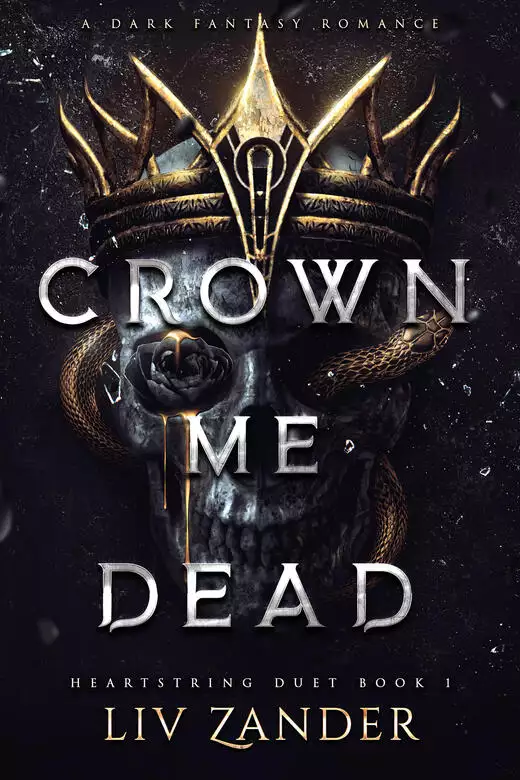
Wed me. Bed me. Slit my throat.
Born in dirt, raised in rot, I dig graves for the dead, while the living decay around me. When my brother coughs blood, he appears. A man too polished for the graveyard, with a bargain too cruel for the light: Seduce the King. Become the Queen. Die. And my brother lives.
Kael is a nightmare of living ruin, the rotting ruler of a festering realm. And Vale is his shadow, the cold architect of my demise. One man needs my heart to beat. The other plans to stop it forever. They think I’m a pawn. But I’m the gravedigger's daughter. And I know exactly where to bury them.
Welcome to the funeral.
Darkly seductive, beautifully written, and deeply emotional, the Heartstring Duet will sweep you away into a world of forbidden desire, deadly intrigue, shocking twists, and impossible choices.
**Crown Me Dead is book one of two in the completed dark fantasy romance Heartstring Duet. Don't miss book two, Crown Me Yours. The world contains deception, mystery, violence, dark elements, and mature content. What this book doesn’t contain is a hero (because villains do it better). You can find more detailed information at Liv Zander's website.**
Release date:
July 29, 2026
Publisher:
Requited
Print pages:
320
* BingeBooks earns revenue from qualifying purchases as an Amazon Associate as well as from other retail partners.
We wrap the dead with our hands steady and our mouths shut, because the living moan and scream enough for everyone.
Mother and I lift the old man from his pallet. Daron holds the oil lamp in the crook of his arm, his walnut hair mussed from a restless night, pretending he isn’t missing the tip of his ring finger. Pretending, because that’s how we like to lie to ourselves—if you don’t look at rot, then rot can’t find you.
It always does.
“He’s light,” I say, just to cut the silence, dragging my shoulder over that long, brown strand of mine that keeps clinging to my sweaty temple. “Either he starved, or the worms were greedy.”
“Quiet, Elara,” Mother mutters, but her dark eyes flicker with the shadow of a smile. Grayed, tired, still beautiful in the lamplight. Her wrinkles soften in the orange glow. She shoulders under the corpse’s ribs. “Legs.”
“I’ve got them.”
The legs are mottled purple and black, marbled like spoiled meat. I carry the weight onto the table, careful not to jostle the man’s jaw. We haven’t wired it shut yet, and I don’t need his tongue falling out like a slab of rotten eel.
Daron coughs behind his teeth—that quiet kind that means pain. Not that he would ever admit it, my little brother, who towers over me like a pine, not yet fifteen.
“Don’t faint,” I tease. “You’ll bring shame to the family business.”
“Break my heart.” He gives a dramatic pound on his chest and sets the lamp down. “If I pass out, it’ll be from boredom.”
He leans in to help me strip the old man’s shirt off over his stiff arms, his fingers deft, even with the missing tip. Another nail went yesterday. He wrapped the wound with linen and lemon balm on his own, because Mother’s hands shook when she touched him and mine shook worse.
Rot found my little brother.
Because we touch the dead every day, some say. Hands in the earth, faces in the grave. And yet I’ve watched it take a child barely out of the womb. A lord who never once soiled his boots. The oak at the edge of the river that stood for two hundred years. The Henner’s entire crops, gone gray-black by morning.
No one can tell us why.
No one can tell us how.
Mother lays out her tools: twine, needle, sponge, copper hook, little spoons for the eyes, and the jaw threader. It matters, the jaw. People don’t like when their dead gape. They’ll forgive a lot of things, but not an open mouth. Especially not when something climbs out during the Last Watch.
She takes the hook and eases it into the nostril, cracking through delicate bone so the rancid fluids drain. “Bucket, Daron.”
My little brother passes it over, nose wrinkled against the gut-turning stench, watching me instead. “You’ve something in your hair.”
“Ah yes, my crown.” I tug out what might be a cobweb or a widow-thread and flick it aside. “Do I look royal?”
“You look like a cat that lost to a broom.”
“Perfect.” I ruffle his hair. He tries to duck, but I grab a handful, anyway. “No one will rob me then.”
He sputters, and I giggle because death won’t get the last laugh in my life. Not when—
My ears prick.
A small sound, like… like cloth sliding over wood. Not Mother. Not Daron.
I turn my head, but there’s nothing in the corner where it came from. Only starched linen, folded tidy as church tongues on a bench.
It’s been a long night…
Returning my attention to the man, I stuff the corpse’s mouth with rosemary and wormwood. The herbs do nothing for their poor souls, but people believe they do, and belief is worth coin. Used to, anyway. I work some under the old man’s tongue and wire his jaw. The thread pulls his lips neat, hiding the pain-choked grimace death had left behind.
Outside, voices rise. Glass breaks. Then silence. A silence thick enough to mean someone stopped breathing over a crumb of bread. The city of Marrowbrae is full of such pauses.
Mother clears her throat. “Eyes.”
Flies crawl in a thick tide over the sunken eyes as Daron takes the spoons. He’s the best with eyes. Always gentle, always steady. He slides them under the sunken lids with a touch so soft I want to cry, then clips the handles.
“You’re good at that,” I tell him. “If you weren’t falling apart, I’d sell your hands to the king.”
“Palace life, huh?” He gives me a cheeky grin. “Do they still pay in gold? Or bones these days?”
“Teeth. Painted to look like gold. Bite one, and it bites back.”
He laughs, softly. His fingers shake, but he hides it. I let him.
We wash the body with boiled river water that smells like ash. The floor drinks what drips. Blood. Bile. It always drinks. We shroud him, pin the linen, lay marigolds at his feet so the flies go elsewhere.
Civilized.
We pretend we’re still civilized.
When all is done, Daron leans over and washes his hands in the bucket. His breath hisses, the gray creeping along his fingertips getting worse by the day. How long until we have to chop away at him again? How long until the rot finds his heart?
My chest clenches.
I don’t want to lose him.
“You’ll be fine,” I say, lying through my teeth if that sudden pressure behind my eyes is any indicator. His skin has that thin look, like parchment pulled too tight over a frame. I know the look. Seen it on the dying, on the boys who brought their grandmother trussed like meat. “I won’t let the worms have you.”
He smirks and straightens. “You don’t get to decide that.”
“Oh, but I do! One word from me, and the—”
“Blasphemy,” Mother cuts in. “A disrespect to death.”
“If death wants my respect, then he should send food instead of lectures.” I kiss the bandage wrapped around my brother’s finger, then spit on it. “For good luck.”
He laughs. Good. I’ll hoard his laughter until death can’t find where it’s coming from.
“Gutter Lane is next,” Mother says when our work is done, ushering us to grab our things so the man’s loved ones can cry over him. “I want this last one done with before the sun warms the maggots.”
We step out into the city’s alley, its foul breath huffing into our faces. Rank. Sweet. A stew of wet stone and boiled bones. Somewhere, a woman sings to a child who doesn’t answer. We hurry, but we don’t run. No point in that since rot is always faster.
Inside the Gutter Lane house, the boy who came to fetch us earlier sits on the steps, hugging his knees. The corners of his mouth are raw. Probably from screaming.
“Where’s your pa?” I ask.
He shakes his head, his blond thatch filthy with months’ worth of dirt.
“Sister? Grandma? Uncle?”
Another shake.
My molars clench, but I yawn it away. If I ground my teeth every time I met an orphan in this city, I’d have none left to chew.
“Inside,” I say gently. “We’ll be quick.”
He looks at Mother. Looks at me, his blue eyes wide with expectation. Rumor has it that people used to flinch when the gravediggers came. Now, they look at us like a thirsty man looks at a cup of cool water, eager for us to get rid of the dead that pile in the streets.
His mother lies flat on the floor. Dropped dead from exhaustion is my guess, with how the impact must’ve popped the pustules on her face. Why else the explosive splatters of pus on the floor, arranged like a halo around her head?
We do the work. Nose, jaw, spoons.
I pack the mouth, pushing the last herbs past her swollen tongue, working them deeper.
Her throat convulses.
All three of us freeze.
The boy whimpers.
Herbs swell against her teeth. My knuckle’s still inside the woman’s mouth when a wet, gurgling sound rises from the back of her throat, thick and frothy, like a child blowing bubbles in milk.
Then the bile comes.
It trickles out from the corner of her mouth, warm and brown-green. It runs slow and deliberate over my knuckle before dripping between my fingers.
Daron gasps, staggering back, hand clamped to his lips.
Mother’s voice is tight. “Sometimes the body remembers to breathe.”
I look at the woman’s chest. The skin ripples. A sluggish pulse of air moves beneath her ribs, as though her lungs stir for one last tantrum.
But it isn’t air.
A slick, pale wriggle forces its way between her teeth. One maggot. Then another, fat and white, squirming from under her tongue. They drop wetly onto the back of my hand like little pearls of rot that twist and curl.
Daron retches into a bucket. The sound is violent, splashing. His shoulders convulse, and his knees knock against the wooden floor.
Mother curses, jaw tight.
That doesn’t stop me.
I just shrug. Wipe the bile off with a rag. Pinch the maggots, flick them to the rushes. One bursts when it hits the ground, spraying that sour milk stink everyone should be used to by now.
Rolling my eyes at how Mother crosses herself, I thread the needle, set it against the woman’s lips, and stitch her mouth shut. The thread pulls neat, and whatever wiggles behind isn’t my problem anymore.
“It happens,” I murmur, mostly for Daron’s sake. “Maggots eating someone from the inside out before death finishes the job. Seen it twice.”
His only answer is another heave into the bucket. Poor boy.
I knot the final stitch, trim it clean, and wipe my hand on my apron. I look at Mother. She looks back, pale but steady.
After we finish, I wash the dead woman’s ooze from my hands and look over at the thin boy. “Payment?”
His bottom lip trembles. He pulls two shiny buttons and a tiny handful of rice from his pocket, reaching it up to me.
“That’ll do.” Wrapping my fingers around his little hand and closing it shut around his treasure, I lean down to him. “Take that to the orphanage by the river. Not by the chapel; they’ll turn you away. The one by the river. Give them that, and they’ll feed you.”
At least for a month or two. Still, it’s better to starve surrounded by nuns who will hold your hand than alone in this shack. Or worse, out there, where a wild pack of hounds will tear off his spindly limbs.
When we finish, I wash my wrists until my skin stings. The cracked mirror above the basin shows three Elaras. All of them thin. Pale. No rot yet from what I can see, but who knows whether the roil in my stomach is from hunger or maggots.
We leave the shrouded body behind for the Watch before we pick her up later, and step outside. A man is standing there, leaning under the overhang by the rickety stairs as if he belongs, his short black curls too shiny, his leather boot casually crossed over the other too clean.
Mother simply passes him in exhaustion.
Daron doesn’t bother looking his way.
But I frown at those cheeks that are too peachy for this street, his silver buttons polished as if he still eats roasted meat. One of those would buy the boy a week at the river orphanage.
“You with the family?”
He drags his olive eyes over my curves like silk that wants to strangle. “I think I can work with that.”
My skin skitters from more than just disgust.
“That’s not the kind of business I’m in,” I say, pushing past him as I look back. “But I’d take that pretty vest of yours for payment to stuff your mouth and sew it shut.”
His jaw grinds. “The crown needs to be fed.”
My eyes tighten into a squint.
The crown needs to… What?
“Uh… yeah…” A drunk, then. Or a fool. Either way, who can afford that these days? “You better go home and feed it then.”
Just as I turn to where Mother and Daron melt into the dark, the man leans down, his breath tingling against the shell of my ear. “I think the crown would love to devour you.”
My pulse trips, but I breathe it back into rhythm. Maybe he has a bad case of arrogance because he’s noble or something. Clean. Clearly important. Or maybe crown is a euphemism for the palace, and he’s been ordered to find a young maid for a night of entertaining our useless king?
I raise my middle finger to his pretty face and hop down the stairs. “Your crown can choke on this.”
He chuckles. Low. Amused.
Pleased?
Squinting through the dim light of the city, I turn back once more. The space is empty now. Silent. Only maggots rustle somewhere at my feet. And for a moment, I swear they’re chuckling, too.
Elara
Dawn breaks like a rotten egg—sickly yellow and with the smell to match.
We come up the alley with our shoulders aching and our eyes full of grit. The graveyard fence crouches like a rib cage, iron spikes crowned in rust. Our house—two rooms and a lean-to—sits just beyond the nearest row of stones. It’s quiet in that way that isn’t silence.
More like the hush after a shout.
Mother stops so fast that my hip bumps her basket. Daron stumbles into my back and steadies himself on my shoulder, but the pressure is wrong, too light, as if he’s there, yet already a step gone.
“What’s this?” Mother asks.
Our door hangs open.
I give her shoulder a squeeze and slowly venture forward. Pushing the door with two fingers, I listen to the room breathe.
Oh no…
Chairs tipped. The small chest overturned. Bowls on the floor, one smashed, one left whole by accident. The peg where Mother’s shawl should be is bare. The nail where Father keeps his shaving knife hangs empty and splintered, as if someone yanked the steel and took the wood for spite.
Daron scoffs, the sound half amusement and half shock. “They robbed the house.”
“Not only the house,” Mother whispers as she jerks her chin at the lean-to door at the back that stands ajar, her shadow cutting the slant of early light.
I walk over and peek in. No spades on the hooks. No mattock under the bench. Rope coils stripped. Linen gone. Even the pitch we use to seal seams pried out of its pot with a spoon.
“I’ll fucking bury you,” I ground out as if the thieves might be waiting in the bushes to be corrected. “Of all the people out there, they come and steal from us?”
Mother runs her fingers down my strands as if combing out my rage. “We are all hungry,” she says in a voice that holds no excuse. “Hunger makes thieves of the gentle and beasts of the rest.”
“We deal in death,” Daron says. “Since there’s plenty of that going around, they think that means coin.”
“They think wrong,” I say. “If death were coin, then Father would be king.”
As if the word tugged a string, Father coughs inside.
No, not a cough. A tearing.
We run inside.
He lies where we left him, propped with pillows that were once fluffy goose down but are now tired sacks. His beard is gray at the corners and dark where the sweat clings. Beside the bed sits the bucket they didn’t bother to take. The surface is pink, flowered with bubbles. A clot slides down the inside as if it’s trying to leave without troubling anyone.
Mother takes his hand. “Husband.”
He blinks. For a moment, his eyes are young and bright, and offended by the dust in the morning sun. Then the fog floats back and settles. He reaches for the bucket by instinct… and fails. Daron lifts it with reverent hands, and Father spits a string of blood into the rim, gasps, and falls back into the narrow world of damp sheet wrinkles.
“Sleep,” he breathes into a room that smells like pennies and soggy wool. “Let me sleep.”
After a pat on Father’s hand and a nod that straightens the useless worry from her mouth, Mother goes to the hearth and takes stock of what the thieves left us. A carrot so old it’s wrinkly. Two onions, one moldy. A nub of lard. No salt, because of course not.
She sets the pot anyway. That’s the kind of woman she is—building a fire even when the thatch is wet, lighting the flame with determination alone.
“It’s not so bad,” Daron says with a slow, tired swat of his hand. “We can—”
His voice turns to coughing so violent his knees bend to sit on the stool. But the wood shifts, and his shins hit the floor, ripping another heave from his caving lungs.
I reach him too late, but I stay with him, one hand on the nape of his neck until the fit passes. “What did I say? That you should stay home, right?”
“It’s fine,” he says when he gets enough air to lie. He wipes his lips with the back of his wrist, a gray smear left behind. Gray, not red. Somehow that feels worse. “Someone has to step in for Father. Two women can’t carry a big man.”
“Well, you shouldn’t be carrying anything at all,” I snap, because if I say it gently, I’ll break. “Lie down.”
“For once, I shall obey the queen of the broom,” he murmurs, but when he tries to stand, his hand slips on the stool’s seat.
I shoulder his weight the way I did last winter when he woke with his fingers numb as stones. He’s too light. Young men should feel like carved wood when you lift them, not like empty baskets.
I put him to bed in the corner where the light doesn’t reach. He turns his face into the pillow the way he did when he was small, afraid of thunder but pretended he wasn’t. Half his hand stays outside the blanket where the bandage sits. I tuck it in. I stand there and pretend that what I’m doing matters. That it will somehow save him.
That clench in my chest worsens.
It won’t.
“We should eat,” Mother says, stirring the pot as if she were stoking a miracle. “Then we right the shack.”
Shaking my head as though it might distract from the mounting pressure beneath my ribs, I head for the door. “You eat. I’ll set the shack now.”
Outside, the graveyard hisses with slow heat, dew rising from the grass in a breath you can see. The sun lifts itself over the palace hill to the right, smoke coming from chimneys smearing the sky. The city says it’s their cooking fires, that King Kael is feeding the poor with it and will soon bring an end to this pestilence that starves the kingdom.
The city says many things.
The city lies to itself like a lovesick drunk.
I pass between headstones I know better than faces on the street, the dirt littered with broken trinkets dragged from graves. A brooch with its stone cracked out. A handful of glass beads, sticky with soil.
That’s how deep we’ve fallen.
We steal from the dead now.
I sweep the mess with a branch because the broom is gone, too. Who steals a broom?
What remains, I put into a broken crate. Not because anyone will come put them back, but because I have the feeling they’ll sink if I leave them in the dirt. Iron does that.
Grief, too.
When my hands slow, I let them. No one to watch. I squat between graves with my elbows on my knees and the hem of my dress in the dirt. There’s a place in me that aches exactly the size of Daron’s palm. It has for weeks now.
Today, the ache has claws.
I press my forehead against my palms and let the air leave me, slow enough not to sob. If Daron dies—no… when Daron dies, h. . .
We hope you are enjoying the book so far. To continue reading...

 Please log in to recommend or discuss...
