
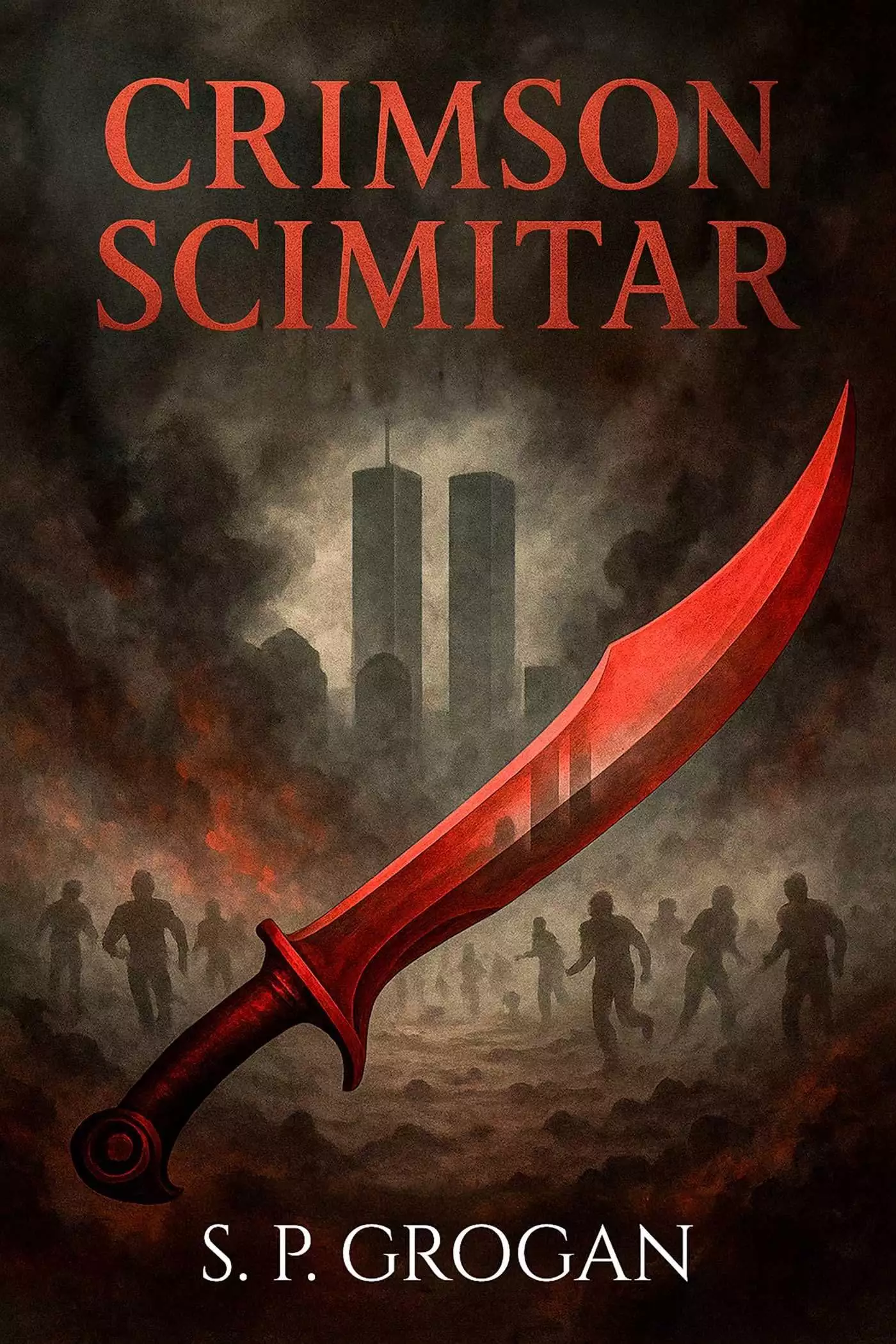
Crimson Scimitar
- eBook
- Paperback
- Hardcover
- Book info
- Sample
- Media
- Author updates
- Lists
Synopsis
Justice, revenge, and a nation on the brink: when a televised mock trial hides a real terrorist threat, one lawyer must face his past to save the future.
A gripping thriller where justice meets spectacle. When a mock trial of Osama bin Laden collides with a deadly terrorist plot, heroes and villains blur into dangerous shades of gray. Only the truth stands between America and devastation.
In the wake of 9/11, defense attorney Booker Langston still carries the weight of losing his fiancée in the Twin Towers. When he's offered the role of defending Osama bin Laden in a televised mock trial, he faces an impossible choice between justice and revenge. Meanwhile, young al-Qaeda operative Khalaf plots a devastating attack that will shake America to its core.
As the mock trial captivates the nation, a deadly plan unfolds in the shadows. With time running out, Booker must confront his own prejudices while racing to prevent another catastrophic attack. Will his pursuit of justice blind him to the real threat, or can he piece together the clues before it's too late? The answers lie in an explosive confrontation where nothing is quite what it seems.
Release date: April 14, 2026
Publisher: Histria Books
Print pages: 600
* BingeBooks earns revenue from qualifying purchases as an Amazon Associate as well as from other retail partners.
Reader buzz
 Please log in to recommend or discuss...
Author updates
Crimson Scimitar
S.P. Grogan
REEL ONEEPISODE ONE — Prologue
Scene 1: On That Day, Where Were They?
Setting: September 11, 2001, New York, Chicago, Jalalabad
Booker Langston, defense attorney
He was angry with her. Not really. His Tuesday schedule went into flux with his fiancée’s casual request (non-negotiable demand) for a mutual shopping appointment before his afternoon court session, where he was set to deliver his closing argument, defending the accused.
Judy said it would be a quick decision on her final choice of the wedding gown design. But he knew women. Maybe he didn’t. He did know that he was in love with investment banker/trader Judith Yu, her brilliance of mind, her beauty, the warmth of her smile, and her malleable body. The perfect cultural match: 3rd generation Chinese, she a math whiz, to merge by wedding vows to a 2nd generation African, his family political refugees, the elite of the previous regime, from a civil war in Liberia. Now, totally Americanized, successful though not yet rich, ‘Bookie’ was gaining a rep as a savvy defender of the legally entangled downtrodden of New York City. Complacent in his happiness within this work day, he had agreed to meet her in the lobby of the World Trade Center, North Tower. She would ride the elevator down from her currency exchange executive position in the financial trading office of Cantleigh & Fitzpatrick on the 103rd Floor. He checked his watch. 8:40 am. He picked up his pace, grinning. This time he would be early. Surprise her. He had flowers in his hand, a small bouquet.
The shadow of an aircraft momentarily darkened his steps. A grumbling scream filled the skies above his head, and then….
Hugh Fox, inventor/entrepreneur
He typed one word into his Tablet PC electronic notepad (re-purposed by his tinkering), ‘Lunch, Wild Blue, late breakfast, after loan closes. They pay.’ To this engagement, he now added, ‘Decline.’ The Wild Blue restaurant was part of the restaurant Windows of the World in the North Tower. More intimate for private business dealings, this smaller venue had the best views from the southern tip of Manhattan Island. Hugh Fox knew he would not be hungry, nor would he attend. Instead, he must rush back to his factory garret to complete another prototype. More so, he did not wish to be scrutinized too closely.
To make this loan, he had lied, or rather ‘misdirected,’ downplaying his involvement in his own loan funding. The Montblanc ink pen they had offered for initialing and signing the 35-page loan document would be their gift for the borrower. They, the bankers, looked as such, all formal uppity, suit uniforms of charcoal Emporio Armani, while his attorney, immaculate in pin-stripe Ermenegildo Zegna. Of course, the bankers would believe his attorney was the corporate borrower, for he had that money stuffiness look about him. It came from stratospheric legal billing, like today. Hugh could only afford to pay him two hours of contract work for agreeing to this prank charade.
Still the kid, wary of grown-ups, Hugh Fox did not yet feel comfortable around power, like the control of the purse, like bankers. Of the steep interest, an exorbitant 7.5% on new customer borrowed funds he would pay back to them; he prayed this would be the last time he would be dependent on debt. They would not appreciate his subterfuge. But risk takers take risks. This was to be his first formal corporate loan. Not much. $400,000. Still a great deal for any financial transaction of a boot-strapped, start-up technology firm in early fall of 2001.
When the loan documents were brought out, his attorney had asked for a private room for him and his ‘aide’ to discuss and sign the papers. The bankers had no problem with this; after all, the grey-haired attorney smiled respectability in his request. They paid the young man little attention in his tan khaki slacks and thin black tie with a white shirt (frayed at the sleeves), yet Hugh Fox was the true corporation at the table. He was the idea generator, the inventor, the scrounger of sophisticated second-hand motherboards, scrubber of floppies.
The bankers, with offices in the Deutsch Bank Building on Liberty Street, next to the World Trade Center complex, understood collateral risk, and they now had a lien on all his ‘research equipment’ including lockbox loan repayment on account receivables from his four sales contracts. He had accepted that he would make a deal with the devil to bring his products to market. As part of his ruse, his attorney had introduced him as the law office’s runner, who would take the signed papers back to the law firm while the attorney would stay to handle the wire transfer details.
Everyone was in synch; both men exited the side office with the transactional legal mumbo-jumbo signed. The bankers then signed their pages, and all was concluded within 15 minutes. Acting in his toady courier role, Hugh exited carrying the papers under his arm; the attorney stayed to chat, pocketing the $200 Montblanc pen for himself for services rendered.
Hugh had done it. A little fakery, not fraudulent, but the bankers would not have loaned the funds to a 19-year-old kid, who some called an ‘erratic genius,’ where others colored him as wild and driven, tinged with unpredictability. The bankers were under the impression that the product he was developing and marketing was ‘transistor type’ because one of the contracts he had signed was with Radio Shack, giving comfort for a relationship with a major retail corporation and thus credence to an asset valuation to support the collateral. He told no one his prototype, ready for his small shop assembly line, was, in fact, going to be a video game of his own design for easy play on the industry’s sixth generation of video game consoles, involving MMORPG (massively multiplayer online role-playing games). The Radio Shack sales contract was of little interest to Hugh; he was merely supplying tooled computer circuitry for how-to-kits, knocked off from a Japanese company for ready cash. As he had envisioned, the ‘home run,’ the ‘pay dirt,’ lay in video games for the masses. That was the future.
Like all those with a belief in themselves and their ideas, Hugh had hocked all his development and tooling equipment. Of the assets on his balance sheet, one line item he had excluded was for his three patents, the most valuable of all. These he controlled with fierceness, his future coin of the realm. One U.S. patent, granted in 1989 (when he was in high school!) for a system that he, with an advanced course for an accelerated MIT diploma, a degree at the age of 19, just completed, had prototyped his design bearing similarities closely mimicking the revolutionary Sega Dreamcast. By his own tweaks, there were enough variances to be awarded a ‘new’ allowed patent. He had engineered a 100 Kbps modem and his own modification of the PlanetWeb browser, moving from LAN networks to a more advanced player system for the improving internet. He called this system, Skilleo, betting that what he had researched was what the player market might want. A second patent, a ‘method of play,’ created by computer input, offered a social survey taken by the player of their thoughts that then would be imposed into a game character which would play the game as the player’s doppelganger. Early A.I. The final patent, approved yet as a concept test program, would put the player’s mind itself directly into video gameplay. Early Virtual Reality meets Sci-Fi futurism.
At this point in today’s journey, he took no chance of street mugging interference or taxi mishaps and placed his signed loan papers into a large pre-stamped envelope taken from his back pocket. Though his attorney and the bank would have signed copies of
the lending documents, he would take no chances of misadventure and deposited his future into the mail chute next to the building’s bank of elevators. The U.S. Post office, he accepted, was the one institution that could perform reasonably well with first-class handling.
Hugh Fox felt, no, knew that with this lending capital, he could now succeed. He was in a buoyant mood. Then, just as his finger hit the elevator’s down button, he looked out the hall window to see American Airlines Flight 11 hit the North Tower.
Shock — loss of momentary comprehension, a sudden horror realized. His mind clicked in. Flee. He avoided the elevator and took the stairs, ten flights down, skipping steps two at a time. He exited, out of breath, finding himself on the street in an unreal world of falling debris, glass fragment rain, the smell of burning jet fuel, and the detritus from 1,000 office desks. With little thought, he joined the growing melee of those believing stampeding and distancing from the tragedy was the best course of action.
His speed took him down Liberty Street; he cut over to Cortland and finally stopped running at the corner of Dey Street and Broadway. Stopping, sweating, catching his breath, admitting that his jumbled mind of fictional battle scenarios and designing ungodly creatures were overwhelmed by his morbid curiosity about the fire and smoke on the still quite visible landmark of the World Trade Center. It came to him perhaps to loiter somewhat, to bear witness (?), accepting that he was part of current headlines unfolding.
Transfixed, he was staring up at the conflagration when United Airlines Flight 175 hit the South Tower. His mind focused. This was an attack. Had to be. He witnessed a body falling from on high, then another. He had to do something, anything to help.
Samantha Carlisle, fashion designer
A hole-in-the-wall office, on the second floor, in the Garment District. The name on the glass kept simple. S. Carlisle, Creative Fashions. Sam, as she was known to
amiable friends, Sammie to her family, wasn’t satisfied with the moniker for a future fashion trademark. She would scribble out words, match, and juggle, but nothing screamed, ‘famous apparel stylist works here.’ Sam was smart, smart-alecky, with a natural dose of ambition. One had to be bold, if not brash, if not outlandish, to succeed in this world of couture glam.
Eve, one of her two seamstresses, arriving late, rushed in, slurring out her sentences.
“A plane hit the World Tower. And not a small plane, a big jet. You can see the smoke from the street.” So, all three of them did just that. Sam, Eve, and Madeline, the other seamstress and the occasional part-time bookkeeper. She saw others were straying outside, glancing, peering down to the end of the island. And yes, black smoke appeared from not just one but both towers. ‘How could one plane set both buildings on fire?’ thought Sam, now hearing the emergency sirens from all directions heading towards the ‘accident.’
“Let’s go, girls,” Sam felt they had the broad picture, and the office television would have on-the-spot coverage, and quickly the news made all too apparent the reality of what had happened and what was happening. On TV, they were saying the words, ‘terrorist attack.’ Unbelievable. Madeline started to cry; Eve chewed on her fingernails.
The shop’s 9:30 appointment had not appeared.
“The streets are going to be a nightmare jam,” moaned Madeline, who lived over in Brooklyn, with a sad expression.
Sam, as boss, got the subtle suggestion.
“You’re right; no one is going to be coming in today. You both scram out of here and get home safely before they do something crazy and shut down the island and close the bridges.” Sam slept in her office, in a store room converted to a one-bedroom apartment. Life in the city was expensive for the twenty-eight-ish sole business shop owner, hopeful for a future, someday soon-to-be the famous fashionista with her own salon, showroom, and more importantly, The Brand — when she discovered it.
The collapsing dual towers cemented their concern and quiet panic. Both seamstress employees rushed out, slight comfort in being together, unsure of what to do but make their way to some form of safety, which they hoped were their apartments and crowded families, full of hugs.
Samantha Carlisle, with one eye glued to the TV, fixated on commentators and the multiple scenes reminding her of what Dante’s Inferno must be like. She gathered up and shoved her color-inked designs for the wedding dress into a file folder marked ‘Yu-Langston Wedding.’ She draped a plastic covering over the fabrics she was going to suggest to Judith Yu today with her fiancé in tow. She accepted that under the circumstances, no one would be paying social or business calls on this terrible day.
She turned her attention back to the television. Good God, it is Dante’s Hell, as she saw ‘ghosts’ coming out of a tsunami cloud of grey ash. Her eyes focused on two men, stumbling toward the camera, neither one recognizable, even to what ethnicity they might be. Leaning, holding each other up, strangers clinging. Aloud, to no one, shaking her head, she mourned, “Everyone is grey confusion, like amnesiac ghosts.” Then thinking as a fashion designer might, seeing the perspective of all people now running. “No ethnics; no discerning tribes, no stuffy cliques, no Benetton colors of culture. The world has gone drab.” No one was around to hear what she later called her epiphany. She threw in a couple of curse words to emphasize a world gone crazy. And then, thinking more, she gained direction, “I will use a grey-black fabric background with minimalist color slashes, walking art of a chained political statement, of starkness representing sadness personified. Disturbed Valentino embraces nihilist Versace.” And Samantha Carlisle began to sketch, ignoring the wail of distant sirens.
Hugh Fox and Booker Langston, survivors
Hugh had found his calling. Never with cash on him, he had earlier that morning borrowed some crisp, large denomination bills to buy his first suit from his attorney to be repaid from loan proceeds. Yet who needed a suit at times like these? Instead, he bought the entire stock of bottled water from a small bodega and began passing them out to frightened people running away in their fear-stoked marathon and later to the police and firefighters arriving in a blaring cacophony of uncertainty. The rescuers knew they would need lots of hydration this day, for they would have to go in and go up to reach survivors.
Hugh did not comprehend that he was in the best position to see the marshaling of rescue efforts to enter the buildings. All civilians were being sent away from the scene, but helpful water boys seemed to have the approval to remain.
He glanced up to see a tall black man in a business suit running towards him and past in anguished panic. Near him, the first line of a police barrier stopped the man with a cautioning upraised hand and warning. Hugh could hear the shouted exchange.
“My fiancée is inside the North Tower. I need to get to her!” It was a demand laced with hysteria.
“Only first responders beyond here.” The cop’s own tribulations cut no slack or sympathy.
“No, you must hear this. I think I can reach her.” He pulled out his cell phone and turned on the recording, thumbing it to loud. Hugh leaned in to listen.
A woman’s voice, the man’s fiancée, screamed in crying anguish,
“Bookie, Bookie, what’s going on? We can’t find an exit; there is smoke all over one side of the building. Someone said a plane hit the building. Bookie, what am I going to do? I love you. Some of us will try all the stairs; the smoke is getting bad. I love you, Bookie.” Nothing more. The anguished black man looked at the police officer. The uniform just shrugged. “I’m sorry. They’re sending in fire battalions now, helping with the evacuation. Please don’t get any closer. There is nothing you can do. Please move back.”
The man turned, downcast, devastated. Hugh shoved a bottle of water toward him. “Is your name, Bookie?” He had to break the man’s concentration on something
he could do nothing about.
The man repeated his name, disconnected, “Bookie?” Then he looked at Hugh, began to reach for the bottled water, then, as if for the first time, realized he held a crumpled bouquet of flowers. He threw them down, took the water proffered, guzzled it all, and nodded grimly, “Booker, my name’s Booker.” Aware of his surroundings, Booker walked away towards safety, and Hugh could see the man’s expression, not disconsolation, not anger, but sad determination.
“Oh-oh,” said Hugh, then distracted, finding himself passing out more water as fast as he could. The rush coming and going was at its apex. Within a half hour, all bottles gone, he looked around, wondering what else he might do, when he saw half a block away, the executive named Booker skirting an unattended barricade next to a fire truck. He was now without his jacket, his sleeves rolled up, looking more a part of the scene. ‘What the — ?’ thought Hugh, noticing the man heading toward the North Tower, now a flaming and smoking torch. Not good, and not knowing why or the reasoning for what he suddenly did, he took off running. Perhaps he had to stop that man from entering a building on fire. That’s the least he could do, bring rationalization to a hopeless task, maybe save one person on this deadly day.
They were both climbing over rubble, dodging fire equipment unlimbered, rescuers running towards the danger. Desperation drove Booker; adrenalin charged Hugh Fox, who eventually caught up, grabbed the man by the arm and spun him around.
“You can’t go in there!” he shouted, not sure he had the right to make such a demand. “The fire up there needs to be first controlled; let the fire departments reach her. After that, it’s a waiting game. Maybe she is already coming down another stairway. What if you miss her going up, and she coming down? What’s she going to say if you get hurt? She’s coming to you. Just wait here. We’ll know soon enough.” With that rush of words, he stared at the man. He noticed tears running down Booker’s face, streaked by the floating dust.
Booker had been in his own world, a reality that all possible ways of being a hero to Judy were available to him, and then some stranger, a kid, yelled out at him to think
practically. Like an attorney. Evidence. Facts. He slowed his mad rush, almost ready to plunge inside, to push aside the rescuers, most suited up with masks, and axes, trying to string water hoses.
“I’ll wait; I won’t leave her.”
“Okay, we will wait. Together.”
Booker looked at the young man, gauging why he was taking a risk for him. There was an understanding.
The ‘kid’ spoke. ‘My name’s Hugh. Hugh Fox. I just borrowed money from a bank. It’s a known fact bankers will not let their clients get hurt before the scheduled repayment.”
Booker stared at this ridiculous statement, spoken within a tempest of carnage and rescuer hope. He looked to the door, waiting to see a familiar face exit.
Not looking at Fox, he answered, “Booker Langston. My fiancée, Judith Yu. We are planning an early spring wedding.” His voice was stunned.
Just then, they heard, within seconds, two sounds, not sirens, not from the rescue teams shouting commands. The crash of a beam to the ground, coming from on high; Hugh thought it might be not façade decoration but looked like an outside column supporting truss.
And inside the lobby, somewhere a ‘crack,’ the source undefined. Hugh glanced to the inside at one of the major steel supporting buttresses. He saw it bending ever so slightly. Stress-to stress-fracture. “Oh, shit.” His liberal arts engineering studies came to him. This building was not going to fall over. It was going to pancake, collapse in on itself. “Oh, shit, shit. We have to go. Leave now, no time.” He grabbed Booker’s arm and started pulling him down the hill of refuse.
“No, no, I’m not going to leave her.”
“She may already have left the building.” Hugh lied; he was good at that, telling convincing fibs.
Booker was an emotional wreck. He had no anchor, no firm belief that would have kept him riveted to one spot, so he allowed Hugh to lead him along, the kid’s firm grip on his shirt. He would wait for her further away. But then, at 9:59 a.m., the South Tower collapsed. Booker and Hugh ran like hell, like their lives depended upon it, as rightly so, staying alive requiring such action.
At 10:28 am, the North Tower followed, imploding. Within that short time, Hugh and Booker had been running like crazed madmen, seeing over their shoulders a rushing, suffocating curtain, chasing them, overcoming all within its path, embracing them in thick particulates of destroyed buildings and tissue fragments of human bodies.
That day, 2,764 people were killed, currency trading employee Judith Yu among them.
Barack Obama, Illinois State Senator
For his part, he remembered it beginning as probably an ‘unremarkable day.’ He was driving on Lake Shore Drive on his way to a required yet probably tedious Illinois Legislative Committee Meeting on Administrative Policy. The radio’s music channel switched to ‘Breaking News,’ and he first learned of a plane crash into one of the World Trade Center buildings in New York. By the time he arrived at his meeting, it had been canceled, and people were milling outside, many of them staring at Chicago’s Sears Tower, wondering, as he put it later, ‘Would this building go from workplace to target’? He drove to his law firm, where he worked at his holding place day job, and found everyone huddled in the basement conference room. The second plane had hit, and he joined his partners with exchanged stares, now saying aloud to no one but for a posterity of sorts, “All the misery and evil in the world has brought a black cloud blocking the sun.”
After a while of repetitive commentators, with the same horrific visuals but little information on the how and why, Barack left for home. He had night duty. Sasha had just been born, and to give Michele a needed respite, he was on feeding and burping patrol, multi-tasking, and at the same time, watching the television. Television that went beyond its rightful purpose as news delivery. Like the rest of the American population that September day, now late at night, Barack’s screen staring quickly zombied him into another internally wounded citizen.
Barack, the politician, had to consider the ramifications. Accepting that the national grief would be pervasive, the calls for immediate revenge. But, beyond the gut calls for firing squad justice, perhaps the following days and months might hold unsought latent opportunities. Barack, after all, was an elected politician; his credentials as a community activist saw him elected in 1996 for the 13th District, Chicago’s South Side. Honing his skills, using his associate professor voice, that of deep timbre to educate, loud enunciation to reach the farthest corners of a lecture hall, he thought he was ready. Not yet, but as part of the learning process of living within machine politics in the trenches, in 2000, he lost a political race for the U.S. Congress. A year later, learning from his failed battle to reach Washington, he had to weigh his public political response carefully to what his constituent base expected of him to what they now called 9/11. His response, crafted and loftier: “I have no empathy for terrorists.” A short pause as if something profound was forthcoming. “We must realize the pain they created was from poverty and ignorance. It is up to us to lift the despair from these regions.”
Several months later, State Senator Obama was having lunch with his go-to media consultant. The purpose — discussing where to, what next — all clichés appropriate: a finger to the wind or testing the [lake] waters. The question asked, cautiously, ‘What was the climate like for a run at the U.S. Senate?’
“Not good,” replied the consultant. “You have a major hurdle to overcome.” His advisor tapped the morning newspaper on the luncheon table. A grainy black-and-white Associated Press photograph of an angry turbaned and bearded man stared back at them, the man now identified as the ‘alleged’ leader of the terrorist attack: Sheik Osama bin Laden of the radical revolutionary al Qaeda, referred to in the same sentence as Islamic Jihadists. One and the
same.
They both nodded to what that meant. His strange name of Barack, his African lineage of ‘Obama’ that easily rhymes with ‘Osama’ and a middle name with Mid East connotations, ‘Hussein.’ The whispering, the wink-wink suggestion of a tie to ‘Mohammed,’ his name would be disastrous in the current climate where ‘Remember the Alamo,’ ‘Remember the Maine,’ and ‘Remember Pearl Harbor’ seemed all rolled into one shouted cry, ‘Avenge 9/11!’ With all political parties speaking with tenuous unity.
The consultant opined. “The time’s not right. They either get this guy or new events move him off the front page. Barack, you must be patient. Give it time.”
Barack did not like ‘hurdles’ or bumps in the road to deflect his goals. He passed the luncheon check over to the consultant, smiled, and thanked him for his advice. He would wait, but not for long.
Three years later, in 2004, he made his move and was elected to the U.S. Senate. He followed the John F. Kenney model: ‘Don’t make controversial waves, low profile, and get the hell out of the Senate.’ He knew where he was going, and it was not to be a long-serving U.S. Senator like the black Republican Edward Burke. Even if a member of that august chamber, he would not long be one of fifty.
Still, it leads one to wonder, that day with his media advisor, both discussing strategic moves to consider, at the luncheon’s end, did State Senator Obama himself tap that face on the newspaper’s front page, thumping hard with a stabbing finger, forming a resolution known only to him?
There were one too many Osama-Obama and Hussein-Mohammed connections on the world stage. And did he pledge to himself: ‘I will be the last man standing?’
Osama bin Mohammed bin Awad bin Laden,
Pan-Islamic al-Qaeda leader
He had called his mother the night before. “You might not be able to reach me for some time.” She asked no questions. They had a pleasant visit about her life, his wives, and children. “No, they will not be coming with me for a month or so.” His mother did not ask why. He ended the call, both of them exchanging endearing goodbyes. Neither said they loved the other. That was not a ritual done in the bin Laden tribal clan. Yet, the call placed him in a good mood, as did other events yet to be.
Wearing no watch, he asked his bodyguard what time it was. Where they were, it was Tuesday evening, 6 pm in Jalalabad, Pakistan. He calculated that it was around 8 am in New York City. Osama bin Laden, also known as Usama bin Laden, an unknown to most of the Western world, had few concerns, and the news at this moment was more good than bad. The good news was, he had heard nothing of the attack being aborted. So, his fellow tactician, Khalid Sheik Mohammed’s first concept outline, had become the blueprint for this multi-faceted launch. A bold move and all Khalid’s idea. Bin Laden could accept letting someone else take the credit. But you could not rest on your laurels when fighting the Great Satan. A battle well done can be called a small victory; only many battles fought lead to a great victory. New planning would be required for the next attack, and Osama bin Laden had his own idea of what might come next, and he had brought with him plenty of writing materials to sketch his thoughts.
“It is time to go,” he touched his driver’s shoulder. They always traveled at night in two SUVs, and this trip with a truck laden with weapons and ammunition. Ironically, in other events happening a world away, his armed followers, his ‘revolutionary army’ always had to worry about the ‘death-from-the-skies,’ ship-to-land missile attacks or U.S. aircraft laser bombs [Military Predator drones were first used in October 2001 (see below), and CIA targeted drones were not used until February 2002].
He knew success would bring a response. It was time to go out and find a safe house with his most loyal supporters. The small convoy was leaving Jalalabad on the way to Spin Ghar Range (Pashto: ‘White Mountains’), a natural mountain frontier border
between Pakistan and Afghanistan. His later plans, not yet set, might, if circumstances dictated, require a move to the more secluded and remote hide-outs in the Tora Bora region of Afghanistan. Let his Taliban brothers form a shield of armed protection. Soon enough, they would know why he had sought them out, to be hidden among the various tribes.
Everything that would be said about him, he would shrug off. All of the accusations and shouting were mere propaganda noise to him. He had done nothing except to right perceived wrongs. If he were to admit to any of their accusations, he would deny all or only speak out to foment new soldiers to his banners, to the caliphate he would create, lead, and rule with a sharp-honed sword.
A bloody scimitar.
He leaned back in the bumping vehicle, his head resting, and was soon asleep. All was well with his world.
[The American government, with the almost unanimous approval of their citizens, would indeed respond less than a month later, on October 7th 2001(‘Operation Enduring Freedom’) with CIA agents and Special Forces, dependent on anti-Taliban allies and the accuracy of U.S. Air Force’s laser-dropped munitions and the Navy’s Tomahawk sea-based cruise missiles. Not an invasion at that time but a surgical strike. One of their strategic targets to be removed was head Taliban leader Mullah Omar. Tracked and located, military high command infighting bungled a Predator drone strike. It failed; an empty truck destroyed, and Mullah Omar and the senior Taliban leadership fled, some even jumping out of windows, all escaping. The irony was that the Taliban knew nothing of what would happen in New York City and elsewhere on September 11th. They were bad people, certainly, but not the ones who unleashed the whirlwind of avenging might. Source: ‘The Story of America’s First Drone Strike,’ by Chris Woods, Atlantic Magazine, May 30, 2015] ...
We hope you are enjoying the book so far. To continue reading...
