A sickly biologist shuts herself off from the world and its deadly pollutants to research her beloved microbiota in peace – until a chance encounter drives her to venture out into an unliveable Bangalore.
In a dystopian Arizona, a couple performs forbidden life-saving abortions amid the threat of tanks and drones, the strict report of automatic weapons and the spying eyes of neighbours.
A young woman competes in a gruelling challenge, determined to win a place in a world where body modifications equal class and grant people the privilege of transcending gender.
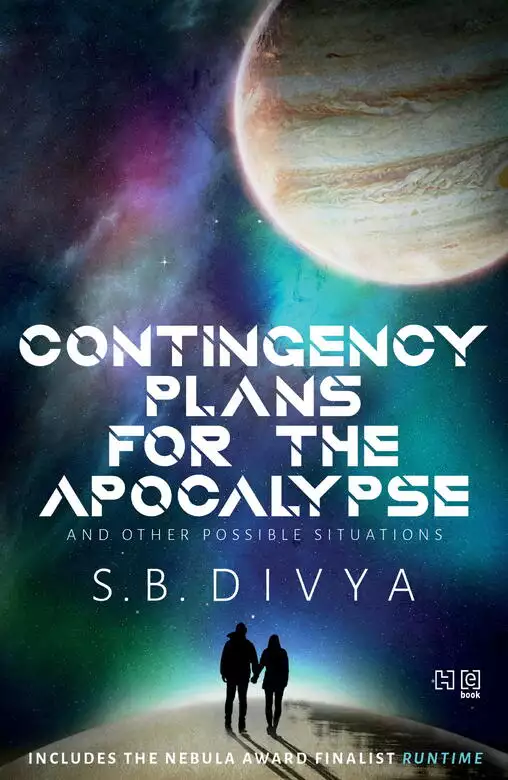
In this collection of 14 layered stories featuring dying cities, undying humans, amorphous bodies, cyborg racers and magic beetles, internationally acclaimed writer and data scientist S.B. Divya treads the line between the present and the future, while exploring the eternal conundrums of identity and love in speculative worlds.
Release date:
August 25, 2019
Publisher:
Hachette India
Print pages:
264
* BingeBooks earns revenue from qualifying purchases as an Amazon Associate as well as from other retail partners.
Contingency Plans for the Apocalypse and Other Possible Situations
S.B. Divya
LOSS OF SIGNAL
When the doors drifted open like wings, when I trained my cameras to the star-flecked blackness, when the metal arms released me from their embrace: that was the moment my first dream came true.
I checked it off the list.
‘You’re clear of the shuttle, Toby. Begin translunar injection.’
Mission Control’s voice sounded in my ear, but I had no ear. I had adapted to that change early on.
‘Roger that, Houston.’ I’d always wanted to say that. I’d learned how to turn my thoughts into a stream of text, the only form of speech I had. ‘Activating ignition for translunar injection.’
The engines roared, but you can’t feel vibrations without bones. You can’t yield to acceleration without flesh.
‘Thirty seconds left on the burn, Houston.’
‘Trajectory change is looking good from here.’
I switched off the engines with a thought command. ‘Delta-v is on target, Houston. I’m on my way to the moon.’
A burst of applause, then: ‘Safe travels, Toby. Let’s make history together!’
After that I coasted in silence for several hours. My cylindrical housing turned slowly, like a rotisserie, so it wouldn’t overheat. The Earth rose in my visual field, filling it with her iconic, marbled glory – half in jewelled light, half in deepest shadow.
Checked off another one.
The sensation of cold built during the quiet, darker intervals. I shouldn’t have felt anything so corporeal. I hadn’t for years, not since the phantom pains of lost limbs and absent organs. They’d wired me for sight and hearing. I didn’t miss the rest.
When your dreams are fuelled by words and pictures, when your body has you trapped in one position and you want so badly to do great things: that’s when you memorize all those famous lines. You act out the scenes in your head, and you’re always the hero.
Heroes aren’t bothered by the cold. They don’t complain. My mother never did. She would come home at night and rub bag balm on to her hands. Chapped skin would curl away, powder white against coffee black, especially after she’d pulled a double dishwashing shift.
On one of those nights, years ago, I asked her, ‘Does it hurt?’
‘Like the devil on Sunday, baby, but it’s only pain. Buckle down and push through. Get the job done.’
She told me that a lot, those first few months after the transfer. My old body was worthless, but my brain was good. The engineers tossed around words I looked up later. Plasticity, neurogenesis, connectomics. Bottom line: the dying, wheelchair-bound sixteen-year-old could make history in the space programme. Sign me up!
But the change was hard, often painful. My new home lacked the usual body parts. I was as frustrated as ever, though I was alive.
‘You’re lucky to be here, son,’ Mama scolded. ‘Getting a second chance like this. I don’t want to hear you fussing.’
Pain was my worst friend even before the transfer. You think you’d get used to it after a while – that failing nerves would mean numbness – but bodies don’t work that way. They take time to die. They make you pay while you wait.
Sometimes Mama couldn’t afford the co-pay for my meds. Sometimes I went days without pain medication while we waited for the pharmacy to reach the doctor, because the government thought Mama might be dealing drugs. As if she had time for that.
I tried to ignore the phantom chill of space. I could handle the discomfort – I’d been through worse in my old body – but the sensation disturbed me. I slept, my only escape.
‘Toby, this is Houston with a signal check.’
I woke.
‘I hear you loud and clear, Houston.’
‘We’ve uploaded the latest numbers for your lunar orbit insertion. Engine readouts look good. How are things at your end?’
Text can’t betray chattering teeth. Not that I had any, but that’s how cold I felt. I wanted my mother’s warm bulk against me. We’d shared a bed long past the age when kids and parents typically stop, but needing someone to roll you over at night isn’t typical.
‘Houston, I’d like to talk to my mother.’
Is it wrong for a nineteen-year-old man – if you could still call me a man – to ask for his mama?
‘We can patch her in.’
After a few minutes, she spoke. ‘I’m here. What’s the matter, baby?’
‘I’m really cold. Freezing. It’s hard to think.’
The seconds stretched like tiny eternities. Do we ever lose the fear of disappointing our mothers?
‘Toby, this is Doctor Keil. Does the sensation decrease with auditory input?’
‘Some.’
‘What about visual?’
‘Maybe? There isn’t much to see at the moment.’
‘I suspect it’s an artefact of sensory deprivation.’
My mother and I had looked up those words long ago. The past two years had been free of phantoms. I’d been able to train with NASA in comfort. Why would they come back now?
Nobody likes surprises in space travel.
‘How about I read to you?’ Mama suggested. ‘All those books you tried to share with me… I never had the time before, but I do now.’
‘Sure. Let’s try that.’
With my mother’s voice in my ears, I captained a vast starship. I battled dragons; teleported across the galaxy; invoked strange and powerful spells. I had superhuman strength and extrasensory perception.
Mama read aloud from books whose spines had been white with use when I’d bought them. That she hadn’t sold them came as a surprise. She kept on until her voice got scratchy, and then Fred Shu over at mission control took a shift, and then others. Mama’s voice kept the cold at bay better than anyone else’s.
‘Folks, I hate to interrupt, but we have ten minutes to the loss of signal point. We need Toby to run a systems check.’
Was I that close to the moon already? Indeed, her alabaster curve swept into my peripheral vision.
‘All readouts are green, Houston.’
‘What about you, Toby? How are you doing?’
‘I’m scared.’
The thought slipped to text by accident. It happens sometimes when I’m not careful.
A long pause before the reply came: ‘We don’t have any good ideas here, I’m sorry to say. You’ll have ten minutes of radio silence before the burn, and then another twenty after. Can you handle it?’
I muted the transmitter to keep my thoughts safe.
‘Toby, if it’s too painful to execute the lunar orbit insertion, stay passive and let the moon’s gravity shoot you back. That’s why we chose this trajectory. It’s better than a misfire. Do you copy?’
Unmute. ‘Copy that, Houston.’
What they didn’t say: give up on circumnavigating the moon. Fail to prove that humanity doesn’t need bodies to crew its spacecraft; that we don’t have to wait for artificial intelligences; that kids like me can go where few able-bodied adults have been…and beyond.
If I couldn’t survive the dark silence, the loneliness, I would set the test program back by years. The Apollo missions had crews. The astronauts kept company, cracked wise, backed each other up. My kind would be alone in the dark. The world was watching, waiting. If I gave up, what were the odds they’d give us a second chance?
‘You can do it, baby. It’s only thirty minutes of quiet, and Mama’s going to be right here when you come back.’
She spoke as if I were a child. I hated that, normally. Now? I wanted to cry.
But you can’t make tears without ducts and glands. You can’t sob without lungs.
I transmitted: ‘I’ll do my best.’
‘One minute to LOS.’
The moon loomed, familiar and white, filling most of my view as I rotated toward it: my cratered dream; my harsh mistress. The blanched horizon terrified me.
‘Baby, you do what you need to and come back safe. You’ve made enough history.’
‘Five seconds to LOS.’
The last thing I heard was Mama’s voice: ‘I love you, baby, no matter what.’
Silence deafens. Cold burns.
How do we make sense of such oxymorons? Insanity, that’s how. If someone offers you a chance to cheat death the sane response is to accept it, right?
Maybe not.
My mind had played all kinds of tricks on me, but the cold of space was the cruellest. Chill seeped into bones I didn’t have. Non-existent fingers and toes ached, like they had on winter nights without gas. I shivered without muscles.
Ten minutes to decide: be a hero, or go to sleep? Jim Lovell, Sally Ride, Guy Bluford. What would Toby Benson mean to history?
I could use my ‘free return’ to Earth. I could sleep and let gravity do its work. I could see the headlines: Toby Benson, Man–Machine Hybrid, Fails to Replicate Apollo 8 Mission.
Better to use my imagination – my strongest remaining asset. I was Amundsen at the South Pole; Shackleton trapped by ice. I had to persist or doom my crew to death.
No second chances. No excuses. No sleep.
The Sandman had often carried me away when I was a child. In his dreaming embrace, I’d found solace. Sleep would swaddle me like a cosy blanket. I never wanted to leave it, especially on school mornings.
‘I’m still tired, Mama,’ I would protest.
‘Get up, Toby! I’m working twelve-hour shifts, and you’re telling me you’re tired? I don’t think so.’
During winter, ice coated the half-dozen steps from our tenement door to the sidewalk.
‘Clumsy,’ Mama chided the first time I slipped. ‘Watch yourself! I can’t be paying for broken bones.’
Each year I fell more often. Fell down. Fell off. Fell asleep. My sixth-grade teacher convinced Mama to take me to a doctor. A year passed before we got a diagnosis, but I looked up a lot of words in those twelve months: ataxia, dysarthria, cardiomyopathy, trans-synaptic atrophy.
I did all the reading. Mama heard the executive summary: my nerves were failing. My muscles weren’t working right, and they were going to get worse until they stopped.
The heart is a muscle. Mama hadn’t known that.
Once upon a time, I was Toby, age fourteen, living in Chicago. I lay on the sidewalk, unable to move. For hours I watched snowflakes drift from the night sky, clouds obscuring the stars, the tiny crystals taking their places.
People walked right past me. I knew what they were thinking: another loser kid, high on drugs, not worth helping. If our landlady hadn’t recognized me on her way home… Well, you know how those stories end.
An orange light flashed: one minute before I had to start the burn. If I stayed passive, the moon would slingshot me back to Earth. If the cold distracted me while I worked the engines, I could drift for eternity or crash into the lunar surface.
I was alone again, this time on the quiet side of the moon. No one would help. No one would see.
Frost buzzed through me like a swarm of bees, stinging my body in a million places. You can’t breathe through pain if you have no lungs. You can’t run warm-up laps without legs. You can’t huddle up when you’re all alone.
But I wasn’t helpless. I was a rocket. I had engines. My new body thrummed with latent power.
Time to write a new story.
When the countdown reached zero, I sent the thought to activate ignition. I applied the right amount of energy, the exact direction of thrust. I gritted my imaginary teeth and triple-checked the readouts as my velocity changed. Then I turned off the engines.
The moon’s gravity held me in stable orbit for as long as I desired. Craters dusted in abalone whites and greys filled my view in one direction. I watched the familiar contours pass by – Secchi, Mount Marilyn, the Sea of Tranquillity – their names etched in my memory better than my own face. On my other side, the stars sang their vast, maddening, frigid aria, but I was safe in a lunar embrace. Safe enough to let myself sleep.
Blissful oblivion took me for the next twenty minutes.
When the sun’s light warmed me again; when a cacophony of cheers filled my hearing; when my planet rose like a robin’s egg from a shadowed nest: then, I checked off one more item.
CONTINGENCY PLANS FOR THE APOCALYPSE
My apocalypse doesn’t ride on horseback or raise the dead or add suns to the sky. It arrives by tank and drone, the strict report of automatic weapons, the spying eyes of neighbours. It seeks my spouse’s life. Mine, too. I don’t expect to survive.
Chula has better odds. She is a four-time triathlete, perfect eyesight, no injuries. She can lift our six-year-old the way I haul a fire log. If anyone can outrun the law, it’s Chula.
‘When they come for us,’ I said, after Kaila was born, ‘you take the children and the backpack, and head for the safe house.’
Chula’s blue eyes narrowed. ‘And you’ll catch up. You have a pack, too. We’ll go side by side, like always.’
‘Sure. If I’m alive.’
Her glare could melt Antarctica. ‘And what if I’m dead instead of you?’
‘That’s so much less likely. I wouldn’t plan on it.’
She raised her pale brows to emphasize my hypocrisy, but I didn’t care. If our survival depended on me, we were in trouble.
Like any ordinary evening, I put the baby down in our room after feeding her. Night darkens the sky. We leave the lights off as much as possible to avoid surveillance from the outside. I trip over the corner of the dining room rug, the one that’s bent upward from all the other times my foot caught it. (My muscles are clumsy thanks to the polio redux pandemic, but I’ve had lots of practice at falling; I know how to avoid sprains and broken bones.) I land on my forearms, nearly prone.
A bullet sings over my head and penetrates Chula’s.
For five seconds, I freeze.
For five seconds, I stop breathing.
My mind refuses to accept the image in front of me. No. No. No no no.
The inhale comes in a rush.
I move.
Her neck has no pulse.
I fling a blanket over my beloved’s body and cover it all: the blond hair now matted with blood, the shards of glass catching the streetlight, the limbs splayed like a sleeping toddler’s, the stain spreading outward on that rug – that thrice-damned rug, which I will never see again.
A yellow thread snags on the hinge of my wrist prosthesis. Chula’s favourite colour. I yank it out and stuff it into the centre of my bra as I crawl across the room. More bullets trash our windows. A rubber band made of devastation tightens around my heart and lungs.
I speak my farewell in my thoughts. To say it aloud is to provide evidence to the sensors. I wish I had time to give Chula a farewell kiss. I wish she’d lived. I hope the people outside think we’re both dead.
In the windowless hall, I stand and run. My booted feet slam against hickory planks, our home improvement project from back before fear decorated our lives. Now, we sleep in our clothes and wear shoes in the house. Photos flash by along the beige wall, memories outlined in black, all but the newest: the four of us huddled in bed after I gave birth to Kaila. That one I taped up, unframed. It gives easily and fits in the back pocket of my jeans.
I burst into our room and reach under the antique bed-frame. I pull out my backpack, filled to eighteen pounds, the same weight I carried across the Andes during our Choquequirao trek. I was a decade younger and fitter then, but today I have to travel only one-fourth the distance. At sea level, that’s manageable. It has to be.
I tighten the straps on the pack. The baby sling hangs on one corner of the crib. Kaila whimpers as I snug her swaddled form against my torso. I lock my arm into a static, supportive position under her, and turn it off to conserve battery.
In the adjacent bedroom, Myles hides under his bed like we have taught him to. His dark curls catch the last light from the window. He has the same hair as his father, killed a year ago while attempting to cross the border, the very same one we’re headed for.
‘Time to go, baby,’ I whisper.
He crawls out. ‘Where’s Chula?’
I’d failed to rehearse the words for this question because I didn’t expect to be here. ‘I’ll explain later.’
Suspicion darkens his six-year-old face, sets his jaw. Not a tantrum, not now, baby, please, we gotta go.
‘Don’t forget Dino,’ I say.
It’s part distraction, part truth, but it works. Myles lunges for the stuffed Tyrannosaurus rex and clasps it to his chest. We run to the side door and out into the chill night – oh, I forgot the jackets, did we pack jackets? – but we can’t turn back because the tank turret looms above the fourth house down the street. A white cover hides the surgical van beside the house. I don’t dare use it, not with all that damning evidence inside, but I send it a silent farewell. Another tie to Chula, severed.
We duck through the hidden door in the back fence, down the alley, across a demented mosaic of chipped stone and glass. I grab my phone and increase the light amplification in my implanted lenses. (They told me it’s an experimental technology with some risks. I told them to shut up and take my money.) I follow the snaking line of garden hose that surrounds a data cable, poached for my illegal purposes.
The hose runs into a plain door set into a low building. I pull it free and fling it back towards the house. They can’t know where we went. My thumb goes against the sensor-lock. A light next to it blinks red. I curse under my breath and lick my too-dry skin and try again. Turn green, turn green, turn green – yes!
I open the door. Where is Myles? He was just here. How could he – oh shit!. . .
We hope you are enjoying the book so far. To continue reading...
Contingency Plans for the Apocalypse and Other Possible Situations

 Please log in to recommend or discuss...
