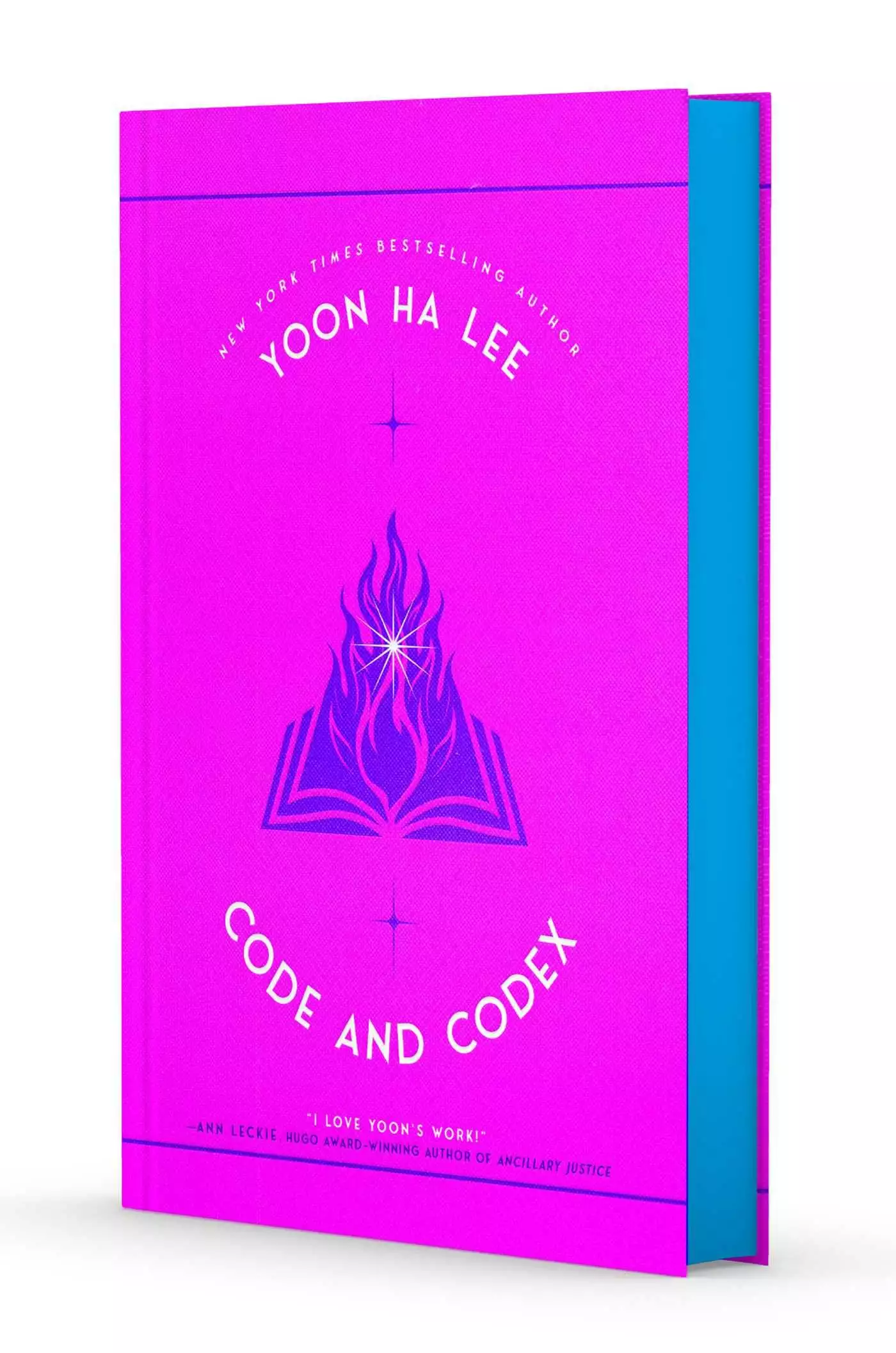
Three-time Hugo Award finalist Yoon Ha Lee returns to science fiction with a swashbuckling space opera fighting against an evil empire trying to erase history.
In the stars-spanning Censorate, languages other than the Republic’s own lingua rubra, which has reality-altering properties, are forbidden. Nevertheless, there are discrepancies. The Censorate’s star forces are called the Athenaeum Navy, and each of its ships is referred to as a codex. Instead of port and starboard, its soldiers refer to verso and recto. The unholy “stigmata” gouged into the ships’ hulls might, to a foreign scholar, bear a resemblance to verboten texts in other languages.
The Censorate is ruled by its Peacock, Aurelia, feared for the power of panopticon: she can look through anyone’s eyes. Moreover, Aurelia’s mastery of lingua rubra lets her force anyone who can understand her to follow her orders. Valentina, sold to Aurelia’s family as a child to be Aurelia’s oath-sister and companion, is its Swan, responsible for extracting useful information from foreign texts, then destroying them as well as entire languages through arcane arts. Valentina is assisted in her work by lower-ranking linguists and AI assistants who accept temporary contamination by foreign languages as a necessity of their work.
But this isn’t enough for Aurelia. She wants to control and deploy the Censorate’s thousand-year traitor and prisoner, the Basilisk, a man with a gaze so lethal that he destroyed its fleet of old through camera feeds. Unfortunately for her, the Basilisk gave himself a form of aphasia that makes him immune to her commands.
Release date:
October 27, 2026
Publisher:
S&S/Saga Press
Print pages:
304
* BingeBooks earns revenue from qualifying purchases as an Amazon Associate as well as from other retail partners.
Chapter 1 CHAPTER 1 1.1 THE CENSORATE THE CENSORATE HAS EXISTED for ten years, or one hundred, or one thousand, depending on who’s doing the telling or where the logarithms land. It consists of worlds uncounted, scattered like Cantor dust through the whispering darkness. Even the Censorate’s officials and the officers of the Athenaeum Fleet do not know its true extent. That would require access to the master maps, jealously guarded by its ruler, the Peacock. Nevertheless, the poets and priests and philosophers claim its borders expand all the time.
Or so they have, until now. The interstellar menaces, the opponents that some call dragons and others call lacunae, gnaw at the Censorate’s unpaginated borders. 1.2 PRELIMINARIES THE FIRST YEAR AFTER we ousted the former Peacock and put out all his eyes, we spent a significant amount of time searching for his collection of dossiers. They should have been on file with the Ministry of Portraiture, which handles personnel. All but mine, anyway.
We searched the high places and the low, the gutters, the margins, the marginalia. We looked for stigmata amid the universe’s sea of virtual particles, examined calligraphy scrolls for telltale blemishes, pored over microfiche so brittle it was likely to shatter if handled by anything but gloves of ghost and shadow ten leagues beyond the wide world’s end, wondering if there was some samizdat secret embedded within. We found nothing.
This failure on our part—on mine, I should specify—agitated the new Peacock. How could she rely on us if she didn’t know our essential qualities, choreograph our potential in combat? She had hoped to rule out subterranean flaws and disloyalties.
In particular, she hoped to tame and deploy the Basilisk, the thousand-year prisoner, the traitor whose gaze was so lethal that it had caused a sun to go nova and destroy the First Fleet.
The Peacock’s paranoia hurt the Swan’s feelings. Valentina would never say so, before or after she took the position of Swan. By definition, Valentina could not compile an objective dossier on herself, written with inviolate ink upon paper pressed from unripe petals and world-tree fibers. So she occupied herself compiling new ones on key figures, starting with the rest of us.
I watched Val compile one on the Peacock herself, although he didn’t realize I was paying attention. He was lucky it was me and not the Peacock. Val is a fine duelist, and the Peacock is not, but the Peacock does not fight her own battles, now or ever.
Ministry dossiers follow a standardized format. There are sound bureaucratic reasons for this, and less sound hermetic ones. It is a requirement, not well known outside the ministry for reasons that will become obvious, that dossiers be written in a language that originates from outside the Censorate, that is not spoken within our borders at all. You can see where this collided with our stated policy of a single official language, lingua rubra.
Let’s examine some exemplars, then.
Valentina dea Regina, also Val.
The Swan. Her power is Swan Song, the voice of lethe: She can inspire someone to a heroic final act. They drop dead afterward. Aurelia’s oath-sister, champion, sometime lover.
Aurelia Flavinia Spinel dea Regina.
The Peacock, ruler of the Censorate, may her reign extend to all times and places. Her power is the Panopticon Gaze, the ability to see through the eyes of anyone who speaks the Censorate’s official language. She rules from the Urtext Fortress.
Jenner, not that anyone else remembers his name.
The Basilisk, once the admiral in charge of the Censorate’s military. His power is the Gaze of Guillotines, which kills everything he looks at. According to one version of the story, he turned his gaze against a sun in order to destroy the First Fleet. Shortly thereafter he was subdued and imprisoned deep within the Urtext Fortress. He has not spoken in a thousand years, or perhaps ever.
Melisande of House Solis.
The Flame of Solis, the False Basilisk, the Censorate’s finest duelist. We do not speak of what happened to her.
A Lacuna
As for myself—well. 1.3 THE BOOK THIEF CHIEF AMONG THE CENSORATE’S leaders were the Peacock, the Basilisk, and the Swan. Of these, some citizens feared the Peacock with her Panopticon surveillance, and others feared the Basilisk with his Gaze of Guillotines that had cindered a fleet. Fewer people dreaded the Swan’s voice of lethe.
Valentina dea Regina, Swan of the Censorate, knew herself the deadliest in certain contexts. She could, and did, defeat the Peacock in any physical contest. Aurelia had the constitution of a palimpsest scraped too thin and wetted.
As an assassin, Valentina was unparalleled: long-limbed, her unruly white hair bound tightly for practicality, her reflexes supremely suited to the blade of erasure that she carried. The Basilisk, who should have led the Athenaeum Fleet, specialized in overkill rather than surgical strikes. Besides, there was the inconvenient fact that he was a condemned criminal no one could figure out how to execute, and the more inconvenient fact that no one had ever explained why, in the wake of his betrayal, with the demonstrated ability to decimate anyone sent to confront him, he’d surrendered.
Today, beneath omen-stars and cloud-scars, Valentina ghosted through the halls of a library on the world with the priority code Yellow 451. Not exactly high in the queue for annexation, which numbered past a million. The world called itself by myriad names in its myriad languages, betraying a lack of unity and discipline. She had not troubled to memorize any of them, thanks to the risk of contamination: standard operating procedure for a high-ranking censor.
Why was Aurelia so desperate for her to retrieve a book on this obscure world without revealing its existence, or Valentina’s absence, to anyone else? Aurelia had sent her without a retinue and, grudgingly, with a skeleton crew for the ship. What could be so important about a foreign book in a foreign language?
Valentina’s usual work, as Aurelia’s chief censor, did not involve preserving foreign books. Instead, she destroyed them after gutting them of any useful knowledge. Here, where she did not expect to perform those tasks, she carried her essential tools: the blade of erasure, ink of aphasia, ink of attrition. The prospect of leaving those tools behind made her itch. Walking through a library full of books to save one awoke delicious and dreadful feelings akin to intercostal pain after good but overenthusiastic sex.
She did not learn languages, exactly. It would have been improper for the chief censor to admit to native fluency in anything but lingua rubra. Lesser officials or nobles might flout the rules; she dared not.
Her computerized neural assistant, the serva, wound itself into her spinal cord, its filaments twinning each nerve. It indicated its presence to observers through an external avatar, coiled extravagantly around her head in the shape of an ornithopter tiara grasping a monocle. The Ministry of Portraiture had registered this avatar to Valentina, approving the rococo design as appropriate to her status.
The serva provided real-time translation and interpretation when she was out of contact with the stealthed Codex Seraphina while it lurked in orbit. Low-ranking human linguists, repeatedly contaminated by the nature of their work, had done the data collection, fieldwork, and analysis that made machine translation possible. Valentina’s office monitored their contamination levels and, when necessary, ordered redress.
The library’s architecture did not resemble that of the Censorate’s archives. It featured open courtyards through which night-drunk flowers exhaled come-hither fragrances, hybridized metamorphic stone whose bas-reliefs gleamed dryly iridescent in the light of the world’s whirling moons, birdsong. The last brought Valentina almost to tears despite the importance of her task, and the remembered desperation in Aurelia’s golden eyes.
Valentina and Aurelia had grown up on a world, Enigma, with a higher quotient of flowers and rocks and birds than most of the Censorate’s holdings. They now dwelled in the Urtext Fortress, traditional seat of the Peacock’s government, a space station judiciously located outside a black hole’s accretion disc. The Fortress harvested the black hole’s energy and fed criminals, offensive envoys, and non-compostable kitchen waste to it. Excellent from a geostrategic perspective, dismal for anyone who longed for the fecund luxuries of pollen allergies, abrasive grit, bird shit on unloved statues.
The field linguists and the military scouts, sent by the Athenaeum Fleet on a routine surveillance mission, had reported that Yellow 451 possessed advanced control of local weather. This might have created complications for the invasion force. No one questioned that there would be an invasion force. Its timing simply depended on Athenaeum HQ’s increasingly cumbersome priority queue.
No one had warned the architects of meteorological obstacles. The library’s shelves, hewn from rock such that the chisel marks had been left unsmoothed, their scrollwork embellishments kissed with rose gold, stood open to the elements. At least the plants were watered by a drip-feed system to minimize the books’ exposure to humidity, as the serva noted in its analysis of thermal gradients, trace chemicals, oddments of light and color.
Nothing impeded Valentina except an itch in her nose and the way her clothes fit too closely over her breasts and hips. She was too well-trained to give away her position by sneezing, and too accustomed to compromise when it came to her outfits. She kept tight control of her shadow, reeling it in when, reverting to straightforward laws of geometry and ray tracing, it attempted to stray past the angled darkness and hint at her presence. The preliminary report had warned of a night shift.
Librarians went unarmed on this world, as far as conventional weapons were concerned. Valentina didn’t fear knives, bullets, fire. But their words—words that carried semiotic contamination and semantic toxins—those she couldn’t afford to underestimate.
Traitorous though the sentiment was, she could not help but approve of people who loved their books so much that they employed librarians day and night. Did readers ever show up at odd hours to ask for books on ingredient substitutions in baking, or vacation tips, or cheat sheets for tax preparation?
Valentina wanted to meet a librarian, although she had not dressed to disguise herself, and she had no idea what a librarian could recommend to her. Besides, any such meeting would compromise her mission. Even in the Censorate, her white hair and pale blue eyes made her stand out. She was a dea Regina by name, oath-sister and champion to Aurelia dea Regina. But Valentina never forgot that she was an adoptee, sold to the dea Reginas for the price set by law. Here, they would identify her immediately as—
“Stranger,” said a creaky voice, “what kind of book-hunger brings you here at this hour?”
Valentina heard and did not hear the words. In a moment she assessed the person before her as not a threat, not in the obvious way: creased skin and liver spots and one cataract-clouded eye. They leaned on a cane. The serva had taken their gabble of up-down noises and translated it into proper words, its voice the clear, low alto that Valentina had selected; nothing to do with the fact that Aurelia spoke in a similar clear, low alto.
This was a complication. Valentina disapproved of complications, although she daydreamed about them. She liked properly typeset text with proper kerning, and faultless hems without stray thread ends that might fray, and problems that could be solved through straightforward applications of violence. Sentiment toward the old did not signify. Sentiment toward old librarians especially did not signify.
The librarian smiled. The creases around their eyes deepened. Their mouth opened.
Valentina smiled back. By then, she had already drawn her blade of erasure, struck the librarian through the heart, returned the blade to its sheath of unhuman leather in a single clean movement. The blade had a pleasing habit of desiccating its prey, with the even more pleasing side effect of cleaning itself. From time to time, it masticated grit, controlled the grade, sharpened the edge.
The librarian’s body drifted to the floor, drained of its virtue. Someone who didn’t look too closely, or know about the properties of Censorate dueling weapons, might mistake it for a misplaced poster, a miscreant parka. Valentina snatched it up, inured to the crinkling noise the flattened corpse made, and shoved it into the nearest bookshelf that possessed a credible gap.
In the archives of the Urtext Fortress, no one would have gotten away with this. The shelves, trained and programmed, maintained in a state of near starvation, would binge on anything that didn’t belong, reduce unauthorized words to their constituent graphemes, and shit them out in a sludge of asymmetrically encrypted shadows.
Valentina knew from past experience that foreigners did not always design their bookcases with appropriate safeguards. Yet each time she came across oddities crammed into such shelves, it woke a pitying disbelief in her. Why would you clutter shelves so that it would be more difficult to remove needed books? These shelves were adorned with salt-crusted seashells, porcelain models of polyploid berries, stray coins that the serva informed her were so obsolete and debased that they weren’t even worth anything to numismatists… and now, a deprecated librarian.
She hurried toward the office where Aurelia had told her she’d find the desired book. It was on the ground floor, open to all and sundry. She prepared for a tedious exercise in excising the lock.
When Valentina got there, the door stood ajar.
“At least tell me what the book looks like,” Valentina had said to Aurelia, reasonably, “or I’ll bring home a cargo hold full of the wrong ones.” For preference, a randomized selection of bad poetry, batshit conspiracy theories, and bathetic oratory.
Valentina was aware that Aurelia did not respond to reason, but Valentina kept trying. Aurelia reacted to logical argument the way a solar flare reacted to tissue paper.
What did work, and always had, was appealing to Aurelia’s self-interest and appetites. The Peacock ran on a combination of ego, hedonism, and inflexible will. For reasons Valentina had not yet determined, Aurelia wanted this book with a terrible conflagrant hunger.
To carry out Aurelia’s will completely, Valentina had to understand Aurelia completely. She had bent herself to this task repeatedly, thought she’d achieved the goal only to discover, when the Peacock summoned her for this, that there was another onion layer she hadn’t known of. To cheer her up, I told her it was like an infinite supply of hymens. Her response was unprintable.
The book (Aurelia said reluctantly, in a voice of suppurating honey) would be found in a box covered in rough, bone-colored paper, inclusions of bark and leaf forming pleasing striations. The book was unlabeled except for a single embossed mark of a bird in flight. With poorly concealed diffidence, Aurelia identified the bird as “a hawk or falcon, some raptor.” Valentina was not to read the book, but to bring it directly back to the Urtext Fortress.
Indifferent to ornithology, birdwatching, or Linnaean binomial classifications, Valentina did not question the description of the bird.
Aurelia relented enough to say that Valentina could open the box to check its contents. This would prevent disappointment in case of outdated intel. The book itself was bound in faded sea-gray cloth, leached of color, cold to the touch like the foam of a winter ocean. There was a stain in the shape of Rorschach regrets on the back cover.
Valentina wondered if she’d find the book inside the office, fourth down the hall, as Aurelia had promised. She chastised herself for her lack of faith, a well-worn internal recitation. Aurelia kept her promises.
This time, Valentina allowed her shadow to enter first, to coalesce like ink and ice, in the hopes of drawing out anyone lurking within.
Someone—something?—lurked within. It was not the size of an adult. When it streaked out, not toward her head or heart or hands (the preferred targets during a duel, in priority order), it nearly barreled into her feet.
The streak resolved into a cat. A little calico cat with… wings? Yet the wings fluttered uselessly: The left one had been clipped so the pair was visibly asymmetrical, preventing any ambitions of flight, no matter what the gravity. The cat looked at her and tilted its head.
Valentina blinked and suppressed a huff of amusement. A cat. She’d almost drawn on a cat.
Her opinion of the librarians, the library, the entire world of Yellow 451 plummeted. They’d given a little cat wings, then taken away its ability to fly.
On the other hand, if the cat threatened her mission—
The cat’s mouth opened. No sound came out. The serva confirmed that it was the limitations of human hearing. It could be performing an aria, reciting the periodic table of the elements, or explaining the policy on overdue books, and she’d never know.
She couldn’t waste time on a cat. Especially if it wasn’t going to interfere. It did have remarkable eyes, one silver, one gold. It would be a shame to slaughter such an appealing creature if it happened to be a rarity.
Deliberately, Valentina looked away from the cat and strode into the office, retracting her shadow as she moved so it would be ready when she needed it.
The precaution served her well. She needed it. The cat might have been nothing more than a moment’s curiosity, but someone else was waiting in the office. The shadow hadn’t provoked them into revealing themself earlier.
The attack came from the desk.
Valentina tracked the flicker and flung up her shadow in time to absorb the burst of four bullets. The shadow screamed and bled into the air, its integrity weakened: disproportioned rebuses, determinatives stripped from their contexts, drunken hexadecimal footnotes.
Her shadow only regenerated so fast. She had to end this quickly. All her efforts to come and go quietly had erupted in gunplay. She continued to move and strike silently, the shadow gulping down the noise of her footsteps as an unwholesome substitute for succulent phonemes. Later, after the fight, it expressed its displeasure by belching tritones notated in lute tablature.
Her opponent—there was nothing silent about gunfire. Valentina had already classified it as a high-caliber semiautomatic, the kind of weapon Censorate citizens found in museums or upcycled art exhibits, painted with botanicals or disassembled for collage.
If Valentina’s actions resulted in the reclassification of Yellow 451 to Red 1, and the opening of an incandescent new battlefront, she’d never hear the end of it from the admiral in charge of the Athenaeum Fleet. The admiral might send her bonbons as a thank-you, but that didn’t make for good strategy.
Her name is Melisande, came the whisper, so quiet that she almost mistook it for the serva, but the serva’s discretion would not permit it to make such a comment.
We don’t speak of Melisande, the Flame of Solis, Valentina thought, a prayer so reflexive that it came more automatically than her heartbeat, with troubling tachycardiac implications.
Valentina split her shadow, a desperate move. Shadows did not obey conservation laws regarding the mass they did not possess. Every time she did this, however, she ran the risk that a part of her wouldn’t return; that holes would open in her memories and skills, or cognitive faculties would irreparably leak out. She could afford to lose the ability to distinguish salad forks from shrimp forks and would, in fact, welcome not giving a fuck anymore. Valentina had strong feelings about fussy fork distinctions. Navigation or walking or harmonic progressions, on the other hand…
Valentina, who had embraced dueling lessons with more eagerness than she had shown any of her friends or lovers, had trained in the Pallium School. The orthodox tactic involved sending one shadow out as a decoy and retaining the second for its shielding characteristics, as though it were a cloak of old.
She had not survived this long, or dominated her duels, by embracing orthodoxy.
One shadow darted sideways, as though seeking cover. The other one leapt toward the desk in the other direction, its movements slower, fumbling, as though shackled to a human and the limitations of muscle fibers. The old saying: Nothing moves faster than darkness.
This gave Valentina a clear view of her target. Human, as tall as Valentina, compactly muscled and considerately exposed. Clad in the same muted colors as the first librarian, whether due to vicissitudes of local fashion or a sumptuary law Valentina hadn’t troubled to research. A wafting, incongruous reek of smoked chicory, reaching her against all odds thanks to a truncated exclamation of dismay.
Valentina left herself unshielded by either shadow, counting on the nameless opponent’s knee-jerk assumption that she wouldn’t expose herself. She lunged. Her blade of erasure sang its triumph, neatly puncturing the target’s throat and lodging in a vertebra. A vibration ran down her forearm and all the way up to her shoulder.
She withdrew the blade from its target, whirled, checked the rest of the office.
The calico cat was watching her. Still silent, its wings moving too slowly to make a betraying noise. She resolved on the spot to take it with her, rather than leaving it in this place.
The corpse fluttered indecorously to the floor, like a sigh of redacted paperwork destined for the shredder.
Valentina knelt to examine the remnants. She needed to figure out if she could convince her blade not to suck out all the color. It desaturated the values for good measure, also an impediment to forensic investigation. Her previous efforts at persuasion had all failed.
Damnation. She hadn’t gotten a clear look at the target’s face earlier, and desiccation inevitably distorted the topographies of the human form. The blade switched its preferred cartographic projections at random, something she would have to remedy for future engagements. It was a to-do action item she had neglected for seven years.
An Athenaeum codex’s computers could analyze the corpse, reconstruct the body’s dimensions accurately so it could print a decorative effigy. Valentina couldn’t contact the Codex Seraphina from here, unfortunately, and attempting to haul the body off planet would slow her down. Not for the first time, she considered the efficiencies she could harness by training her shadow to carry as well as shield. It would certainly open up an alternate illicit career as a burglar.
There was no help for it. Valentina toed the door shut, despite the calico’s plaintive expression, then retrieved the knife she carried for situations like this. It was an exceptional tool, forged sharper than obsidian. The name the dea Reginas had given her, and the family’s crest of a crown circled by an Ouroboros, adorned its hilt.
Exceptional in quality, but with no eldritch properties. Sometimes she needed a knife that was just a knife, rather than one that would siphon out someone’s fluency or leave them illiterate. Those weapons had their own appetites, which had to be carefully managed. Her blade of erasure was, embarrassingly, prone to nutritional deficiencies, particularly of serifs, that had to be remedied with regular supplements. This made it almost as cranky as it made her.
Valentina cut the corpse’s clothes away, working as swiftly as she dared. Who were you, she wondered, that you owned and protected a book that the Peacock craves?
Inconsiderately, the corpse provided her no answers. She smoothed her scowl, forced herself to composure, then cataloged its post-desiccation dimensions, mass, a quick and dirty field chromatography of the surface, other characteristics. It was a shame she couldn’t bring the corpse with her despite its current distended form.
“Check the drawers,” suggested the serva, unusually forward, but time was of the essence, and she appreciated its diligence.
The drawer was held shut only by a tied ribbon. Ritual, she gathered, rather than functional—or, it occurred to her, its function involved the little winged cat rather than human burglars. She confirmed this with a quick glance under the desk, which revealed claw-shredded sheets of blank paper. It was only a matter of time before the cat learned to shred ribbons, or worse, eat them.
Within she found not one book but two.
One was as Aurelia had described it in every detail. Valentina didn’t know why she kept questioning Aurelia’s vision, when the Peacock was defined by her eyes, even if (she implied) her panopticon ability ended at the Censorate’s borders. Nevertheless, Aurelia was meticulous in vetting intelligence from beyond.
Valentina could have snatched the desired book and left. But she was drawn to the other, which she had not been forbidden from opening or reading, save for the conventions and protocols of her position. The other, whose title, as translated by the serva, was Ossuary Songs. It informed her further that the glyph for bone in ossuary differed from the one for dust by only one ambiguous stroke, and the one for fuel by a different ambiguous stroke—innuendo exploited by native calligraphers—and that the word for song was also the word for symptom.
She opened the book. It won’t take me long, she told herself. Just a taste.
The book’s lists or poems or symptoms wandered from topic to topic like the holographic butterflies that traced predetermined filigree paths through the Fortress’s artificial gardens. The book contained complaints about archaeological sites. Verses praising different types of clouds and their portents, the same way one might, prophylactically, praise a supervisor prone to unwarranted outbursts. A fragment of what appeared to be a shopping list: goat’s milk, honeycomb, liqueur-soaked figs, and… a perpetual motion machine? That had to be a translation error.
Valentina turned the page again. She did so several times. One more page. One more turn. Another, and another. If the book was a game, it was playing her, finding her preferred tempo.
She remembered the first woman she had loved, despite Aurelia’s disapproval, and then despite Aurelia’s approval. Melisande, then as now the Flame of Solis, her dark, curly hair gilded red-gold at the ends and caught up in a net of pyrope and garnet, sheathed like a famished sword in military red. Jewels glittered at her fingers, traced unstable orbits through the air with her every gesture; her perfume was of smoked rose petals and tobacco, absolute and all-purpose dilapidation.
As the newly confirmed captain of the dreadnought Codex of Julia Minor, Melisande saluted Valentina across a room of strangers, fingertips to lips to brow, and it ceased to matter that Aurelia wanted Valentina to bully her way into a meeting with the Minister of Onomastics.
That first stabbing impression of Melisande never left Valentina. All the same, she did not anticipate being heart-struck by foreign poetry, a world and a war later.
Then again, contrary to popular observation, her first love hadn’t been Melisande, but the written word.
I was thirsty for birds.
I drank their shadows
amid the estivating trees.
They tasted of hymn and honey.
Now, as winter strokes my face,
all that’s left on my tongue:
a residue of rhyme.
THEY’RE JUST WORDS, VALENTINA thought, her hand trembling. A foreigner’s scribblings. Unimportant.
Beautiful.
If she’d come here on an official mission with the Athenaeum Fleet, she would have been obliged to obliterate the poetry with ink of aphasia. Standard protocol. She’d approved the latest version of the handbook herself.
But she wasn’t here as part of a military operation. It was a personal mission from the Peacock herself. There was a loophole.
Valentina slipped both books into her jacket and opened the door as though she had
We hope you are enjoying the book so far. To continue reading...

 Please log in to recommend or discuss...
