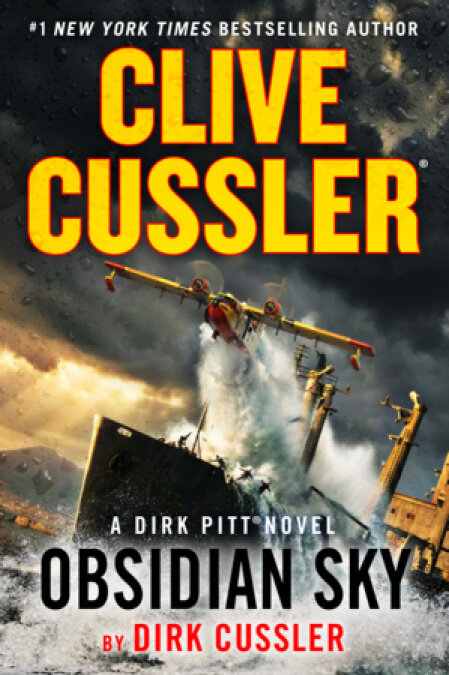
A forgotten civilization. A lost Biblical artifact. A criminal enterprise lurking beneath the seas. What links them with a potential cataclysmic event that threatens all of humanity? That’s the question facing Dirk Pitt in this latest electrifying novel in the beloved New York Times bestselling series created by the “grand master of adventure” Clive Cussler.
When National Underwater and Marine Agency director Dirk Pitt rescues a team of archaeologists trapped in a cavern by an earthquake, an unexpected artifact is discovered that rewrites history. A two-thousand-year-old silver scroll contains a message in a language more ancient than Phoenician and offering clues to a priceless treasure from antiquity.
While they work to decipher the message, another mystery arises. A freighter has disappeared without a trace in the Mediterranean. When Pitt and his partner Al Giordino find the wreck, they discover that the cargo—a large scale particle accelerator capable of creating plutonium and radioisotopes—is missing. In the wrong hands, its use could spell disaster for Western civilization.
It’s only the first step in a perilous journey to uncover a trail of drugs, deceit, secret technology, and a conspiracy that threatens the planet. From a desperate car chase in the hills of Sicily, to a wild escape on a Spanish river, to a harrowing ride on an underground boring machine, the race begins to connect the pieces in a puzzle with very ancient roots but deadly modern consequences. Only Pitt can discover the truth and halt the plans to extinguish humanity and turn the skies to obsidian.
Release date:
November 10, 2026
Publisher:
G.P. Putnam's Sons
Print pages:
496
* BingeBooks earns revenue from qualifying purchases as an Amazon Associate as well as from other retail partners.
CAUTION: This email originated from outside of Penguin Random House. Please be extra cautious when opening file attachments or clicking on links.
1
The Mediterranean Sea
September 14, 2028
It was a calm night for a killing.
A warm North African breeze blew softly across the dark sea, nudging only a few sporadic whitecaps. High clouds draped the sky in a charcoal glaze, hiding the cobalt stars beyond. Only a single white light intruded on the night, glowing like a beacon on the horizon.
Under the ten-power magnification of a pair of Steiner binoculars, the light gradually split into multiple orbs. Deck lights, mast lights, bridge lights, and faintly colored red and green running lights crystallized into view.
A self-assured woman with short copper-colored hair lowered the binoculars. She had affirmed the vessel was on a direct approach to her own position aboard a black ship with its lights extinguished.
"Distance?" she asked, holding her gaze on the horizon.
Three paces to her right, the ship's captain examined a radar feed overlaid on a digital map. The interior bridge lights were also turned off, the space illuminated in an eerie glow by the various radar and navigation monitors. "Three point eight miles," he said. "She's running a true heading of one-five-zero at a speed of thirteen knots. That will put her alongside us in about fifteen minutes."
"We will engage," she replied. "Is the equipment in the proper position?"
The captain deferred to a younger, bespectacled man seated at an open laptop computer nearby. "Rodrigo?"
"Yes," the man said. "The device is configured off the port beam. It is ready to activate upon command."
"Engage the instant we are in range," the woman ordered. She turned and faced the captain.
"Once the ship is disabled, position us alongside. I'll lead the team across. Just make sure," she added, a heavy cruelness in her voice, "that not a single person escapes."
First Officer Ernst Brugel took a swallow of lukewarm coffee, then stared out the bridge window with the watchful gaze of a Las Vegas blackjack dealer guarding the casino chips. Despite the calm seas and light marine traffic, he was ever vigilant on the night watch, particularly in this region of the Mediterranean. Migrants from North Africa were still attempting the perilous journey north to Italy or Greece in small overcrowded boats and rafts. Brugel didn’t want a nighttime collision with an unseen craft on his conscience, particularly with so many women and children refugees at risk. He scanned the dark seas ahead every few seconds like clockwork.
The ship beneath the Belgian officer's polished shoes was about as nondescript as they came on the high seas. The Arabell was classified as a break-bulk carrier, otherwise known as a general cargo vessel. Just under five hundred feet long with a hull painted midnight blue, she was the type of ubiquitous freighter that was once the workhorse of the seas, until displaced by the massive container ships that could carry ten times as much cargo.
Hundreds like her still plied the seas, carrying large or unwieldy cargo that was unsuitable for containers. In the case of the Arabell, it was a mix of farm equipment and technical components shipped from the German port of Hamburg en route to Athens. The trip was something of a milk run, Brugel thought. The weather had been fair throughout and a lengthy anticipated turnaround in Athens meant he would have time to visit the acropolis after the ship's arrival in the ancient capital port.
Brugel looked from the window to a large X-band radar monitor, which painted a digital picture of the open sea ahead. The executive officer cautiously regarded the triangular notation of another vessel approaching the Arabell a few miles ahead.
The helmsman, a squat Croatian with a blond buzz cut, studied the monitor as diligently as Brugel from his station at the center of the bridge. "She was stopped for several minutes on our path, but is now moving ahead at slow speed."
"Looks sizable on radar," Brugel said. "Odd that she is not transmitting on AIS."
Automatic identification system transponders were required on all commercial ships over three hundred gross tons, publicly transmitting vessel course and identification data via satellite.
"I'll keep an eye on her, sir," the helmsman said.
The Arabell was sailing on autopilot, which could easily be overridden at the ship's helm. Brugel paced the bridge as his ship plodded ahead, wary of the other vessel's position. He kept a close watch as the two ships closed on each other, mentally plotting their paths. The unknown vessel remained uncomfortably close, but on a heading where they would properly pass along each other's port side. As the ship drew near, he realized a course correction would be unnecessary.
He stepped onto the outside bridge wing and raised a pair of binoculars to study the mystery ship as it neared. There was little to observe, as all of its running lights and deck lights were extinguished. Only a faint glow was visible from the elevated bridge. From its outline, Brugel could tell the vessel appeared a near match to the Arabell, with a similar dark hull and a tall white superstructure amidships. He focused on the dimly lit bridge, where he spotted a woman looking back at him through a like pair of field glasses.
"Sir, they've turned to us," the helmsman suddenly shouted.
Brugel rushed onto the bridge and gazed at the radar screen, confirming the helmsman's warning. The other vessel was angling toward the Arabell just a few hundred yards away.
"Helm, come right to one-seven-five degrees," he barked, reaching for the VHS radio transmitter.
He quickly hailed the oncoming ship, but received no reply. Slamming down the transmitter, Brugel punched a button on the helm that activated the ship's air horn. He sent five thundering bursts from the device, the maritime warning signaling an imminent collision.
"She's . . . she's turning away," the helmsman said, a trickle of sweat running down his brow.
The approaching ship was just off the Arabell's port bow now. With agonizing languor, its prow eased away, barely avoiding the freighter. As the two ships began to pass one another, Brugel detected a high-pitched whine from the deck of the opposing vessel. The Arabell's bow lights instantly turned black followed by the rest of the exterior deck lights. A few seconds later, the bridge lights and electronic monitors all flickered out.
"Where's the emergency power?" Brugel said, stumbling to check an electrical panel at the rear of the bridge.
A backup generator momentarily sounded in the bowels of the ship. The lights flickered again, but then the generator fell silent and with it all auxiliary power to the ship.
"We've got nothing," the helmsman cried in the darkness. An instant later, he let out a bloodcurdling scream and began thrashing about the bridge like he was on fire. Brugel felt it a second later, a sudden wave of excruciating heat as if his blood were boiling. He instinctively hurled himself out the open starboard bridge wing door, crashing onto the landing and rolling behind the weathertight door. As he fell, he glanced across the bridge to the other ship gliding by. An odd apparatus with a multi-tube configuration, resembling a giant Gatling gun, was extended over the side rail and pointed at the Arabell. Brugel saw no light or flames emitting from the device, but he knew it was somehow responsible for the pain he felt.
He writhed across the deck a moment, the burning sensation disappearing as quickly as it had originated. Aft of him, he heard the brief cries of other crewmen on the vessel and then all fell quiet.
The Arabell's propulsion had failed with the electronics and the dead ship slowly drifted to a halt as Brugel crawled back onto the bridge. The silent wheelhouse gave him an uneasy sensation. He had never before seen the command deck devoid of sound, light, or human life. In the darkness, he made out the still body of the helmsman lying face down near his station. The unsettling silence was finally broken by the sound of an outboard motor in the distance.
He rose and staggered to the port wing and cautiously peered around the doorframe. He couldn't see the small boat, but the passing freighter was readily apparent. Its decks were now ablaze with lights and working crewmen on its decks as it made a sharp U-turn and approached the Arabell's port beam once more.
Brugel shook off a lingering numbness in his body and stumbled to the back of the bridge. Inside a cabinet, he found a VHF radio in a charging cradle. Grabbing the radio, he hit the power button and a green light blinked on.
"Mayday, Mayday, this is the MV Arabell. We are under attack by an unknown vessel. Request immediate assistance."
He waited for a response, but there was none. Adjusting the radio's squelch control, he realized there was no static. The radio was inoperative, just like the rest of the ship's electronics.
The radio's silence was shattered by the sound of a gunshot somewhere on the main deck. A faint cry for help sounded nearby, silenced by more gunfire. A light appeared on the bridge wing and Brugel turned to see a woman enter holding a pistol in front of her. She wore a headlamp, which cast her body in a faint glow. She had a slender body and moved in the calm, deliberate manner of a stalking panther as she entered the bridge. Brugel saw she was wearing torn jeans and an embroidered vest, dressed more for a rock concert than a sea voyage.
She moved to the center of the helm, where she stood perfectly still with her gun aimed at Brugel. She remained frozen as the drumbeat of advancing footsteps echoed from below. A door at the rear of the bridge sprang open and a grizzled man burst up from a companionway.
It was the white-haired captain of the Arabell, who had been asleep in his bunk until awakened by the ship's air horn. He was clad in a worn bathrobe and his disheveled hair sprouted like a lion's mane.
"What in the Sam Hill is going on here?" he blurted.
The woman fired twice, striking the ship's commander cleanly in the chest. The captain staggered back and fell down the companionway, his body landing with a thud at the bottom of the stairs.
The woman turned to Brugel, who remained frozen at the bulkhead. He stared back at her cold impassive eyes.
"Why?" he asked simply.
The woman replied in a crisp calm voice.
"To cool the fevered tides."
And then she squeezed the trigger again.
2
The Gulf of Mexico
Off the southwest coast of Florida
A steady vibration from the marine diesel engine thrummed through the wooden decks of the aged trawler as it crept north under a moonless night. The dingy, rusted vessel was nondescript by design, appearing like a thousand other shrimp boats that plied the Gulf of Mexico. Only an interior inspection would reveal its upgraded engine and surplus fuel tanks that allowed a round-trip voyage from the Yucatán without the need to touch land.
Its outriggers were raised inboard and its nets stowed, as the boat's cargo hold was already filled. It wasn't shrimp the boat carried beneath its splintered deck, but something much more valuable.
"Where is the drop zone?" the captain asked in Spanish. A slight, unshaven man wearing a sweat-stained tank top, he gripped the ship's wheel with gnarled hands.
"Same as before," replied a smooth-voiced man behind him. "Fourteen miles due west of Cayo Costa Island."
Wearing a button-down oxford shirt, dark trousers, and custom-made Lucchese cowboy boots, Carlos Toluca was overdressed for the fishing scow. With slick-backed hair and a thin mustache, he could double for a high-class restaurant maître d'. Only his piercing black eyes, which never seemed to blink, gave the hint of a darker side.
Both men eyed the radar monitor, but the seas were empty at the late hour. Toluca stood light on his feet, scanning the horizon until they were within a mile of the rendezvous point. "I'm going to run to the head while I have a chance," he said.
Toluca slid past a third person on the bridge, a beefy, long-haired man with a Kimber .45 poorly concealed beneath a loose Hawaiian shirt.
Toluca made his way past him, garnering a suspicious gaze, then slipped out the leeward bridge wing and closed the door behind him.
He pounded down a stepladder and entered a narrow passage that fed three cabins and the ship's galley. Toluca casually glanced into the galley as he passed, relieved to count three black-clad crewmen seated inside, drinking coffee while waiting to be called to action.
Toluca smiled. That left only one crewman unaccounted for, the engineer, who was scheduled to be off duty and likely asleep in his bunk. Toluca reached his own cramped cabin and pulled a locked case from the bureau. Inside were a white hazmat suit, three unmarked aerosol cans, and a thick folder filled with documents.
He placed the folder on the bureau and secured it with a heavy metal ashtray. Inside was a detailed description of the fleet, transport protocol, key players, and, most important, details of the secret methamphetamine and fentanyl manufacturing labs operated by the Mexican drug cartel that employed Toluca.
He turned to the case and donned the hazmat suit, adding a self-contained breathing apparatus he carefully fit around his face. Grabbing the aerosol cans, he stepped into the corridor. The engineer occupied the adjacent cabin and Toluca moved to the door. He turned the handle and cracked the door, allowing a sliver of light into the dark cabin. It was enough to see the engineer asleep on the upper bunk.
Toluca activated one of the canisters with a metal clip, set it inside the cabin, and closed the door. He crept down the passageway, ignoring the men in the galley for the moment, and moved silently out a side door to the portside deck.
There he removed a wall-mounted gaff. Using a roll of duct tape, he secured the second can to the gaff's metal tip and pressed open the nozzle with a clip. He quickly raised the pole and secured it to the bulkhead.
Looking up, Toluca confirmed the can was spraying its aerosol mist alongside the open bridge door, blowing into the compartment with the offshore breeze.
He ducked back into the corridor and crept toward the galley. Through his protective head covering, he could hear the voices of the three crewmen inside.
Activating the final canister, he stepped to the doorway and tossed the can into the galley. The three looked up in surprise at the man in the hazmat suit as the can rattled across the floor.
Toluca slammed the door shut and gripped the handle as he braced one leg against the doorframe. Seconds later, fists began pounding on the door, joined by desperate shouts. Gradually the clamor faded to silence.
We hope you are enjoying the book so far. To continue reading...

 Please log in to recommend or discuss...
