
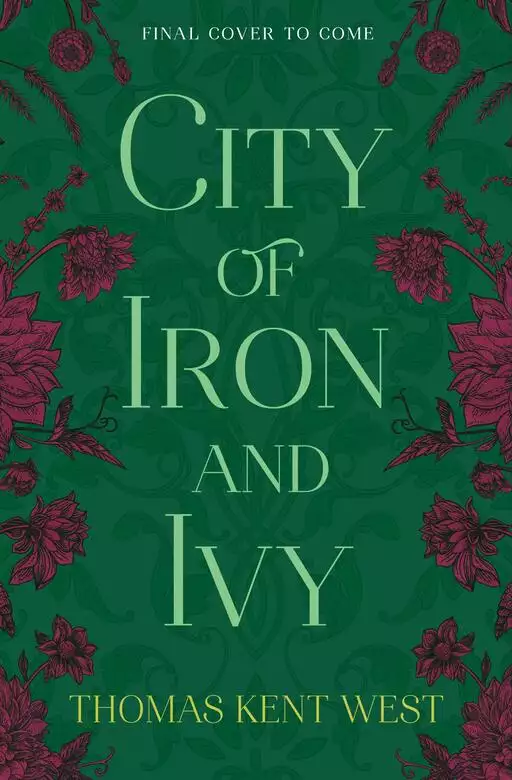
City of Iron and Ivy
- eBook
- Paperback
- Audiobook
- Book info
- Sample
- Media
- Author updates
- Lists
Synopsis
This beguiling historical romantasy debut blends dark academia with the glamour of Bridgerton, as a scholar of magic investigates her sister’s murder—perfect for fans of Heather Fawcett and H. G. Parry.
In an alternate London alive with botanical magic, Elswyth Elderwood is a thorn among roses: a bristly, scarred scholar in a world of socialites. Her sister Persephone is the opposite: a graceful debutante seeking a marriage that will save their family from ruin. At least, until Persephone is murdered.
Suddenly the last scion of her house, Elswyth must abandon her studies and find a wealthy husband. She is thrust into a London fueled by floromancy: hedge witches sprout nightshade from their fingertips, high-born ladies weave gowns from wildflowers… and a serial killer called the Reaper transforms his victims into plant-human hybrids.
When clues suggest the Reaper is a powerful nobleman, Elswyth’s search for her sister’s killer and her hunt for a husband become one and the same. But she is drawn to bastard-born archaeologist Silas Blackthorn—who may have dark, twisted secrets of his own.
Elswyth must determine friend from foe and lover from liar—or suffer the same fate as her sister.
Release date: April 21, 2026
Publisher: Grand Central Publishing
Print pages: 544
* BingeBooks earns revenue from qualifying purchases as an Amazon Associate as well as from other retail partners.
Reader buzz
 Please log in to recommend or discuss...
Author updates
City of Iron and Ivy
Thomas Kent West
Two months later, beneath the red sky of sunrise, along past the city and the moors and the ancient woods, a girl tied a ribbon in her hair. She sat before a window in her dressing room in the crumbling manor that was her home. The window—a weave of colored glass and tracing stone—looked out over the grounds of Elderwood House, now covered in January snow. It had begun to fall the day they received news of Persephone’s death and had not ceased since. Now it lay like a shroud over the grounds and the forest, even reaching the sea. White waves lashed the shore, their sound repeating like a dirge.
Her handmaid laced Elswyth’s gown, pulling it taut—there was no resistance from her figure. The dress, which had fit mere weeks prior, now slipped from her pale shoulders. The gown was nothing extravagant: a black wool petticoat and jacket, set over a cotton shirtwaist. It was a scholar’s attire, modest, practical, and black. Elswyth dressed for a funeral, after all, and so modest was appropriate, and black was expected. But the dark dress managed to make her scar seem almost crimson in comparison.
Elswyth, looking out over the grounds, caught her reflection in the glass of the window, imposed over the snow and the dark wood beyond. She stared at herself, but did not meet her own gaze. Instead, she looked at her scar.
Without it, she was the picture of a young lady: pale, fine featured, chastely dressed. But the scar changed that. It tore across her left side, arcing into rootlets. Her left eye was gray, nestled in the branches of the scar, while her right eye remained a gentle green. Her lip puckered at the edges where the scar crossed it, giving her a permanent sneer. She almost never smiled, but if she did, the left side of her face was slower to respond than the right.
Elswyth brought her hand to the scar and then concentrated, secreting a layer of arrowroot powder from her fingers. She rubbed it in, watching the red lines fade but not vanish. That scar would always be with her, no matter how she tried to hide it. And so—no matter the paleness of her skin or the fineness of her gowns—she would always be hideous.
Elswyth summoned asphodel to her skin: white petals and star-gold filaments. They appeared in bunches behind her ears, pricking through her skin as though it were soil. With a breath, she pushed vitæ into the flowers, though not enough to drain her. She was frail enough already.
But Persephone had always loved asphodel. She had said the starlike blooms made her look heavenly. Elswyth never cared for floriography, but the meaning of asphodel in the language of flowers haunted her: My regrets follow you to the grave.
She faced her lady’s maid, who offered a black veil. Elswyth touched the familiar fabric, lace and silk organza woven with roses and ivy along the trim—roses for grief, ivy for immortality. The same veil she’d worn for her mother’s funeral, not ten years ago.
Elswyth kept her face stern as the maid placed the coronet of the veil beneath her crown of asphodel. The lace obscured her scar. For that, at least, she was grateful.
Her father’s coach waited on the gravel carriage circle. Staff flanked the entrance as Elswyth walked through the great doors of Elderwood House. Like the manor itself, the staff had seen better days. Chamberlain, gardener, laundress, groom—all of them cast their eyes downward, as though they too believed the death of Persephone meant the death of the Elderwoods.
They bowed as she passed, and Elswyth did her best to keep her gaze forward. They would never truly love her, not like they’d loved her sister. All they’d ever see in Elswyth was her scar. And who could blame them? If Elswyth was kindlier, more graceful, perhaps they would look past her deformity. But she was not kind, and she was not graceful. Of course they preferred Persephone.
Elswyth stopped before the coach and then looked back at the house, once the seat of the Elderwood kings, now half a ruin. The roof of the east wing had long since rotted through, leaving naught but stone walls and empty windows, their baroque tracery hinting at the former glory of the place. Ivy had taken back what people had given up, and it curled through the broken stone, winter-dry and ancient.
The coachman cleared his throat, and Elswyth handed him her parasol before allowing him to guide her into the carriage. Inside, her father and grandmother waited.
Her father was an austere man, strong but bent by age, like an old oak. He had a pronounced nose, proud and straight, and the rough-lined face of a wooden carving. Two sprigs of rowan sat behind his ears, forming a funeral laurel. Small details set apart his suit as that of a once-wealthy lord: embroidered branches along the cuff and a pocket watch sitting open on his lap, the golden case engraved with the crest of their house: a circuitous elderwood tree, its roots intertwining with its branches, with a lone eye at its center.
“You’re late,” he said, tapping the watch. He knocked on the wall of the carriage, and the coachman stirred the horses forward.
“Forgive my grieving,” Elswyth said, not meeting her father’s eyes. Next to him, her grandmother sat hunched, her face covered in a thick veil. Beneath her cloak, her body was lumpy, malformed. Her gnarled hands clutched a cane of elderwood.
“Elswyth?” her grandmother asked. Her voice was weak, like the creaking of a distant tree.
Elswyth put her hand on her grandmother’s. “Yes, I’m here.”
“A beast,” she whispered, “pale horses…”
Elswyth frowned. Little of what her grandmother said made sense these days. She patted her hand gently. The woman’s rheumy eyes gazed out from under the veil, barely visible through the cloth.
Outside, the carriage rolled down the hill, away from Elderwood House and into their estate. The ancient forest called the Wildwood sprawled over the valley behind the house, into the hills beyond. Before them, the road led downward, toward the village and the sea.
Her father cleared his throat. “You look lovely.”
“Loveliness was not my ambition for my sister’s funeral.”
“It was a compliment.”
“Find something else to compliment, if you must.”
Her father frowned and looked out the window. Her grandmother kept mumbling, “Little babes in the wood.”
“Has anyone tried to claim the reward?” Elswyth asked. She kept her voice steady, still avoiding her father’s eyes.
Her father shook his head. “Nothing. Perhaps that is for the best.”
Elswyth bristled at the look of resignation on her father’s face. She gripped her skirt so tightly that her fingernails bit through the fabric and into her palm. When she spoke, she struggled to keep the ire from her voice. “Would you not gladly pay that money to see her returned?”
“If I thought there was any chance of her returning.”
“Because you believe she is dead,” Elswyth said. The word dead came out like a curse.
“A labyrinth of bones,” her grandmother said. “An amber eye.”
Elswyth released her gown and took her grandmother’s hand again. She tried to find some softness for the old woman, even through the frustration she felt with her father. “Hush now, Grandmama.”
Her father looked at the old woman, visibly irritated, and then lowered his spectacles over his nose. “Because she has been declared dead, yes.”
Elswyth folded her hands in her lap and tried not to fidget. They had had this conversation before, of course, and it had always ended in tears or shouting. It was true that the Metropolitan Police had closed the investigation into her sister’s disappearance and declared her dead. But only two months had passed since Persephone had vanished, and declaring her dead seemed conspicuously premature. Elswyth sent daily letters asking why they had closed the investigation, but she received nothing but the standard responses for grieving widows in return. Sometimes they even forgot to replace the word husband with sister. “With what evidence? There is no body. She could have run away. She could have been kidnapped, or gotten lost, or—”
“For Eden’s sake, Elswyth! I am not having this conversation today. We are going to her funeral. We are laying her to rest.”
“A prince of leaves,” her grandmother whispered. “A mask of serpents.”
Her father rounded on the old woman and shouted, his face blooming red. “Damn it will you be quiet!”
Elswyth placed a hand defensively over her grandmother’s. “Do not scream at her,” she said. “She is ill.”
“Mad, is what she is, like all the women in this family,” her father said. He closed his eyes, letting his head fall back on the seat.
Elswyth said nothing. Instead, she watched the veins under her father’s eyes, the papery skin there stained with violet. She listened to his ragged breathing and watched his eyes flicker beneath their lids like a man falling into dreams, and her rage subsided for just a moment, replaced by pity, and sadness, and fear—everything she had been hiding from herself since the day Persephone vanished.
Her father blinked his eyes open, and Elswyth thought she could see tears beginning to form. But then he took off his glasses, rubbed the bridge of his nose, and sighed. “I am sorry, Elswyth. I suppose we are both not in our right minds. But I do not care to hear any more of your conspiracies. For just today, let me mourn my daughter in peace.”
The carriage stopped. A small stone chapel stood on the hillside nearby. Townsfolk trickled through the doors, coming to pay their respects. Up above, the church bells tolled, signaling the start of the proceedings.
The door of the carriage opened. Her father exited, helping her grandmother down, and then Elswyth was alone.
After the vicar said his piece and the mourners had cleared into the church courtyard, Elswyth stood atop the hill with her father, watching as the empty coffin was lowered into the ground. She’d pushed her grandmother’s wheelchair to the cemetery, where the grave sat beneath an ancient elderwood tree. Elderwood trees were often planted in cemeteries. Or rather, cemeteries often sprung up around elderwood trees. The leaves of the elderwood made a distinct whispering sound when moved by the wind, which the ancients had believed were the voices of the dead. The trees themselves were completely without color, bone-white from the deepest root to the tip of the highest leaf, and at night they glowed faintly, casting eerie white light over their graveyards. She supposed it had never been an auspicious namesake for their house.
And now the last remaining members of the House Elderwood stood before an empty coffin and an empty grave and prepared to pay respects to a person who was not there. Who might not—Elswyth dared to think—even be dead.
Her mother’s grave sat next to Persephone’s, its headstone already beginning to fade. The wind from the sea bore down relentlessly upon the stones. Her ancestors’ graves were little more than nubs, their headstones worn down by the centuries, their names lost to time.
They stood in a circle of black-clad mourners. There stood the vicar, saying his final verse: The grass withers, the flower fades, but the Gates of Eden stand forever. A few lords had come to pay their respects, but not many; the House of Elderwood—once kings in their own right—had long since faded into obscurity. A crowd of townsfolk waited behind the nobility. They wore their best clothes, little more than cotton tunics and breeches or a sheath of dyed wool for a gown. Fungus had blighted last year’s crop, and the common folk had suffered for it; Elswyth could see the bones in a small boy’s wrists, jutting out beneath his finest cotton shirt.
The wind stung the skin of her cheeks and tore at her veil, but she bore it, persisting even through the cold and the endless dirge of the bagpipes. Persephone would have hated it—there were not enough flowers, nor any eligible bachelors. If Persephone could have planned her own funeral, Elswyth thought, it might have actually been enjoyable.
But Persephone was not there. She would never plan another party. She would never don another gaudy dress, or steal another bottle of wine, or tease Elswyth for being boring and bookish. She would never love, or cry, or dance, or gossip. Would never wed some silly man and bear spoiled children as she always meant to.
No, Elswyth thought, setting her jaw. There was no body. The police might have stopped looking, but that did not mean Persephone was dead. London was a city of millions, endless miles of twisting streets and darkened alleys. Somewhere in that faraway city, Persephone might still be alive. Her father and the police might be willing to give up on her sister, but Elswyth would not—she could not.
A line formed to pay respects. Elswyth was second. She watched her father kneel in the snow, whispering. He summoned a clutch of funeral lilies to his hand and dropped them onto the casket. When he stood, he kept his head low, so that the others did not see his tears. Elswyth bristled at this, that he would weep for Persephone even as he turned his back on her.
Elswyth stepped toward the grave, staring at the casket of polished oak. She closed her eyes, summoning a bouquet of asphodel from the veins at her wrist. Then she dropped it onto the coffin. My regrets follow you to the grave, dear sister.
When Elswyth had finished she walked away quickly. She did not want to see the pitying looks of the other mourners. Did not want them to wonder why she shed no tears, why her face was a mask of rage rather than grief. But when she returned to her grandmother’s chair, she found it empty. Elswyth spotted the old woman across the graveyard, standing beneath the elderwood tree.
She hurried to her. It was considered bad luck to touch an elderwood, but her grandmother seemed not to mind. She rested her old hands on the wide trunk and mumbled to herself.
“Grandmama?” Elswyth said. She put a hand on her grandmother’s back and tried to lead her away, but it seemed as though the old woman was fixed there, rooted to the ground.
“Persephone?” her grandmother whispered.
“No, Grandmama. It’s me. It’s Elswyth.”
“Where is Persephone?” Her grandmother turned to face Elswyth, her ancient face shifting beneath the veil.
The question broke Elswyth’s heart. What was she to say? Would her grandmother understand if she told her the truth? And what was the truth?
“I don’t know, Grandmama.”
Her grandmother turned back to the tree. Her fingers caressed it, moving over the eyelike knots on the trunk. “With the bones now,” she said, “under the earth.”
Elswyth shook her head. Now, of all times, tears came. They pricked her eyes, making her voice waver. “No. No, I don’t believe that. Persephone is gone, that much is true. I don’t know where, and I don’t know why.” Elswyth took her grandmother’s hands from the tree, placing them in her own. Her voice shook with anger. “But I’m going to find her. I’m going to find whoever did this to her.”
A sudden wind tore across the cliffs. It lifted her grandmother’s veil, revealing the horror beneath: a face half-warped and knotted with wood, lichen crusting her jaw, twigs sprouting from beneath folds of skin, and galls dotting her flesh like pustules. The warping—that curse of all floromancers—had taken most of her body now, as it had her mind. Her grandmother stared into the distance, clouded pupils set amid green veins. But in that moment, under the tree, she seemed almost lucid. She looked at Elswyth as though she recognized her.
“As you should, my dear. And Elswyth?” Her old hand gripped Elswyth’s wrist with shocking strength. “When you find him: Kill the bastard.”
Elswyth shivered at the venom in the old woman’s voice. Then, as suddenly as her grandmother’s lucidity came, it vanished. The grip on her wrists slackened, and recognition left the old woman’s eyes. They began to drift, focused on nothing.
“Persephone?” she asked, her voice a whisper once more.
Elswyth frowned, leading her grandmother toward her chair and lowering her in.
Elswyth took the handles of the wheelchair and they left the cemetery, her grandmother mumbling about grapes. Behind her, the leaves of the elderwood whispered.
Elderwood trees, Orcus luminii, are known for their unusual pale color and their ability to produce light through a process called bioluminescence. Although rarely used in floriography, including elderwood leaves in a bouquet is said to mean Death walks with you.
Two weeks passed, and Elswyth stood in the hall outside her father’s study, clutching a letter in her hands. A letter that—she hoped—would change everything.
The room beyond the door was drenched in shadow. It was early evening, but embers crackled in the hearth, casting a flickering light over the study. The fire did little to stop the cold, which leaked from the old stones as though the house itself were made of ice.
“Father?” Elswyth asked, sliding through the door and into the study.
Once she’d loved that room, with its towering shelves filled with dusty books, its mahogany walls, and its wide desk scattered with papers. There was a carving of her name and Persephone’s underneath that desk from when they were children. A little secret once shared that now belonged only to her.
A portrait of their family hung above the hearth. Her father, young, hair still coppery brown, body strong as an oak. Persephone, silver-haired and violet-eyed, standing primly at his feet. Elswyth, ever dour, even as a girl, even before her scar, with straight red hair and hands folded in her lap. And her mother, willow-thin and beautiful. Her emerald eyes, captured in oil forever, looking down on Elswyth from the past.
There were two chairs before the fire, high-backed and upholstered in damask. Her father slouched in one of them, wearing his evening robe. She could see the balding back of his head and see the contents of the small table next to him: a bottle of whisky, its amber insides flickering in the light of the fire, and a smaller bottle made of emerald glass. A rubber dropper lay next to it, discarded. She could smell the bittersweet sting of laudanum.
Elswyth hesitated, then moved to the chair opposite her father and sat. She reached across the table and touched his hand. “Father,” she said.
Her father woke with a start. His eyes were bleary and bloodshot, and a thin sheen of drool edged at his mouth. He stared at her, surprised, and then wiped his lips with the back of his sleeve.
“Elswyth,” he said, “what are you doing here?”
“I came to check on you. You were not at supper.”
“Ah. Yes, well, I’ve been working.”
He looked over her shoulder to the pile of papers stacked high on his desk. Invoices and ledgers, no doubt, along with letters from their lenders. Those letters had sat unanswered on his desk for months, since the news of Persephone.
Elswyth cleared her throat and forced a smile. “As have I, Father. I have news.”
She hesitated and then handed the letter across the table. Her father looked confused, but took it, reaching for his spectacles. His sleep-stained eyes scanned the page, pupils two pinpricks of black. His nose—once regal, stern as the bow of a ship—had turned red and soft in the past few months. Faint veins traced their way across it and across his cheeks.
“What is this?” he asked.
Elswyth’s smile faltered. “A letter of acceptance. From Oxford. They’ve begun accepting women, and I applied. Father, they want me to join them in the autumn. The Imperial Botanical Institute.”
Her father stared at her over his spectacles, looking exhausted.
“Oh, Eden’s Ashes, Elswyth. I thought we’d come to an understanding.”
“You said that, if I were accepted, I could earn my degree before marrying. You said—”
“I know what I said. But that was before Persephone. If she found an auspicious match, you could delay marriage in pursuit of an education. Things have changed, Elswyth. Surely you must see that.”
“What has changed? Why can I not pursue my education?” Elswyth tried to keep her voice even. She’d written down what she had planned to say, but already the words slipped away, and anger built in their place.
“Elswyth, you are already eighteen. By the time you are finished with university, your options for a husband—for a good husband, one who can help us—will be severely limited. Wait too long, and you’ll wind up a thirty-year-old thornback with no chance at marriage.”
Elswyth swallowed. “Perhaps—perhaps with an education, I could contribute to our family’s finances. More and more women are finding work these days, in all sorts of fields—”
“So what will you do? You will go and study botany. And who will pay for it? I see nothing in this letter about a scholarship.”
Elswyth began to speak, but her father cut her off. “And even if you do graduate, what will you do then? How many pounds does a scholar of botany make in a year? Do you know many unmarried female botanists who can support a household?”
“There are many applications. Pharmacy, medicine, academia—”
“They’re letting women become professors, now? That surely is news to me. Or was your thought to become a midwife? A corner-store druggist? Perhaps a hedge witch.”
Elswyth gripped her skirts until her fingers turned white. “It would be better than being some lordling’s broodmare.”
Her father’s face blanched. “Elswyth, you will not be a broodmare. You will be the lady of a house. Your mind will be well occupied with the keeping of the estate and the social status of your family. And yes, you will have children, but is that so terrible? You and your sister were—are—the light in my life, Elswyth. I only wish for you to have the same. You might even study. There are women’s interest groups, gardening, floriography—”
“I do not want to study gardening. I do not want to spend my life taking walks and throwing parties and cleaning up after children. Is it really so hard to understand that I wish to have a say over what happens to me? Is it not my life, after all?”
“You will not have a choice if we cannot pay our debts. A proper match—to a wealthy gentleman—could save us. Persephone understood that. And now that she is gone…”
Her father removed his spectacles and rubbed his eyes. “I have always wanted what is best for you, Elswyth. I have supported your studies. Sent you to the best schools our name and fortune could provide. But now… now it is time to put your own interests aside for the interests of your family.”
Elswyth shut her eyes. She knew she would regret what she said next before the words left her.
“And why not you, Father? You are not far past fifty. Young by no account, but certainly not too old to sire an heir. Why is it me, and not you, who must bear the future of our house on their shoulders?”
His eyes drifted up to the portrait of his late wife. “And who would want me, my dear? A penniless old man with barren lands and a broken castle.”
“A penniless viscount is still a viscount. I’m sure there are many who would marry you for the Elderwood name alone. There are plenty of wealthy heiresses looking for a title. Were we not once royalty?”
“And besmirch the reputation and good breeding of our house with an upstart? The reputation of our house is all we have, Elswyth. The Elderwood name stands alongside the likes of Plantagenet, Angevin, d’Orange—ours is the blood of kings. Not commoners.”
“And yet we die like them, don’t we? So what good is our ancient blood? There are but two of us left, Father. Persephone and Mother are gone. Grandmama is a ghost already.”
As if in response, the wind beyond the castle walls moaned. The fire shifted in its hearth, and the carved eldren on the mantel shifted as well, the flickering light making it seem alive.
When her father spoke again, his voice was quiet. “Do not speak to me of my wife’s death,” he said. “You of all people.”
Elswyth’s face burned. Heat prickled through her scar, and she turned away, hiding it.
Her father sighed. “I am sorry. That was cruel,” he said.
Her father stood, shakily. He picked up his glass and moved over to the fire, placing a hand on the mantel. For a moment, he only stared into the flames. Then he took a long drink. “I had not planned to tell you this, Elswyth. I had hoped—I had hoped that you would go willingly.”
“Tell me what?”
Her father looked at her. His mouth opened slightly, as if he did not know what to say.
“I am dying, Elswyth.”
A peculiar silence settled over the room. Her father’s four words sank like fangs into her throat, tightening until she could no longer breathe.
“What are you saying?” she asked. But her voice was too small and far, far away.
“I am ill. That is why I cannot marry. I’m afraid that, in my grief over your mother, I waited too long to find a new wife. I will not sire a son. Not now, not ever.”
“You are…” Elswyth started, then shook her head. “How? What is wrong?”
“The warping, Elswyth,” her father said.
Elswyth’s mind swam. Her father showed no signs of the growths and galls that plagued her grandmother. The disease was common enough among older floromancers, even those with little ability, like her father. When her thoughts finally settled, her words came out in stops and starts. “But that is not a death sentence, not necessarily. Grandmama has been living with her warping for a decade. There are treatments, medicines…”
“The doctor has excised all the growths he can. But your grandmother’s warping is on the outside. Mine is in my organs, Elswyth. It’s in my bones.”
He absently put a hand to his stomach, staring into the fire. She imagined what that must feel like—to experience the slow growth of plants inside one’s body, growths that one could not control. How painful it must be.
“How long?” Elswyth asked.
“A year, perhaps,” he said. “The doctor has prescribed laudanum for the pain, and it helps some. But it won’t stop the growths.”
Her father turned to her, set his glass on the mantel, and pulled back the sleeve of his robe. There, under the silk, she could see fresh wounds where some of the galls had been cut away. But even in the bloody patchwork of his forearm she could see new growths forming, spots of black lichen and the tips of crooked branches breaking through the skin.
“It’s spreading quickly. Soon, I will not be able to hide it. There is no hope for me in finding a match, not with a death sentence so close and not a penny to my name. I am sorry, Elswyth. You are all we have.”
A thousand emotions moved through Elswyth, amorphous, ineffable. She settled on anger so that she would not be sad or frightened. Even so, her words came out tearful. “When were you planning on telling me? How long have you known?”
He sighed. “It began about a year ago. My plan was to see you and your sister married before I passed. I could not, in good conscience, leave you unprotected in the world. I never told Persephone. I didn’t want to trouble her during her season, and I knew she would find a wealthy husband without my prodding. And then Persephone was gone, and you were grieving her—how could I have told you then?”
Her father’s voice began to break, and Elswyth felt her heart would break with it. “But now I fear I have no choice. I am sorry for keeping this from you for so long.”
The weight of it was too much. First her mother, then Persephone, now her father. Her grandmother would follow soon, and then Elswyth would be alone. The last Elderwood.
“Father, I… I do not think that I can bear it if you die. There must be something we can do.”
Her father moved to her, knelt, and put his hand on hers. He looked up into her eyes, and she tried not to weep.
“That is not for you to worry about. I am working with very good doctors. I may see a few years yet, if I am lucky.”
“But—”
“Elswyth,” her father said, sternly. He took both her hands in his own. “There is nothing you can do for me. You must look to your own future now. Women may be able to inherit some things now, yes, but not a lord’s land or a lord’s title. When I die, you will be destitute. You must find a husband. And soon.”
Elswyth blinked her eyes. She stood, dropping her father’s hands and moving to the bookcase. She looked at the old volumes for a while as she wiped the tears away. She straightened her skirts, lifted her chin, and then turned around, poised.
“And how do you suppose I do that, Father? I am certainly not the most agreeable woman, nor am I the most beautiful. What man will want a wife with the scars I bear?”
“In that respect, I suppose I do have some good news. You… already have a proposal.”
Elswyth hesitated. “From whom?”
“Your cousin. Mr. Ficus Elderwood.”
Cousin Ficus—a mean little man and nearly twice her age. He used to bring Elswyth and Persephone sweets when they were children and then take them away, lest they get too fat. Cousin Ficus, who always came sniffing around their house as if he owned it. Because, he supposed, one day he would—if Ambrose Elderwood never had a male heir.
“Cousin Ficus,” she said.
“He is, w
We hope you are enjoying the book so far. To continue reading...
