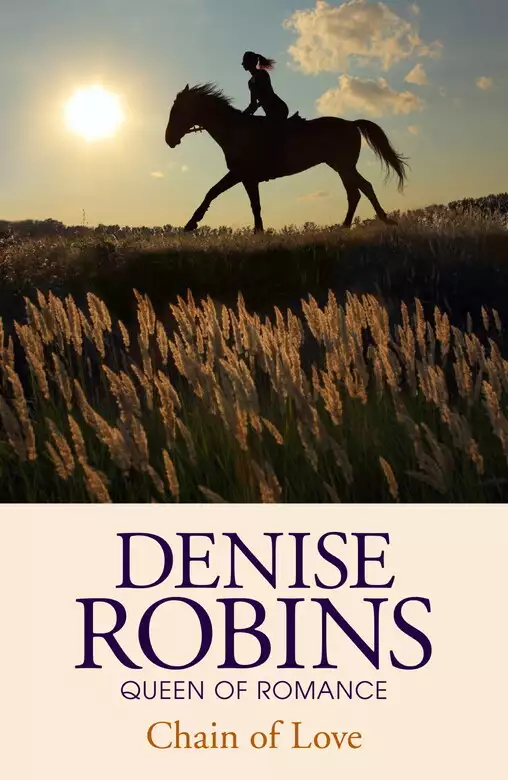
Beloved--or pawn in a game of revenge? When Rina Morrison's family browbeat her into accepting a proposal of marriage, she resigned herself to a loveless--though wealthy-- existence in Hungary. Aand a devastating encounter with the dashing Michael while she was journeying to her wedding ensured an even more heart-wrenching future for her. Now she was betrothed to one man while loving another. But did Michael really love her? In reality he was Miska the Gypsy and his bitterest enemy was Rina's fiance. It was possible that his love for her might very well be hatred....
Release date:
December 5, 2013
Publisher:
Hodder & Stoughton
Print pages:
112
* BingeBooks earns revenue from qualifying purchases as an Amazon Associate as well as from other retail partners.
WHEN Rina Morrison stood in the hall of the Hotel Sacher in Vienna reading the letter handed to her by the reception-clerk, and discovered that her fiancé was not there to meet her as he had promised, her first reaction was one of relief.
She realized that it was all wrong. Here she was, young, beautiful, romantic, a dreamer of the sweetest, wildest dreams. She ought to have come out to Vienna, en route for Budapest, thrilled and exhilarated by the knowledge that a good-looking husband, a castle in Hungary, and unlimited wealth awaited her.
But she could not work up the vestige of a thrill. She felt definitely relieved that Lionel was not there, that she would not have to spend the rest of the journey with him.
She read the last half of his apologetic letter
So sorry that you should have to travel to the Castle alone, darling, but as my mother is seriously ill, I cannot leave her. Take the Rapide straight through to Budapest. My chauffeur will meet you and drive you up to the mountains. I long for our meeting …
Rina tore up the letter and looked towards the crowded lounge. There was no doubt in her mind that Lionel Quest longed for their meeting. He had told her that he counted the hours until she would be with him. And she knew that he loved her—as surely as she realized that she could never love him.
“It isn’t fair,” she told herself. “I wanted life, a lover, love that would obliterate everything else—and I’m marrying for money.”
Rina did not want wealth. She had always longed for the luxuries and comforts of life which had been denied her—but her dreams had meant more to her than money. If it had not been for her family, she would not have crossed her own village square—let alone Europe—to marry Lionel Quest.
The family had put up a strong argument. Her mother persuaded her that it was a “marvellous match”. Her father, floundering in a sea of financial depression, openly admitted that it would be a godsend. He was heavily in debt.
It was less than three months ago that Rina had met Lionel. He had been motoring through Aversham when his car broke down near the Morrisons’ house. Lionel, hot and angry at the delay, had seen Rina in the garden with the sun on her red curls, her white tennis shorts accentuating her slender figure, and had been agreeably surprised to find such beauty in the remote English village. Five minutes later they were walking together to the nearest garage, and Lionel knew that he had met the only girl whom he had ever wanted to marry.
Rina admitted that she was impressed by his aristocratic good looks, his big white Mercedes, and his obvious adoration of her. But she did not fall in love with him.
He told her of his castle in the Hungarian mountains, where he and his family had lived for generations. She thrilled to his descriptions of the country, of the great treeless plains ringed by mountains where huge droves of cattle and horses grazed, guarded by mounted herdsmen or Csikos. But when, only a few weeks later, he asked her to marry him, she said, “No.” She did not love him. She wanted him to realize that she could not make him happy.
It was a crushing blow to the family. They liked and respected Lionel Quest, and had watched his pursuit of Rina with almost hysterical anticipation. It seemed fantastic to them that any girl could turn him—and what he had to offer—down.
Lionel returned to Hungary without Rina, but refused to give up hope. A string of letters and telegrams followed her. Every night the Aversham exchange was booked for a long distance call from Hungary.
It was more than the family could stand. The atmosphere in the little house was tense and electric. Mrs. Morrison stormed and pleaded in turn.
Was there not a young sister still at school? A brother without a job?
Rina’s father, faced with bankruptcy, prevailed upon her to change her mind. He argued that it was her duty to look after their interests as well as her own.
At last their arguments wore Rina down. She gave in, almost believing that her father was right. It probably was her duty, she decided, to marry Lionel Quest.
But now as she stood alone in the hotel at Vienna, on her way to meet him, she wondered if she had not been a weak fool. The prospect of the life she must lead in future terrified her. She knew she could never care in the way he would want or expect her to. It was a bitter pill which Fate, backed up by the family, was forcing her to swallow. A pill which would be offered her on a golden spoon bearing the Quest coat of arms. But now it was too late. She must make the rest of the journey to Hungary and resign herself to the future.
Turning to the bureau, she asked the clerk about her reservation on the Budapest Rapide. The man excused himself with a smile.
“If Madame will wait one moment. I am just attending to this gentleman’s requirements.”
Rina glanced at the man who stood next to her at the desk. He was an amazingly handsome creature—tall, with thick black hair brushed back from a tanned forehead. He spoke fluent German to the clerk, but she was sure he was neither German nor Viennese. He looked Latin.
“I beg your pardon,” she said. “I didn’t notice that you were making enquiries.”
The stranger looked down at her and smiled. He said in perfect English:
“It’s my fault for being so long. I’ve been bombarding this unfortunate fellow with questions, but I am finished now. Forgive me for having kept you waiting.”
Rina watched him walk through the lounge before she turned to the clerk.
“What a very interesting-looking man,” she said. “Do you know who he is?”
The clerk shook his head.
“I don’t know, Madame, except that he is from Hungary.”
“From Hungary?” she said curiously.
“Yes, Madame. He goes back tonight by barge.”
“But how thrilling! Can one go by barge to Budapest?”
“Certainly, Madame,” the clerk told her. “It takes much longer, of course. Two or three days.”
“It must be heaven,” she said enthusiastically. “The Blue Danube! I long to see it.”
The clerk nodded.
“It is said to be the loveliest river in the world.”
Rina half closed her eyes. She envied the handsome stranger his trip on the barge. But then it was impossible to imagine him travelling to Budapest in an overcrowded, conventional train. He was so obviously a man who had woven the correct design for living. She would gamble on that. And she would gamble that the key to the design spelt “freedom”.
Freedom! Rina smiled bitterly. That was what she had always sought for—in vain. In Aversham she had rebelled against the narrow, hemmed-in life of the village. She had grown to loathe the complacent, smug attitude of her friends. The constant round of tennis and bridge parties where one saw the same old faces bored her. During the last few years she had managed to drift away from them, and had gained the reputation for being a recluse. That did not worry her. She was happier in her own room, or in a secluded corner of the garden where she could dream her dreams and build her “castles in the air”.
They had been wonderful castles, very like the one which Lionel had described to her. But always in the dream castles she was married to the man she loved. That castle had been merely a background to her lover.
Now her hours of freedom were rushing past. If she went by train she would be with Lionel tomorrow morning. But if she went by barge it would mean another three days of liberty. And it would be so lovely to go down the Danube—to see life—real life—perhaps real romance.
Rina made up her mind at that moment. She would go by barge. She would snatch at her last chance of liberty.
There was no definite desire at the back of her mind just then to follow the attractive stranger. She might never see him on board. It was something deeper, fundamentally, that made her cancel her reservation on the Rapide and book a cabin on that barge. The thrill of freedom, of adventure, of all that would be denied her once she was the wife of Lionel Quest.
She wired to Lionel that she would be three days late. She would explain when she saw him—no explanations now. Then she collected her luggage and took a taxi to the quay.
It was with a queer feeling of excitement that she boarded one of the old grey barges which take passengers and cargo down the broad, shining river through Austria and Hungary. She felt it was a crazy thing to have done; but when they were moving quietly away from Vienna she stood on deck, looking about her with bright, eager eyes, and was glad—terribly glad—that she had come.
The night was perfect, warm and windless. The river, jewelled with moonlight, reflected the red and green glow of lights from other passing barges and boats. Opposite her lay the dark shadow of the shore … woodland … forest, hill and an occasional old castle with gardens sloping down to the water. Like a scene from a Hans Andersen fairy-tale, she thought. And no Lionel or his mother to worry her—nothing to jar her nerves.
Rina leaned over the rail and lit a cigarette. She felt that life was good. One could forget everything on a night like this. The gentle lapping of the water against the boat fascinated her. Then suddenly she turned and looked over her shoulder. A shadow had fallen between her and the moon.
“This is a surprise,” said a rich, musical voice. “You, too, are journeying by barge to Hungary?”
She recognized the tanned face of the man from the hotel. The colour rose to her cheeks.
“Yes.” She smiled. “I’m going to Budapest.”
“That’s grand,” he said. “You’re wise to have chosen the river. Think of a train on a night like this!”
Rina looked up at the stars.
“I was thinking that the Danube—this river-trip—is the most exciting thing that has ever happened to me,” she said softly.
The man looked at her critically. She was very lovely, this English girl. That small vivid face with the retroussé nose was fascinating. Her figure in well-cut tweeds was perfect. If ever he had pictured a woman he could love madly, it was a woman like this one—young and fresh, with red hair, green eyes, and skin like white satin.
“You are going to live in Hungary?” he asked.
“Yes,” she said.
“Then Hungary is fortunate.”
Their eyes met. Rina felt her heart quicken. What was the matter with her? She was being crazy. But she found herself eager to smile back at him.
“You live there, too?” she asked.
“Yes, in the far mountains. I love Hungary. It’s a wild, splendid country—lawless, in many parts.”
“That sounds frightening!”
“Not so frightening as the word ‘law’ to me.”
“What do you mean?”
“That no sane person can want to be hidebound by convention.”
His words found an echo in her heart. She agreed with him. She was so dreading her life with Lionel and his essentially conventional family. But for the next three days she was determined to forget about the future. Nothing would be allowed to spoil her days and nights on the Danube. She was still free; she could do what she wanted until they reached Budapest.
Free to do what? To travel beside this attractive man who lived in the Hungarian mountains and led a lawless existence? To take what life and the fates offered?
“I agree with you,” she said. “But it’s difficult not to be conventional in this civilized world.”
“Of course it is. But thank heaven we can’t be too civilized on this old barge. The Danube just wouldn’t stand for it!”
“I don’t believe it would,” she laughed. “But would it be too conventional if I asked you your name?”
“Michael,” he said. He offered no other.
“I am Rina. …”
“Rina,” he repeated. “That’s a very sweet name.”
She had never thought of it as “sweet”. But when he said it in his rich, haunting voice, she felt that it sounded both sweet and exciting.
Michael! Who was he? Why did he live in Hungary? Where did he come from? She did not know. She did not care. She only felt glorio. . .
We hope you are enjoying the book so far. To continue reading...

 Please log in to recommend or discuss...
