- Book info
- Sample
- Media
- Author updates
- Lists
Synopsis
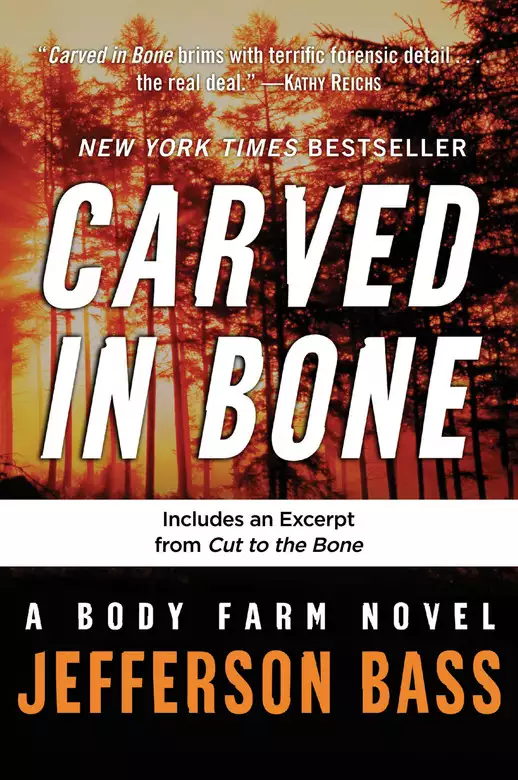
There is a patch of ground in Tennessee dedicated to the science of death, where human remains lie exposed to be studied for their secrets. The real-life scientist who founded the "Body Farm" has broken cold cases and revolutionized forensics . . . and now he spins an astonishing tale inspired by his own experiences.
Renowned anthropologist Dr. Bill Brockton has spent his career surrounded by death at the Body Farm. Now he's being called upon to help solve a baffling puzzle in a remote mountain community. The mummified corpse of a young woman dead for thirty years has been discovered in a cave, the body bizarrely preserved and transformed by the environment's unique chemistry. But Brockton's investigation is threatening to open old wounds among an insular people who won't forget or forgive. And a long-buried secret prematurely exposed could inflame Brockton's own guilt—and the dangerous hostility of bitter enemies determined to see him fail . . . by any means necessary.
Release date: March 27, 2007
Publisher: William Morrow
Print pages: 416
* BingeBooks earns revenue from qualifying purchases as an Amazon Associate as well as from other retail partners.
Reader buzz
 Please log in to recommend or discuss...
Author updates
Carved in Bone
Jefferson Bass
I PICKED UP THE hunting knife with my left hand and tested its heft, then shifted it to my right hand to compare. Golfing and batting, I’m a lefty, but I grade papers and dial phone numbers with my right. The knife felt more at home there, too. Okay, I thought, add “stabbing” to the list of right-handed activities.
The nude man lay facedown in the woods, the Tennessee sun filtering through the trees and dappling his back. Kneeling beside him, I slid my left thumb along his spine, feeling for the gap between his fourth and fifth ribs, just behind the lower chambers of the heart. Having found the spot, I set the tip of the hunting knife there—it snagged in the soft flesh—then leaned in and began to push. It took more force than I’d expected, and I found myself using both hands, plus some weight. Once the blade was deep into the muscle tissue, I cocked the handle to the left, skewing the blade in the opposite direction, toward the man’s spine. It wasn’t angling as sharply as I wanted, so I leaned harder. Still no go. I sat back and considered whether there might be some other angle of attack that would land the tip of the blade in his right lung. As I contemplated the weapon jutting from the bare back, a black-and-white SUV, blue lights strobing, roared up and slid to a stop on a concrete slab in front of me. A young deputy leapt out, his eyes wild and his face a battleground of warring impulses.
I held up my left hand, keeping a tight grip on the knife with my right. “You reckon you could hang on for just one second?” I asked. “I’m not quite done with this.” Grunting with the effort, I gave the handle one final sideways shove and bore down with all my weight. As my victim jerked and skidded from the force, a rib broke with the sound of a green tree branch splintering. The deputy fainted dead away, his fall cushioned by the corpse I knelt beside.
FIVE MINUTES HAD PASSED since the deputy’s eyelids first fluttered open, and he still hadn’t spoken, so I figured maybe it was up to me to break the ice. “I’m Dr. Brockton, but I expect you know that,” I said. He nodded weakly. According to the bar of brass on his chest, his name was Williams. “This your first visit to the Body Farm, Deputy Williams?” He nodded again.
“Body Farm” wasn’t my facility’s real name, but the nickname—coined by a local FBI agent and given title billing in a bestselling crime novel by Patricia Cornwell—seemed to have stuck. Cornwell set only a brief scene of the novel at my postmortem-decay research lab at the University of Tennessee, but that one scene—along with the facility’s catchy nickname and macabre mission—must have been enough. As soon as the book hit the shelves, the phone started ringing and the media descended in droves. The upshot is, millions of people know about the Body Farm, though few of them know its boring but official name: the Anthropology Research Facility. Unlike some of my colleagues, I don’t care which name people use. To paraphrase Shakespeare, a Body Farm by any other name would still stink.
A lot of people wonder what an anthropologist is doing with dozens of rotting human corpses scattered across (and beneath) three acres of Tennessee woods. When they hear the term “anthropology,” they think of Margaret Mead and her sexually liberated Samoans, or Jane Goodall and her colony of chimps, not physical anthropologists and their calipers and bones. But the rise of forensic anthropology—using the tools of physical anthropology to help solve crimes—seems to be elevating the profile of the bone detectives. It’s amazing what you can learn about murder victims by studying their skulls, their rib cages, their pelvises, and other bones. Who was this person who was cut into pieces and hidden in a junkyard? What’s the age, race, sex, and stature? Do his dental fillings or healed fractures match X-rays of missing persons? Is that hole in the skull from a gunshot wound or a golf club? Was he dismembered with a chain saw or a surgeon’s scalpel? Finally—and here’s where my facility has made its greatest mark over the past quarter-century—judging by the degree of decomposition, how long has this poor bastard been dead?
s of disrepair, all sorts of interesting research questions come your way. That’s why I now found myself kneeling over a corpse, plunging a hunting knife into his back.
I looked down at my “victim,” the weapon still jutting from the oozing wound. “I’m running a little experiment here,” I said to the shell-shocked deputy who had caught me in flagrante delicto. “Despite the knife in his back, this fellow actually died of a coronary—halfway through a marathon.” Williams blinked in surprise, but I just shrugged in a go-figure sort of way. “Forty years old, ran every day. I guess you could say his legs just outran his heart.” I waited for a laugh, but there wasn’t one. “Anyhow, his wife took some of my anthropology classes here at UT about twenty years ago, so when he keeled over, she donated his body for research. I’m not sure if that says good things or bad things about the marriage.”
Williams’s eyes cleared and focused a bit—he seemed to be at least considering whether to smile at this one—so I kept talking. The words, I figured, gave him something to latch on to as he hauled himself out of his tailspin. “I’m testifying in a homicide case that’s about to go to trial, and I’m trying to reproduce a stab wound—what the medical examiner’s autopsy called the fatal wound—but I’m not having much luck. Looks like I’d have to violate a couple of laws of physics or metallurgy to get that blade to follow the path the ME described.” His eyes swiveled from my face to the corpse and back to me again. “See, the ME’s report had the blade entering the victim’s back on the left side, then angling up across the spine, and finally veering sharply into the right lobe of the lung. Can’t be done. Not by me, at least. Between you and me and the gatepost, I think the ME botched the autopsy.”
I had propped the deputy against the trunk of an oak tree. By now he looked like maybe he was ready to get up, so I peeled off a glove and hauled him to his feet. “Take a look around, if you want,” I said, nodding toward a cluster of clothed bodies at the edge of the main clearing. “You might see something that’ll help you with a case someday.” He considered this, then took a tentative glance around the clearing. “Over there, we’ve got a decomposition experiment that’s comparing cotton clothing with synthetic fabrics. We need to know if certain types of fabric slow down or speed up the decomp rate. So far, looks like cotton’s the winner.”
“What difference would it make?” Ah: he could talk!
“Cotton holds moisture longer, which the flies and maggots seem to like. Keeps the skin nice and soft.” He winced, clearly regretting the question. “Up the hill in the woods,” I went on, “we’ve got a screened-in hut where we’re keeping the bugs away from a body. You’d be amazed how much the decomp rate slows when bugs can’t get to the corpse.” I turned to him. “One of my students just finished a study of cadaver weight loss; guess how many pounds a day a body can lose?” He stared at me as if I were from another planet. “Forty pounds in one day, if the body’s really fat. Maggots are like teenage boys: you just can’t fill ’em up.”
He grimaced and shook his head, but he grinned, too. Finally. “So you’ve got bodies laid out all over the ground here?”
“All over the ground. Underneath it, too. That concrete slab you just parked your Cherokee on? Two bodies under it. We’re watching them decompose with ground-penetrating radar.” He spun toward the SUV, looking all panicky again.
“Don’t worry,” I laughed, “you’re not doing them any damage, and they’re not coming after you for parking on ’em.” I felt an urge to goose him in the ribs and yell “boogedy-boogedy-boogedy!” as I might have done with a skittish student, but I resisted. “Just relax, son. Take a deep breath—or maybe not so deep, now that I think about it. Look at all this as research, not as dead people.” I paused for effect, then delivered my dramatic closing argument. “What you’re seeing here is forensic science in action.” With that, I reached down and wrenched the knife from the back of my research subject with a flourish. The blade popped free with a wet, sucking sound. A blob of purplish goo arced toward the deputy and plopped onto his left shoe, where it quivered moistly.
This time, I caught him before he hit the ground.
DEPUTY WILLIAMS, STILL LOOKING like he’d seen a ghost, threaded the Cherokee through the maze of UT Medical Center parking lots that bordered the Body Farm. “I make a good neighbor for the hospital,” I joked to Williams. “If you’re late to work, you have to park out by the Body Farm, so all the hospital employees get to work a half-hour early.” Judging by his expression, if he worked there, he’d be clocking in an hour or more before his shift.
Leaving the hospital complex, we merged onto a six-lane highway and crossed the Tennessee River on a soaring span of concrete. To our right, the bridge offered a panoramic view of UT’s main campus, sprawling along the river’s north shore for nearly two miles. To our left, the view ranged from dairy cows on the near shore to mansions on the opposite side, lining the upper shores of Fort Loudoun Lake.
Fort Loudoun—locals call it “Fort Nasty” for its cornucopia of pollutants and sewage—is one of a string of dammed reservoirs along the 650-mile length of the Tennessee River. The Tennessee actually begins just a few miles upriver from the Body Farm, at the confluence of the Holston and French Broad rivers. For a brief stretch through downtown Knoxville and past the university, the river runs narrow and brisk. Then, just past the concrete bridge Williams and I crossed, the Tennessee makes a sweeping left-hand turn, where it slows and broadens, domesticated by Fort Loudoun Dam, forty miles downstream. The inside of this big bend is occupied by a UT cattle farm; the outside, on the northwest shore, by Sequoyah Hills, Knoxville’s richest neighborhood. The mansions’ views across the water to the rolling cattle farm are stunning, but they come at a price over and above their jumbo mortgages: on torrid days, if the air’s drifting slowly from the east, Knoxville’s finest homes are bathed in the pungent aroma of cow manure, overlaid—very faintly and very rarely—with a hint of human decomposition.
Williams angled to the right where the highway intersected Interstate 40, dumping us into the traffic crawling through downtown Knoxville on I-40 East. Inching along through the latest in a seemingly endless series of interstate “improvements,” we had plenty of time to admire Knoxville’s modest architectural skyline—a couple of thirty-story bank towers, a hulking Presbyterian hospital, a few cereal-box-shaped UT dorms, and the “Sunsphere”—an empty relic of the 1982 World’s Fair that looked like a seventy-foot golden golf ball balanced on two-hundred-foot structural-steel tee. But once we cleared downtown, traffic thinned and the buildings dropped behind us, replaced by the rolling foothills and the sharp spine of the Great Smoky Mountains, backbone of the Appalachians. The Appalachians defined the entire eastern border of Tennessee. And Cooke County, Tennessee, defined—or at least personified—Appalachia at its most rugged.
Officially, the man who had sent Deputy Williams to fetch me, Tom Kitchings, was Cooke County’s sheriff. In reality, though, he was its sovereign. The title “Lord High Sheriff” had never been used in Tennessee, as far as I knew, but that term seemed to sum up Kitchings’s position in his mountain stronghold.
With its forested hills and tumbling streams, Cooke County was one of Tennessee’s most beautiful places. It was also one of the wildest, in every sense of the word. Buttressed by the rugged border of North Carolina to the east and Great Smoky Mountains National Park to the south, Cooke County was a legendary refuge for moonshiners, bootleggers, and other sundry scofflaws. Its rugged topography, tight-knit clans, and serpentine roads had kept the law at bay long after most of Appalachia had acquiesced in its own taming. Well into the era
of television, the Internet, and mountaintop condos, Cooke County had hung onto a frontier mentality—the Wild South, I guess you might say—where rough, redneck justice was the only sort of justice whose arm was long enough or strong enough to reach back into the hollows and up to the mountaintops.
But all that seemed to change when Tom Kitchings took over. Kitchings himself was a product of Cooke County—there was no way an outsider could ever get himself elected sheriff of the most clannish, insular enclave in a clannish, insular part of the state. There had probably been a Kitchings in Cooke County for as long as there had been a Cooke County, maybe longer. But Tom Kitchings was not your stereotypical hillbilly. He’d played high school football, though that part wasn’t surprising; the school was so small, every able-bodied boy was drafted to play, and they played with a vengeance. Other East Tennessee schools dreaded playing away games in Cooke County. Members of the visiting team—including my son, Jeff—invariably limped home with sprained ankles and bloody noses; some returned sporting fewer teeth than they’d gone up there with. Kitchings, though, was not just a thug in pads; he was a gifted athlete. He ran tailback for Cooke County High, and he was good enough to win a scholarship to UT during a period when UT had its pick of the best athletes in the Southeast. He looked to be on the fast track to the NFL—he rushed for a thousand yards his sophomore year and twelve hundred the next. But his college career and his football career ended seven minutes into the first game of his senior year in front of 90,000 fans in Neyland Stadium, when an Alabama linebacker slammed into his left knee and shredded the ligaments.
Kitchings had hobbled home to Cooke County and dropped from sight. My son—who tracks UT players the way daytime TV fans track soap opera stars—said Kitchings was rumored to be drinking a lot, but that was all he was able to tell me. Then, six or eight years later, Jeff showed me a story in the sports section reporting that Kitchings was alive and well and had found his life’s calling as a lawman, helping tame the wild denizens of Cooke County.
The taming didn’t always go smoothly. Some years after Kitchings joined the force, his boss, the sheriff, was killed in a moonlit shootout on the edge of a two-acre marijuana patch. Pot, outsiders seem surprised to learn, is the number-one cash crop in Cooke County, followed quite distantly by tobacco. Marijuana grows tall in the cool and moist mountain air; in fact, Cooke County pot supposedly packs more punch than the crops from Mexico or Colombia, say my law enforcement colleagues. It doesn’t take a big patch to bring in good money, and the county’s roadless ridges and hollows give farmers the kind of privacy once prized by moonshiners. But every now and then, somebody’s pot patch gets busted, and sometimes somebody gets shot, though it’s not usually the sheriff.
In a special election held to fill the post, Kitchings outran his opponent—a local undertaker—as easily as he’d once outrun would-be tacklers. Since then, he’d spent a decade bringing the sheriff’s office into the modern era. With the money seized in a spate of drug busts, he bought a fleet of new vehicles: SUVs that could handle the rutted roads threading the county’s hollows; off-road ATVs that could cross swollen streams and reach hillside pot patches; even a helicopter from which he could survey his mountain kingdom from on high, with his brother, Chief Deputy Orbin Kitchings, a former army chopper pilot, at the controls.
lly gotten over his football injury. He still carried a slight hitch in his step and a fair-sized chip on his shoulder. He’d gone about as far as he could go in Cooke County, but that was leagues away, literally, from NFL stardom.
I didn’t actually know any of this firsthand. Everything I knew about Tom Kitchings came from UT fans like Jeff and law enforcement colleagues like Art Bohanan, a criminalist with the Knoxville Police Department. Unlike every other sheriff in East Tennessee, Kitchings had never consulted me on a forensic case. Not that I minded. Judging by things I’d heard from Art, getting involved in Cooke County cases was a lot like snake-handling: it was an act of faith that violated all the dictates of common sense—and it entailed a damn good chance of getting snakebit. According to Art and others at KPD, it was not entirely clear which was more venomous in Cooke County, the bad guys in the battered pickups or the good guys in their SUVs and aircraft. Nothing was certain; anything was possible.
I had plenty of time to ponder these things as the Cherokee bored east on Interstate 40, traversing the broad valley of the French Broad River. Then, just before I-40 plunged into the heart of the Appalachians, Williams whipped the Jeep down an off-ramp, skidded left onto a county road, and began threading curves that made a corkscrew seem straight by comparison.
The road had a solid yellow center line, but Williams drove as if both lanes were his alone, wandering from one edge to another. “Is this one way?” I asked, knowing it wasn’t, but hoping he might take the hint and stick to the right lane.
“One way?” He laughed easily. Now we were in his territory, not mine. “Naw, but you got to straighten these curves or you’ll never get where you’re going.” By way of demonstration, he took both hands off the wheel, and the Jeep barreled straight ahead for a hundred yards, while the center line whipsawed beneath us. “It’s easier at night, when you can see the other cars coming.” He drifted left to hug the inside of a tight curve. “Unless they got their lights off. One or two nights a year, we get a bad head-on wreck long about here.”
I switched to pondering that for a minute, but as the road grew more tortuous, my pondering shifted to another alarming topic: how many more curves could I take before I threw up? Not many, I realized, as sweat began beading on my forehead and premonitory saliva filled my mouth. I rolled down the window and thrust my face out into the bracing air, panting like a dog. It helped, but not enough to offset our continuing roller coaster ride. I pulled my head back inside. “Listen, I hate to do this,” I said, “but I’ve got to ask you to stop. I’m getting really carsick.”
He looked startled, as if he’d never heard anything so ridiculous. Carsick? On this fine road? It was the look a camel might give a parched human in the Sahara. Thirsty? Didn’t you drink some water just last week?
A pained expression worked its way from his mouth up to his eyes; then he shook his head once. “Sheriff said he needs you right away. Reckon we better keep on a-keepin’ on. Just hang out the window there and let fly if you need to.”
As if on cue, I did. Flecks of vomit spattered the gold star painted on the door. I pulled my head back in. “It’s not that simple,” I rasped. “It isn’t just vomiting. I’ve got Ménière’s disease—vertigo—and I’m about thirty seconds from getting a dizzy spell that’ll last for days. Trust me, if that happens, there’s no way I’ll be able to do whatever the sheriff needs me to do.”
He cursed under his breath, but he hit the brakes and we crunched to a stop on the shoulder beside the tumbling Little Pigeon River. Two minutes later, we were under way again. This time, we kept to our side of the blacktop, and the tires had ceased to squeal. That’s because this time I was driving.
“I can’t believe I let you talk me into this,” Williams muttered. “Sheriff’s gonna be mad as hell.”
“Not as mad as he’d be if I had to lie down in a dark room for three days,” I said. “Maybe it won’t be so bad.” I rolled down the window to dispel the acrid scent of vomit.
Ten minutes later, we rounded yet another curve, and suddenly—for the first time since we’d dived off the interstate—I could see for more than a hundred yards ahead. The road ran straight and level for half a mile, bringing us into Jonesport, the county seat. The town occupied what must have been the one patch of level ground in all of Cooke County.
Hunkering in the center of the town square was the courthouse, a two-story structure that appeared designed to repel a military siege.
Laid up in thick slabs of rough-hewn granite, its façade was broken by only a few small windows, all of them barred, and by a mammoth ironclad door that could have shrugged off a medieval battering ram. I’d seen prisons that were flimsier. Prettier, too.
“That’s a mighty stout courthouse you’ve got there,” I observed.
“Old one burned down back in the twenties,” he said. “Fellow was in jail, his kinfolks was trying to get him out. There was a shootout, then a fire. Reckon they didn’t want that kind of thing happening again.”
“Fellow get away?”
“No sir, he didn’t. First he caught a bullet, then he burned up. Thing is, he shouldna oughta been in jail in the first place. It was a goddamn frame-up from the get-go.”
“You take a strong interest in local history,” I said.
“That piece of it, anyhow. Fellow was my granddaddy.” He pointed. “Park here.”
As I eased the vehicle into a diagonal slot in front of the courthouse, I sensed a presence beside me. I glanced out my open window and saw a khaki-clad belly hanging over a pair of olive-drab trousers; a .38 dangled from a gun belt. Then a face leaned in at the window. “Williams, what in holy hell is going on here?”
I thought it best to speak right up. “Sheriff Kitchings? This is one smart deputy you’ve got.”
Both men stared at me in astonishment. I plowed ahead, full speed. “I got sick as a dog on the way up here. I was on the verge of passing out when your deputy remembered an article he’d read about motion sickness. Asked me if I’d be willing to try driving a spell, see if that helped.” Kitchings looked from me to Williams and back again. “Fixed me right up. Lucky thing, too—if it hadn’t, I’d’ve had to lay under that tree over there for a week till my head quit spinning.”
I could see a question forming in the sheriff’s mind—something about his deputy’s medical library, I suspected—so I shifted gears before the discussion could take a bibliographic turn. “Sheriff, I don’t remember having
you in any of my anthropology classes at UT,” I said. “Should I?”
He blushed and shook his head, suddenly a student being quizzed by a professor again. “Uh, no, sir, I never got around to taking anthropology. I did come to your class once, though. The time you showed slides of that fireworks explosion.”
An illegal fireworks factory in southeastern Tennessee had gone up with a bang one day, hurling thirteen people—in half a hundred pieces—through the roof of the barn where they were mixing gunpowder with pigments. It was a gruesome accident, but it was also a fascinating forensic case study, a homespun mass disaster. Before showing slides of the carnage to my classes, I always warned students a week in advance that the pictures were horrific, and I gave them the option of skipping class—that one class out of the whole semester—without penalty. Invariably, the day of the slide show, the lecture hall was jammed—standing room only, including dozens of students who weren’t even taking the class. The first time it happened, I was surprised; after that, I knew to expect it. If I were smarter, I’d have charged admission every year, then retired early and rich.
“That was an interesting case,” I said. “I think we finally got everybody put back together right, but when we first stacked up all those arms and legs, I wasn’t sure we’d be able to.”
Williams was safe now, I guessed, so I cut the small talk. “What can I do for you, Sheriff? Your deputy here said it was mighty important, but he didn’t say what it was.”
“There’s a body I need you to look at.”
“I kinda figured that. Is it in the morgue?”
“Morgue?” He snorted. “Doc, the closest thing we got to a morgue up here’s the walk-in beer cooler at the Git-’N’-Go.” He and Williams shared a laugh at the image of a body laid out atop cases of Bud Light. “The body’s still where we found it at yesterday.”
The look of alarm on my face made him smile. “Don’t you worry—another twenty-four hours in that place ain’t gonna hurt it none.” He winked across me at Williams, and Williams laughed again, this time not so much at what Kitchings had said as at what he hadn’t said. Williams laughed with the relief of a child who’d come home from school expecting a whipping and gotten a cookie instead. At that, I smiled, too.
OKAY, BOYS, SADDLE UP and move out.” Kitchings swung a leg over his mount, and Williams and I did the same. I hit the ATV’s starter button and the Honda engine purred to life. They’d offered me a choice: double up with Williams or ride solo. I’d ridden with Williams once today, and I hadn’t much liked it, so I opted for a machine of my own.
I had never driven an all-terrain vehicle before, but I’d seen kids tearing along highway shoulders and across fields on them, so I figured there couldn’t be much to it. There wasn’t, at least on flat ground. The throttle was a lever on the right handgrip that you pushed with your thumb, just like the Honda jet ski I rode once at a colleague’s lake house on Fort Nasty.
The sheriff’s ATV had a hand brake for the front wheels and a foot brake for the rear—just like the English three-speed bike I pedaled to campus back during my own graduate student days. So far, so good. The gearshift was an oddly placed pair of buttons on the left handgrip—my first few shifts lurched comically—but after a few uneventful laps of the courthouse parking lot, the sheriff seemed satisfied that I’d make it back in one piece from wherever it was we were headed.
The serpentine road we’d taken into Jonesport was a superhighway compared to the track we followed out of it. It started out as a lane of gravel, turning off the highway a half-mile south of town. The first time we crossed the river, we did so on a sagging wooden bridge. The next four times—or was it five?—that we forded it, the current piled up against the balloon tires of the ATVs. Before long the single lane of gravel gave way to a pair of parallel ruts, and soon those turned into a single muddy gully. Our progress, as we lurched and fishtailed upward, was excruciatingly slow—which was the only thing that kept me from getting sick again. The ATV had seemed simple to handle on the road. On the trail, it was a whole different beast. Keeping my balance and maintaining control required half-sitting, half-crouching, in a posture that I could tell was going to send my academician’s thighs and buttocks into fits of agony. But every time Kitchings and Williams looked back to see how I was faring, I gave a quick thumbs-up, trying not to look completely clumsy and panic-stricken as I made my grab for the handlebars again.
Gradually a limestone cliff reared out of the mountainside, and the trail, such as it was, edged close to its base, at times running beneath overhangs framed by towering hemlocks and glossy rhododendrons. At one such overhang the officers slowed, turned toward a cleft in the rock face…and then plunged into the bowels of the earth. I sucked in my breath, gritted my teeth, and plunged in after them. Okay, I didn’t actually plunge—crept, more like it—but I fol lowed. The key point is, I followed, finding the switch for the headlamp just as the last glimmer of daylight dwindled behind me.
The floor was surprisingly smooth and level—dry sand in some places, packed mud in others. The headlights of the ATVs fell away into nothingness, which told me we were in a huge subterranean chamber, the blackness so thick you could almost touch it. Then, after a distance that I had no way of estimating, glistening walls began closing in upon us, and we entered the bed of a subterranean stream. It was a foot deep, perhaps six feet wide, and straight as an arrow, following some precise crease in the layers of bedrock. When the passage widened again, Kitchings and Williams turned the vehicles up out of the streambed and stopped. They killed their engines and cut the lights, so I did the same, and we sat in utter darkness.
No one said a word. The water gurgled softly past. My ears adjusted to the quiet, as my eyes might have adjusted to dim light, had there been a single photon to latch on to. Gradually I began to hear another sound underneath the stream’s noise, a sound that was musical, haunting, and human: unmistakably, I heard the laughter of small children.
“Do you hear…?” I began, but I couldn’t even bring myself to finish the question.
“The kids. Yeah.” It was Kitchings. “Spooky, huh? I’ve been told two different things by people who know this cave. One is that it’s just some weird echo from the stream. The other is that it’s the spirits of Indian children.”
He must have sensed my confusion, because he continued, “This cave is on land that was sacred to five separate tribes. Even when they were at war, they could mingle here in peace. Powerful magic, they say. When I’m out in the daylight, I believe in the science. When I’m in here in the dark, I believe in the spirits.”
He flipped on a flashlight, and when he did, the laughter died in midnote. Opening a cargo box bolted to the rear of the ATV, he fished out three powerful lanterns and a jacket that read “D. ...
We hope you are enjoying the book so far. To continue reading...