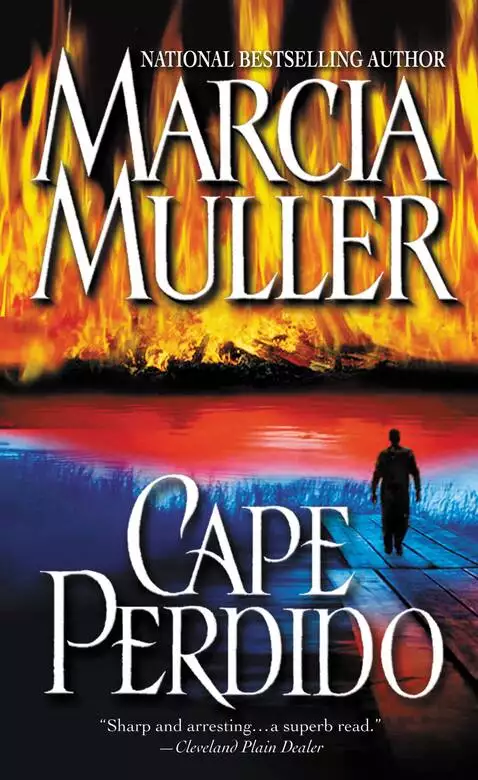
Amid ancient redwoods and sun-dappled reeds, the Perdido River runs clear and cold from the mountains of Soledad County to the blue Pacific. A wildlife refuge and a pristine recreational area, the river brings tourists to the old lumber town of Cape Perdido…and flows through the memories and hearts of the rugged people who have settled there since the Gold Rush days.
Now that is about to change. An out-of-state corporation wants to pump the river nearly dry and float the water to southern California's thirsty cities in huge rubber rafts. With lobbyists, lawyers, and dirty tricks, the company intends to get what it wants-any way it can.
Against this corporate Goliath, a community protest group and four unusual individuals are drawing a line in the sand. Flying in from New York City, ecologist Jessie Domingo hopes to grab headlines for her cause. Environmentalist Joseph Openshaw has come back to the home, and the secrets, he left behind decades ago. His former lover, local restaurateur Steph Pace, fears both the emotions and the ghosts arriving to haunt her. And old man Timothy McNear, owner of the defunct mill that once employed most of the town, silently broods about the sins he has hidden for too long.
But no one envisions what will happen when the crack of a sniper's bullet sets off a chain of desperate acts. As the peace of this small town is shattered, murder stains Cape Perdido, and one by one, those who stand tall for a cause may be swept away by the current of a town's ugly truths-and a killer's revenge.
Release date:
September 3, 2007
Publisher:
Grand Central Publishing
Print pages:
320
* BingeBooks earns revenue from qualifying purchases as an Amazon Associate as well as from other retail partners.
Jessie gripped the seat with both hands and stared at the back of the charter pilot’s head, hoping he was as calm and capable as he sounded. Through the tiny plane’s window she saw nothing but pine trees stretching toward the placid gray sea.
Where the hell was the runway?
“Make sure your seat belts’re fastened tight, folks. We’ll be on the ground in a couple of minutes.”
Thank God!
She yanked on the end of the belt so hard that it all but forced the air from her lungs, then glanced at her traveling companion, Fitch Collier, for reassurance. Wouldn’t you know it? The lawyer was sprawled out in his seat, sound asleep.
What an asshole!
First he’d upgraded to business class on their flight from New York, leaving her with her knees pressed against her nose in coach. Then he’d proceeded to wander back and forth between their seats the whole time, bringing her documents he’d finished reading, and annoying the other two passengers in the cramped row by leaning across them to issue comments and instructions. And now he was comatose, just as the pilot of the little four-seater got set to plunge them into a thick forest in the wilds of northern California!
Where the hell is that runway?
The tops of the trees came level with the window. Jessie felt as if she were being sucked down a steep green chute. She closed her eyes, her ears popped, and then the plane thumped onto the ground so hard that pain shot up her spine. She tried to remember if her health plan paid for chiropractic treatment.
When the pain cleared and she opened her eyes, the plane was turning toward a low brown prefab terminal where two figures stood in a patch of pale winter sunlight. The welcoming committee from the Friends of the Perdido River. An ancient, mud-splattered white van was the only vehicle in sight. If this was to be their ground transportation, Jessie hoped it had good suspension.
Beside her, Fitch stretched and yawned—a honking sound that reminded her of a recent National Geographic special on Canadian geese. She glared at him before she felt around at her feet for her briefcase. Predictably, he didn’t notice.
She’d met Fitch Collier, as prearranged by her employer, in the boarding area at Kennedy a long ten hours before. Already she was beginning to loathe him. Besides the upgrading and the kibitzing from the aisle, he’d spent their entire layover in San Francisco on his cellular, talking to more people than Jessie even knew about a variety of subjects designed to impress anyone within the greater Bay Area. From these conversations Jessie had learned, among other things, that Fitch expected to make a small fortune on the upcoming IPO of SoftTech, that the Benz was being repainted, that he was still searching for a good deal on a time-share on St. Bart’s, that “the babe” couldn’t get enough of him.
In short, Fitch was an ostentatious, inconsiderate jerk—all the more so because he made her feel mean-spirited for disliking him so much after so short an acquaintance.
When she’d drawn this assignment, Jessie had been excited—what community liaison specialist at Environmental Consultants Clearinghouse wouldn’t have been? An opportunity to work with Fitch, one of the best water rights attorneys in the country. A trip to a remote part of the northern California coast. A complex and potentially precedent-setting case that, should they win it, would earn them front-page coverage in newspapers across the country.
Jessie Domingo, in the New York Times!
Jessie Domingo, on Sixty Minutes!
Jessie Domingo, stuck at the end of nowhere with an egomaniacal, dictatorial lawyer who clearly considered her a mere flunky. And who, should they succeed, would end up taking all the credit for their joint efforts.
Reality strikes. Jessie strikes out—again.
The pilot shut down the plane, and Jessie peered out at the pair by the terminal. The stocky woman in the voluminous multicolored skirt and cape would be Bernina Tobin, and the lanky denim-clad man with the cloud of silver-gray curls, Joseph Openshaw. From both her reading of the foundation’s research files and her phone conversations with Bernina, Jessie knew that she was a Maine transplant and had led the Friends of the Perdido River in their yearlong battle against a water grab by Aqueduct Systems, Inc., a North Carolina corporation. Openshaw had been one of Jessie’s heroes ever since she became interested in ecology. A nationally known environmental activist and author and a native of the Cape Perdido area, he’d returned from the state capital early in the fight to lend his support and had done much to turn public opinion against the waterbaggers, as the locals called them.
Jessie and Fitch had been sent by ECC to Cape Perdido in order to familiarize themselves firsthand with the situation; they would consult with local experts in hydrology and ecosystems, as well as with the leaders of the protests and other residents of the area. Next week they would journey to Sacramento, where Fitch would argue their case before the state water resources control board. If all went well, they would score a major coup for pro-environmental groups; if not, the board would rule to allow a pumping station to be built upstream on the Perdido, and pipe laid across a defunct lumber company’s mill site, where the river’s waters would be sucked into massive rubberized bags moored offshore, to be towed south and sold to drought-starved southern California municipalities such as San Diego.
Leaving the community with no recompense for its loss.
Leaving the ecology of the Perdido permanently damaged, and a visual blight on what was now a pristine and beautiful coastline.
Leaving the door open for violence in a place where the citizens had long embraced the tradition of taking the law into their own hands when the law didn’t suit them.
The challenge was clear. Jessie stepped down from the plane, prepared to embrace it.
JOSEPH OPENSHAW
Here come the New Yorkers.”
Joseph ignored Bernina Tobin’s comment and folded his arms across his chest, squinting at the luggage-laden pair moving toward them. What in God’s name did they have in those suitcases?
The woman was very attractive, tall and slender with straight, light brown hair that swirled about her shoulders in the strong breeze. The man was also tall, and very thin, with silver-rimmed glasses and blond hair that was styled in casual disarray. They were dressed in what city dwellers always assumed was proper attire for the wilderness: pressed jeans, stylish sweaters, brand-new down jackets, designer walking shoes. Within a week, the jeans would be rumpled, the sweaters in need of dry cleaning, the jackets mud-stained, and the shoes replaced by sturdy boots from Perdido Feed and Surplus.
Thanks for coming all this way, strangers. And welcome to a world you can’t begin to understand. No offense, but I doubt there’s anything you can do for us.
Joseph unfolded his arms and, nudging Bernina foward, went to greet the visitors.
“You must be Ms. Tobin,” the young woman said, extending her hand to Bernina. The heavy bag she had slung over her left shoulder slipped free and landed in the crook of her elbow. Momentarily she was thrown off balance and bumped against her traveling companion, who frowned in annoyance.
“Call me Bernina,” Tobin told her. “You’re Jessie, of course, and you’re Fitch.” She nodded at the man. “And this is Joseph.”
Joseph relieved Jessie Domingo of the uncooperative bag and returned Fitch Collier’s stiff nod with a smile.
“This all your stuff?” Bernina asked.
“Pilot’s unloading the rest.” Collier gestured at the plane.
Joseph glanced over there, saw Al Raymond, the regular on the charter flights from San Francisco to Soledad County, dragging two more bags from the luggage compartment. Jesus, they really didn’t travel light! Each had gotten off the plane with a briefcase and a large duffel, and Collier carried a hanging bag. Maybe it contained his golfing clothes—or his formal attire?
Joseph went to help Al load the luggage into the back of his van while Bernina got the delegation from ECC settled inside.
When the offer of assistance in the Friends of the Perdido’s opposition to the waterbaggers had come from Environmental Consultants Clearinghouse’s executive director, Joseph had felt uneasy. Not that ECC didn’t have an excellent track record. A nonprofit foundation funded by grants from corporations and wealthy philanthropists, it employed a full-time administrative staff and called upon a large panel of attorneys and other professionals specializing in a wide spectrum of environmental issues. When the foundation took on a cause, it would pair the various experts, such as Fitch Collier, with an on-staff community liaison specialist—in this case, Jessie Domingo—and send them into the field to gather information. This method created a picture of the situation that encompassed the legal, technical, and sociological issues. More often than not, ECC was able to work out environmentally favorable solutions through the appropriate legal channels.
Now, viewing the pair that had been sent west, Joseph’s unease returned. In spite of her confident manner, the woman couldn’t be much more than twenty-five, and the man, while closer to his own age, reminded him of the fresh-faced fraternity boys he’d known at UC Berkeley who laughed and played their way through the world, oblivious to the fact that it was swiftly going to hell. Neither of these people seemed capable of dealing with the volatile situation that was shaping up at Cape Perdido.
But it was Eldon Whitesides, ECC’s director, who really raised the level of Joseph’s discomfort. He and Whitesides had come up together in the environmental wars of the eighties at Berkeley but had long since followed divergent paths. Whitesides’s route led him into the rarefied realm of important political connections and substantial philanthropic backing, while Joseph’s led to the grassroots, poorly financed ghetto. While Whitesides made compromises and hammered out agreements in well-appointed parlors and boardrooms, Joseph held to a hard line in storefronts and on the streets. Not once in the year that the Friends of the Perdido had opposed the North Carolina water-exporting firm’s proposed project had Eldon Whitesides taken notice of the battle raging in Soledad County—a battle whose outcome might very well determine the way water rights were handled throughout the state, and perhaps the country, for decades to come.
So why, when the hearings before the state water resources control board were so near, had Whitesides surfaced with his offer to help?
Joseph slammed the van’s back doors, mock-saluted Al, and went around to the driver’s side. Bernina sat half turned in the passenger’s seat, chattering at the newcomers in her Down East accent. Something flattering about the Shorebird Motel and the Blue Moon Cafe, obviously trying to paint an appealing picture of what to outsiders would seem a pretty drab coastal outpost on a winter day. He started the van, only half listening, and drove down the access road of the small airport. At least Tobin wasn’t getting dogmatic on them just yet.
He didn’t dislike Bernina, but an uneasy and sometimes prickly philosophical truce existed between them. She embraced the principles of feminist ecology—which Joseph, in a self-admittedly paranoid and simplistic fashion, interpreted as the view that everything wrong with the natural world was the direct result of men’s piggish behavior toward it. Although he didn’t like to think in terms of labels, if he had to characterize himself according to the currently accepted guidelines, Joseph would say he was a social ecologist. Which, once the fancy rhetoric was stripped away, meant a practical person who believed there were ways for humans and nature to coexist in health and harmony. Throughout the six months since his return to Cape Perdido, Bernina—who was also his landlady—had spiritedly lectured him about the wrongness of his beliefs, insisting that if he’d only admit that a patriarchical society had fucked up the earth, he’d be on his way to enlightenment.
To Joseph, she sounded like the missionaries who used to come around to convert the coastal Pomos, a tribe with whom he had blood ties: cast off your heathen religion, accept our teachings, repent your sins, and the kingdom of heaven is yours.
From the corner of his eye he saw Bernina glance at him, a frown that said she thought he was being inhospitable knitting her thick eyebrows. “Oilville coming up,” he said, too heartily.
Jessie Domingo asked, “Why’s it called that? I don’t recall from my reading.”
Bernina said, “It’s the site of one of the first oil fields in California. Most people think all the state’s oil wells are in southern California, but there was a short-lived boom here in the mid-eighteen-sixties. After the wells dried up, so did the town. Now that’s what’s left.” She motioned at the lone gas station and convenience store, the scattering of small frame houses that nestled in a clearing upon which the thick forest was slowly encroaching.
The lawyer, Fitch Collier, hadn’t spoken or moved since they left the airport. With some concern, Joseph glanced into the rearview mirror. No, not dead, just sleeping.
Bernina went on. “Cape Perdido is a different story. The lumber mill, first called Breyer’s, and then McNear’s, was built there in eighteen-sixty-three. The Cape became a doghole port, where schooners would take on lumber for transport south to San Francisco. Generation after generation worked that mill, but the decline in the lumbering industry forced its owner to shut it down five years ago, and now—well, you know from the press coverage about Timothy McNear offering to let Aqueduct Systems lay the pipe for their operation across the site. Anyway, the Cape’s managed to hang on economically because of tourism and recreational opportunities. And people like me, who enjoy the small-town atmosphere and natural beauty, are still moving there—
although there’s no telling what’ll happen if those waterbaggers succeed in raping our river. And ‘rape’ is the right word for it. I can draw a lot of parallels between a violent sex crime and what that man, Gregory Erickson, wants to do here.”
Please don’t start, Joseph thought. Not now. Let these tired people get settled in before you try to indoctrinate them.
To turn the conversation in another direction, he said, “Bernina’s a real authority on our little piece of the earth, even though she only came out from Maine three years ago.”
Immediately he regretted the way it sounded. Bernina’s eyes narrowed and she glared at him. “I suppose you’re an authority, even though you abandoned this ‘little piece of the earth’ twenty years ago?”
He was not going to argue with her in front of strangers. “Oh, look, folks!” he exclaimed, pointing skyward. “There’s a golden eagle!”
As they craned their necks to spot the nonexistent bird, he accelerated toward the turnoff for Cape Perdido.
STEPH PACE
Steph let the fishnet curtain fall against the front window of the Blue Moon. Anxiety tickled at the base of her spine like restless fingers.
Get a grip, woman!
Joseph and Bernina were checking the New Yorkers into the Shorebird Motel, across Highway 1. Once finished there, he would come over for his afternoon cup of coffee, and she didn’t want him to see her in this state. He’d notice that something was wrong—he noticed everything—and he’d ask what had happened. And then she’d have to lie—something she didn’t do very well to him—or else explain, which w. . .
We hope you are enjoying the book so far. To continue reading...

 Please log in to recommend or discuss...
