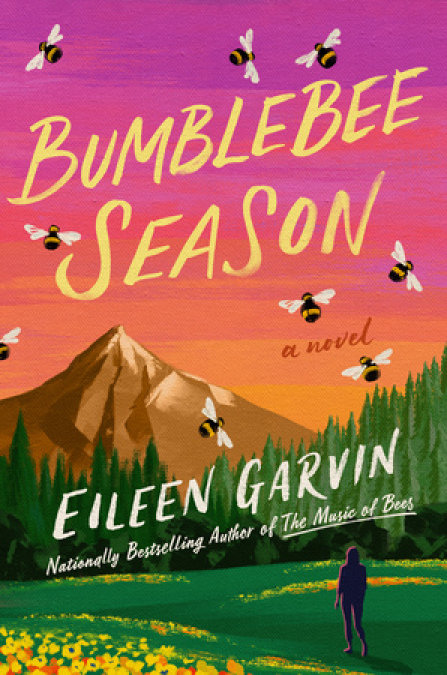
From Eileen Garvin, nationally bestselling author of The Music of Bees and Crow Talk, a heartwarming new story that returns to the vibrant world of beekeeping in a small Oregon town
Beekeeper Jake Stevenson should be celebrating. His fledgling honey farm has been inundated with orders. Instead, Jake is worried. He can’t seem to hire anyone—with local teens more interested in jobs at Hood River’s hip waterfront—and there’s no way he can handle the approaching harvest all by himself, no matter how adept he’s become at maneuvering among the beehives in his wheelchair.
Meanwhile Flaco López, a young migrant from Mexico, is lost on Mount Hood when he stumbles upon Jake’s beehives in a high alpine meadow. As Flaco takes refuge on Jake’s farm, they begin to form a tentative friendship. And the two soon cross paths with Abigail Plue, a scientist more interested in insects than people, who’s on Mount Hood studying a threatened native bumblebee.
Then a local rabble rouser begins to rally support to build a commercial hunting camp that would destroy Mount Hood’s pristine wilderness—the home of Jake’s honeybees and Abigail’s beloved bumblebees. And Jake, Abigail, and Flaco must come together to protect everything they hold dear. Full of warmth, big-hearted characters, and a celebration of nature in all its complexity, Bumblebee Season reminds us that human connection might just be the most powerful force there is.
Release date:
April 21, 2026
Publisher:
Dutton
Print pages:
400
* BingeBooks earns revenue from qualifying purchases as an Amazon Associate as well as from other retail partners.
Abigail Plue surprised people, though she didn't understand exactly why. It seemed as if, upon meeting her, they'd been expecting someone else. At least after Abigail had spoken. That was the only way she could explain it. People seemed to harbor some expectation of what she'd say or how she might say it, and when her words came out they were never quite right. No one ever said that exactly, but she could tell it was what they thought.
Before she opened her mouth there was a neutral space, a two-dimensional field that she could exist on, suspended, in orientation to other people. She felt like a stick figure on a flashcard, fulfilling the correct requirements. Human. Woman. Person. But something changed in the air after she spoke. Her voice induced an invisible but tangible shift, a breaking apart of particles. Sometimes she imagined a pungent scent, like the smell of petrichor right after it rained. And then she was Other, Different, Strange. Was it what she said or how she said it? She didn't know. It all seemed terribly unfair to Abigail. How could people have expectations of a person they'd never even met?
When she was alone, though, Abigail didn't feel troubled by how others might perceive her. She simply felt like herself. She enjoyed her own company and found the workings of her brain interesting. Instead of that cramped two-dimensional plane she balanced on so precariously with others, her solitary world was vast-a boundless expanse to observe and explore, to turn over rocks and look under logs, both literally and figuratively. As a girl, Abigail had spent considerable time on her hands and knees observing what was happening on the ground. In fact, it was in this exploratory setting that Abigail first understood she was odd. People also called her strange, weird, and wacky. But "odd" was the first moniker, and one she didn't mind. Odd. Pronounced by Miss Mary Ricketts, Abigail's neighbor, the day they met, when Abigail was seven years old, and already enraptured with the kingdom underfoot.
Abigail's father didn't get home from work until five thirty, so Abigail spent hours alone. Another girl might have felt lonesome. Another girl might have passed the time watching TV or sneaking cookies her father had hidden above the refrigerator where he thought she wouldn't find them. But Abigail liked solitude, was bored by television, did not overindulge in sugary treats, and preferred to be outside. In the soil around the front walk she observed armor-plated pill bugs, which she'd learned from National Geographic were called Armadillidium vulgare-a delightful discovery because didn't they look exactly like tiny armadillos? She found banded woolly bear caterpillars inching along the underside of the hydrangeas. These fuzzy black-and-red striped Pyrrharctia isabellas looked like bumblebees and transformed into golden-colored Isabella tiger moths.
The day she'd met Miss Ricketts she'd been absorbed by velvety tree ants. A trail of the tiny insects snaked across her yard over the fence and into the neighbor's driveway. Abigail had followed them to the base of a mountain ash tree and was watching them closely when a car pulled up. Since she was not obstructing the driveway, she saw no reason to move.
Miss Ricketts was talking to herself as she climbed out of the car juggling several bags and a purse. She startled at the sight of the small figure and let out a yell. She peered down at Abigail, her eyes covered by large wraparound sunglasses.
"What the heck are you doing down there?!" she barked.
Abigail often struggled to understand the emotion behind people's words. Once she started third grade, she'd begin working with Miss Star-blond, blue-eyed Miss Star, who dressed in soft pastels and whose classroom smelled of peppermint and cotton candy. Miss Star used a set of thick flashcards to help Abigail identify her own emotions, which was difficult enough. Translating other people's emotions was a completely different mystery. What might Miss Ricketts have been feeling when she'd asked that question? Confused was a card that often came up for Abigail. Also Surprised. However, at the age of seven, Abigail hadn't yet met Miss Star and could only take people's words at face value.
She stood up and pushed her hair out of her eyes.
"Research, ma'am. I'm doing a field study on these velvety tree ants," she replied. "Did you know that colonies of velvety tree ants can be as large as sixty thousand workers and they'll forage up to six hundred feet from the nest?"
Miss Ricketts recoiled slightly, peered at the column of ants climbing the tree, and sniffed.
"I was unaware," she said. "But I do know it isn't polite to do a 'field study,' as you call it, without asking permission to be on someone's property."
Abigail cocked her head and didn't say anything. She watched Miss Ricketts's nostrils flare. She would later learn this was something that happened when Miss Ricketts was feeling Irritated or Annoyed. She would also sigh in a groany way, as she did that first day.
"Young lady. If you want to conduct a field study in my yard, you need to ask first. Before you begin your research."
Abigail blinked. Her mouth gaped. Her mind worked furiously to try to solve the problem. How was she supposed to ask first when she'd already begun her study? She didn't know what to say.
Miss Ricketts sighed again and leaned against her car. She removed her wraparound sunglasses and blinked.
"I suppose you are my new neighbor. My name is Miss Mary Ricketts. You and your folks moved in last week?"
Was that last part a question? The sound went up at the end, but Abigail wasn't sure. And as for her folks, well, it was just her and Dad. As Abigail considered these details, Miss Ricketts's nostrils flared again.
"Young lady, what is your name?"
Abigail straightened.
"My name is Abigail Elizabeth Plue," she said, holding out one hand and tucking the other behind her waist like a little duke. "Pleased to meet you, ma'am."
Abigail's father had taught her it was important to introduce oneself and to be especially polite to older people. She couldn't appreciate how the gravity of her tone contrasted with the dirt under her fingernails and the muddy knees of her jeans and her short hair, cowlicked and uncombed.
"Odd child," Miss Ricketts whisper-breathed, shaking the dirty little hand and replacing her glasses.
As the older woman looked down at her, Abigail thought Miss Ricketts's wraparound sunglasses made her eyes resemble the complex foci of the housefly she'd found on the windowsill of her new bedroom. But she didn't say that.
"You may continue your research in my yard," Miss Ricketts said. "Just don't dig any holes."
Abigail said thank you and returned to her spot at the foot of the mountain ash, where she watched and watched until the light faded and it was too dark to see the ants any longer. Then she climbed back over the fence between their yards and went in the house to wait for her dad to come home. She told him she'd met the neighbor.
"Her name is Miss Mary Ricketts. She's old. She said I was odd," Abigail reported over dinner. "What does it mean, exactly? Odd."
Abigail's father looked thoughtful and gazed up at the ceiling.
"Well, odd means different from what is expected. Unusual."
Abigail thought that sounded nice. Praying mantises seemed unusual, the way they could turn their heads 180 degrees like little green robots. Dragonflies were unusual, with their uncanny ability to fly forward and then suddenly reverse.
"Do you think I'm odd, Dad?" she asked.
He smiled, his eyes crinkling in the corners.
"I think you are perfectly yourself, Abigail."
That wasn't an answer, but that was Dad.
Unlike Miss Ricketts, other children didn't call Abigail odd. At school they called her a weirdo, a wacko, a retard. By the time she and her father moved next door to Miss Ricketts, Abigail had attended four different elementary schools. And it was the same at every school. Once she opened her mouth, she felt all wrong. She knew they didn't like her but didn't know why. She didn't like them either, or at least the way they made her feel, which was Scared and Lonely. And Unwelcome. Unwelcome was not among Miss Star's flashcards, but it described how she often felt-through grade school, high school, and even college. Unwelcome.
Feeling unwelcome was no longer surprising to Abigail. She felt out of place in school, at work, and in social situations. But at the age of twenty-three she'd finally found a spot that fit. Her teaching assistantship in the entomology department at Oregon State University had felt like a safe haven, at last. Until this unfortunate meeting with her adviser, Dr. Thomas, when the familiar feeling descended. Unwelcome.
Abigail folded her arms and watched Dr. Thomas's mouth. His lips were thin and pink. A tiny scar on the right side of his upper lip thickened the flesh there. Under his bottom lip, a small patch of facial hair danced and twitched as he talked. The day Abigail had met Dr. Thomas, at a mixer for freshmen six years ago, Abigail thought he'd missed a spot shaving. She'd felt compelled to point it out, and he laughed, explaining it was intentional.
"It's a soul patch," he said, tapping it with his index finger. "I've had it since undergrad."
Abigail stared at it, troubled. It was too small to rank as a beard and, being under the bottom lip, could not be correctly characterized as a mustache.
"But why?" she blurted. Another student snickered, and Dr. Thomas reddened and said soul patches were cool when he was their age.
"Times change," he said, and shrugged.
"Oh," Abigail said.
For the rest of the mixer, her eye had strayed to the tiny pelt on Dr. Thomas's upper chin as she tried to process the idea of what might be cool now and how the definition of cool could change. She knew enough to know she would not know what was cool. She could ask Dad later, she thought, but she stopped herself from pulling out her notepad. She knew from experience that making notes about what people said in casual conversation was definitely not cool.
The soul patch had continued to distract her whenever she talked with Dr. Thomas over the years, which happened often since he was her adviser. There was something about how it jumped and twitched that fascinated her.
Now she realized Dr. Thomas had asked her a question.
"Pardon?" she said.
"I asked you if you knew why you were being transferred," he said. His voice rose in what Abigail understood from experience was Frustration. And yet, that puzzled her. She was the one who should feel Frustration at being fired. Dr. Thomas kept insisting on using the word "transferred," but she knew it was the same thing.
Abigail pondered the question.
"Because I'm not a good teacher?"
It was the only thing she could think of. Abigail didn't have any idea why she was being removed from the teaching assistants pool and sent to work in research. She wasn't interested in why. All she could think of was the tragedy of leaving her lovely quiet office with its perfect view of the sidewalk outside Stellar Hall.
Dr. Thomas's face grew pink, and he swore softly under his breath. Abigail suppressed a laugh. She was not amused at her supervisor's distress. It was just that she found swearing and swear words hilarious. She also tended to laugh when she knew it was inappropriate to laugh, which made it even harder to stop.
Dr. Thomas closed his eyes and breathed in and out through his nose. When he reopened his eyes, Abigail noticed, as she had before, the lack of symmetry in them. The left eye drooped slightly, which made that side of Dr. Thomas's face look sadder somehow, though he was generally a cheerful person. Abigail had the urge to share these thoughts but bit her tongue.
"Abigail. You are a satisfactory teacher as far as your command of the material. You're being transferred because you yelled at your students. Often. Also, you don't answer their questions on the Canvas portal."
Abigail thought the Canvas portal was excessive. She delivered the information in class, perfectly clearly. Why should she repeat what she'd said in written form to students who were too lazy to take notes or too distracted to remember what she'd said? Or had skipped class?
"The Canvas portal is not a requirement of my job," she said.
She'd checked.
Dr. Thomas sighed.
"But it's a courtesy, Abigail. It helps create rapport with the students. Which is something else you could be better at. For example, you failed one student outright because you didn't like the topic of his semester project."
Abigail crossed her arms.
"But it was a stupid topic. The assignment was to investigate an important environmental concern affecting invertebrates and he wrote a paper about advances in drone technology. Drone technology has no place in the study of biology. I just told him what was obvious. We study creatures. Living things."
The student had seemed to agree with her, hadn't he? He'd said something like, "Of course you think it's stupid." From which she took him to understand that she, being his instructor, would know better. But if he'd agreed with her, why had he gone complaining to Dr. Thomas? It didn't make any sense.
". . . can't behave like that, Abigail," Dr. Thomas was saying. "You can't fail people because the paper doesn't interest you. We have specific grading guidelines. And you can't yell at people! Our institution does not tolerate heated displays of emotion, even if your heart is in the right place. That's not how we communicate with each other! It's the twenty-first century!"
Abigail uncrossed her arms, propped her elbows on her knees, and leaned forward.
"You are yelling at me right now," she said.
She was genuinely curious about the contradiction between Dr. Thomas's words and actions.
Dr. Thomas closed his eyes and whisper-swore again. Abigail suppressed a chuckle. She felt bad for upsetting him because she really liked Dr. Thomas. He dragged his palms down his face, which made the skin under his eyes sag. He looked tired. She probably should not tell him that, she decided.
"Abigail," Dr. Thomas said, his voice level. "You have your new assignment and keys to Dr. Mora's lab. Good luck and let me know how things go with the research group."
We hope you are enjoying the book so far. To continue reading...

 Please log in to recommend or discuss...
