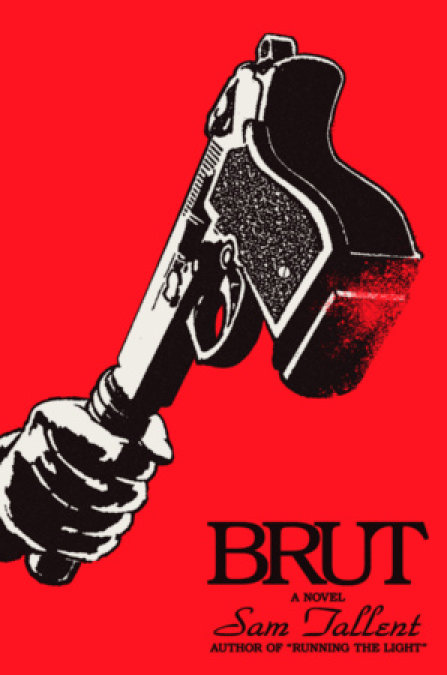
A propulsive, electrifying novel about a hitman who is forced to take an impossible job, by the rising literary sensation and comedian Sam Tallent, author of Running The Light
“With his American contract killer in Paris, Sam Tallent has created a protagonist you’ll never forget as the bodies pile up like cordwood. Brut comes on like a freight train and never stops. Violent, chilling, wonderfully well written, as modern as tomorrow—this is a novel for our times.”—Terry Hayes, New York Times bestselling author of I Am Pilgrim
Robert Beaujolais forfeited the last years of his youth to the Marines, watching his friends die. Beaujolais survived, but civilian life made him regret it. Compared to the truth of war, peace fit him like a casket. At least he was in love, even if he was the only one who could admit it. They were together—until they weren't.
Then, out of nothing, something: the architects of the world offer Beaujolais a job in the blood business. They prefer to call it arbitration, but Beauj knows murder—killing is his calling—and as an arbiter, Beauj is the ultimate judge.
But when Beaujolais botches a simple hit in San Francisco, his shadowy employers manifest to remind him that he is, in fact, capable of dying. Beauj is given a choice: kill or be erased. The destination is Paris; the target is Europe’s last remaining godfather, the Archangel of Florence.
A blistering tale of love and violence, Brut is the story of a man measuring the circumference of his soul in bulletholes. Is his or any other life worth saving? Only the arbiter can decide.
Release date:
September 22, 2026
Publisher:
Random House
Print pages:
368
* BingeBooks earns revenue from qualifying purchases as an Amazon Associate as well as from other retail partners.
There were two men in Tama, Iowa, until one killed the other badly with a shotgun at intimate range. The killer continued to Fort Dodge where he knifed a second man—liver, heart, liver, liver—in the parking lot of a reptile expo. In Nebraska he ate a fried pork cutlet pounded the circumference of a hubcap.
"Do they have a machine back there?"
"Nope. Just a mallet. It's crazy what meat will do."
At a sporting goods store outside of Omaha he purchased a one-pound bag of pistachios, electrolyte paste, a pair of size-11 Nike Monarchs, a .22 Ruger and a box of bullets. The driver's license he proffered was one of three in his possession. He asked if he could pay in cash.
The counterman snorted. "This was still America, last I checked."
He rented a room at a hotel with a hot tub and a gym. He prepared the weapon, attempted sleep and burnt the day subjecting his body to intervals of punishment and reward.
At dusk, the GPS led him to a chain restaurant he remembered for the babyback rib commercials they ran in his youth. He sat in the car and stared at the entrance; whenever a white man used the door, he compared his face to the face of the man in the photos on his phone. This was most of the job. Pistachio shells amassed between his feet.
Inside the restaurant the lights became brighter. A woman exited, followed by a man, his man. His eyes followed them to a red Mazda. She had to go up on her toes to kiss him. The Mazda departed, his man waving goodbye.
He was crouched on the passenger side of a gray Pacifica—Missouri license plate 091752—when the van unlocked remotely. He duck-walked around the hood, weighing the footsteps. Close, closer—"Turn around."
His man's face flattened, registering this wraith with the black gun out in front of him. "What is—"
"Turn. Around."
Smoothly his man spun. He joined the gun to his back, pushing his man toward the car.
"Where are we going?"
"You'll know it when you see it."
"Who are you?"
"Just an arbiter."
Sighing, panting, his frustration plumed visible in the cold. He considered the man pinned bleating beneath him. Helpless, vulnerable. With his face he apologized to the world. The predictable cacophony beseeching creation.
"Please!"
Begging yet more grace.
"Please!"
Perverting his dignity.
"Please please please!"
There was never anything new.
Disgusted equally by the man as with himself for allowing this indecency to befall him, the arbiter, eager to herald the quiet, produced the Ruger, and the man lost his voice down the barrel. Finger pressured steel.
Klik.
"Oh good." He tried the trigger again. The firing mechanism's metallic denial was lost to the belching of toads. "Very good."
Getting to the water's edge had been more of a procedure than he'd assumed. The man had slipped descending the hill, dragging the arbiter down onto his hip and caking the firearm in mud. Now both of them were useless. A mosquito flew in his mouth. He spat. "Really, very good."
The arbiter governed himself via systems. His tools were precision and speed and stratagem. Swift operating was proper operating. This was not that. He'd scoffed when he read the assignment: "the asset must be realized on the southside of the pond." Asset. Realized. The blocking of a play directed by a child.
His gut was that someone had been wronged here, maybe even ruined, by this man now groveling in the mud. The lore didn't interest him. What mattered was the man knew why they were here, and he did, his eyeballs greedy, bursting, desperate to take it all in before it became impossible to see.
"Pleasepleasepleaseplea—"
The vulgarity of cowardice. It was important to the arbiter that he was different from this man: he hoped his own death might inspire him. He gripped the gun barrel and swinging the butt like a gavel imploded the pleading man's nose. He hammered repeatedly, dusting teeth, pulping lips, a nightmare backlit by moonlight digging a passage to hell. The feeling of a spoon in nearly ripe mango, the initial resistance concealing the softer flesh below. Mud splattered. Bones gave.
Quiet.
He knelt beside the body, blinking sweat from his eyes. An owl cut across the night like a porthole and he watched it because there was no one else to see it. He disassembled the gun and pitched the components into the center of the pond. The body, per his instructions, remained.
Wet earth coated his dungarees and inside of them his legs were heavy as he high-kneed the cattails to avoid losing his shoes to the muck. At the car he peeled off his sneakers and socks. As he removed his pants, his knife fell out of his pocket. He sucked his teeth, said the word "excellent."
He disrobed completely and poured a bottle of water over his head, his chest, his hands. To the squirrels watching in the high branches he appeared a celebrant concluding a ritual, a demon or oni, some lesser god, inhuman. Nude he smoked, studying the motion of the alfalfa swaying in the fields across the pond. He bagged his cigarette butt with his clothes and shoes and set the bundle in the passenger seat and put on underwear and sweats and the last of Benny's shirts.
With the hot air blowing full blast on his bare feet, he backed the car out of the reeds and turned onto the unpaved road. The clock on the dash read 00:07. Thirty-three years ago was the day he was born.
He parked the car in front of door 8 and took the bag from the passenger seat and followed the gravel path behind the motel to the dumpsters and buried the bag beneath a layer of trash.
In the room he sent a text message from the provided phone then removed the SIM card, snapped it in half and dropped the hemispheres in a glass of water along with the device.
With the lights off, the room was depthless black and he lay staring until coronas of light emerged at the rim of his vision. Beneath the tawdry sheets, thinking of nothing, he experienced the darkness as a palpable thing, the weight, the totality, and he allowed it to crush him and disappeared from himself.
In the morning he dressed quickly, ready for his jog, only to remember his shoes were soaked. He sat on the edge of the bed passing a hair dryer over his sneakers watching The Price Is Right. He overbid every item. He didn't know the cost of things.
The man at the front desk said there was a shoe store just down the street.
"How about a library?"
"Brother, I'm not the guy to ask."
The librarian showed him to the computer and told him the first fifteen minutes were free and he thanked her and waited for her to leave before he typed the password into the box. He created a new email—Sumo123456Sumo followed by, as always, the date—and at exactly noon the message arrived.
DEAR NEPHEW.
WE RECEIVED YOUR LETTER. CONGRATULATIONS. KEEP UP THE GOOD WORK. YOUR TUITION HAS BEEN PAID. WE LOOK FORWARD TO SEEING YOU AT DINNER ON THURSDAY THE 20TH. SAN FRANCISCO IS BEAUTIFUL THIS TIME OF YEAR. WE SENT YOUR CARE PACKAGE TO THE MAIN POST OFFICE. BEST. UNCLE.
After deleting the message and deactivating the account he searched MAIN POST OFFICE SAN FRANCISCO and printed a map from here to there. The directions totaled three pages and the librarian stapled them together. "Going on a trip?"
"Yes ma'am." The sound of his own voice surprised him: in the last week he'd said less than five hundred words aloud. "That's the plan anyway."
She smiled, sweeping an errant bang behind her ear. "To California?"
"Yes ma'am."
She laughed. "You keep calling me ma'am but you're older than me."
"I'm sorry."
"I've never been to California." She rubbed her chin with the knuckle of her index finger. "I've barely been to Iowa."
"You should go."
"To Iowa?"
"Anywhere. It's a big country."
"So I've heard."
In North Platte he traded the car for a blue Ford Fiesta with dealer tags and eleven hundred dollars cash then continued to Sidney where he pulled off the highway at a motel attached to a truck stop surrounded by wheat fields embossed molten bronze by the gasping sun. He scraped the breading from his chicken fried steak and lingered over coffee reading a William Johnstone novel while the truckers watched Sunday Night Football on a miniature black and white TV.
At halftime he bought a pack of cigarettes and nodded to the men gathered smoking around a space heater in a clear plastic tent.
". . . that's what I get for letting her sleep in the truck."
"Can't never trust no lizard."
"It was like to freeze."
"She was colder."
The flip of his Zippo drew eyes as he smoked a Newport, the flame illuminating the memories of acne in the hollows of his cheeks. He shut the lighter and tucked it in the watch pocket of his jeans and hooked a thumb through his belt loop and stared at the fire.
"Never had a Zippo," a trucker told him.
"They're more hassle than they're worth."
"Sounds like my wife."
"Don't get me started."
Across the parking lot bathed in a cone of fluorescent yellow light a young man in high-cut shorts stood in a tight huddle with two women. The women, one wide and tall, the other short and frail, wore miniskirts and boots and puffed down coats. The broad one punctuated her sentences by clapping the back of her hand against her palm, causing the young man to flinch, while the other woman, her hands hidden in her pockets, turtled her chin into her jacket and bounced on her heels.
We hope you are enjoying the book so far. To continue reading...

 Please log in to recommend or discuss...
