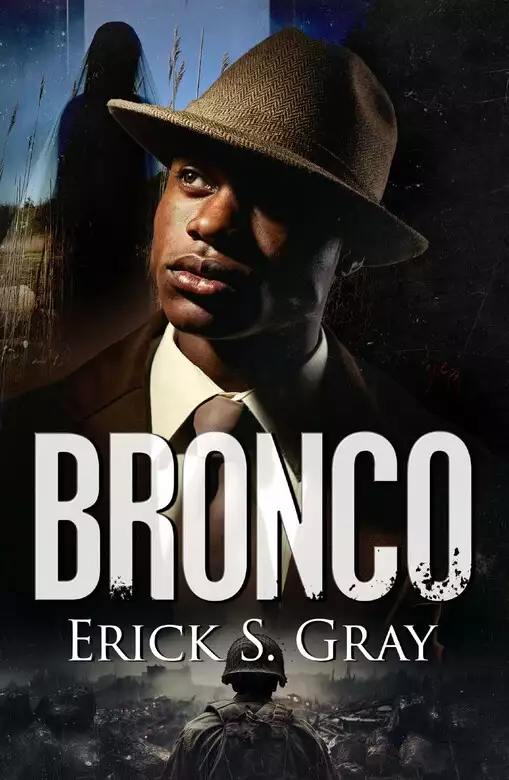
Bronco’s supernatural abilities are a blessing and a curse. Haunted by memories of World War II, he seeks to avenge the deaths of a family killed by the Klan, finding love and solace in the process.
Bronco was once a Harlem gangster in the 1930s before becoming a skilled soldier with the all-Black 92nd Infantry Division, fighting the Germans in Italy in 1944. During a chaotic night, embroiled in an intense battle, Bronco fought like a one-man army and took down several German soldiers. However, he encountered a strange sight: a group of dead German soldiers wearing World War I uniforms. Bronco was the only one who could see these soldiers, as he was cursed with the ability to see the dead, along with his supernatural strength.
A decade later, Bronco is suffering from PTSD and has turned to alcohol while working as a gravedigger. The bars and lounges of Harlem are his only reprieve from haunting memories. Serving as a conduit for the dead, he is soon haunted by the daughter of a Mississippi farmer killed by the KKK. Entangled in a strained war between gangsters in Harlem, Bronco reluctantly leaves the city for Mississippi to investigate the girl's death and uncovers more than he could have ever expected.
Release date:
January 27, 2026
Publisher:
Urban Books
Print pages:
288
* BingeBooks earns revenue from qualifying purchases as an Amazon Associate as well as from other retail partners.
Bronco Jolted awake to the anxious thudding of his heart and cold sweat upon his brow. He felt suffocated and breathless from the vivid nightmare that had just plagued him in his sleep, unsure of where he was or what was real. He was a bit disoriented, and it took him a moment to realize that he was in his own bed, safe from the terrifying sounds of war and bloodshed. He remained on edge for a moment. The one-bedroom apartment he resided in in Harlem was quiet, still, and dark.
Bronco was shirtless and drenched in sweat, with his heart still racing. It was only a nightmare, but they were becoming recurring. He removed himself from the bed, needing a glass of cold water. The sound of Harlem came through his open bedroom window, alive like a Broadway play. He lived above a quaint nightclub and could hear the last of the drunken stragglers exiting into the cool morning air after a night of drinking, dancing, and partying. It was five in the morning, but New York, especially Harlem, never slept. Though the Harlem Renaissance ended nearly two decades ago, Harlem was still buzzing with recognition from fashion, food, music, especially jazz, art, and nightlife. It was the new Negro movement with a new Black identity. Black Mecca at its finest.
But with the new Negro movement came the crime—numbers running, bootlegging, gambling, and prostitution, fueled by postwar prosperity. Men like Bumpy Johnson became godlike figures and controlled Harlem with an iron fist. Politicians such as Adam Clayton Powell Jr. broke the color barrier by being elected to the city council.
But no matter what Harlem was or became, this would always be Bronco’s home. It was where he grew up—a few blocks north of 110th Street. Mathew “Bronco” Washington was the only child of Janice and Rosco Washington. His parents had migrated north at the turn of the century to escape segregation and the harsh conditions of the South. Jim Crow and the KKK became the cornerstone for brutal violence, poverty, and injustice for Black people and families, creating the great migration north—the mass movement of about five to six million African Americans from rural areas of the South to urban areas in the North.
In the beginning, life finally seemed fair for Janice and Rosco Washington. Rosco had gotten a job in a furniture factory and become a part-time barber. Janice worked as a seamstress. Together, they made a decent living for themselves and Bronco when he was born in 1923. They lived in a two-bedroom flat and were saving to buy a car. But then the Great Depression hit the country in the 1930s, and it didn’t take long for Roscoe to find himself unemployed and depressed. Following his sudden unemployment, Bronco’s father became an abusive alcoholic father, turning to the streets for income.
Life became rough for Bronco. His parents had to downgrade their living conditions, and shortly after, his mother lost her job as a seamstress. Roscoe had gradually become an absentee father and husband by the time Bronco turned 10 years old. Unfortunately, his mother took to prostitution to pay the bills and feed her son. Though he was a good student in his youth, when Bronco was 14, school became irrelevant to him. He began to lead a teenage gang in stealing, fighting, and becoming an enforcer for the local crime bosses.
He got the nickname Bronco from a gangster and numbers runner named Pinch. Although Bronco was young, he was a brute on the streets of Harlem, able to knock out grown men and take on multiple enemies simultaneously. His wild and violent actions reminded Pinch of a bronco horse, a wild and untrained animal with unpredictable behavior such as kicking and bucking. A bronco was bred to be fast, strong, and agile. And Bronco was rough and rude.
Shortly after Bronco’s sixteenth birthday, his father was killed in a bar fight. This devastated his mother, and she, too, turned to alcohol to escape or cope with the pain of losing her husband and the dramatic downfall of her life. Bronco took out his anger and frustration on the streets, becoming a feared young goon in Harlem. His name began to ring out, and Pinch took him under his wing to school him on numbers running and committing various crimes for Pinch, like robbery, burglary, racketeering, and gambling.
“You’re a beast, Bronco. Always have ’em fear you because fear is the only thing men, even white men, respect,” Pinch had said to him.
Bronco nodded. He looked up to and respected Pinch. The man ran a profitable business in Harlem, and the ladies loved him.
One day, Bronco went missing for a week. No one could find him. Pinch and his men searched everywhere in Harlem and New York. Pinch began to fear the worst: his protégé may have been kidnapped and killed, most likely by his rivals. It seemed unlikely, but it was Harlem. The Italians were becoming an opposing force in Harlem, and men like Pinch and Bumpy Johnson were becoming a problem. Then, one day, Bronco turned up suddenly. He was found unconscious in an alleyway on the east side of town, nearly naked and confused with strange markings on his chest. When questioned by Pinch and doctors, Bronco had no memory or recollection of the past week. It felt like his memory had been wiped clean.
“You don’t remember nothin’, nigga?” Pinch had questioned him.
“No. I don’t. Not a damn thing, Pinch,” Bronco had replied.
Pinch thought it was odd for a man to suddenly go missing for a week and not remember anything. He began to suspect the worst. Maybe Bronco was cooperating with the police or his enemies. Doubt began to stir within Pinch.
The relationship between Pinch and Bronco began to shift in a different direction and turned sour after Bronco’s sudden disappearance. People were in his ear about Bronco’s account, questioning his movements, loyalty, and story.
“A nigga don’t disappear like that and not remember anything, Pinch. He knows something. He ain’t telling it,” one of his goons said about Bronco.
Pinch knew he couldn’t take any chances, not with the police investigating him and the Mob looking to destroy him. He gave the order to his men. “Do it. Make it quick.”
Two men went to retrieve Bronco from his mother’s pad one night. He was only 17 at the time. Bronco knew Shortie and Coco really well. He trusted them. He climbed into the back seat of a black 1940 Buick Sedan, and they drove off. Shortie and Coco were quiet during the ride, which Bronco found odd, especially with Shortie. He was always bragging about his rendezvous with beautiful women. He was a playboy.
“Where we going?” Bronco had asked them.
“Pinch wants to have a word with you,” Shortie had said. “No need to flip your lid, young’un, you dig?”
Bronco nodded. Still, something didn’t feel right with him.
They’d arrived at an old warehouse in the Bronx, and Bronco climbed out of the car. It was late, and Bronco was sandwiched between Shortie and Coco as they entered the warehouse. Surprisingly, it was empty. There was no Pinch. When Bronco spun around to ask what was happening, he saw Shortie and Coco pointing their guns at him.
“Shortie, Coco, what I do wrong?” he’d asked.
“Pinch wanna know who you talked to,” Coco had said.
“No one. I didn’t talk to anyone.”
“Fool, you lyin’ to live, beatin’ up your gums,” Shortie had said. “Don’t know how one loses a week’s memory after disappearing for a week.”
“I don’t know what happened to me. I promise you that,” Bronco had replied.
“It don’t matter to us, fool. Pinch still wants you dead,” Shortie had said. “You can’t be trusted.”
Bronco had scowled. He’d braced himself for the worst. Shortie and Coco were two cold-blooded killers, Pinch’s finest. Once someone saw the barrels of their guns, it was lights-out. As expected, Shortie and Coco opened fire on Bronco, striking him in the chest multiple times and not caring that he was only 17 years old. However, the unexpected happened—nothing! Bronco was still alive, breathing heavily. He was sure they didn’t miss him. It seemed like every shot had ricocheted off him. Bronco stood there as shocked as the two shooters.
“What the fuck?” Coco had exclaimed.
“We hit the nigga, right?” Shortie had questioned himself.
Bronco remained wide-eyed, knowing they’d hit him. He felt the impact, but his skin didn’t break at all. Realization hit Bronco. Run! He sharply pivoted and took off running. Shortie and Coco gave chase, shooting at him, and multiple rounds struck Bronco in the back, but nothing brought him down. The two men were taken aback. How is he still alive after that?
Bronco had burst through a back door to the warehouse that led into a tight alleyway. He stumbled over some trash cans but kept it moving. Shortie and Coco were right behind him. But Bronco was fast. When he reached a towering, chained fence at the end of the alleyway, the way he scaled it, it was something out of a movie. He was young, and he’d become something different. Shortie and Coco stood behind, dumbfounded by what they had witnessed. It was impossible. But more important, how were they going to explain this shit to Pinch?
Word had gotten back to Pinch about the mishap, or fuckup, and he was livid. He didn’t believe a word of what Shortie and Coco had said. No one was bulletproof. But Shortie and Coco were adamant with their story.
“You two fools done flipped your lids,” Pinch had exclaimed. “You find him and kill him.”
Bronco remained confused and frightened. He had no idea what was happening to him and why or how he’d disappeared for a week with no memory of it. His world had been turned upside down. Pinch went from being his mentor in Harlem to an adversary. He’d decided to hide out in Brooklyn with a girlfriend until he could figure it out. Fortunately for Bronco, the situation worked itself out. Pinch was a dominant force in Harlem, but he bumped heads with Bumpy Johnson, another fearsome crime boss. One day, Bumpy Johnson got the better of Pinch. A few of Bumpy’s men had gunned down Pinch outside a popular lounge on Lenox Avenue, and that was the end of Pinch.
The demise of Pinch gave Bronco mixed feelings. It felt like he’d lost an older brother, though Pinch tried to have him killed.
The following three years of Bronco’s life were nothing to him, working odd jobs and committing various crimes to earn a buck. World War II was at its peak, and in 1943 came the second Harlem riot. It was a hot August day when a white police officer shot and wounded an African American soldier, and rumors began to circulate that the soldier had been killed. A crowd of about 3,000 people gathered at the police headquarters, and Bronco was among the crowd. A riot had ensued, with the property destruction of white-owned businesses in Harlem. Bronco didn’t care why the riot had started. He only wanted to take advantage of it. He’d smashed the windows of an electronics store and grabbed a radio and a small TV. But before he could flee with the items, he was accosted by three white officers.
“Where do you think you are going with those items, boy?” one of the cops had scoffed.
Bronco frowned.
“You think you can steal from a white business and get away with it?” another cop had exclaimed, clutching a billy club.
Bronco recognized the look on the officers’ faces. It was familiar to every Black man and woman in Harlem: white superiority and prejudice. And they weren’t there to just arrest him but to teach him a lesson.
“You hear me talking to you, boy?”
Bronco had heard the crackers loud and clear. By this time, he knew what he was, what he’d become, and what he was capable of. And three racist cops weren’t going to stop or arrest him tonight. Out of nowhere, Bronco threw the TV at one of the cops’ faces so fast it seemed like his face exploded, and the cop went down like a hurt boxer. The remaining two cops had charged at Bronco to beat him with their clubs, but they were no match for Bronco. One was hit with the radio so hard that he flew off his feet and became unconscious, and the latter had struck Bronco against his head with the billy club to no avail. He might as well have hit Bronco with a pillow. The cop stood there in awe, not knowing what to think, and then, like his fellow officers, it was lights-out. Bronco had hit the man so hard that teeth spewed from his mouth, and blood went flying everywhere.
But Bronco knew he’d fucked up. He’d assaulted three cops, and though he knew he was somewhat invincible, he was still outnumbered and living in America, where white men seemed just as invincible because of the unjust laws and status quo. They would come for him with everything they had to destroy or dissect him to study what he’d become.
Fortunately for him, he’d been summoned by the local draft board for military service in World War II. Bronco knew it was time for him to leave Harlem, even though it was to fight in a war.
Bronco splashed cold water onto his face and stared at his rough and beaten image in the bathroom mirror. He exhaled, knowing it was going to be a long day. Being back home was nice, but he had a past in Harlem, one he wanted to forget. His mother was dead. She’d died while he was in Europe, and most of his friends were dead, too, or incarcerated.
Bronco felt alone and trapped in wartime memories.
What he’d done to those cops twelve years ago never came back to haunt him. The only things haunting Bronco were flashbacks of war and the death of his fellow soldiers in his infantry division back in Europe—and something else.
The sun began to rise in the heart of a bustling city. Harlem began to awaken, with the first rays of sunshine reflecting off the windows of buildings. The sunlight added a magic touch to Harlem, becoming a moment of harmony between nature and human innovation. Bronco proceeded to dress for his job at the cemetery. He was a gravedigger. It was an odd and awkward job to have, digging graves for the dead, especially being a veteran. But Bronco found some delight in it. It gave him peace and some time away from a busy city. He spent a significant amount of time beautifying lawns, trees, and the aesthetics of the cemetery.
Bronco moved around in his one-bedroom pad, buttoning his traditional dungarees for work. The place was sparsely furnished, the walls were bland, the fixtures were decades old, and the lighting was dismal. It was an ugly, run-down apartment with cracked floors. But for Bronco, it was home sweet home. It was his, and the rent was cheap, $50 a month.
Bronco snatched a bottle of whisky from the dresser and took a few swigs to ease the tension and sudden visions. The liquor helped—sometimes. But this morning, he would have another incident. Preparing to leave his apartment for the day, when Bronco went to close his bedroom window, he suddenly saw her, a little girl who looked to be about 12 years old. She stood in the center of the street, hauntingly gazing at him. She wore a charred shirtwaist dress, no shoes, and had severe burns to her face and body. It was no mistake. She was the undead, an apparition.
His curse had returned to him.
Morton, Mississippi, was a small town with a population of 1,600, surrounded by the Bienville National Forest. The town was an unincorporated community near vital rivers that flowed through the forests and was located on a railroad line along that same river. It was a place where the bank was a building smaller than a house and the high school was the size of a midsize church. Doting housewives, hardworking husbands, flourishing agriculture, recreation, segregation, and knowing where home was defined this small-town culture.
It was a beautiful, quiet, and humid night in the country. It was after midnight when three carloads of Klansmen speedily raced through the back dirt roads. They were armed with pistols and shotguns and inebriated from drinking whisky and bootleg moonshine. These men wouldn’t wear their traditional white hoods tonight. They wanted their victims to see their faces clear as day. These niggers needed to be dealt with.
“How far this nigger lives?” a Klansman named Joseph asked the driver, Paul.
“Out yonder. Heard this nigger and his family have more acres of land than any white man around,” Paul uttered.
“This an uppity nigger, huh?” asked Mark.
“An uppity nigger that needs to be put in his place,” said Joseph.
“He and his family are stubborn niggers. Benny gave ’em a good offer for their land, and they turned it down. Benny said he’s tired of playing nice with this nigger,” said Joseph.
Mark, Paul, and the others knew what Joseph was saying. Each said nothing, but their silence said something.
“What is this nigger’s name?” asked Mark.
“Sylvester Baker,” said Joseph.
“We’ll put this nigger in his place all right. Tonight will be their last night on that land,” a man named Keith uttered.
Each man nodded in assurance. Each man in the car was very familiar with implementing cruel and inhumane beatings and punishment, including death, toward Black men and women in Mississippi. They were the decree, and they believed this was their country to protect under the laws of God.
They were in the lead car. Behind them were other blinding headlights, men with wicked intent who navigated through the thick country woods. Without the bright moon in the night sky and the car headlights, they would have lost their way in the dusky forests. And though the entire forest served as a reminder of how beautiful nature could be, tonight it would become the scenery of injustice and viciousness against those who strove for a better future and way of life.
Sylvester Baker and his family were sound asleep in their home. Their four-bedroom log cabin farmhouse sat on 21.5 acres of land in the middle of nowhere. Sylvester was a proud landowner and a farmer. He was a man in his late fifties and a World War I veteran. He was one of the 380,000 Black soldiers who had served in the United States Army during the World War, serving in the 369th Black Infantry Regiment. Sylvester had emerged from the war bloodied and scarred, but he was determined to cut himself a slice of the American dream. Although he was an American soldier who fought with dignity and courage in Europe, back in America, Sylvester continued to face disenfranchisement, segregation, systemic racial discrimination, debt peonage, and racial violence. He also had to endure slander from his fellow white soldiers and officers.
Sylvester was smart and determined, with a dream, a knack for business, and a green thumb. He’d settled in Mississippi with his wife, Martha, in 1922. And as they would say, he’d pulled himself up by his bootstraps by saving and purchasing land for himself and his family. Over the years, he and his family grew tobacco, cotton, tomatoes, carrots, and squash. He owned horses that helped to plow his fields, and his oldest son owned and operated a grocery store in a Black town. While some African American and white farmers struggled with climate, education, financing, and infrastructure, Sylvester was becoming the pinnacle of Black wealth.
But in the past three months, a private land company and a group of investors wanted to drive every Black family off their land and out of the area despite them being there for years. First, the company offered Black families pennies on the dollar for acres of their land. These families lived near a large lake, and this company wanted to acquire most of the land and the lake to drain it for cotton cultivation and other means. Many Black farmers found they could feed themselves and supplement their income by fishing in the lake and farming in the fertile land nearby. This area became their slice of heaven, and they didn’t want it converted to exclusively private use. Sylvester was against this and began to rally for the Black families to protect their land and fight for their livelihood and what belonged to them. Boycott. The company retaliated by bringing in the local Klan, and the Klansmen began to hang, beat, and threaten other locals with extreme violence. Sylvester remained steadfast in keeping his land despite the threats and violence against his community.
Sylvester was nestled against his wife in their bed. All was peaceful and quiet. It had been a long day, and everyone needed their rest for tomorrow. Suddenly, a bright light flared through their bedroom window, followed by men shouting and hollering outside. Sylvester sprang awake and leaped from the bed. Looking outside, he became wide-eyed and horrified at what he saw. There was a burning cross in front of his cabin and nearly a dozen armed white men ranting and threatening his family.
“Come outside right now, nigger!” the men shouted.
“Mommy! I’m scared,” their 5-year-old daughter, Megan, hollered. She ran into their bedroom and leaped into her mother’s arms. The sudden disturbance from outside awakened the entire family consisting of three sons, three daughters, and Martha’s mother.
“Oh, my God. God help us,” Martha cried in a panic.
“Take the kids in the back room, Martha,” Sylvester shouted.
Sylvester went to retrieve his shotgun while his wife gathered their children to hide in the back. He checked to see if it was loaded, and it was. While Martha tried to harbor their children and pray, Sylvester made his way to the front door to confront the Klan.
“We don’t want any trouble now,” Sylvester shouted. “Get from ’round here.”
“Sylvester, you best to bring your black ass out from the cabin right now. Think about your family, boy.”
“I am thinking about my family,” Sylvester shouted. He cocked back the shotgun, ready to protect his family by any means necessary.
Sylvester was outnumbered and outgunned. He had to think fast. It pained him to hear his family crying and whimpering in the other room. Maybe he could take out one, two, or three white men with his shotgun, but he was trapped inside his own home.
“Sylvester, you come out that got-damn cabin right now. Don’t make it worse for yourself, boy.”
Sylvester seethed. It wasn’t happening. He knew the moment he stepped outside of his home he was a dead man. The Klan was approaching the porch, determined to retrieve Sylvester with violence. When they got close to his door, Sylvester swung it open, pivoted the shotgun in their direction, and fired—boom! He struck Mark in the chest, killing him immediately. The Klan took cover and retaliated with their own pistols and rifles. The cabin came under heavy gunfire, and Sylvester crouched behind the door. His wife and the children began to scream and holler. They were scared.
“Stay down!” Sylvester shouted to his family.
“Got-damn you, nigger!” Paul shouted angrily.
Mark’s lifeless body was sprawled across Sylvester’s porch. It triggered absolute rage and hatred in every Klan member, and there was no turning back. Sylvester had killed a white man.
Seething, Keith shouted, “Burn them niggers out!”
The lynch mob began to pour coal oil onto the cabin, and they didn’t hesitate to set it on fire. The cabin quickly became engulfed with thick, heavy flames. In contrast, Keith and the others stood their distance from the intense heat and waited for their opportunity to come.
“Please, I have my family in here,” Sylvester shouted and pleaded.
“Come out now or burn, nigger,” Keith countered.
Sylvester continued to plead for his family’s safety when he decided to surrender himself to the Klan. He exited the burning cabin, raising the shotgun above his head like waving a white flag in defeat and surrender. The Klan ignored his surrender and opened fire. They shot him so many times that his body was riddled with bullets. But it wasn’t going to end there. When all three of Sylvester’s sons and a daughter tried to flee the burning cabin, the Klan opened fire on them, too, killing everyone.
Martha exited the burning cabin holding Megan tight to her chest. “Please, I have my child.”
Disregarding Martha’s pleading, the enraged mob opened fire, and bullets pierced the body of her daughter while she was in her mother’s arms. They both fell to the ground, riddled with bullets, with Martha still holding the dead body of her daughter.
Meanwhile, their middle child, Nancy, refused to leave the burning log cabin. Along with her grandmother, she remained hidden in one of the back rooms. They both preferred death by burning rather than placing themselves at the mercy of the mob. The fire grew close and hot.
Nancy cried and screamed, “Mama! Mama!”
“It’s gonna be okay, Nancy. Stay with me. Look at me and stay with me, chile,” her grandmother uttered with tears trickling down her face.
In horror, Nancy stared at her grandmother wearing a shirtwaist dress with no shoes.
“Pray with me, chile,” the grandmother said.
The fire became so intense that the air began to stiffen and boil. The flames roared like an angry beast. The crackling of burning wood echoed, and the walls started to collapse. Their fate was inevitable.
Nancy began to recite the Lord’s Prayer with her grandmother. They tightly held hands and recited, “‘Our Father who art in heaven … hallowed be thy name. Thy kingdom come. Thy will be done on earth … as it is in heaven. Give us this day our daily bread …’”
The grandmother pulled Nancy closer to her in a tight, secure hug. The flames were upon them, and they began to catch fire with the hot flames dancing and flickering at their flesh. The acrid taste of smoke hung in the air, making each breath sharp and bitter.
The grandmother continued while burning in piercing pain. “‘And forgive us our trespasses, as we forgive those who trespass against us …’”
Nancy began to char while in her arms.
“‘And lead us not into temptation … but deliver us from evil.’”
The grandmother began to holler in extreme pain. She could no longer finish her prayer. The fire and heat became unbearable. The cabin started to collapse in flames, with thick, smoldering black smoke stretching toward the night sky beyond the vast, leafy forest for everyone to see.
Hours later, the grandmother’s and Nancy’s charred bodies would be found among the debris, and the town would become outraged by what happened. But justice would not be implemented, though an entire family of nine people, including children, had been brutally murdered at the hands of the Klan.
Bronco and several other gravediggers stood off to the side with their shovels and pickaxes. At the same time, the preacher gave the eulogy to the family. This was a family’s worst moment, burying a loved one. There was weeping and sadness. Sadness and sorrow were part of bereavement. This was an inevitable part of life—death. Virtually everyone would face losing someone they loved and, of course, one day they themselves would face dying. Death involved some of the most painful experiences everyone wo. . .
We hope you are enjoying the book so far. To continue reading...

 Please log in to recommend or discuss...
