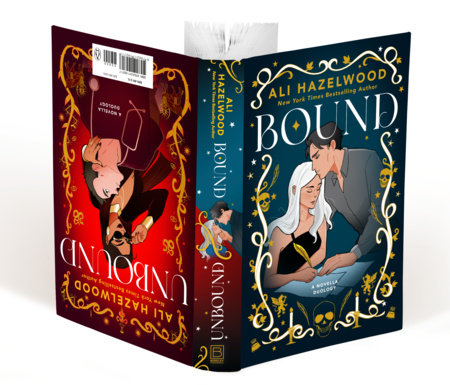
New York Times bestselling author Ali Hazelwood’s intoxicating paranormal romance novella duology—together for the first time in print and ebook! Read the captivating dark academia romance in Bound, then flip your book over to unleash the dangers of forbidden love in Unbound. Bound A reluctant con artist and a professor with too many secrets are bound by an arcane text—in more ways than one.
Veronica “Vero” Mercer grew up with grifters for parents, and she knows her way around a con. When grad school bills pile up and her friends are in trouble, she turns her art history skills into a forgery side hustle.
It’s supposed to be a short term deal, but her work draws the attention of Dr. Viktor Ashworth, a reserved, very British professor. Instead of turning her in, Ashworth kidnaps her—politely—and makes an unusual offer: forge a mysterious ancient manuscript for him.
Soon Vero finds herself spending long nights with Viktor, bent over rare vellum samples and obscure inks. But as the con grows riskier, Vero has to wonder: what does Viktor really want, and why can’t she stay away?
Unbound A five-thousand-year-old woman who has outlived empires. A doctor who has spent his life fighting death. Their fates collide in a blood game of vengeance.
Lilit of Nineveh has spent millennia in control. As a powerful revenant, she enforces one rule above all: protect mortals. Disciplined and focused, she has never made the same mistake twice, and she has learned that attachments can only lead to ruin.
Enter Roman Martin. An overworked and relentlessly kind ER physician, he is the one mortal Lilit cannot quit. Any relationship between them is against everything Lilit has fought for. Still, she keeps coming back to him.
Until someone starts hunting Lilit, and Roman is caught in the crossfire. When everything comes crashing down, Lilit must choose between the world she has sworn to protect and the man she was never meant to love.
Release date:
October 6, 2026
Publisher:
Berkley
Print pages:
416
* BingeBooks earns revenue from qualifying purchases as an Amazon Associate as well as from other retail partners.
As fond of and consumed by my own story as I am, I must admit that it's not too different from most others. Stories are stories, with their beginnings, trappings of middles, and nice, tidy conclusions; I've told so many, it should be second nature to grab a fountain pen, a stack of homemade paper, and add mine to the collection. But here I am, hesitating, because I cannot make up my mind on where to start.
A friend suggested that I begin with the summer prior to the final year of my PhD at Rockhaven University, a few months before I died. By then I had already been in trouble for quite a while, and my fate was decided, even though I was not yet aware of it. But I'm not convinced. It seems too bold a choice, starting in medias res, all the more because the first lines of this tale were written when I was still an elfin kid with oddly colored hair and a chewing gum addiction.
Back then, my main pastime was observing an elderly neighbor dip Kolinsky sable-hair brushes into vintage tins of watercolors. "You are lucky," Grace would say in her peeved, cigarette-rough voice, never glancing up from her latest piece. "That your no-good, credit card-skimming father got out of the clink just before your no-good, fake charity-driving mother went back in. Or you'd be in some foster home down in Tullahoma by now, just you and a box of Crayola. C'mere, kid. I'm gonna show you why this layering I just did turned out to be such crap."
I was never a devoted wishful thinker. I refused then, as I do now, to claim that Grace's insistence on teaching me the ins and outs of craquelure, or how to properly clean mildew from leather binding, were vocabulary words in her highly individualized love language. Still, if I'm going to tell my story, she should get some credit for being the first to set me on the path of those who appreciate a certain kind of beauty. So should the judge who made it clear that his eyes were on me, and that they were going to stay fixed right there for the foreseeable future-unless, of course, I cleaned up my act, boosted my grades, and sent out those university applications, stat. Honorable mentions: the Chemistry of Conservation class I chose to take in my second year of college because it was the only non-eight a.m. option; the undergraduate advisor who suggested that if this medieval art stuff was really my thing, he might have a friend at some fancy university up north; the way time and space always seemed to disappear whenever the world shrank to something consumable through my eyes and my hands; that letter Grace left for me to read after she was gone, the handwriting as jagged and sparse as her heart. I don't have much, but it should be enough for a U-Haul. Now get the hell out of this shithole.
So, that's how my story started. There were lots of beginnings, but they coalesced into a perfect storm a few weeks into my first year of grad school, when Mortimer "Don't Call Me Morty" McManaman pulled his best trick out of a top hat and convinced Roxanne, my landlady, to go out with him.
Mortimer was a floppy-haired rich boy who loved to introduce himself as a fine-arts connoisseur, owned polos in every color of the rainbow, and repeatedly failed at growing an authoritative mustache. Not very likable, although he tried very hard. Sometimes I felt bad for him, and maybe Roxanne did, too. Or maybe Mortimer took advantage of her rock-bottom phase. She was, after all, recently separated. Despite her reputation as one of the top gemstone experts in New England, her ability to take commissions had been severely curtailed by having to shoulder most of the care for Rorie, her toddler daughter. The ongoing divorce proceedings had been a financial hit, and desperate people tend to do desperate things. Dating a questionable guy was not qualitatively different from plucking a doctoral student from Craigslist and renting her out one's spare bedroom.
Mortimer may have been less threatening than Roxanne's lying, cheating ex, but they were still unlikely to have a future, especially after he started addressing her as kitten halfway through their first date and never wised up enough to stop. She knew it. I knew it. Judging by the sheer number of increasingly desperate presents that cluttered our home, Mortimer knew it, too. And yet, he clung fiercely to the idea that she might be the one. He'd come over once a week, or whenever Rorie was with Roxanne's ex for the night. He'd fuss with his hair in the entrance mirror and then lay his offerings at the altar of Roxanne's spin-sculpted body: imported coffee beans, wine that didn't live in a box, trays of assorted several-dollars-apiece pralines.
And, one fateful night, a first UK edition of Dracula by Bram Stoker.
This one, in all fairness, wasn't a gift, more like show-and-tell. "We just got it in today," Mortimer said, taking the book out of a leather briefcase and setting it on the table. The McManaman family was based in Boston, but they owned a local antique dealer of middling reputation here in Vermont, and Mortimer had recently gone on a break from his main gig-recommending local breweries and golf courses, unprompted-to take over the business. "Isn't it stunning?"
Roxanne gasped. "Oh my god." She reached out, maybe to trace the gilt-and-red lettering on the cover, but thought better of it and snatched her hand back. "This is incredible. Look at the way the binding is sewn."
"I know." Mortimer smiled smugly. "Over a century ago, at some point in 1897, some guy sat in front of a fireplace to smoke his pipe and read this book. And now it's in your kitchen. Can you believe that?"
"No," I said. Which made Roxanne and Mortimer look up at me from across the table with surprise and irritation respectively.
"What do you mean?" she asked.
I glanced down at the panini press I'd pilfered from my last stint at the Costco deli, already regretting speaking up. "I think it might be a forgery," I said, as neutrally as I could-which was a lie. I was, in fact, dead certain. But despite my parents' repeated accusations, I did not enjoy disappointing people.
"I mean, you can think that the Earth is flat and clouds are made of marshmallows." Mortimer's tone was the usual-artificially affable-but his eyes narrowed. "That doesn't make any of it true."
"No, it doesn't." I longingly contemplated a world in which I could slip onto the balcony to eat my grilled cheese and mind my business, forgetting all about this conversation. But would it not have been a careless, selfish thing to do? If I said nothing, Mortimer was going to try to sell the book for one hundred grand. Either his reputation or his rap sheet was going to take a hit.
Cruel to be kind, and all that.
"It doesn't," I repeated. "However-may I?" I crossed the room to pick up the tome and flapped it open, ignoring Mortimer's darkening expression. "See here, the way the endpapers are attached? Can't be sure, of course"-I could-"but it suggests a more recent gluing technique than the ones used in the late 1800s. The regularity of the sewing patterns, the paper . . . This pulping is not Victorian, not to mention how unusually crisp some of this lettering looks, and . . . Well." I returned the book to the briefcase, feeling a touch sorry for Mortimer. "All the stuff I just listed? That makes it true."
"Excuse me? What- How would you even know about fucking Victorian pulping?" He laughed nervously.
"Vero's getting her PhD in art history," Roxanne told him, clearly irritated on my behalf. "And her grandma did restorations. You didn't say she also did books, Vero."
Grace would rather have chewed on a palette knife than be referred to as someone's grandma, but I had little experience discussing my past with others, and didn't know how else to explain her role in it. Grad school was a fresh turn in the winding road of my life-starting anew, making friends, building community, that kind of stuff-and I was willing to give it all a try. Still, some abridging seemed wise. "She did mostly books, actually. Lots of demand."
That was when Mortimer's eyes settled on me, really settled, for the first time, as though I'd just now materialized from invisibility in the middle of the living room. They started at the center part of my hair, traveled down my long body, and then lingered around my bare feet. He and Roxanne were less than a decade older than me, but he eyed me like I was a ragamuffin begging for a bowl of porridge. "Vero, right?" he asked, sullen.
"That's me." We had been introduced before, had even exchanged pleasantries as I microwaved my soup or chopped salad ingredients, but I knew how Mortimer's kind saw the world, and that they could rarely be bothered to acknowledge the existence of women they didn't care to sleep with. Several inches taller than him, with silver-gray hair, crooked teeth, a penchant for piercings, and an almost exclusively oversize, shapeless wardrobe, I doubted I was his type. I'd long ago accepted that there was something about me that seemed to leave most men stumped, or scared, or indifferent.
Mortimer was nothing if not predictable.
"How could you even tell what the sewing pattern looks like from across the room?"
Because it's that badly forged, I didn't say. "Really good eyesight."
"Yeah? Is this what you're studying, rare books?"
"Not quite. Late medieval manuscripts."
"You wanna become a professor?"
"I-"
"See, that's the problem. You"-his finger pointed at me-"have taken half a class on a tangentially related matter and think you're better than the book expert my family has been working with for half a decade." He paused, perhaps expecting me to get angry and fight him on this. When I couldn't be assed to care about his tantrum, he smiled in triumph and muttered, "Grad students, man. They're all the same."
Roxanne scoffed at Mortimer, pointed out that she had a graduate degree (material sciences), too, that he was being rude, and other things I never heard because I didn't stick around. I had a delicious grilled cheese sandwich on the balcony while the early fall New England breeze swirled around me, and fed leftover crumbs to a brave pair of mated cardinals. I forgot about the whole interaction-until two days later, when I spotted Mortimer rocking on his heels under the late-morning sun outside of my pedagogy seminary. He was scanning my classmates' faces in search of someone. When his eyes landed on me and didn't move on, I wasn't even surprised.
"It was fake, huh?"
He nodded, pasty face even paler than usual.
I considered myself an averagely petty person, but this gave me no pleasure. "I'm sorry," I said, truthfully. "You should get a better consultant." I made to walk around him, but he blocked my path.
"Yeah, I should." He looked me in the eye so unsubtly, I wondered why Roxanne had stooped to seeing this guy. Maybe it was Stockholm syndrome. Maybe he had dirt on her. There must have been an explanation, because he had even less game than I'd originally suspected.
"Sadly, I am very busy with that doctoral degree that you so respect."
"It could be practice for your-"
"I don't need the practice." I sidestepped him and climbed down the stairs. "Have a good-"
"I can pay."
Alas, those were the three magic words sure to stop every graduate student in their tracks. We all needed money. Those who didn't still could have used money. Despite its preppy rowing clubs, stones engraved with Latin mottos, and thirty-five-billion-dollar endowment, Rockhaven University couldn't afford to pay us livable wages.
Someone really ought to have checked the math.
"Can you?" I turned back to him. "Pay, that is."
"Yes."
"How much?"
"Well. Very well."
Any romantic relationship between Mortimer and Roxanne may not have lasted past midterms, but for him and me, it was the catalyst for a long and fruitful collaboration.
The first three years of my PhD were humdrum and uneventful-a true boon for someone who had spent the previous two decades and change as a drama magnet of great potency and misfortune.
In my defense, some of it couldn't have been avoided. I wasn't at fault if my parents were petty criminals gummed up in a toxic yo-yo pattern of getting together, grifting together, then grifting each other. Still, it must have left a mark, being raised by two people whose idea of love and respect was to get the other to pony up bail and then disappear.
I wonder now, after all that has happened, if the way I was raised made it easier for me to accept what happened once I got to Vermont. If this story of mine could have been anyone else's. Messed-up, mixed-messaged upbringings taught one expediency, resourcefulness, and how to embrace the fluctuating nature of ethical principles. By the time I entered puberty, I was already well acquainted with a number of short cons-fake raffle tickets, selling stolen electronics, ye ol' price tag-switch scams. Surprising that it took until I was fifteen to get caught. After that I'd mostly behaved, and despite little to no contact with Mom and Dad, I never fully weaned myself off my lawbreaking tendencies.
"And here's why." Grace, who flicked through every free magazine that landed on her doorstep and couldn't have distinguished a news item from a sponsored link to save her life, once looked up from under her green banker's lamp, pointing at the article she'd been reading. "Did you know that people with hypoactive amygdalas are more reckless? And that amygdala function is hereditary?"
"Can't say I did."
"I bet that's what's wrong with you."
"Maybe I'm just too broke to care about morals?"
"No, it's your brain. It predisposes you to nonviolent crime!"
"Spoken like a true brain scientist," I said. "By the way, please explain what an amygdala is, Grace."
She slid a hand out of her paint-stained apron to flip me off, and I bit back a laugh.
I'd always been a guest in Grace's home-a pantry-plundering, welcome-overstaying guest, but a guest nonetheless. It was during my sophomore year of college that I let go of my dorm room and began commuting to the University of Tennessee from her house. "Even though no one asked you to," she reminded me daily. "I like my privacy. If I wanted urchins underfoot, I'd have spawned my own!"
We hope you are enjoying the book so far. To continue reading...

 Please log in to recommend or discuss...
