Prices may change without notice. Check price before purchase.
Share
Book info
Sample
Media
Author updates
Lists
Synopsis
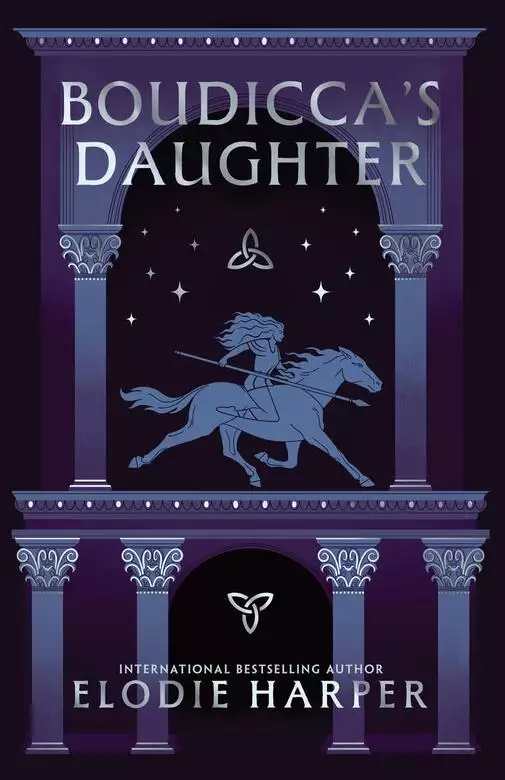
The story of Boudicca, the notorious warrior queen who led a legendary rebellion in 60 CE against the Roman Empire in Britain. This book by acclaimed Wolf Den Trilogy author Elodie Harper follows Boudicca's meteoric rise and devastating fall through the eyes of her youngest daughter, Solina, who seeks revenge against Rome.
Boudicca—infamous warrior, queen of the British Iceni tribe, and mastermind of one of history’s greatest revolts. Her defeat spelled ruin for her people, yet still her name is enough to strike fear into Roman hearts. But what of the woman who grew up in her shadow? The woman who has her mother's looks and cunning and her father’s druidic gifts, but a spirit all of her own? The woman whose desperate bid for survival will take her from Britain’s sacred marshlands to the glittering facades of Nero’s Roman Empire . . . The narrative arc and emotional heart of the book is Solina's complex relationship with Rome, and what resistance means in the radically different world she finds herself in after her mother's fall. After she is taken to the Empire's capital by the ruthless Roman general Paulinus, she will have to decide what it truly means to be Boudicca's daughter. Forced to fight. Determined to succeed. Meet Solina. Boudicca’s daughter.
This epic and emotional novel is perfect for fans of Madeleine Miller’s Circe and Constanza Casati’s Clytemnestra.
Publisher:
Union Square & Co.
Print pages:
400
* BingeBooks earns revenue from qualifying purchases as an Amazon Associate as well as from other retail partners.
The twisted branches flash past, swift as shadows, yet solid as spears. I don’t have time to feel afraid of falling or being struck by deadly low-hanging trees. Instead, I cling to Tan’s mane, my heartbeat racing to the thunder of his footfall. A horse gallops faster than thought, and nothing exists for me but the exhilaration of his speed. The force of it hits me like fire, filling me with joy. Around us the wild wood, stripped of its leaves, glows green from the moss that rolls over waves of roots and stone in a luminous sea. Then Bellenia’s scream rings out, startling Tan, sending the last of the birds scattering. I turn in the direction of her cry. My sister has managed to overtake me, weaving dangerously through a narrow gap in the woods, more reckless than I would ever dare to be. Before I can urge Tan to go faster, Bellenia’s horse Kintu shoots onto the path in front, kicking up clods of earth, blackening the way. I don’t have the guts to try and shoulder her aside—either of us could be snared in a savage tangle of roots and whip-like boughs. Anger fills my heart as my vision shrinks to Kintu’s powerful haunches, the dark rope of his tail, the gold of my sister’s blonde hair.
White sky burns through the thinning trees, the green glow fading, then we burst out onto the plain. Open space excites Tan, giving him another burst of speed. Bellenia is ahead but not out of reach. I shout at my horse, encouraging him to gallop faster, but Kintu is still swifter, and the two waiting figures grow more solid in the distance. Beyond them the target also looms, the curved husk of a wide, blackened log, upended in the boggy ground: a dark imitation of a Roman invader. I see Bellenia hold out her spear, poised, an image of grace before she throws. Iron sinks into bark and she wheels off, screaming in triumph. I raise my own arm, bracing against the weight of the weapon, urging Tan to gallop directly at the target. He shears off at the last minute, but I ride him so close I hit the chalk daubed at its heart.
Unlike my sister, I canter toward Riomanda and our mother in silence. They sit tall on their horses, watching. Tan’s breathing is heavy, sweat lathered into foam at his sides, his coat drenched. Bellenia is already dismounted, weapon drawn, leaving Kintu untethered, the horse’s sides heaving like bellows. I leave Tan, drawing the weighted wooden sword from my back. Not a real weapon but still banned, still reason enough to train out here, where the grey fingers of the sea reach into the land, and no spies will watch us.
“The aim is to disarm,” Riomanda says, raising her voice over the wind.
I glance over at Riomanda and my mother, sisters by marriage and two of the most formidable warriors of the Wolf Tribe. Rome has forbidden the Iceni from bearing arms, but my mother once told us this is like commanding the sun not to rise. She has brought my sister and me here to learn how to fight, just as she and Riomanda once learned, tracing the thread of their knowledge back through time to the god of our people, Andraste. Riomanda’s dark hair is tied in a knot of plaits, her face hard, like the one shaped in metal on the hilt of her knife. My mother, Catia, is cloaked in a wolf pelt, its fur grey as winter clouds. Her eyes are on Bellenia. As always.
My sister’s cheeks are flushed red, eyes bright with excitement as she waits for me. We circle each other. She strikes first, as I knew she would. The force of her blow jars up my arm, but I keep hold of my sword. Bellenia begins to shout, aggression transforming her beautiful face, making her look as vicious as the carved head of a carnyx.
“You are slower than a badger, Solina! Even if I cut off one of Kintu’s legs, I would still beat you!”
I circle her, dodging another blow.
“Are you silent like a Roman?” she taunts. “Perhaps you are not Iceni at all.”
I say nothing, knowing that will enrage her more, and keep my eyes on her blade. The next time she hits out, I dodge in anticipation, and she lurches forward. Before she can recover her balance, I knock her over, sending her sprawling into the mud. Then I pounce, resting one boot on her stomach, the other on her weapon.
“Who’s slow now?”
“You sneaky piece of shit!” she exclaims, angrily wiping the mud from her trousers as I help her to her feet. Then she catches my eye and laughs.
“I’m glad you both find fighting so amusing,” Riomanda’s voice is ice. “Solina, that is a poor way to win, without daring to strike a single blow. Bellenia, if you fight like a fool, you will fall like one.”
I look over at our mother. She says nothing, which is even more ominous. Eyes narrowed, she dismounts, murmuring something to Riomanda as she hands over the reins of her horse. She walks over to Bellenia.
“Raise your weapon.” My sister swiftly obeys. “You strike well but you lack sense,” she continues, drawing a wooden weapon from her own back. “Fight me now, without signaling where you will hit.”
I watch them both, envy burning in my chest. Nobody can handle a sword like our mother, not even Riomanda. Yet, somehow, when Bellenia faces her, my sister draws strength from the encounter rather than falling to pieces as I do. I watch my sister’s thrusts and parries grow bolder and know how much pride our mother must feel; I know exactly why she will never love me as much as she loves Bellenia.
They end their bout. My sister did not manage to score a hit, but still, she came close. Our mother’s face is lit by an affectionate smile. “Better,” she says.
I brace myself, knowing it is now my turn. “Solina,” my mother turns to me. “You fight like a coward. In silence. Without striking a blow.”
The unfairness stings. “And yet I just won.”
“You have no fire,” she replies. “How would you survive in battle?”
I hit out in rage. She blocks my impulsive blow with ease, then rains down on me, just as she did with Bellenia. But while this inspired my sister to fight back, it only makes me shrink, my moves becoming ever more defensive.
“Do you have no insults?” my mother shouts. “Where’s your passion? Where’s your fury? What sort of warrior comes to battle like a mouse?”
“Quasi tuba inanis!” I scream back, swinging the sword at her, nearly scoring a hit. I see her face flush—not at the words, which she would not understand, but because I have spoken in Latin. She knocks the sword from my grasp as if it were a reed, then slaps me across the face.
“Never speak their tongue to your own with a weapon in your hand,” she says.
Shame floods through me, scalding my cheeks. Latin is the language of our enemy, the language used by the centurion who murdered Riomanda’s brother. I want to apologise but cannot bring myself to do it. My mother’s face hardens at my lack of remorse, then she turns her back. I stare after her, watch her swing herself into the saddle, then startle at an unexpected punch to my arm. It is my sister.
“Why would you do that?” Bellenia hisses, her voice low. “How could you shout at her in Latin? Like one of them. What did you even say? It sounded so ugly.”
“You would know what I said if you had paid any attention to our father’s lessons!” I snap back. “It was nothing that bad, anyway. I just told her she sounded like an empty trumpet.”
Bellenia can’t help snorting. “That’s a pathetic insult. Just as well nobody understood.”
I roll my eyes, but I’m grateful to her for lightening the mood. Tan edges away from me when I go to fetch him, tired from galloping through the woods, but I seize him by the reins. He lets out a long, heavy sigh when I swing myself up onto his back, sounding like a phlegmy old man. Bellenia laughs.
“Tan sounds ready for battle.”
I wallop Tan on the backside so that he lurches toward my sister, who trots off with a shriek. I laugh, then look nervously toward our mother and aunt, who have already set off. They do not turn around.
We ride together across the marshland, back toward the Town of the Wolf, through the northernmost edge of Iceni territory. Our mother sets the pace, picking out the path over the wooden causeways, guiding us through the treacherous, watery ground. It is not long past midday and yet the sky has a washed-out look, as if the veil to the Otherworld were already thinning. By nightfall it will be no more substantial than the mist creeping over the plains, and the spirits will walk with us. I stare out over the marshes, at the feathered reed beds that stroke the low-lying cloud, and the iron grey of the sea that lies beyond. I think of Esus the river god, squinting to see if I can glimpse one of his birds, the long-legged herons that wade through his waters.
I have long since abandoned hope of meeting Esus himself—though perhaps this year, at the Winter Solstice, one of the gods will finally speak to me. As Solina, the daughter of Druids, I still lack the sight to match the meaning of my name. Riding beside me, her golden hair brighter than sunlight, Bellenia looks the very embodiment of her name: strength. I glance down at Tan’s neck, my heart heavy, ruffling his mane. His coat is white and red, both colours that mark him as a servant of the Otherworld. But Tan has never led me to any gods.
The closer we come to the town, the more marks the landscape shows of the mortal realm. Salterns stretch toward the horizon, and here a few men, women, and children bend over pools and smoking fires, extracting white treasure from the bog’s briny water. I see a girl grasping a bucket with red chapped hands, and feel thankful to be safely up on my horse instead of toiling in a freezing trench. The Romans pay dearly for our salt: my father told me once that their soldiers even measure their wages in it. Salarium. I murmur the foreign word under my breath, feeling its shape.
“What are you mumbling about?” Bellenia demands, always too sharp-eared to miss anything. She has always been this way, my little sister, full of curiosity and mischief.
“Nothing,” I say.
“It sounded foreign.” Like our mother, Bellenia cannot speak Latin. She has no patience for my interest in the Roman settlers who have seeped into our country, embedding themselves in the land like leeches. They invaded when my sister and I were small children, and now I cannot remember life without their shadow, their casual violence and endless theft. We were raised to hate them, and I do. Yet, unlike Bellenia, the invaders also fascinate me. Our father was gifted slaves when he agreed to serve Rome, and I became fond of one, a woman named Salvia. But while I sat beside her as a child, encouraged by our father to learn about her language and her gods, Bellenia refused to join me. Salvia is dead now, as is her knowledge.
“It was a prayer to Esus,” I say. A lie, but not an unlikely one. Bellenia used to tease me for my love of legends about the handsome river god. So many stories tell of him walking among mortals, as if he were an ordinary warrior, granting gifts to his favourites or inviting them to the Otherworld. I spent years hoping I might find him.
The track becomes a road, marked by wheel ruts, boots, and hooves. We pass a cluster of roundhouses surrounded by fields, and a gaggle of foraging children run to the roadside to watch us, firewood clutched to their chests, their faces eager. My mother lays her hand over her heart in greeting, bowing her head as if they were kings. The children grin, nudging each other in delight, making me smile too.
On the vast, flat plains of our kingdom, covered by an even vaster sky, the town is visible long before we reach the gates. It rises above the fields, surrounded by steep earth embankments and wooden walls. Sheep graze up to the edge of the settlement’s encircling ditch, and thatched rooftops peek over the ramparts, like sentries keeping watch. Travelers grow in number the closer we get, a stream of farmers and traders from nearby villages, heading here to celebrate the week-long Feast of Darkness. A few stare at me, giving Tan a wide berth. One old man even makes the sign of the evil eye. His fear doesn’t offend me. I know I make an uncanny sight at any time, but especially today. White skin, red hair, eyes dark as a raven’s wing. Marked in the colours of the Otherworld, like my horse.
A growing hubbub of human voices drowns out the birdsong. We ride through the deep trench that cuts through the town’s defensive ditches and reach the wooden gatehouse. The beast of my mother’s people is painted at the top as a mark of respect for the goddess Andraste, giving the place its name: Town of the Wolf. I look up as we pass underneath. Seven human heads hang above the wolf’s back, some so decayed they have shriveled like rotten apples. They are the remains of thieves and murderers, staked here as a warning, even though everyone knows we lack the power to punish the worst criminals—hanging a Roman on our gates would be taken as an act of war. Still, my mother says the heads are a reminder to Rome that our patience should not be tested too far. And my father’s presence, as Rome’s client king, is an effective deterrent from their violence.
Inside the town, clamour and warmth engulf us. Smoke rises from the roundhouses, making the grey sky above shimmer a darker shade of blue, and my spirits rise with them. We weave our way past traders at the gatehouse, men and women jostling to sell baskets woven from marsh-reeds, or clay pots, or fabric. Further into town, grain stores stand on stilts, hovering like herons. Their height offers protection from vermin and damp, though not from Roman tax collectors.
Bellenia and I ride single file through the milling people, dogs, and pigs, following the loud clanging of metal that marks out the blacksmiths’ quarter. This part of town was once the armoury, where people and horses were equipped for war, before it was banned. We pass the forge, where beautiful metal masks sit either side of the door. They are for horses, horned and inlaid with silver. I try to imagine Tan wearing one, how fearsome he would look riding into battle, and picture myself charging over the field like a warrior of legend, as glorious as Esus’s bride, Epona. I pat Tan’s neck. “Maybe one day,” I murmur, as if he might hear my thoughts.
Our home lies at the heart of the town. My mother’s family have ruled here for generations, cousins and kin all living in a vast painted roundhouse, its hall big enough to hold hundreds. Today, the clearing outside our home is crowded with visitors who have not only come to celebrate the feast, but also to bring their grievances to my father. I dismount, watching one of the servants lead Tan to the stables, suddenly nervous. I have lived most of my life in the south, with my father’s people. The Wolf Tribe are tougher, harder to read, more prone to fighting. More like my mother.
Even though his rule has brought us peace, many here have never forgiven my father for making our kingdom a client state of Rome. My mother resents his choice most of all. She beckons now to Bellenia, who walks beside her into the hall, their hair the same shade of gold, while I follow behind with Riomanda. Dust motes dance in the dimmer light, and our father, Prasutagus, sits by the red glow of the hearth, pressed close by men and women, the leaders and warriors of surrounding settlements. High above them, carved wolves’ heads are shaded by the fire’s rising smoke, and the walls glint with the metal of a hundred shields.
Our father rises as he watches us approach, holding out his hands to our mother. “Catia,” he says, embracing her. She draws close to him, resting her forehead to his. He might be king, but everyone watching this performance of unity knows their rule is like a rope, drawing its strength from weaving together the warriors of the north with the Druids of the south.
My parents stand apart, his grey hair at a height with her gold. I try not to notice how much older my father looks. He gestures for me to come closer, laying a hand on my shoulder. “Solina will lead the ceremony tonight,” he declares, looking round at our guests. I force myself to ignore my nerves and meet the assembled warriors’ eyes with a show of pride, as my parents expect.
“May the gods guide you.” The words are spoken by a tall, blond warrior, with a chest as broad as one of the shields on the wall. I recognise him as Isarninus, the leader of a settlement near Andraste’s sacred hill. He is the man Bellenia has her eye on.
“I pray they bless the feast,” I reply. Even though we are standing near the hearth, the hall feels chill. I fold my arms, not wanting to shiver.
“Your daughters wear warriors’ clothes,” says another man, dressed in a wolf pelt, his expression as unfriendly as the beast he wears. Bellenia pulls her own cloak closer around her thighs, perhaps hoping to hide the mud stains where she fell. “Yet you have not called for arms against Rome?”
“We still hope for peace,” my father answers, not rising to the man’s tone.
“They leave us no peace,” snaps an older woman, deep grooves cut through her weathered face, like wheel ruts in the road. I know her as Diseta, one of my distant cousins. Like my mother, Diseta wanted us to join the rebel Caratacus ten years ago in his doomed uprising against Rome. I remember Caratacus coming to our home at the City of the Horse, a glorious warrior in a cloak of gold, making promises of freedom. My father refused to help him, to my mother’s grief.
“They are demanding money from me, from all my kin,” Diseta says. “Roman filth turn up at my home without shame, then the bastards make off with whatever they can grab. Demanding we return loans they never even gave us. Stealing our cattle! Even our men are being kidnapped, forced to fight in their armies. Yet we do not fight back to defend ourselves? Why?”
I glance anxiously at my mother, whose hand now rests on Bellenia’s shoulder just as our father’s rests on mine. Her lips are pursed in a hard line. I know she agrees with Diseta, that she would have us go to war. But she will not say so here. It is more important to give a pretence of unity between herself and my father.
“Diseta, I know they are arrogant,” my father says. “I know they demand too much. But we are not enslaved, like the Trinovantes. War would risk the loss of every remaining freedom we have.”
“We don’t yet have the means to fight them,” my mother adds. “Too many have forgotten how. It is a question of timing.”
There are nods of agreement at this—my mother is always closer to the mood of her own people. “So that is why they are training.” Isarninus gestures at my sister.
“Our daughters have always trained in the old ways,” my father says, unwilling to give any quarter. “Nothing has changed.”
“Everything is changing,” Diseta snaps. “Prasutagus, you have given your life to peace, and we have trusted your guidance. But that season is ending. You cannot keep Rome at bay forever, their violence grows daily. They are stripping the land like rats in a barn. Their greed will never be satisfied.”
“Do not invite the Darkness,” my father says, a note of command in his deep voice, a reminder of his divine status as a Druid. “Tonight, of all nights.”
“We share your anger.” My mother turns to Diseta whose mouth is already open, ready for a furious retort. “Feast with us tonight. And we will ask the gods to guide us.”
At the back of the hall, screened from sight in a chamber under the eaves, Bellenia and I dress for the feast. Through the wicker slats, we can see a few guests still gathered around the hearth, arguing with our father.
“Will Roman soldiers come this far north in winter, do you think?” Bellenia whispers to me. “Surely not with the king here?”
She has voiced my own fear. “Not tonight, they won’t,” I say, trying to sound less afraid than I feel. “And Diseta would see them all off, anyway.”
Bellenia smiles. “She gets more like a forest troll every year.”
I can hear one of the maids scolding the children playing knucklebones in the hall, then she is inside the chamber, bringing a bowl of water for us to wash our hands and faces. “Naughty little mice,” she says. “Running around, getting in everyone’s way.” The girl cannot be much older than a child herself, and I remember being her age, wanting to join the adults. “Will you be getting married this year?” she asks, yanking my hair back into plaits. “Imagine all the dancing and feasting!”
“Solina won’t be happy unless Esus himself swoops down to claim her,” Bellenia teases. “I’m not sure a mortal man will ever be good enough.”
“I don’t have to find a man of any sort,” I say, giving her a withering look. “I will serve the kingdom as a Druid, like father, and marry or not as I please.”
“You see.” Bellenia smirks. “I told you. She’s holding out for Esus himself. Though failing a god, there’s always Vatiaucus.” I shove Bellenia, who laughs but then shoves me back, hard, and there’s a moment when I know my sister, like me, is thinking of throwing a punch. I picture our mother’s fury if we were to be caught brawling and lower my fist.
“Vatiaucus might not even be here,” I say unconvincingly.
Last spring, I chose Vatiaucus as a lover, dazzled by the sight of him on horseback, but after a few intoxicating weeks, I realised his body was by far the most interesting thing about him. I managed to disarm the poor man once when we trained together and took this as an excuse to end things—as the king’s daughter, I have the right to an unconquered warrior. Now, whenever I see him, Vatiaucus gazes at me with large, sorrowful eyes like a cow stuck in brambles, much to my sister’s amusement.
“It’s Bellenia you should watch,” I say to the serving girl. “She’s got her eye on Isarninus.”
“The tall one, with the lovely eyes?” the girl exclaims. “What a match that would be! He’s blond as a haystack, isn’t he? And almost as big.” I try not to snort at her ridiculous description.
“He’s handsome enough,” Bellenia says, with a smug little smile. I roll my eyes. I have no doubt she could claim Isarninus if she wanted. Bellenia has always been more beautiful than me, with our father’s fine features, while I take after our mother—tall and striking, but unlikely to steal a man’s heart on sight. Even Vatiaucus used to stare at Bellenia when he was mine. I think of the reassurance Riomanda once gave me. You have a beauty that grows, an acorn that will become an oak in the soil of the right heart.
“Perhaps you and Isarninus will dance together tonight!” the maid says to Bellenia. “A shame there are no flowers for your hair. Will you kiss him or take him to bed? I’m sure he couldn’t refuse!”
The girl has now lost interest in helping me dress, fluttering around my sister. I wrap myself in the heavy robes I will have to wear for the ceremony later, woven in a shifting pattern of red and white. Horses run around the borders, stitched in gold. I lift my arms, wanting to see the colours of the fabric shimmer. My chest feels tight—although I always stand beside my father at the Feast of Darkness, I have never led the ceremony. He will take over from me after the invocation, but I am unsure I deserve the honour. Father has reassured me there are many ways to be a Druid; some serve through learning, others through visions or prophecy. Yet I still feel crushed by my inability to see beyond the veil, to walk in the Otherworld as he does.
The maid is now gawping, awestruck, at the sparkle of my robes. “Do you think the gods will speak through you?”
I catch Bellenia’s eye. My sister sees my fear and steps forward to take my hand. She is always there when it truly matters. “Solina is a gifted Druid,” she declares. “She is blessed by the gods. That is why our father chose her to cross to the Otherworld tonight.”
I squeeze my sister’s hand, hoping she understands the gratitude I cannot express in front of the maid. Bellenia turns and kisses me quickly on the cheek. “The gods will speak to you this evening, Solina,” she says. “I feel it in my heart.”
Catia watches her daughters, their figures lit by flames, her heart gripped by pride and pain. In their faces she still sees the babies she nursed and held, the children they have so recently been and the women they are becoming. Impossible to imagine all the winters that have passed since she carried them. Now they stand, surrounded by hundreds of their people, in the divine clearing between town and wilderness, greeting the Darkness with fire. It is the most sacred night of the year, when the veil between worlds thins, allowing spirits to walk in the mortal realm. Sacrifices made tonight will ensure that the gods will allow the rebirth of spring.
A giant bonfire for Taranis, God of the Sky, burnishes Bellenia’s hair to a brighter shade of gold, outshining the priceless torc around her neck. Her youngest daughter is so beautiful, sometimes Catia cannot believe she birthed her. She is a child who has brought nothing but joy. Beside her, draped in ceremonial robes, Solina is clearly Catia’s daughter—no other woman could have carried her. That distinctive tall stature, her uninviting frown. Their similarities don’t always endear Solina to Catia—it is disconcerting to meet her own stubbornness in another. She frowns, remembering how her eldest child cursed in Latin earlier, like a Roman brat.
Solina moves to stand next to her father. Other Druids who have gathered for the ceremony make space for her, allowing the king’s daughter to take precedence. Nothing Catia has done in life has ever pleased Prasutagus more than this child she gave him. She feels a flicker of resentment at her husband’s favouritism for their firstborn. He has never believed Bellenia to be as intelligent as her older sister, forever telling Catia that Solina is the one destined for greatness. He has seen her spirit soar over the rooftops of Rome. He has watched her rise through his black crow’s eye, the form he wears in the Otherworld. There is no arguing with the gods, Catia supposes, but it still rankles, her husband’s inability to realise Bellenia is just as special.
In the darkness, Prasutagus looks more like the man Catia met as a girl. His face glows red as blood in the flames, silver horns are set upon his head, and his sacred authority makes him appear ageless. Her husband is not one man to her, but many: the Druid who speaks as a god, the warrior she fell in love with, and the man who betrayed her. Their marriage brought the Wolf Tribe under his control, a gift she should never have bestowed, and he repaid her by becoming a client king to Rome, defying her wishes. Prasutagus succeeded in achieving the prosperity that he promised the gods had foretold, and Catia thought she had managed to make peace with his decision, but now Rome is growing bolder, and the king is weakening. She knows her husband is losing his power to old age, like an oak stripped of its leaves, naked against the coming cold. Rome is a darkness that frightens her more than winter ever could.
Sacred mistletoe is thrown on the fire, and the silver mirror to the Otherworld shines bright on Solina’s face, illuminating an expression of fear. Catia’s resentment melts into tenderness at the sight. Solina is not Prasutagus, however close the pair may be. Instinctively, she murmurs a prayer. “May the goddess of souls speak through my daughter, may her vision be true.” Solina holds out the mirror, its surface representing the veil between worlds, and begins to sing. She invokes the birds of Epona, creatures with the power to wake the dead and send the living to sleep. All eyes are upon her, none as intent as those of Prasutagus. His lips move, silently mirroring her words.
Solina stops singing. Her voice when she speaks sounds harsh and unfamiliar. It is Epona speaking through her, addressing the spirits.
“For one night you may walk among the living. For one night you may leave the Otherworld. For one night the veil is lifted.”
There is silence. Catia stills her breathing, hardly daring to make a sound. She can see Epona’s horse, inlaid with gold on the back of the mirror clasped in Solina’s pale fingers. Her daughter is staring into the glass, waiting for a vision that might guide them through the year. Solina frowns as if surprised, her eyes searching the silver surface, her expression intent. Then her shoulders droop, and she hands the sacred object back to her father.
“I see only darkness.”
Catia tries not to let the disappointment show on her face. So many are watching to see her reaction. It is not a terrible vision—the dark of winter is indeed here, and on many occasions, Prasutagus has seen nothing more than this. And yet, they had all hoped Solina might be blessed with more tonight.
Solina steps back. Prasutagus takes over the ceremony, heaping dried mistletoe on the fire that sends up a shower of sparks, calling for the bull to be brought forward for sacrifice. He is swiftly surrounded by other Druids, a circle of white robes and long hair, chanting their prayers to Taranis. Catia realises Solina is trying to catch her eye, seeking reassurance. It takes Catia by surprise. Solina is so much her father’s child, she has long since given up hope the girl really cares what she thinks. Before she has time to nod in encouragement, Solina looks away, mistaking her mother’s blank expression for a coldness she does not feel.
In the gr
We hope you are enjoying the book so far. To continue reading...

 Please log in to recommend or discuss...
