Moonflower ran. The pack keeping pace, panting hard, paws drumming on the dirt.
Two coyotes, a Patterdale terrier, and two mutts. Even though his legs were shorter, the little terrier was the fastest of them all, weaving through the scrub like a black mis- sile. The two mongrels scampered after, the taller of them jumping the low bushes, the smaller ducking between them. The coyotes held back, both females, still wary. But they belonged to Moonflower, no question. They would die for her.
Moonflower came to a halt and looked up at the end- less expanse of sky. Stars already prickling the deep blue blanket of the new-born night. The pack did as she did. Scant wisps of cloud skated the heavens above as wind climbed the mountain, tearing the evening scents away before she could grasp them. Hunger had wrung her stomach to a dry ball of pain. The mountain scrub glow- ered all around. How many days and nights? Moonflower had lost count. She was alone now, that much was certain, except for the voice that had been whispering in her ear.
Low and insistent, the voice seemed to speak from somewhere just inside, as if some tiny creature had nested next to her eardrum and spoke to her in the quietest moments, or when she lingered in the strange limbo between sleep and waking. This morning, back in the cave where she had taken shelter, when her mind kaleidoscoped between the real and unreal, the voice had whispered to her that she should take one of the dogs.
They were so devoted to her that they would offer themselves gladly, lie on their backs with their bellies and throats exposed, and allow her to rip them open and feast. They would welcome it, the voice said.
“Liar,” Moonflower had said aloud in the dark, causing the dogs to stir around her.
Yes, they loved her, and yes, they would give her any- thing she wanted, but she would not take it from them.
The Patterdale—Sweeney, she called him, after the villainous barber in a book she’d read—stood erect and sniffed at the air, then gave a stream of yips.
“You smell something?” Moonflower asked.
Sweeney gave her one look before rocketing off through the scrub. Moonflower paused for breath then sprinted after him. The rest thrummed behind, panting, paws beating dirt. She giggled. Despite the aching sadness, the thrill of sprinting through the moonlit scrub brought a shining joy to her heart.
She wondered what scent had caught Sweeney’s atten- tion. Out of all of them, his nose was the keenest. Even sharper than hers. In the few days he’d been part of her pack, Moonflower had learned to trust his lead. Now she followed him up a rising slope, steeper and steeper, her tattered sneakers dislodging grit and gravel, robbing her of momentum. The others passed her, the two mongrels, John and Yoko, she called them. A boy and a girl, bonded so tightly to each other that they could barely be separated.
Then the coyotes—she had no names for them yet— keeping a cautious distance. It was the other dogs who should be scared of them. Moonflower had heard of coy- otes playing with domestic dogs to lure them away from their homes, but these two feared her too much to harm her friends.
The dogs all paused on the crest of the slope. All except Sweeney, who barreled on and down the other side, yip- yip-yipping as he went.
Too late, Moonflower found the scent on the rushing desert air, and her stomach rolled and growled in response. Not the blood of a wounded animal, not even the scat of a rabbit or a deer. This was a more subtle smell. Flesh, not alive, but not rotten. Clean butchered meat, ready for cooking. And above it all, the acrid sting of burning charcoal.
“Oh, no,” Moonflower said.
She sprinted up the remainder of the slope, but she heard the cry before she reached the top.
“Daddy!”
A kid’s voice, bright with fear. Sweeney barking.
“Oh, no,” Moonflower said, “please, no.”
Moonflower reached the crest and looked down to a clearing in the scrub. A mobile home, new and shining, its awning out, lights glowing from within. A kettle grill, some kind of metal container on top, like a chimney filled with charcoal, gathering heat as fire spread from piece to piece. A table alongside loaded with two plastic bags full of Saran-wrapped meat. A moonlit feast ready to cook.
“No,” Moonflower said.
A boy child backed up against the side of the vehicle, Sweeney a few feet away, barking at him. The boy cried out for his father once more.
A door opened on the side of the mobile home, a man leaning out. “Hey, buddy, what’s—”
The man fell silent, staring at Sweeney. The Patterdale became quiet too, briefly, then turned his fury on the man, dashing forward, barking, backing away, then forward again.
“Don’t move, Jerod,” the man said. “Just stay real still, now. Amy?”
A woman’s voice from inside, the words indistinct.
“Take it easy, now,” the man said, glancing back into the mobile home. “Just hand me my rifle.”
More words from inside, rising in pitch.
“Just hand me my rifle. Quick, now.”
The other dogs sensed the fear that rose up from the clearing. Low growls came from the mutts’ bellies; the coyotes hunkered down low.
“Quiet,” Moonflower said. The dogs became still and silent, and she took three steps down the dusty slope. “Sweeney,” she called.
The Patterdale didn’t hear her, but the boy did. He stared up at her, eyes and mouth wide.
A woman, the boy’s mother, appeared in the door behind her husband, pressing a gun into his hands. A large hunting rifle, its oiled stock gleaming, a toy seldom used. He raised the butt to his shoulder, aimed the muzzle at Sweeney. The snick-snick of the bolt echoed over the hills as he chambered a round.
“No!”
The man spun his aim to Moonflower’s voice. Whether he meant to fire or not, the muzzle flashed. Dirt plumed from the ground inches from Moonflower’s feet. The woman and the child cried out. The man stumbled down the steps and lost his grip on the rifle as he landed on his hands and knees.
The dogs surged.
“No, stop!”
They did not heed her. The man had threatened her. It had been an accident, but it didn’t matter. They went for him like arrows to a target. Sweeney first, seizing his wrist as he reached for his rifle. The man raised his arm, howling, taking Sweeney with it. The Patterdale’s hind legs thrashed at the air as they left the ground.
The coyotes came next. The mutts held back, their cau- tion getting the better of them, but the wild dogs did not hesitate. One went for his leg, biting down on his booted ankle. Whether by instinct or chance, the man tucked his chin down into his chest as the other coyote went for his throat. It snapped and nipped at his neck and head, seeking the softer flesh and the heat within.
Moonflower ran after them, calling, Stop, stop! They did not obey.
The woman fell from the mobile home, crawled for the rifle. One of the mutts threw itself between her and her target, bared its teeth, snarled. She froze, fingers in the dirt, and closed her eyes and mouth. The other mutt inched toward the boy as he eased himself beneath the vehicle.
Moonflower halted at the edge of the clearing. “Stop,” she said, forcing her voice to be calm and firm. “Leave them be.”
The two mutts backed away, came to her, their bellies low to the ground.
Moonflower hunkered down and scrabbled in the dirt for a stone to fill her hand. She found one, stood, and lobbed it at the coyote that held the man’s ankle. It yelped and gave her a baleful look. Moonflower pointed to the ground beside her feet. The coyote obeyed and came to her. The other ceased its snapping at the man’s head and neck. It glared for a few moments then followed its sister. Only the Patterdale remained, dangling from the man’s wrist, feet kicking at the air.
“Sweeney,” Moonflower called.
The Patterdale became still, but he did not release his grip.
“Sweeney, let him go.”
The dog opened its jaw and dropped to the ground. The man cried out in pain as he cradled his bleeding wrist to his chest.
“Sweeney, come.”
The Patterdale did as he was told, his claws skittering in the dirt. He halted at Moonflower’s feet, the growl still rolling in his barrel chest.
“I’m sorry,” Moonflower said. “We didn’t mean to hurt you. We’re hungry, that’s all.”
As the man whimpered, and the boy cowered, the woman opened her eyes. She fixed Moonflower with her gaze as she lifted one hand and reached for the rifle.
“Don’t,” Moonflower said.
The woman’s hand paused, only for a moment, then moved again, fingers stretching.
“They’ll kill you,” Moonflower said. “You and your hus- band. I won’t be able to stop them. They’ll rip your throats out. They’ll eat you both.”
The ground beneath her feet resonated with the growling chests of the dogs. Each of them hunkered down, bared their teeth. The coyotes’ jaws snapped at the air. Fear pulsed from the darkness beneath the mobile home.
“They’ll leave your little boy for me,” Moonflower said.
The woman stopped, her quivering fingers an inch from the rifle, staring at her. She remained there for a time, reaching, trembling, staring, terror rolling from her in waves. Then she moved away, back toward her mewling husband. She took him in her arms, cradled and rocked him, both of them weeping. The boy crawled from under the vehicle and scrambled to his parents, buried himself between their tangled bodies.
Through their pain, their fear, Moonflower felt their love.
For the briefest of moments, she hated them for it. The idea danced through her mind, no more than a flashing instant, to set the dogs on them. The idea burned out as quickly as it had flared, and then she hated herself more than she ever could have hated them. She pushed the traitorous thoughts to the back of her consciousness.
“Stay,” she said.
The dogs obeyed, still growling, as Moonflower went to the table by the smoking grill. She lifted the two bags of meat, glancing inside: burgers, steaks, pork chops, all in styrofoam trays and sealed in Saran wrap. The smell of iron filled her head, and her stomach roiled. She looked down at the man, still crying in pain, one hand gripping his injured wrist. Blood pattered through his fingers onto the dirt.
Moonflower’s tongue moved behind her teeth, moist- ening her mouth. Her stomach seemed to reach up into her throat. All that blood, right there for the taking. She imagined her lips sealing around the punctures in the man’s wrist, the hot sweetness filling her mouth. Swallowing, her hunger sated.
No.
If she took him, she would have to take them all.
Do it anyway, the voice in her ear said. No longer a whisper, the voice rang out bold and loud.
“No,” Moonflower said.
Do it, the voice said. Take them all. Devour them. Feel their warmth in your mouth, in your throat, in your belly. Do it.
“Be quiet,” Moonflower said.
The boy and his parents stared at her. Maybe they thought she was crazy. Maybe she was.
“Don’t come after us,” she said.
Moonflower climbed the slope, up into the scrub, not hurrying. Her pack followed, panting, excited, jumping up at her hands to sniff at the packed meat. At the crest, Moonflower paused and looked back down to the clearing.
The parents rocked in each other’s arms.
The boy stood apart from them, staring up at her.
Moonflower stared back.
Then she ran.
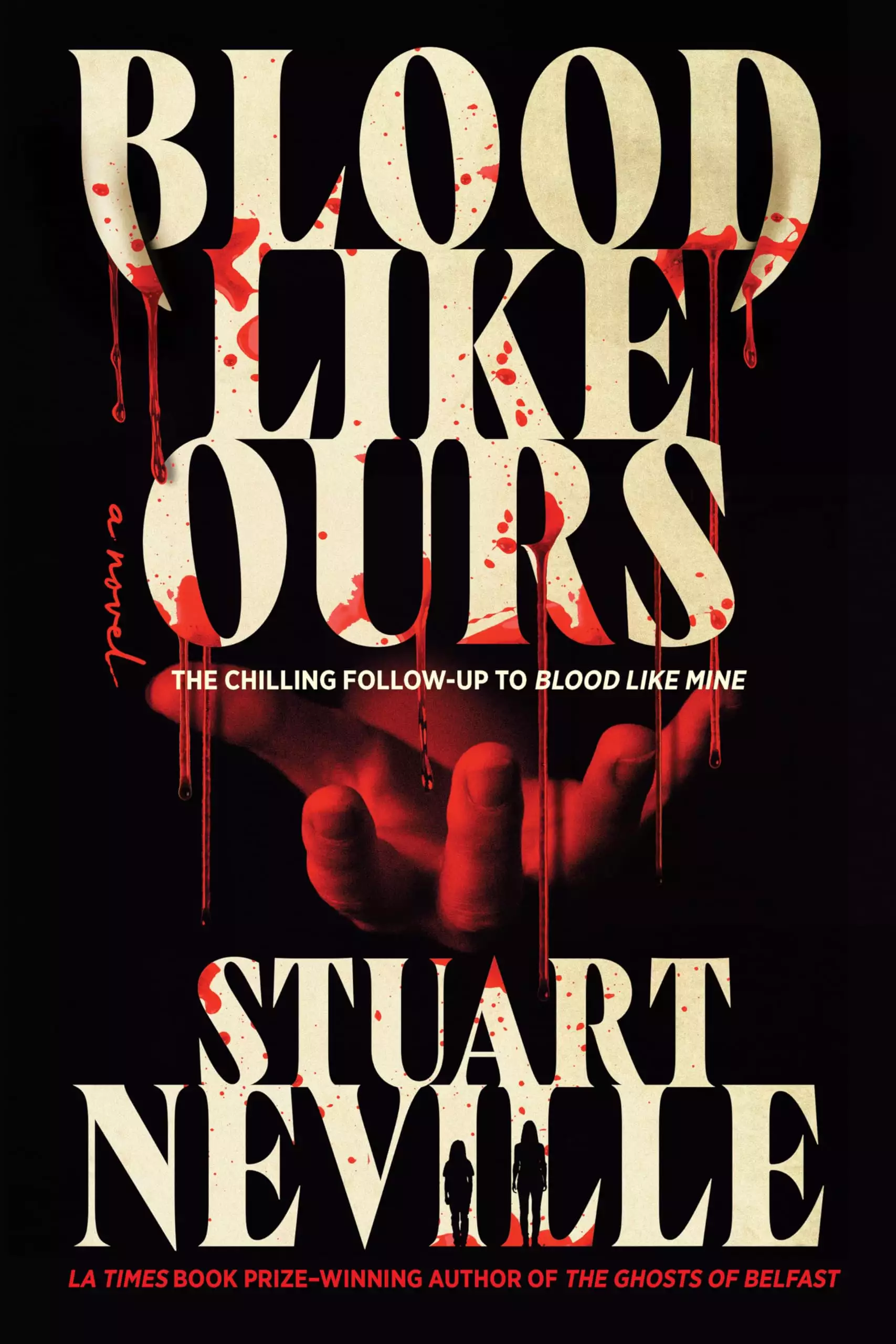
Excerpted from Blood Like Ours, copyright © 2025 by Stuart Neville.
We hope you are enjoying the book so far. To continue reading...
Copyright © 2026 All Rights Reserved

 Please log in to recommend or discuss...
