Chapter 1 1
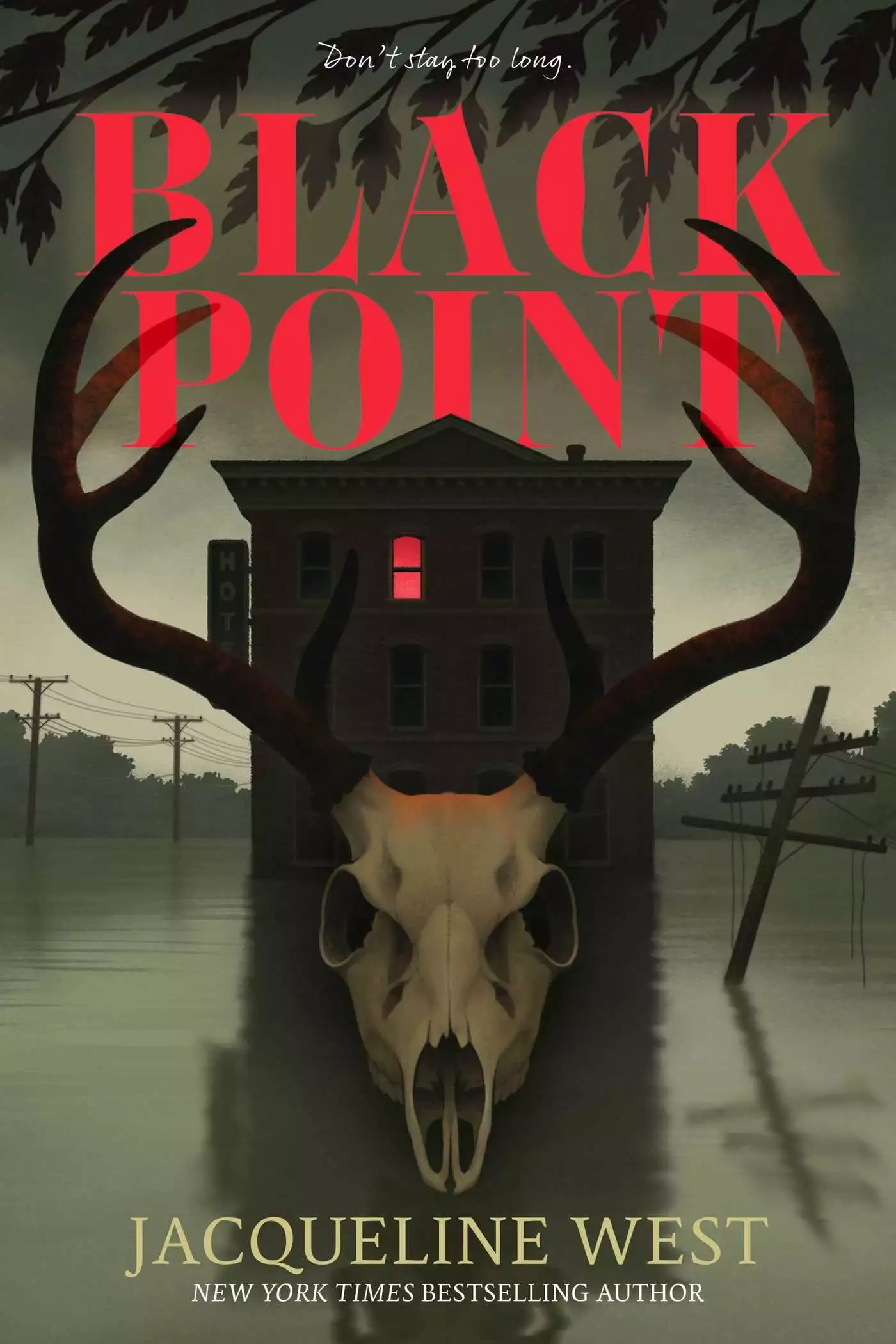
BLACK POINT IS GOING TO drown someday.
They explained this to us back in ninth-grade science class: Eventually the river will rise and widen, or the big earthquake that experts keep predicting will finally snap through the riverbed like the dotted line on a graham cracker, and the whole town of Black Point will slide down into the water at last.
Sometimes I picture it there, at the bottom of the Mississippi. I can see the old hotel, Lou’s Café, Grandpa’s museum, all the redbrick churches and redbrick bars and stilt-braced wooden houses laid out on the riverbed just as they were on land, every wall and window flickering in greenish water-light. Black Point has balanced on the bluffs for a hundred and seventy years. It’s withstood floods, blizzards, fires, the occasional avalanches that send boulders bouncing through the houses. Each trial has just made the town hold on tighter.
Even sinking into the Mississippi River couldn’t destroy Black Point. I’m not sure anything could.
Grandpa’s museum stands on Third Street, three blocks up from the river. Its official name is The Viking History Museum of Black Point, Wisconsin, but everyone here just calls it Frank’s Place. Grandpa owns parts of several other local businesses—businesses that actually
make money—and has used his income over the years to buy so many weird old things that they won’t fit into our house anymore. Thus, the museum.
I would never use the word
thus in conversation, by the way. Everyone around here thinks I read too much as it is. They also think I’m the teen girl version of my grandpa: history nerd, bookworm, devoted to this place.
There, at least, they’re probably right.
Visitors don’t expect a town the size of Black Point—population 893—to have a world-class collection of Viking paraphernalia. A lot of our objects are reproductions, of course, or they’d be under glass in the Smithsonian or something. But there are handmade weapons, drinking horns, model ships, carved runes, and scads of treasures brought here by our Swedish immigrant ancestors. It’s over two million dollars’ worth of stuff—I’ve seen the insurance paperwork. But really, the collection is priceless. Nothing creates history but time. And no one can buy that.
Tourists wandering in from the River Road always seem a little stunned by the place. The ones who expected a Viking
football museum are the most confused of all. They shuffle around for a while, staring at the ancient iron swords and the carvings to Odin and Freya and Thor, and then they wander back out again, drifting downriver along with the rushing green water.
I spend my weekends, my afternoons, and my summers at the museum. If it weren’t for high school, I’d basically never leave. It’s my favorite place in the world, I suppose because being there is like getting to live inside a thousand years all at once. I answer emails and make social media posts, climb ladders, sweep floors, and do whatever else Grandpa and the other Oldies can’t. Or shouldn’t. Since the last heart attack, Grandpa is supposed to take things easy, but he constantly forgets.
I never do.
Today, from my spot behind the front counter, I watch Grandpa saunter around the museum’s main floor, smiling and nodding at the small knots of visitors. I monitor his pace. I watch his posture, still straight and sturdy. I check the smile that creases his always-stubbly cheeks.
Two older couples in khaki shorts have gathered around the big sword display. One of the men is talking loudly.
“… Just imagine one of those naked berserkers running at you with this,” I hear him saying to the other three, pointing at the replica sword in the center. “It says the original was found in a bog in Jutland. Probably part of a human sacrifice.”
Grandpa saunters up to the group. “Human sacrifices happened every now and then,” he says. “It seems to have been rare, but because wetlands were sacred to Norse people, evidence of sacrifices is frequently found preserved there. Often it was the weapons themselves that were sacrificed. Swords were so valuable, and so honored, they were given names. They were basically thought to have lives of their own.”
“Hmm.” The loud man gestures up at the sword—the one-of-a-kind, hand-forged, folded-steel sword. “Sure,” he says. “That one looks like a ‘Bob’ to me.”
The other khaki shorts laugh.
Grandpa grins. He’s heard this one before. “Just let us know if you’ve got any questions,” he says, turning and heading toward the front desk.
I watch him approach over the scuffed glass counter. I’m leaning on my elbows next to the register. Behind me, wearing their Viking Museum staff pins and seated on their usual folding chairs, are Les Gustafsson and Duane Bjorklund, who have known Grandpa since they all went to kindergarten together at Black Point’s old one-room schoolhouse. Les is small and wiry and permanently dressed in plaid, and Duane is huge and bald and doughy everywhere but his hands, which are always carving a chunk of wood.
“Hey, you hear about Jerry Hallquist?” Les says as Grandpa reaches us.
I glance up.
Of course Grandpa has heard about Jerry Hallquist. We’ve all heard about Jerry Hallquist.
Jerry lived in Black Point his whole long life, running the family farm that’s been here for ages. Last week a tornado ripped through the upper edge of town, yanking trees up by their roots, pouring rain on the already swollen river. It destroyed acres of crops, killed a couple of cattle, and pulled Jerry Hallquist’s entire house into the air. People have been finding his possessions—old photos, papers, bits of faded clothes—for miles around. They found Jerry himself, or what was left of him, in the middle of a cornfield two days later. The farmer who spotted him thought he was a broken scarecrow.
“What about Jerry?” asks Grandpa. He circles around the counter to the rest of us, but he’s still looking over his shoulder, across the museum floor.
Les folds his arms. “Mark’s having him buried down in La Crosse.”
“What?” says Grandpa.
Duane stops carving.
Mark Hallquist, Jerry’s only son, owns a car dealership down in La Crosse now.
Deserter.
“Guess he thought it would be more convenient,” says Les. “Or maybe he wanted him closer.”
“Pretty sure Jerry would have wanted to be buried here,” says Grandpa.
Duane nods. “He always said he’d leave this place in handcuffs or a coffin.”
The Oldies chuckle softly.
“He’s getting his way,” says Grandpa.
“Hey, Lucia,” says Les abruptly, angling toward me, “you still seeing that Jake Meier?”
I’m not thrown by the change of subject. The Oldies have five regular topics of conversation. They slide back and forth between them, adding tiny variations to things they’ve said ten thousand times, like a band playing a set of favorite songs. Subjects include:
- 1. The weather.
- 2. The weather in the past.
- 3. Things people in Black Point have done, said, or died of.
- 4. Who’s selling what, who bought what, and who owned it in the past.
- 5. My love life.
I snort, turning on my elbow. “I was never ‘seeing’ Jake Meier.”
“Hmm.” Les shrugs. “Good-looking kid. Captain of the wrestling team. Seems pretty decent.”
Les is a volunteer wrestling coach at the high school, which means he knows more about the locker-room habits of my male classmates than I’d ever want to.
“Didn’t he take you to prom?” Duane puts in.
“We went to prom in a
group,” I tell them for what must be the fiftieth time. My insides are starting to squirm. “It was me and Cara and Bailey, Jake and Colton Norquist and Kyle Larson—”
“How about Kyle Larson?” says Les. “He’s another decent-looking kid.”
“Kyle Larson,” I repeat. “Kyle Larson used to pull the legs off of grasshoppers one at a time and then throw their bodies at other kids, yelling,
‘Hopper bomb!’”
Les grins. “Aw, I bet that was at least a few months ago.”
“Does it matter? Do you just outgrow being a sadistic idiot?”
“Well, Duane here has,” says Les. “Almost.”
Duane guffaws.
“Is Mark going to sell off the Hallquist place?” Grandpa asks, pulling the band back to the previous song. Thank goodness.
I tune out while the Oldies talk acres and prices and watch Grandpa instead. His skin looks normal today, tanned and dry, not grayish. His stance is missing the rigidity it gets when there’s pain and he’s trying to hide it. But he doesn’t look relaxed either. His eyes keep flicking across the museum floor toward something in the distance.
Any little change in Grandpa is enough to fill my stomach with ice water.
I step closer to him. “Something wrong?”
Grandpa makes a gesture that’s not quite a headshake, not quite a shrug. “Just not sure about one of our visitors.”
The ice water warms a little. At least it isn’t pain. I look back at the khaki group, who are now talking loudly beside a row of axes. “Which one?”
“Someone downstairs.” Grandpa nods toward the top of the staircase. “You might not have noticed when he came in. He’s been down there quite a while now.”
Grandpa’s eyes have always been sharper than mine. He’s always first to spot the migrating cranes flying in over the river bottoms, or to notice the deer standing in the deep grass of a ditch, as still as if they’d already been shot and stuffed.
“What’s wrong with him?” I ask.
“Just seems out of place.” Grandpa answers. “A kid about your age, maybe eighteen, nineteen. In here by himself. Seems off.”
A kid my age in here—a kid we don’t already know—would be more than “out of place.” It would be wrong.
“I’ll go down and check,” I say. Grandpa looks like he’s going to argue, but I dodge out from behind the counter and cross the floor before he can stop me. “If anything’s going on, I’ll come straight back up.”
Grandpa gives a nod.
I head down the steps.
The museum used to be a grocery store, decades ago. Grandpa fixed up the interiors so the wooden floors gleam, the walls are eggshell white, and the recessed lights glow bright enough to showcase every object. But even with the lights on, the lower floor is dimmer than the one above. If Black Point weren’t built on such steep slopes, with basements that are half underground and half exposed to the river valley, it would be darker still.
I reach the foot of the staircase, moving softly. We’ve never had a crime at the museum, unless you count the misspelled swear words some kid scrawled in a bathroom stall, but if something is going on, I need to see it without being seen. I pad out onto the lower floor.
The basement holds most of our larger displays: racks of tunics and helmets for little kids to try on, three miniature ships, an open-walled longhouse. The space is quiet. No voices, no sounds but my own steps on the hardwood. The visitor must be in the corner with the replica village, tucked away behind the slant of the staircase.
I slip past the stuffed four-horned sheep in his glass box (I named him Olaf when I was five years old, so that’s what his tag says:
Olaf, four-horned sheep) and around the carved wooden chariot.
And there he is.
A black-haired boy in a gray T-shirt.
His back is to me. He’s alone, staring down at the display about Black Point’s founders. I’ve told Grandpa we should probably add “white” or “European” founders, because Dakota people have had settlements here for centuries. Grandpa always says that I can change it after he’s gone. And I tell him that he’ll never be gone.
I know exactly what’s in that display case, below the map of Sweden with our founders’ home village marked by a little flag.
Pocketknife, owned by Jan Lundberg, c. 1850. Compass, owned by Lars Angstrom, c. 1850. Firesteel, owned by Hans Hansson, c. 1800. Long Knife, owned by Varg Sorenson, date unknown.
The boy in the gray T-shirt isn’t doing anything wrong. He’s not doing anything at all. And still a bolt of cold electricity spears through me, like I’ve gone downstairs for a drink in the middle of the night and found a stranger standing in our living room.
Grandpa is right. This boy doesn’t belong here.
I’ve never seen him before. He definitely doesn’t go to school in Black Point. There are only ninety-four kids in the whole high school, and I could describe the hair and clothes and deodorant use of every single one. This boy’s hair is longish and jagged, like it hasn’t been cut in a while, but its last trim obviously wasn’t at Dianne’s Shear Beauty down on Second Street. His shirt doesn’t have a team name or symbol on it. And he’s wearing bracelets. Three of them, leather bands with small silver beads.
But the boy isn’t our usual kind of tourist either. He’s a few decades too young or a decade too old, and he’s not part of a group that will pile back into a minivan and head off for burgers and ice cream afterward.
He’s different.
He’s wrong.
He steps to the right, turning slightly, and I duck behind a shelf.
Around its edge, I watch the boy examine some old farming tools. He doesn’t touch anything. Doesn’t hurt anything. He just looks, for a long, quiet moment, and then he turns toward the staircase, and I get my first glimpse of his face.
It doesn’t look quite how I’d imagined it, which is how I realize I was imagining it in the first place. The features are a little less delicate. The eyebrows are heavier. The eyelashes are longer. It’s an interesting face. An out-of-place face.
Without a glance in my direction, the boy heads up the staircase.
I wait until he’s neared the top of the flight before dodging out from behind the shelf and tagging after him.
Upstairs, Grandpa and Duane are busy talking with a couple at the front desk—they’re wearing Minnesota Vikings shirts, so they’re in for some disappointment—and Les is out of sight. Grandpa’s eyes flick toward the front door when the boy steps through it, then slice to me before going back to the tourists and their brochure.
I slip out the door behind the boy in the gray T-shirt.
I expect him to get into one of the cars parked along the slope of Third Street.
But he doesn’t. The boy just turns to the left, striding away down the steep sidewalk like he already knows his way around. Like he knows exactly where he’s going.
And suddenly I need to know too.
So I follow him.
I must have walked down Third Street five thousand times. Now I try to see it through a stranger’s eyes. The steep, quiet street, still littered with leaf piles from last week’s storm. Redbrick buildings pressed up against narrow sidewalks. Empty plate glass windows streaked with our reflections. I know what used to be behind each of these windows, which one was the hardware store, the antique shop, the bakery-café. All the things I’ll help bring back to this town someday.
The boy doesn’t pause anywhere. Not even at the intersections. He just strides across the streets like he’s already sure there won’t be any traffic. As I cross Eagle Avenue behind him, the storm-swollen river flashes into view, and the muddy breeze rises toward us, almost as thick and brown as the water itself.
We head down another block, across Falcon Avenue, into the oldest part of town—the part with three-story brick buildings with arched doorways and wooden balconies that sag out over the sidewalks. The boy walks toward the building on the next corner. The largest building in Black Point. The one with four stories of blank windows, and a broad stone stoop, and a huge set of double doors.
The old hotel.
It’s been closed for more years than I’ve been alive, but everybody still calls it the hotel. Everybody knows the stories about the place: the bootleggers and old-time celebrities and politicians who stopped there on trips down the river, the bar where everyone in town used to gather. All the ghosts that haunt it.
I’ve never been inside. No one my age has. But its stories are ours, which makes the place ours, too.
When I stop on the far side of the street, leaving space between me and the boy in the gray T-shirt, he heads straight up the steps to the hotel’s front doors. He takes a key from his pocket. Unlocks the door. Steps inside.
The double doors thump shut again.
I rock backward on my feet.
No one goes inside the hotel. Definitely not out-of-towners. Strangers. I feel a disoriented kind of anger, like I’m watching someone in a dream eat the food from my own plate.
This boy isn’t from Black Point. He doesn’t belong here, in the old, quiet, locked-up heart of it. Not unless he’s a ghost himself.
I watch the hotel for a minute.
Finally, when I’m sure no one else is walking by, I run across the street after him.
We hope you are enjoying the book so far. To continue reading...
Copyright © 2026 All Rights Reserved

 Please log in to recommend or discuss...
