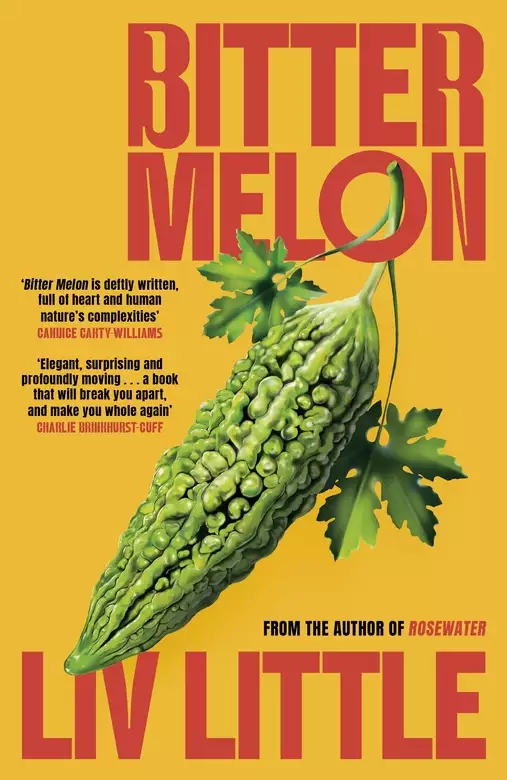
'Liv Little pulls you into a world where the characters feel like everyone you've ever known, loved and learned. Bitter Melon is deftly written, full of heart and human nature's complexities.'Candice Carty-Williams
The hotly anticipated second novel from Liv Little, founder of gal-dem and author of Rosewater
Jalissa and her dad aren't close, but when he invites her to Jamaica, his homeland, for the first time, she says yes.
She's running from heartbreak and a loss of her own; he's running out of time.
As they travel through sun-drenched towns and navigate tangled family roots, old wounds open and long-held silences begin to break. They're both trying to outrun something-but along the way, they cross paths with people whose stories shift their own, helping them face the past, reckon with the present and reimagine what comes next.
Bitter Melon is a tender, funny, heart-bruised road trip into memory, mortality and the fierce, fragile love between a daughter and the father she's still learning to understand.
'A beautiful, tender story about the relationship between a father and daughter, the meaning of home, and finding your way back to yourself. Little captures Jamaica, forever home to me, so beautifully. Thank you for taking me there.' Shani Akilah
'So moving and unguarded and beautiful. I didn't want to miss a word.' Lucy Boynton
'Brilliant, tender and intimate.' Elle
'A moving read about identity, fatherhood and family reconciliation.' Good Housekeeping
Release date:
October 22, 2026
Publisher:
John Murray Press
Print pages:
70000
* BingeBooks earns revenue from qualifying purchases as an Amazon Associate as well as from other retail partners.
Delroy sat back and ran the fingers of his left hand over the indentations in the tabletop. He glanced around the square and watched the weekend bustle unfurl around him. For the past twelve years, every Saturday between the first days of spring and late summer, he and his friends – Des and Stephen, and his honorary brother Hennrick – had gathered in Belmont Square to play dominoes. It had become a commitment, like work, that they fulfilled religiously. But unlike the night shift, this was an order of service they looked forward to.
The men had met at Catford Bus Garage thirty-odd years ago. At twenty-seven and fresh from Jamaica, Delroy had joined as a trainee. He was adrift until he met Hennrick, a veteran driver, who was tasked with showing him the ropes. Hennrick, a nurturer and the eldest of five brothers, became a surrogate older sibling to Delroy, who clung awkwardly to the edges of a family unit formed in his absence. He was the only one of his mother’s four children not born abroad, and, unlike the rest of them, he didn’t share a name, a father or a familiarity with his mother’s pragmatic approach to nurturing.
Hennrick, who had already been working at the garage for a decade when Delroy joined, took pride in his work and was well-known along the winding route of the 54 bus. He was well-loved for his cheery announcements, half-sung in Jamaican patois, which remained entrenched despite not having lived back home for more than forty years. On more than one occasion, the warmth of his words had been recorded and shared across social media by Londoners who praised his ability to bring sunshine to the grey, damp conditions of the city. Des (the Dominican) was the third in their quartet. Before working at the garage, he’d served in the military, and the comfort he had been taught to find in order and routine was ideally suited to his position as a controller. Finally, Stephen (the St Lucian) worked as a technician and was the only one born under what he called ‘the political trickery of the West’. He moved to St Lucia briefly for a couple of months in his thirties, but this didn’t quell his diaspora blues; it just confused him further.
Between them, Delroy, Hennrick and the rest of the men had watched as their kids had gone from taking their first steps to birthing babies of their own, turning men whose hearts remained young into grandfathers, the next generation of elders. They had seen those children fly beyond their wildest imaginations and, on the flip side, cause so much stress that flickers of silver hair emerged at the edges of fresh shape-ups. They had also been there to talk through life’s tougher moments – diabetes diagnoses, the increasingly challenging conditions of work in the public sector, and great loss. They’d attended nine-nights for five of their seven known parents, and raised glass after glass of strong white spirit and Red Stripe and Guinness punch in their honour. They’d witnessed just about everything, including a handful of enduring romantic relationships, though some women left just as quickly as they came. They shared a bond that was unshakeable and true. ‘Likkle more’ and ‘Inna di morrows’ were their equivalents of saying, ‘I love you.’
Over the years, their group had become well-known among local residents, sometimes drawing a small but enthusiastic crowd on dominoes game days when the stakes were particularly high. Moments like the summer of ’09, when Delroy won big on the horses and put it all on a game that Stephen, the most underestimated player of the group, later won, scooping up the money Delroy had promised his girlfriend at the time he would use to pay for a visa and fly her sister out from Jamaica. Stephen had felt like he owed Delroy something ever since. And Delroy hadn’t lived that loss down to this day; his pride was a fragile thing.
In the right-hand corner of the table, closest to Hennrick, a Bluetooth speaker played a rotation of Tyrone Taylor, Charley Pride and Dennis Brown. The speaker had been a present from Hennrick’s eldest son, and replaced the distorted sound of a boom box almost twice Hennrick’s age. While the four men settled in, ready for a new game, the wives gathered in one of their front rooms, drinking sorrel with more than a splash of Appleton. Occasionally, Delroy clocked them glancing over to check on the activity in the square and then quickly refocusing their attention on whatever or whomever they were dissecting. For some time, the wives had been speaking about their neighbours – 197 of them, to be precise. These mostly new residents – you know the type – had taken it upon themselves to complain about the disruptive and antisocial behaviour of a small group of Caribbean men who enjoyed a game of dominoes once a week. Much to the complainants’ dismay, this was a rare case in which the originals (Hennrick, Delroy, the rest of their crew and their fans) had battled and were victorious in cementing their spot.
Today was the first time Delroy and his friends had gathered since succeeding against the new neighbourhood committee. Delroy, who was known to bring a small bottle of Wray & Nephew to their games, had led the charge that allowed the men to continue with their ritual in relative peace. For months, he had become an unofficial campaigner. It was a shock to everyone, including Delroy, that he had led the movement. He wasn’t ordinarily one to get into politics. He rarely read the papers, and if he did, it was one owned by a particular media tycoon. Delroy often refused to vote on account of all politicians being bad mind and uninterested in real people’s struggles. He and his friends agreed that whether it be Labour, Lib Dems or the Conservatives, the status of black people in the UK remained unchanged. His distrust of the powers that be was never rooted in the injustice he personally faced; he brushed off the time a man had driven into his car, only for the police to arrive and check whether the perpetrator, not Delroy, was okay. His distrust stemmed from how he saw others being treated. Still, he’d made a pretty impressive leader, drumming up 271 supportive local signatures in opposition to the 197 complaints. Hennrick joked that, of course, the only thing to mobilise Delroy would be a shortage in spirits, rice and peas, women or dominoes. He wasn’t wrong.
On the campaign trail, Delroy was helped by his status as a local celeb and heartthrob. When he had first come over from Jamaica, he soon became well-liked for his sharp dress sense, dance moves, wicked sense of humour and generosity, and this had stuck. Youngers spudded him whenever they passed by, and women of all ages continued to swoon over his deep voice and immaculate outfits (for which he was once snapped for an advanced style column in the Evening Standard). Delroy looked GOOD, and he knew it. Not only had his looks endured, but he also had a way of talking to people, and as he did the rounds on the campaign trail he was charming, his patois morphing into proper English depending on who he was speaking to. He would remove his hat and hold it against his chest if talking to an older lady, or flash his perfect set of dentures when a family with small children opened the door. If it was someone he fancied, he’d compliment whatever scent was wafting from the stove and find himself invited to dinner, which gave him plenty of time to convince whoever she was to sign his petition and recruit more signatories.
It was now close to 1.30 p.m. as Delroy and his friends sat around the small, foldable teak table that had served them since they started playing together. A twenty-year-old box of dominoes, passed down from Hennrick’s dad to him, was at its centre. Delroy and Stephen were dressed in cowboy hats. Delroy’s gold chains shimmered under the dappled light. Around them, new parents made a dash for freshly baked sourdough, babies strapped to their chests; owners pretended not to notice their dogs relieving themselves on the pavement; and young couples snapped selfies under the blossom trees lining the streets. Hennrick was dressed head to toe in a Gucci suit, despite the heat, because it was a look worth sweating for. ‘Kiss an Angel Good Mornin’’ played gently from the speaker. Stephen had even brought with him a handkerchief with the St Lucian flag printed on it. Because this was not just any other Saturday: it was a celebration, a moment of victory, and one for which only their best would suffice.
‘They should’ve known not to mess with us big, big people.’ Hennrick grinned and his gold teeth glistened. Bottle in hand, he cheered in unison with his friends, who were each clutching a celebratory bottle of warm Guinness, apart from Delroy, who had his signature bottle of white rum. After several unsuccessful attempts to unscrew the lid, without speaking, or making direct eye contact, Hennrick reached over and opened the bottle for him. Just as Delroy was pouring himself a large glass, Hennrick leaned over and spoke so that only he could hear. ‘You have to get that looked at too. Okay?’
Delroy nodded, though he was not ready to investigate further. He appreciated Hennrick for saving him from embarrassment. It had been this way pretty much since they first met. When Delroy first started working at the garage and would make mistakes, Hennrick would cover for him, whether that meant telling dispatch Delroy was adjusting his route for spacing when really he was just late, or physically coming to rescue him and course-correct after several wrong turns.
The men mixed up all the dominoes and chose their tiles until there were just two left. Stephen pushed one towards Hennrick before taking the other for himself.
‘No man, mi want that one,’ exclaimed Hennrick. ‘The one yu tri keep fi yuhself.’
Stephen, who was used to his single-mindedness, sighed and swigged from his bottle of Guinness, then reluctantly switched the dominoes. Des put down a double six with vigour, and then it was Stephen’s turn to play; he put down a six and a five. Hennrick tapped the table, forfeiting his go. When it came to Delroy, he smiled and fumbled for his domino, his friends looking on impatiently.
‘Come on, man!’ Des couldn’t help himself.
After a couple of attempts, Delroy played; Des was next in line, and he relinquished another tile. Hennrick, who was clearly over his inability to play, offered each man another drink, choosing to redirect the conversation.
‘Haven’t seen much of Dean lately,’ he said, knowing full well this remark would elicit a long proclamation of wrongdoing from the Lucian.
‘Young people today nuh know how easy dem have it,’ Stephen answered, the ‘dem’ lingering awkwardly on his tongue, the place he was born made glaringly obvious. Delroy rolled his eyes at the admission from his friend; he’d heard this complaint countless times. After pausing for a brief moment, Stephen kept going. ‘He would never be able to survive the fuckery I have, any of us have. About how he wants to be a famous rapper.’ Stephen rolled his eyes, and Des let out a sympathetic laugh before ushering Hennrick to play.
Hennrick tapped the table once more before adding his two cents. ‘That’s right, and you know everything that starts with “F” is a fuckery; the fame will get him.’
Des, ever the one to play devil’s advocate, wasn’t convinced. ‘What about “friends”?!’
Hennrick looked over at his friend as if to say, You think you’ve caught me out, do you? Without hesitation, he jabbed back, ‘One friend can tun around and stab you in your back.’
The group looked around at each other, at first with straight faces. But then their lips began to quiver, and eventually they broke into rapturous laughter. There was at least one of Hennrick’s tirades at every game or gathering.
‘Okay, what about the word “fond”?’ asked Des, determined to catch him out.
‘One time you can be fond of something, and that something can turn around to bite you in the backside,’ Hennrick replied.
‘Enough nuh man? Let’s play! We didn’t knock on all them doors for nothing!’ said Delroy, and they all reached for their dominoes.
Hennrick wasn’t done checking in on the status of each of their children, though. His attention now turned to Delroy. He wanted to know how baby girl was doing – his goddaughter, who was no longer a baby at all but a thirty-two-year-old woman he hadn’t seen for some time.
‘I’m seeing Jalissa next week,’ said Delroy proudly as he knocked back his plastic cup.
‘Everything bless?’ Hennrick asked.
‘You know, she’s doing her ting, as always; she’s a smart one.’ Delroy smiled with pride, even though he couldn’t quite remember exactly what it was she was doing or whether she was doing it well.
Two hundred and one point three miles away, it was the final day of term and Jalissa was winding up a particularly gruelling day of teaching at the University of Leeds. First, there had been planets and the search for life, followed by seminars and one-on-ones with angsty first-year students desperate to prove themselves beyond their understanding. Then came multivariable calculus, followed by a two-hour session on properties of matter. This was her favourite. Jalissa was meticulous, aroused by structure. So the precision required to detect the propensity of gravitational waves – the faint, elusive ripples stretching the fabric of the universe – had seduced her effortlessly. To her, there was nothing more intimate than the study of cosmology. It made her feel less alone and less terrified of the unknown. Of death.
As a child, Jalissa had been petrified of the afterlife. It wasn’t long after her dwarf hamster, Mr Marky, died under mysterious circumstances that her fear began to take root. She had always been the ultimate good girl. A certified purveyor of rules and regulations. She did everything by the book, exactly as instructed. She fed him twice a day, cleaned his cage biweekly and refreshed his water at least three times a week. It didn’t make sense. Mr Marky was taken before his time. At eight years old, after this profound loss, Jalissa refused to sleep without the lights on. Whatever had claimed Mr Marky in the middle of the night, would not, she was determined, with its unseen grip, pull her into the abyss. She mourned him for weeks, unable to understand how something so small, so full of life, could simply vanish.
‘Energy can’t be destroyed,’ Sandra would say as she sat at the edge of her daughter’s bed each night. Her words temporarily soothed her daughter’s anxieties. Sandra would remain until the darkness felt a little less threatening to Jalissa and the extremity of her tiredness overtook the fear. After months of this familiar routine, Sandra, who had always had a penchant for astrology, star signs and any form of planetary wisdom she could find, tried a different tack. She started reading children’s books on the topic to her daughter. There was The Ladybird Book of the Night Sky, There’s No Place Like Space by Dr Seuss and Laura’s Star. And once the sky had opened up for Jalissa, she wanted to hear of nothing else.
Over time, her knowledge of the natural world, and black holes in particular, expanded beyond her mother’s comprehension. Now she was thirty-two and working as a lecturer, and her mother delighted in sharing stories about the inevitability of her daughter’s ascent into the world of academia. The affection and pride she felt for Jalissa were even more true than the inevitability of death. She loved to tell one story in particular about how, around the age of ten, Jalissa would create her own private planetarium and every night, without fail, gather her toys (literally all of them) and arrange them in a circle. Then, with torch in hand, she transformed her room into a magical cosmos, ready to impart whatever knowledge she had most recently ingested about the solar system. ‘She’s always been curious, my girl. Destined to reach the stars,’ Sandra, who had left school when she was sixteen, would tell whoever would listen.
Jalissa was one of the youngest lecturers in her department – and the only black woman. She was beautiful but unassuming, and wrapped her braids in a rotation of plain headscarves. She wore a capsule wardrobe consisting of tailored trousers, crisp white shirts and polished loafers. When people looked at her, she wanted them to see a lecturer first and foremost. Someone capable and brilliant. There was a deep sense of responsibility that accompanied her wherever she went.
Jalissa was acutely aware of the rarity of her position, an awareness aided by Sandra’s constant reminders. And so, with steadfast determination, she poured herself into her work. She was convinced that her talent would eventually eclipse the obstacles in her path. But all had not proven to be quite so straightforward. She was often mistaken for a more junior fellow or, on a couple of occasions, a student, and often found herself overlooked for opportunities to progress. On top of this, her age had always meant that it was not uncommon for students to speak to her in far too familiar a tongue. All of this had been complicated further by the fact that she was in a relationship with a fellow scholar. They had been engaged for six months. The first time they’d spoken, she could tell Robbie had already decided she was the one. It had taken her longer. She had weighed him up carefully, as she did everything. But in the end, she had chosen him too.
Every Friday, Jalissa would meet Robbie in their usual spot, and today was no exception. They met at a small Thai café with a hippie vibe on the edge of town. It was just far enough away from campus to minimise their chances of running into their students. There was no greater embarrassment than being spotted out in the wild.
Jalissa shuffled into the restaurant, where she was greeted by smiles from its owners and wafts of pad thai, fragrant soups and massaman curries being served up. As she approached the table they always sat at, Robbie was diligently studying the menu, as though he didn’t know it from memory. Jalissa coughed lightly to draw attention to her arrival, and he lowered the menu to reveal a scruffy head of mousy brown, almost blond, hair and kind grey-blue eyes.
‘Oh, hey,’ he said, and she repeated the same words. Formalities. Since the loss of their baby, their love had become less about romance and more about survival. Jalissa coped by pushing forward and burying her pain in her daily responsibilities. She took on extra duties in the physics department, covered for her colleagues, and offered additional support sessions for her students. She did this not out of genuine desire but because she knew that if she paused, she would have to confront her thoughts. And thinking meant remembering. It meant sitting in the terror of her waters breaking at seventeen weeks. It meant being forced to confront the helplessness of watching her body betray her.
She was grateful, then, that Robbie didn’t ask how she was. Not properly. Jalissa slid into the seat opposite him as he said, ‘Long day?’
She nodded and unbuttoned her mac. ‘Painfully so. You?’
‘Nothing out of the ordinary,’ he said, with his eyes firmly focused on the condensation sliding down his beer glass. ‘Fiona said that if you wanted to reduce your workload next term, temporarily of course, she’d be supportive of that.’
‘And why would I want to do that?’
‘Because you haven’t taken any time off. Not since . . .’ His voice trailed off and he looked tentatively up at her.
‘As much as I’m glad that you and Fiona have taken to discussing my wellbeing, I can assure you that I’m fine.’ Jalissa had always been suspicious of Fiona. Fiona smiled too much. She said all the right things. Jalissa found her relentless kindness to be a marker of insincerity. Sandra had taught her that people who smiled all the time were likely to be hiding teeth.
‘She meant it kindly.’
‘Of course she did,’ Jalissa said, but she was busy considering the real reason Fiona was involving herself. Fiona and Jalissa rarely said more than two words to one another, and so Jalissa found it unlikely that her mental health would be of paramount concern to Fiona. Potential reason one was that Fiona was waiting for an opportunity to prove Jalissa was not ‘fit’ for work. This would surely mark the beginning of the end. She’d then hire one of Jalissa’s students to take over, because she hated her that much. Or potential reason two: she was making a move on Robbie. Fiona had always been on the touchy-feely side – not with Jalissa, of course, but with literally everyone else. Or, there was potential reason three. She couldn’t figure out what reason three was yet, but she knew there would be another sinister reason to explain Fiona’s offer of time off.
‘You don’t have to be so suspicious of everyone,’ Robbie said, and Jalissa wondered whether she’d accidentally spoken aloud.
Anchali appeared with Jalissa’s soft drink, and Robbie took this as an opportunity to drain his beer and order another. Jalissa watched but didn’t say anything. In an act of solidarity, Robbie had stopped drinking the day her pregnancy test came back positive. Now, he drank more than he used to.
‘Would you like the chicken curry?’ Anchali asked, in a voice that was comforting, familiar.
Jalissa nodded, her response automatic. ‘Yes, please.’
‘And the prawn pad thai for you, sir?’ Anchali turned to Robbie.
Robbie hesitated for a moment, then shook his head. ‘Actually, I’ll have the khao pad.’ Jalissa looked up – they always got the same thing. ‘Spicy,’ he added.
Jalissa asked if he was sure (he had a non-medical aversion to chilli; he couldn’t tolerate anything hotter than a ‘spicy’ Nik Nak), but he was adamant. Jalissa was unsure what to make of his newfound machismo.
Anchali left, and Jalissa did her best to redirect the conversation. ‘How’s the project with Dr Raif going?’
‘It’s fine. You know how he can be.’
‘Yeah,’ she responded, letting out a stilted laugh.
Robbie shifted in his seat. ‘Anyway, it’s not exactly groundbreaking stuff.’
‘Still,’ she said, ‘it’ll get you where you want to be.’
Robbie shrugged in response. ‘Sometimes we have to do things we don’t love.’ Jalissa found herself irritated by Robbie’s nonchalant response to the c. . .
We hope you are enjoying the book so far. To continue reading...

 Please log in to recommend or discuss...
