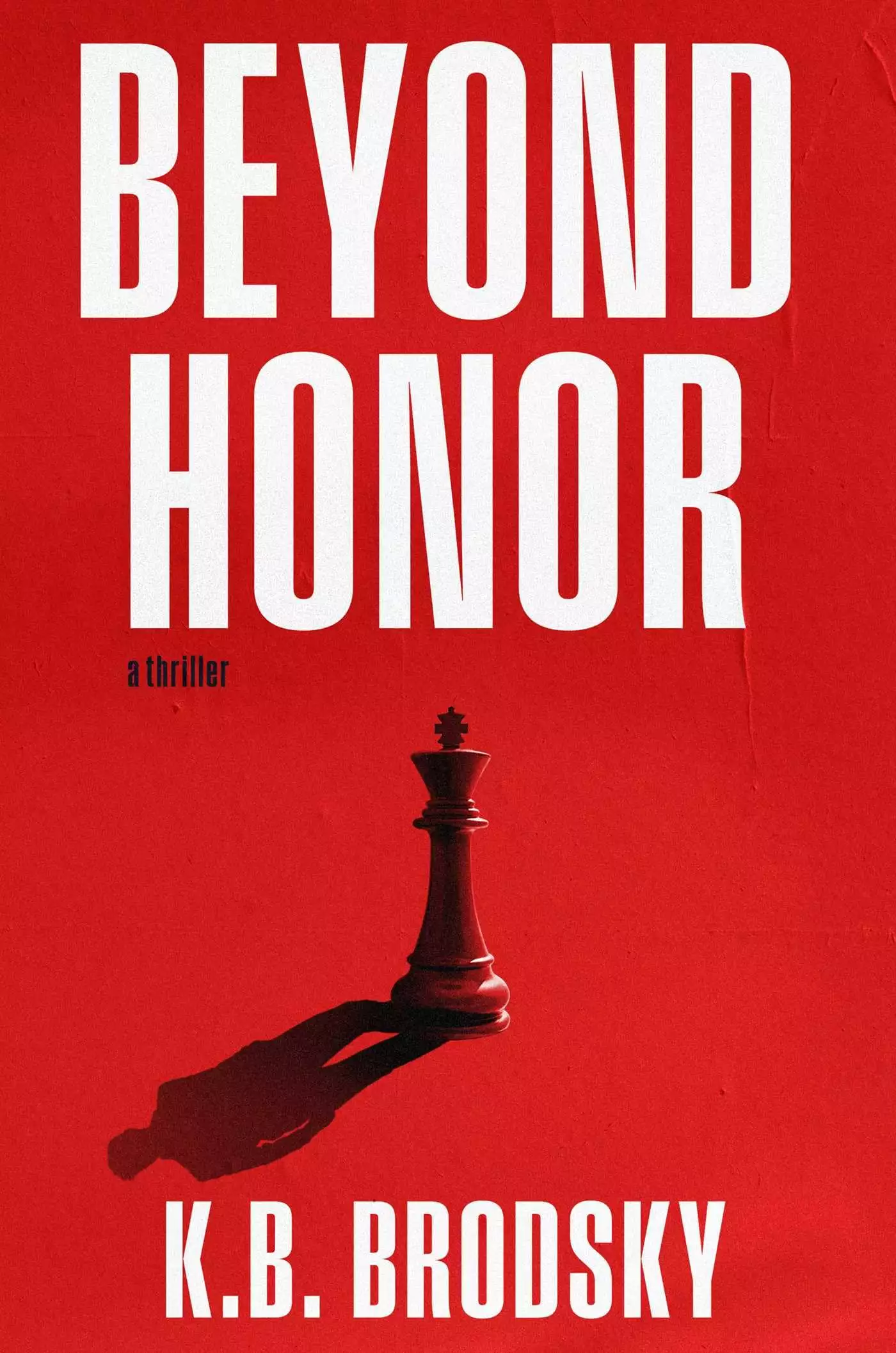
A CIA analyst hunting a conspiracy that leads to the Oval Office. A paramilitary operative confronting his grief on a path of retribution. A Russian agent hiding in plain sight. Jason Matthews’s Red Sparrow meets Jack Carr’s The Terminal List in Beyond Honor, a debut political thriller that plunges readers into a world of international espionage, where loyalty and duty are tested.
Whitney Skyler’s investigation into a Russian-backed bank on American soil leads to the President of the United States. CIA paramilitary operative Kevin Rhoads, a man forged in war zones, is shattered by loss. Recruited for a solo extraction mission deep inside Siberia, he discovers a devastating betrayal.
At CIA headquarters, Director Cynthia King plays an audacious gambit, leveraging a thirty-year debt of honor to save a captured American agent. But in this world of shifting alliances, even the most careful plans can unravel.
Skyler faces an impossible choice: expose her mentor’s dangerous game to protect national security, or reveal to Rhoads, the man she loves, a truth that will transform him into a force of vengeance with death in his wake.
From the war-torn streets of Damascus to the merciless Siberian tundra, from the rugged Kenai Peninsula to the polished corridors of Langley, Virginia, Beyond Honor is a white-knuckled thriller about duty, betrayal, and the impossible choices made by those who serve in the shadows.
Release date:
September 1, 2026
Publisher:
Atria/Emily Bestler Books
Print pages:
368
* BingeBooks earns revenue from qualifying purchases as an Amazon Associate as well as from other retail partners.
Clear the room.” Alan Rexin burst into the operations center at CIA headquarters, the pneumatic door hissing shut behind him. The glow of two dozen monitors cast a pale blue light across his face. Eight technicians stood and began to exit. Rexin held up his hand. “Except,” he said, eyes finding the staff operations officer, “who handles Python?”
“I do, sir.” Rexin located the voice—a woman in her forties with silver-streaked hair pulled back in a tight bun, her desk crowded with half-empty coffee cups. She sat at a workstation in the lower part of the room, hand half-raised like a cautious student.
“You stay. Everyone else grab a coffee,” he ordered. The technicians climbed the short flight of stairs to the exit. Two people hurried into the room as the door closed behind them. The only sounds were the steady hum of servers and the soft clicking of the remaining technician’s keyboard.
Rexin, the deputy director for operations, stood at the head of a sterile conference table in the center of the mezzanine. He removed his jacket, hung it over the back of his chair, loosened his tie, and rolled up his sleeves. He raised his eyebrows at the newcomers and turned to the staff operations officer. “You too.” The officer, looking deflated, cast a questioning glance at his remaining technician in charge of the missing operative, Python, and left the room.
“Tom,” Rexin said, shaking the hand of Tom Hudgins, the deputy director of the Russian desk.
“Director Rexin,” Hudgins said. “This is Leslie Block, assistant director of Technical Services.” Rexin nodded at the woman and motioned them impatiently to the table, elevated above the three rows of computer stations, commanding a view of the video wall across the room.
“Is he dead?” Rexin asked.
“We are not sure, sir,” Hudgins replied. His wrinkled shirt and the deep circles under his eyes indicated that he had been asking the same question since Python missed his second check-in one day ago.
“Did he defect?” Rexin continued. He had seen everything in his twenty-five years of service.
“No. No fucking way! I recruited the kid. Daniel Komoroff is a true believer,” Hudgins protested, all deference to the director pushed aside as if his own loyalty were being questioned.
Rexin looked mildly amused by the outburst but continued down the list of questions he knew needed to be asked. “When was the last time he checked in?” The three division heads looked to the technician.
She turned to her monitor. “The last time we got a positive ping from Python’s device was three days ago.”
“What was his protocol?” Rexin pushed.
“We sheep-dipped Komoroff three months ago as a technician at MinskTech Labs, a Belarus-based financial systems support firm with a list of Federation banks as clients,” Hudgins said. “He had no contact with Moscow Station. We would get a ping every twenty-four hours if he logged into his laptop that day. That ping did not come two days ago.”
“So, what happened?” Rexin searched the faces of the three other people in the room.
“Sir, we don’t know,” Block said. “He was tasked with installing a Remote Access Trojan into every Federation bank on MTL’s client list. This specific RAT is the product of a collaboration between our technical division and the NSA, designed to provide us with a back door into the banks’ software and, therefore, into the flow of Russian capital. Once installed, the RAT malware allows the US to monitor and control the infected system.”
“Did we lose the RAT?” How bad is this? Rexin thought.
Block continued. “When the wrong protocols are entered into Python’s computer, a magnetic charge is released onto the hard drive, frying everything. So no, it wouldn’t be possible to retrieve anything off his computer,” she explained, adding, “The wrong protocol was entered yesterday. We were going—”
Block stopped mid-sentence as an older woman entered the operations center, with a noticeable limp, a cane in one hand, and a half-smoked cigarette in the other.
“Christ, what is she doing here? This isn’t a Special Situation,” Hudgins said, glaring at the newcomer.
“The DCIA thought King could be helpful here,” Rexin said, making further protest futile.
Cynthia King, director of Special Situations, nodded to the three gathered around the table, limped to the corner, and remained standing, letting a small stream of smoke curl from her cigarette.
An awkward silence hung momentarily around the table. “So, who is Python?” Rexin asked, bringing the focus back to the missing operative.
The primary monitor facing the table came to life as the technician brought up Daniel Komoroff’s file. A photo of a handsome young man filled the screen. Short-cropped black hair, thick brows, a strong jawline, and a mouth that curved naturally into a slight smile matching the confidence beaming from his dark, bright eyes.
Hudgins began, “One of our recruiters spotted him in his junior year at Yale. He was a double major in Russian language and cyber security. 4.0 grade point average. He also played hockey for them. Started as a freshman. Pretty good too. Just over six feet and all muscle. We had him at the Farm only months after he graduated.”
“That’s quick,” Rexin said.
“He was a natural. He grew up speaking Russian. His paternal grandfather escaped the Nazis in Odessa and moved in with his son’s family in suburban Chicago shortly after Komoroff was born, so they spoke Russian at home. The kid was a promising chess player when he was young. His grandfather taught him and taught him well.” He asked the technician to pull up the internal psychological assessment. The screen showed a detailed report prepared by the CIA’s Dr. Eleanor Damon, PsyD.
“Just the conclusion,” Rexin cut in.
Hudgins read the last lines. “The candidate has a profound sense of duty and responsibility, which we largely attribute to a substantial transference of survivor guilt, a psychological burden inherited from his grandfather’s traumatic experience as a survivor of the Holocaust. This experience has instilled in the candidate both a strong sense of moral obligation and high-level perseverance in response to the suffering his grandfather endured.”
Hudgins continued. “He excelled in all his training: dead drops, SDRs, technical infiltrations, shooting, parachuting, boat and small aircraft piloting, and other paramilitary skills in both urban and rural environments. What’s more, he loved it. He graduated top of his class.” Hudgins looked at the photo staring back at him from the monitor.
“We posted him in a number of embassies across the region.” He motioned to the tech to pull up a map of Eastern Europe. “He spent a couple years in Uzbekistan, Kyrgyzstan, Tajikistan, and a couple other ’Stans to get his feet wet. We brought him back here for two years for more training. Once again, Komoroff performed. The kid was ready.”
There was a knock at the door. An administrative assistant came in, handed Block a folded note, and walked out. Block scowled. “The RAT installed at Bank Alta was discovered and neutralized.”
“Bank Alta?” Rexin asked, gleaning more information from Block’s defeated expression than he expected to get from his question.
“Alta was the last bank Komoroff infiltrated. It was the one we had been waiting for, the one we call ‘Putin’s Laundromat,’ ” Hudgins said in a monotone.
The technician sat forward in her chair. “Sir, when he installed the Bank Alta RAT, a dynamic target presented itself—a military-grade HSM, a Thales Luna Network module.”
“In English,” Rexin demanded.
“It is a hardware security module,” Block explained. “Used for encrypting classified financial operations.”
“And?” Rexin pressed.
“And Python discovered one in the server room and managed to clone it. Ballsy move,” Hudgins added.
“Did the kid have the clone on him when he missed his check-in?” Rexin asked.
“No,” Hudgins said. “We inserted a singleton for a pickup.” He motioned to the tech who pulled up a picture. “Kevin Rhoads. Former Delta, works in our Special Activities Center. We sent him on a round trip. We have the clone.”
Rexin already imagined the devastating call he would have to make to the young operative’s parents. It wouldn’t be his first. “God help him.”
Cynthia King tapped her cane on the concrete floor. “God can’t help him. That’s why I’m here.”
We hope you are enjoying the book so far. To continue reading...

 Please log in to recommend or discuss...
