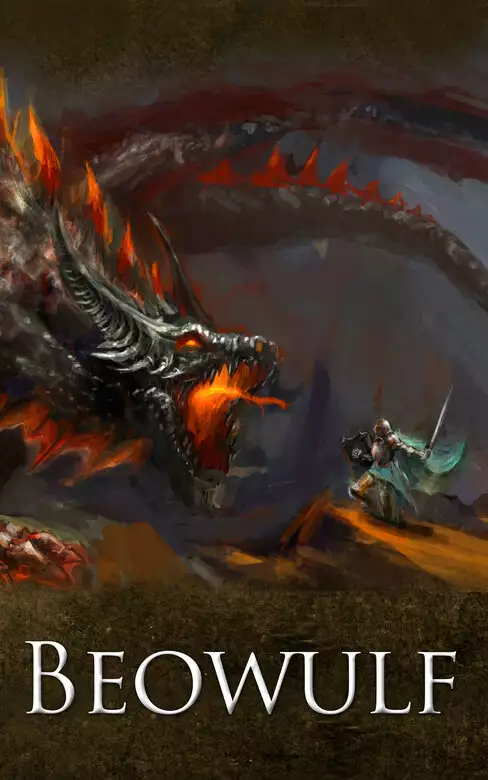
"Beowulf" is an Old English epic poem and one of the most significant and influential works of early English literature. Consisting of over 3,000 lines, it narrates the tale of its hero, Beowulf, and his adventures as he battles the monster Grendel, Grendel's mother, and later in his life, a dragon. The poem delves into themes of heroism, bravery, the transient nature of life, and the conflict between good and evil. Written by an unknown poet, "Beowulf" dates back to somewhere between the 8th and early 11th century and is preserved in a single manuscript known as the Nowell Codex.
Release date:
May 17, 2016
Publisher:
HarperPerennial Classics
Print pages:
208
* BingeBooks earns revenue from qualifying purchases as an Amazon Associate as well as from other retail partners.
Of Hrothgar, son of Healfdene and king of the Scyldings, and how he built a fair mead-hall, which he named Heorot. How the merriment in the hall angered Grendel, an evil monster.
THEN BEOWULF5 OF THE SCYLDINGS, DEAR KING OF THE NATION, was long famous in the cities and among the peoples—the prince, his father, had departed from his home6—till high Healfdene was born to him in after-time. He, while he lived, old and fierce in war, ruled graciously over the Scyldings. To him there were born into the world four children after this order: Heorogar, leader of armies, Hrothgar, and Halga the Good; Queen Elan, I have heard, was the dear wife of Ongentheow, the brave Scylfing.7
Then to Hrothgar was given success in battle, glory in warfare, so that his loyal kinsmen gladly obeyed him, until the young warriors were grown, a mighty band. It came into his heart to command his men to build a hall, a mead-hall greater than any that the children of men had ever heard of, and therein to give gifts of all kinds to old and young, as God had prospered him, save the people’s land and the lives of men.8
And I heard men tell how the work of adorning the people’s hall was allotted unto many a tribe, far and wide throughout this earth. After a season—quickly, as man’s work prospereth—it came to pass that it was completed for him, this greatest of halls. And he fashioned for it the name of Heorot,9 he whose word had power far and near. He broke not his promise, but gave out rings and treasure at the feast. High and pinnacled, the hall towered aloft. Yet it awaited the surging blaze of hostile fire; nor was it long thereafter that fatal hatred was destined to arise between father-in-law and son-in-law, after the deadly strife.10
Then that mighty spirit11 who dwelt in darkness bore in his wrath for a season to hear each day the merriment, loud in the hall. There was the sound of the harp, the clear song of the gleeman. He spoke, who could recount from of old the creation of men, told how the Almighty made the earth,12 the fair-faced land, and the waters that compass it about; how, exultant in victory, He set the sun and moon as lights to lighten the dwellers in the land. He adorned all the regions of the earth with leaf and branch, and created life in everything that lives and moves.
Thus the king’s men lived, blissful and happy, until a certain one, a fiend of hell, began to plot mischief. This grim foe was called Grendel, a mighty stalker of the marches, who haunted the moors, the fens and fastnesses. The wretched being had long inhabited the abode of the monster kind, e’er since the Creator had condemned him. The Lord eternal wreaked vengeance upon the kindred of Cain, because of the murder—the slaying of Abel. He got no pleasure in the feud, but for that wicked deed the Lord banished him far from mankind. From him there woke to life all evil broods—monsters and elves and sea-beasts, and giants too, who long time strove with God. He gave them their reward.
5 Not the hero; compare here.
6 Died.
7 The rendering of this sentence is extremely uncertain, owing to the corruption of the MS. Nothing else is known of the people mentioned.
8 He respected rights of property and personal liberty.
9 “Hart”; probably so called from its decoration with antlers.
10 Epic prophecy; a reference to some tale of the fate of Heorot, familiar to the audience.
11 Grendel.
12 Cf. Psalms 148; Aeneid 1. 742 ff.
Grendel falls upon Heorot and slays thirty heroes. Hrothgar and his men are helpless before the monster, and the destruction is continued for twelve winters.
AS SOON AS NIGHT WAS COME, HE SET OUT FOR THE HIGH-BUILT hall, to see how the Ring-Danes were faring after the drinking of the mead. And he found therein a band of warrior-nobles sleeping after feast. They knew naught of sorrow, that wretched lot of all mankind. The creature of destruction, fierce and greedy, wild and furious, was ready straight. He seized thirty thanes upon their bed. Then back he returned to his abode, exulting in his booty, back to his lair with his fill of slaughter.
Then at dawn, with break of day, Grendel’s deeds were manifest to men, and the voice of weeping was uplifted—a great cry at morn, after their feast. The great lord, the prince exceeding good, sat joyless, when they had looked upon the track of the monster, the accursed foe; the mighty hero suffered, sorrowing for his thanes. Too great was that strife, too loathsome and lasting.
It was no longer than a single night ere he wrought more deeds of murder; he recked not of the feud and the crime—he was too fixed in them. Then, when the hatred of that thane of hell was fully known to them, truly told by tokens manifest, it was easy to find the man who sought him out a resting-place elsewhere more at large, a bed among the bowers of the hall. He kept himself thereafter further aloof and more secure, whosoever escaped the fiend.
Thus he held sway, and alone against them all fought accursedly, until that best of houses stood empty. Long was the time: for twelve winters the friend of the Scyldings suffered distress, yea, every woe, uttermost sorrow. And so it became known to the children of men—sadly told in song—that Grendel had long been fighting against Hrothgar, and for many a season had waged a bitter war and wicked feud, an unending strife. He would not stay the waste of life out of compassion toward any of the Danish race, compounding with them for tribute, and none of the wise men could look for a fair ransom from the destroyer’s hands. The dread monster, like a dark shadow of death, kept pursuing warrior and youth; he trapped and ensnared them. Night after night he haunted the misty moors. Men know not whither hell’s sorcerers wander in their rounds.
Thus the enemy of man, the terrible lone wanderer, oft wrought many a foul deed, much grievous affliction. In the dark of the night-tide he took up his abode in Heorot, the hall brightly adorned. Hrothgar could not approach the throne, precious in the sight of God, nor did he know His love.13
Mighty grief and heart-break was this for the kind lord of the Scyldings to bear. Many mighty men oft sat in council and deliberated together touching what it were best for great-hearted men to do against these sudden terrors. Sometimes they vowed sacrifices at their idol-fanes; the people prayed aloud that the Destroying Spirit14 would aid them in the torment that had fallen upon them. Such was their custom,15 such their heathen faith; the thoughts of their heart were turned on hell; they knew not the Creator, Judge of deeds; they wist not of the Lord God; verily, they knew naught of the worship of the Ruler of heaven, the King of glory.
Woe unto him who through deadly hate16 is doomed to thrust his soul into the fiery abyss, to hope for no comfort, no change in anywise. But blessed is the man who at his death may go unto the Lord and find refuge in the Father’s bosom.
13 The subject of this sentence, not plainly indicated in the original, may perhaps be Grendel. One spot was inviolate. But no thoroughly satisfactory explanation has ever been given.
14 The devil.
15 The rest of the section is usually regarded as the interpolation of a Christian scribe.
16 The notion is not clear; hatred of the new Christianity, perhaps.
In the far country of the Geats, Beowulf hears of Grendel’s deeds, and resolves to go to the help of Hrothgar. He makes him ready a great ship and sails with his men to the country of the Danes. On landing he is accosted by the shore-guard.
SO THE SON OF HEALFDENE17 KEPT EVER BROODING OVER HIS sorrow. The wise hero could not stay the suffering; too grievous, too long and heart-sickening, was the struggle which had come upon that people, a cruel plague, greatest of evils that walk by night.
A thane of Hygelac,18 great among the Geats, heard of these deeds of Grendel in his native land. In his strength he was the best of men in the day of this life, noble and mighty. He bade make ready for him a goodly ship, saying that he would go over the ocean-road unto that war-king, the great prince, since he had need of men. Little did his prudent thanes blame him for that journey, though he was dear to them; they encouraged him in his high purpose, and looked for good omens. The hero had warriors, chosen from among the Geats, the keenest he could find. Fifteen in all went down unto the ship. A skilled mariner pointed out the landmarks unto them.
Time wore on. The ship was upon the waves, the boat under the cliff. The ready warriors mounted the prow. The ocean-streams dashed the waves upon the beach. The men bore rich armor into the bosom of the ship, splendid war-harness. The warriors pushed off their tight-fitted craft on the willing adventure. So, driven by the wind, the bark most like unto a bird, sped foamy-necked across the waves, until, about the same hour the second day, the curving prow had journeyed on so far that the sailors caught sight of land, saw gleaming cliffs and lofty hills, broad ocean-headlands. Thus the sea was crossed, and the voyage ended. Then the Weder people19 went quickly up ashore, and made fast their ship, while their mail-coats and battle-raiment clashed. And they thanked God that their sea-paths had been easy.
The guard of the Scyldings, he who had been set to watch the headland, saw them from the cliff, bearing over the gangway their bright shields and ready weapons. His heart was spurred with longing to know who the men were. So the thane of Hrothgar went down to the shore, riding upon his horse. He shook his spear mightily with his hands, and asked in fitting words: “What warriors are ye, in coats of mail, who come hither, sailing your great ship over the sea, the ocean-paths? I have been warden of the coast and have kept watch by the sea that no foe with force of ships might do harm in the Danish land. No shield-bearers have ever tried more openly to land here, nor did ye know at all the password, the agreement of the warriors, our kinsmen. Never have I seen a mightier hero upon earth, a mightier man in armor, than is one of you. He is no common thane decked out with weapons, unless his face, his matchless countenance, belie him. But now I must know your lineage from you, ye false spies, ere ye go further in the land of the Danes. Now ye seafarers, strangers from afar, give ear to my plain counsel: it were best to make known forthwith whence ye are come.”
17 Hrothgar.
18 Beowulf, hero of the poem.
19 Another name for the Geats.
Beowulf makes answer touching the purpose of his coming, and is guided by the coast-warden to Heorot.
THE CHIEFTAIN, LEADER OF THE BAND, ANSWERED HIM AGAIN and unlocked the treasure of his speech: “We are men of the Geatish kin, and Hygelac’s hearth-companions. My father was well known among the peoples, a noble prince named Ecgtheow.20 He lived many winters ere, full of years, he went his way from home. Him well nigh every wise man remembers, the wide world over. With friendly purpose we are come to thy lord, the son of Healfdene, guardian of the people. Give us thy gracious counsel; we have a great errand to the mighty lord of the Danes. Naught secret shall there be in that which I intend. Thou knowest if it be, as we have heard for a truth, that some foe among the Scyldings, a secret destroyer, causes on dark nights by the terror of his coming unutterable evil, shame and slaughter. Now by my great mind I may perchance give counsel to Hrothgar, how he, the wise and good, can overcome the foe; if this burden of anguish be destined ever to leave him, release come once again, and the waves of care wax cooler; or else, ever after, shall he suffer seasons of affliction, wretched misery, long as the noblest of houses stands there in its lofty place.”
The warden spoke, the fearless servant, there where he sat upon his horse: “A keen shield-warrior, he who judges well, must know the difference between words and deeds. I learn that this is a band friendly to the lord of the Scyldings. Go forth, then, with your weapons and your armor. I will guide you. Likewise, I will command the thanes, my kinsmen, to guard your ship with honor against every foe, the new-tarred boat there upon the strand, until the bark with curving prow bear the dear master back over the ocean-streams to Wedermark. Unto so brave a man be it granted to endure unharmed the shock of conflict.”
Then they departed along their way; the boat lay quiet, the broad-bosomed ship rested on her moorings, fast at anchor. The boar-images above their golden cheek-guards glistened21; bright were they, and hardened in the fire—there the boar kept guard. The men hurried on in warlike mood; they hastened, marching on together, till they caught sight of the well-built hall, stately and bright with gold. It was the greatest among the dwellings of men beneath the skies; in it dwelt the king, and its light shone over many lands. Then the bold chief22 pointed out to them that radiant dwelling of brave men that they might straightaway go to it. He—himself a warrior—turned his horse and spoke a word to them: “It is time for me to go. May the Almighty Father by his grace keep you safe in your adventures. I will down to the sea to keep watch against hostile bands.”
20 Nothing further is known of the events here touched upon.
21 Carven figures worn as charms upon the helmet.
22 The coast-guard.
Beowulf and his men come to Heorot. They are met by the herald, who tells their coming to King Hrothgar.
THE STREET WAS BRIGHTLY SET WITH STONES;23 THIS PATH GUIDED the band of men. The byrnie gleamed, hard and hand-locked, the bright iron rings sang in the armor, as they came marching to the hall in battle-harness. Weary of the sea, they placed their shields, bucklers wondrous hard, against the wall of the house; they sat down upon the benches.24 Their byrnies rang, harness of heroes. Their ashen spears stood together, gray-shafted weapons of the seamen. This armored band was well adorned with weapons.
Then a proud warrior asked the heroes concerning their lineage: “Whence bring ye your plated shields, your gray war-shirts, and your visored helmets and this group of spears? I am Hrothgar’s servant and herald. Never have I seen so great a band of strangers of more courageous mood. I think that ye have sought out Hrothgar nowise as exiles, but from valor and out of the greatness of your hearts.”
And the proud lord of the Weder people, famed for his strength, answered him again; he spoke a word to him, bold under his helmet: “We are table-companions of Hygelac. Beowulf is my name. I will tell my errand to the son of Healfdene, the great king thy lord, if he will grant us to draw nigh to him who is so good.”
Wulfgar spoke (he was a chief of the Wendels, his boldness was known to many, his wisdom and might): “I will ask the friend of the Danes, king of the Scyldings, giver of rings, the mighty lord, touching thy journey, as thou dost entreat, and will straightaway make known to thee what answer the good king thinketh meet to give me.”
And he went quickly to where Hrothgar was sitting, old and exceeding white-haired, with his company of thanes; the valiant man went until he stood before the face of the lord of the Danes—he knew the custom of the court. Wulfgar spoke to his friendly lord: “Hither are come across the sea-waves travelers, Geatish men from a far country. Warriors call their chieftain Beowulf. They beg to have speech with thee, my lord. Refuse not to converse with them, O gracious Hrothgar. In their equipment they seem worthy of the esteem of heroes, and verily the chief who led the warriors hither is a man of valor.”
23 Notice the poet’s interest in a paved road.
24 Outside the hall.
Beowulf is graciously welcomed by the king, and thereupon tells how he will fight with Grendel.
THEN SPOKE HROTHGAR, DEFENCE OF THE SCYLDINGS: “I KNEW him when he was a child; his aged father was called Ecgtheow, to whom at his home Hrethel the Geat gave his only daughter in marriage. His bold son is now come hither to a loyal friend. Moreover, seafarers, who carried thither rich gifts as good-will offerings to the Geats, have said that he, strong in battle, had in the grip of his hand the strength of thirty men. Him holy God hath sent us, as I hope, to be a gracious help to the West-Danes against the terror of Grendel. I shall proffer the hero gifts for his boldness. Make haste and bid all the band of kinsmen come in together unto us. Say to them, moreover, that they are welcome among the Danish people.”
Then Wulfgar came to the door of the hall and announced the word from within: “My victorious lord, prince of the East-Danes, bids me say that he knows your noble lineage, and that ye, as men of stout courage, are welcome unto him hither over the billows of the sea. Now ye may go in unto Hrothgar in your war-array, under your helmets; but let your spears, shafts of slaughter, here await the issue of your words.”
Then the mighty one arose with many a warrior round him—it was a noble group of thanes. Some remained and guarded the armor as the chief bade them. The heroes hastened, as the guide led them under the roof of Heorot. The great-hearted man, bold under his helmet, went on until he stood within the hall. Beowulf spoke—on him gleamed his byrnie, his coat of mail linked by the smith’s craft—: “Hail to thee, Hrothgar! I am Hygelac’s kinsman and thane. Many an exploit have I undertaken in the days of my youth. In my native land I learned. . .
We hope you are enjoying the book so far. To continue reading...

 Please log in to recommend or discuss...
