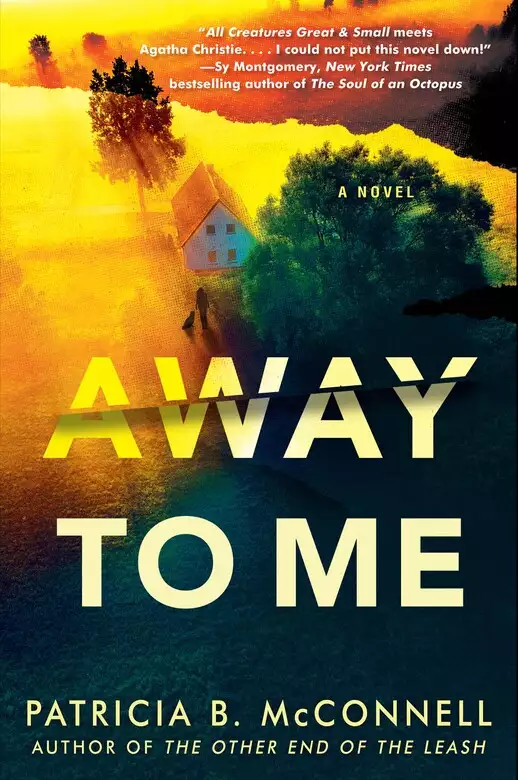
The vivid, immersive nature writing of William Kent Krueger and Peter Heller meets the taut suspense of Louise Penny against the lush, sprawling landscape of rural Wisconsin in the first of a new mystery trilogy by internationally renowned animal behavior expert Patricia McConnell, bestselling author of The Other End of the Leash and The Education of Will.
"Like All Creatures Great & Small meets Agatha Christie – only with more glorious writing, more training tips, and more border collies! I could not put this novel down – and when I did, I felt blessed by the company of great characters both human and canine, inspired to live lives of courage and hope." —SY MONTGOMERY, New York Times bestselling author of The Soul of an Octopus, What the Chicken Knows, and The Hummingbird's Gift
Maddie is living her best second life on a 40-acre sheep farm in the Wisconsin countryside. In addition to her passion for training sheepdogs—including her spirited border collie Jack—she sees all manner of dogs with behavioral problems ranging from biting to thunder phobia as part of her local practice. No stranger to trauma herself, Maddie has worked hard to recover from the ordeal of her previous marriage.
But things take a turn when Maddie’s friend and mentor, George, is inexplicably killed by a rifle shot fired from the woods during a sheepdog trial. Maddie is devastated and also baffled—it’s not hunting season, and who could mistake a man, standing alone in a field, for a deer?
She’s still reeling from George’s shooting when a shelter calls her for help with a German shepherd found half dead beside the highway who’s too aggressive to feed and care for. The dog flourishes at the farm, but when Maddie returns one day to find her house invaded, it’s clear that she has stumbled into a situation far more complex and sinister than she realized. And her romantic involvement with an enigmatic young shelter worker soon leads to even more trouble. As Maddie continues to search for answers to George’s death, it quickly becomes apparent that her own life is once again in danger . . .
Release date:
February 24, 2026
Publisher:
Kensington Books
Print pages:
320
* BingeBooks earns revenue from qualifying purchases as an Amazon Associate as well as from other retail partners.
On that day, burned into my brain like a cattle brand, the woods stood dark and silent, an audience to the fog rising in an amphitheater of spring-green grass. The air was fuzzy with moisture, so the Twin Oaks Championship Sheepdog Trial outside Portage, Wisconsin, had been delayed until one could see the sheep, four hundred yards away. A barred owl called in the distance. Who cooks for you? Who cooks for you? Finally, the fog began to lift and the forest hummed with songbirds, so the first team walked up to the post.
George and Jess had drawn the first run of the day. George, all six foot four of him, was a top hand at trialing, and most of the other handlers had gathered to watch his run. He had a lot of wins under his belt, but his little bitch, Jess, was young and inexperienced. Her sire had won the Nationals, so there was a lot of interest in her performance. Few were more interested than I. Not only was George my friend and mentor, my own dog was Jess’s brother, a young male Border collie who infatuated and infuriated me with equal intensity. His name was Jack, aka Mr. Wonderful. Or, on a bad day, something else I’d rather not say.
George and I had talked earlier that morning, when he gave me some last-minute advice about running Jack on this particular course. George wasn’t just a great dog trainer; he could read sheep as if he’d been one in a former life. “Watch the pull to the exhaust pen, Maddie. The sheep are gonna charge down the field to your left and you’ll need Jack to cover them sooner than you think unless you want a wreck.” As usual, he was generous with his support. “Go get ’em,” he said, with a gentle squeeze around my shoulders.
“Good luck yourself,” I laughed. “Heaven knows you’ll need it, Georgie.”
Calling a man “Georgie” who looked like he walked out of a 1950s TV Western—his body lanky, his face chiseled—was patently ridiculous. Which is why it was so much fun. I’ll never know why George adopted me as if I was his long-lost daughter, letting me tease him relentlessly and giving me free advice and lessons, no matter how much I protested. We spent countless sun-speckled afternoons on his porch nursing a beer while we shot the shit after we worked dogs. He had become, over the three years since I’d bought Jack from him, one of my best friends. I’d add in cheerleader, if cheerleaders expressed their enthusiasm with a raspy whisper of “Good enough,” and a barely perceptible dip of the head.
His face looked drawn that morning—I wondered if it was the high expectations everyone had for his run with Jess. He smiled his cowboy grin when I wished him luck, and said he’d need it. I turned to go, not wanting to interfere with him getting ready to run, but he grabbed my hand, pulled me back, and looked straight into my eyes.
“You take care of yourself now, girl.” He was the only man who could call me, a forty-two-year-old woman, “girl,” and not piss me off. I had enough trouble being taken seriously, being only five foot two and, as my aunt used to say, “a little hefty,” with vaguely red hair that I battled into submission every day. George walked away, Jess trotting beside him, looking up at his face with a gaze of adoration. A man for all species. Something in me wanted to run after him and give him a hug.
As George walked away, Jack was standing transfixed by my side, watching a group of four sheep, a faraway blur of cottony white, that was being carefully moved into position by another handler and her dog. The caw caw caw of a crow rolled through the valley as wisps of mist swirled above the grass.
Jess, a small Border collie with a foxy feminine face and a curly ruff, stood beside George looking for the sheep, her pointed ears toggling left and right. Her jaw chattered from excitement. I could barely hear George whisper “away to me,” the signal for Jess to run counterclockwise around to the back of the flock. Jess bolted forward, a black and white bullet, hitting full speed in three strides and beginning her run around to the back of the sheep.
What is more beautiful than watching a dog, all muscle and mind and heart, run free across a field of green to gather a flock of sheep? My heart swells up every time I see it. Every time. And I see it a lot. Being an applied animal behaviorist is my career, but working sheepdogs is my passion. It’s an addictive sport—imagine playing chess with all the pieces alive and full of their own opinions, moving at twenty miles an hour. It’s like Through the Looking Glass, except for real.
Jess turned in behind the sheep at exactly the right point, her body low to the ground. She crept toward the sheep like a lion on the hunt, easing the sheep forward with controlled determination. She moved the sheep quietly but with authority toward George, pushing them forward as if she’d put them into a shopping cart. But then, the lead ewe turned and put her hoof down. Literally. A big wooly thing with black legs and a speckled face, she turned to face Jess, stomping her hoof and ducking her head, presenting an anvil-like forehead that threatened to send Jess flying. She stomped again. Jess didn’t flinch.
We spectators took a collective breath, riveted by the standoff between a thirty-five pound dog and a hundred-and-thirty-pound ewe. Many a dog, especially a young one, would give in to the pressure by backing away, or by panicking and biting, an automatic disqualification. What happened next would make or break the run and let us know if Jess had the chops to be a top competitor.
It was silent, every spectator caught up in the drama. Jess leaned forward, just an inch. The ewe bent her head down farther and made a mock charge. Jess crept forward another inch, looking directly into the ewe’s eyes. Finally, the sheep lifted her chin and turned her head. She began trotting away, Jess behind her, leading her flock in the right direction.
I exhaled, not realizing until then I had been holding my breath. I looked down at Jack.
“See that? That’s how you do it, bud.”
As I did, an audible crack split the air, so loud I felt it in my chest. I startled, not expecting anyone to be hunting this time of year. Gunshots are common in the country, but we rarely hear them in spring. They’re usually the boom of shotguns, not the air-splitting sound of a rifle.
I started to shake it off, but suddenly heard Stephanie, a fierce competitor in her own right, yell, “Oh God. George!”
I looked up to see George sprawled on the grass where he had stood moments ago, a pool of blood expanding in the grass beneath him. He lay on his back, his blue eyes wide open, as if surprised. His left leg was bent at an unnatural angle underneath him. For a moment we were all frozen in place. Even the birds went still.
I started to run to George, but someone behind me yelled “Get down!” grabbed my arm, and pulled me back behind a Ford F-150 with chrome wheels and a teardrop trailer. I can see the image of its silver hubcaps to this day, but I cannot for the life of me remember who pulled me away from George. Trauma does weird stuff to your brain.
No new shot rang out. A lone robin began to sing, two dogs began howling behind us.
“What the hell?” said someone behind me, and stood up slowly. Suddenly there was action everywhere; two handlers ran to their trucks and started loading their rifles and pointing to the woods, looking for the dumb-ass hunter who must have shot George. Others pulled out their phones and called 911, while running over to George. I ran after them, desperate to help him, save him.
I took his face in my hands while the pool of blood underneath him grew. Another handler joined me and put her fingers on his neck. “Oh no. Oh no,” she said so quietly I could barely hear her. “He’s dead.”
I started to crumble and then someone wrapped their arms around me. It was Dorothy, a top-level handler and my best friend. Except for George, she was the only other person I would call a good friend, at least the human kind. She wrapped me in her arms and tried to pull me away. I fought to stay with George—I couldn’t bear to leave him, alone in the wet grass. But as I struggled, I realized that I had left Jack by the truck, abandoning him when I ran to George.
“Jack? Oh my God, where’s Jack?” I looked around in desperation.
Jack was standing by the truck I’d hidden behind, trembling. He could’ve run away in a panic, and then there would have been two tragedies. Border collies are known for their sensitivity to loud noises; he could have been running away in fear, a mile away by now. But there he was, his eyes huge, his mouth closed tight, and if I didn’t do something soon, he could forever be fearful of loud noises. Or sheepdog trials.
I ran to him, crooning “Good boy, stay there, good boy,” and slumped down to the ground beside him. I wanted to go back to George, but couldn’t bear to leave Jack. Dorothy leaned down beside me and gave me an awkward hug.
“Take Jack back to the truck, Maddie, there’s nothing you can do here. I’ll call Tom.”
Tom was George’s business partner and co-owner of the H & H Working Dog Center, a dog-training facility where George had worked with stock dogs, and Tom raised and trained K9s for the police.
I took some deep breaths to try to stop my own hands from shaking. “Wanna go for a ride?” I said to Jack, as I picked up his leash and walked him back to the truck, parked a hundred yards behind the trial field. Jack looked calmer, but his eyes were still huge and dilated. “Take a bow, bud.” I’d learned years ago that asking a dog to do a play bow helps them relax. Jack knew the trick well and complied instantly.
“Good boy.” I took a few deep breaths as I fished into my pocket for dried liver treats.
Jack slurped them up. Good. At least he wasn’t too frightened to eat. I asked him for a few more play bows, and after that some high fives. Jack’s eyes returned to normal. To my relief, his mouth relaxed, so I popped him into his crate and walked back to the cluster of handlers on the field.
George had been shot in the chest. Someone had covered his body with a purple blanket. And yet … George couldn’t be dead. It had only been ten minutes since we talked. This could not have happened: “Shooters” don’t happen at sheepdog trials, and although hunting accidents happen too often in the country, who could mistake a man standing alone in a field for a deer? One of George’s friends had collected Jess, who pathetically had brought the sheep to George’s body. She seemed a bit disoriented but had willingly responded. The rest of us stood in stunned disbelief, needing to talk, not knowing what to say.
I walked over to sit beside his body, just to be there, with him, one last time. The birds were singing their cheerful spring songs full volume. It sounded wrong, like heavy metal music at a funeral. I pulled George’s hand out from under the blanket and held it. For the first time in my life, I understood that it can actually feel, physically, like your heart is breaking.
A sheriff’s car pulled me out of my reverie, speeding down the dirt road leading to the parking area, the Dodge Charger’s front end flapping up and down over the bumpy grass. Within minutes there was an EMT vehicle and several other law enforcement cars, lights flashing. We didn’t need a medical examiner to confirm what we already knew. It wasn’t George anymore; it was his body.
The site began to swarm with people in uniforms. Two officers surrounded the body with a tent, with bright yellow crime-scene tape around it. One squad car backed up and flew down the side road toward the area we thought the shots came from. Three officers, two male, one female, herded us away from the body and asked us to stay put until they could talk to us. Another siren, the loudest of all, announced the arrival of an ambulance, and behind it a car with what looked like a forensic team.
It was chaos. And noisy. Jesus, it was noisy. Between the sirens, the car engines, and the dogs barking, I began shaking again. I ran toward the truck—surely, I should check on Jack again—when a cop yelled “Hey! Stay with the group.”
“My dog. I’ve got to check on my dog. He’s just right over there, please, in the Toyota Tacoma, right there.” He stood silent for a moment, and then said, “Okay, but come right back.”
“Hey, bud,” I said, opening the door leading to Jack’s crate. His pupils were huge. I took some breaths before I let him out and, glancing over my shoulder at the nearest cop, took him for a short walk toward the woods and away from the noise. He squatted beside an old buckthorn stump and deposited a puddle of diarrhea. After a bit more walking and a few tricks, there was nothing for me to do but put him back in his crate and return to the other handlers. They were standing in clumps, phones in their hands, trying to make the unreal feel real by telling the world what happened.
We all agreed that the shot had come from the woods northwest of the field. From who? During the fall hunting season the woods are full of out-of-towners who do stupid, and sometimes fatal, things. In spring you might hear a local going after squirrels, but not with a high-powered rifle. Besides, it was hard to imagine anyone confusing the figure of a man, standing in the open, for a squirrel or a deer. But then, plenty of cows have been shot at or killed over the years by trigger-happy people, so who knows. The only thing we knew for sure was that George was dead.
I spotted Dorothy over by her truck, sitting on the ground, petting Jess. We exchanged looks of disbelief and hugged when she stood up. As always, tall, slender Dorothy looked like she’d just left a photo shoot for an outdoor clothing line. No matter the weather, her hair looked gorgeous and her mascara never ran. Runny mascara wasn’t a problem for me. I hadn’t worn makeup in decades, not since my husband insisted I wear it all the time. I could be mucking out a horse stall and he’d tell me to go inside and “fix yourself up.”
But Dorothy looked like she was born with the makeup of a cover model. Dorothy was a wildlife rehabilitator; once I had found her with a cadre of volunteers trying to treat an injured otter. Everyone but Dorothy had been covered in shit and fur and mud. She looked ready to go on a dinner date.
“Holy fuck,” said Dorothy. “Is this really happening?” The face of an actress, the mouth of a sailor. I shook my head from side to side and wrapped my arms around her.
I lifted my head up as two members of the Jefferson County Sheriff’s Office walked toward us. They had gold stars, actual gold stars as if in a TV western, pinned onto the left side of their dark brown shirts. The embroidered patches sewn onto their shirts below their shoulders said “Sheriff” or “Deputy Sheriff, County of Jefferson.” They reminded me of Girl Scout badges. They began interviewing us one at a time, while others drove back to the road to investigate the area where we thought the shot had originated. I had little to say: “No, I don’t know if people usually hunt around here off season, I don’t live around here. No, I couldn’t imagine why anyone would want to kill George, that was impossible. No, he seemed no different than usual earlier this morning.”
After getting all my contact information, the deputy snapped his notebook shut, left me a card, and turned toward another handler. I went back to the truck, let Jack out, and sat down beside him, wondering. Had George been really “no different than usual” this morning? That’s what I’d said, but as I thought about it, why the drawn face, and why did he pull me back to tell me to “take care of myself”?
After endless hours, we were released by the sheriff. I didn’t want to go home. Dorothy came back over and said, “Want me to come home with you?” She turned me to face her and looked into my eyes when she said it. This was a generous offer. Dorothy and I live a good three hours apart, and she had three dogs and a litter of puppies to take care of, not to mention her own farm and full-time job as a wildlife rehabber.
Our jobs had gotten us together—she’d heard about my work with dangerous dogs, and called to see if I could help her manage an injured bobcat. She couldn’t get near the thing to treat its mangled paw. Eager for the challenge, I drove up curious, having waived my usual fees. I drove home having made a best friend, as if I’d known Dorothy all my life. No one could lighten me up like Dorothy, and few people could put up with her flat-out honesty and, uh, colorful speech.
“No, I’ll be fine,” I said to Dorothy. “What about you, you okay? Maybe let’s talk on the phone later today?”
“Yeah. Good, okay.” Dorothy gave me another hug and walked back to her Chevy Silverado. I stood beside my truck, knowing there was nothing to do but to leave.
I couldn’t bear to go home. I asked one of the deputies if I could stay if I didn’t interfere. He looked at me intently, made a valiant effort to suppress an eye roll, and said, “Suit yourself, just stay over there out of our way.” I sat beside the truck, almost immobile, while tides of grief ebbed and flowed. I stroked Jack’s head robotically until he went to sleep. A pair of sandhill cranes landed in the field behind me, where previously there had been rows of cars and trucks, all full of Border collies waiting for their chance.
The activity calmed down as the sun rose higher in the sky. Some of the uniformed people walked to their cars, drove away. Nothing seemed to be happening. I walked over to the tent, expecting at any moment to be confronted. No one noticed me, except some sparrows who flushed out of the grass as I crept forward. I stood on the outside and peeked in as one EMT, a young woman with electric blue hair and bright white gloves, supported George’s head as he was put into a body bag. I was reminded of carrying my first Border collie to the grave I’d dug for him. I still remember how his head lolled over my arm and how important it felt for it not to do so. I couldn’t comprehend then, and still can’t now, how someone who means the world to you can, in an instant, turn into nothing more than a floppy sack of skin and bones.
I stood watching his body being loaded into the funeral home’s van. Then I turned, loaded up Jack, and drove away.
It was a two-hour drive from the trial field to my farm outside Clear Creek, give or take the time dawdling behind the springtime farm implements that migrate on the roads like massive metal reptiles. I usually don’t mind being stuck behind them; driving in May here is like flowing through a calendar cover, the trees with leaves so soft you want to pet them. The forest is sprinkled with milky-white trillium, the pastures have turned Irish green, and the air bubbles with oriole song. But today all I wanted was to get home. I swerved to pass an interminably slow tractor pulling a bright green plow. I barely got back into my lane, tires squealing, before I would have slammed headfirst into a milk truck. I pulled over, took some breaths, and said, “I’m sorry, Jack, I’m so sorry!” The poor dog must have been thrown against his crate. I turned back to check on him and he grinned and wagged his tail at me as if nothing had happened. I sat deep breathing in the cab, as I had learned to do so many years ago, after New Mexico. Inhale, 1-2-3-4. Hold, 1-2-3-4. Exhale, 1-2-3-4. Hold, 1-2-3-4.
Soon I began the gradual ascent up to my little farm. Lonely Owl Farm is forty acres of heaven and hell on a bluff overlooking the south branch of Clear Creek. It’s the view that sold me on the place, that caused me to beg and borrow every dollar I could manage for a down payment eight years ago when I stumbled upon it, bumping my way down a dirt road, following a faded FOR SALE sign by the side of a county highway.
I had imagined accomplishing a long list of renovations when I signed the papers, after convincing the local bank to loan me more than they should have. I didn’t care that the old farmhouse was in such disrepair that you couldn’t lock the doors, or the barn was on the verge of collapse, or the gate to the yard around the house almost impossible to open. Barns can be salvaged, doors can be repaired and locks added, gates mended. All I cared about was the land and the view. It wasn’t my smartest financial decision; I didn’t have much money to fix things up. But I needed it, knowing that the land and the view and the birds would be better than therapy or drugs to make me whole again after running away from the nightmare that was my marriage. Best decision I ever made.
I let Jack out of his crate after parking the truck. Unlike his sister Jess, Jack is a big Border collie, forty-seven pounds of muscle and sinew. He has a lustrous collar of white fur, like the ruff around the necks of seventeenth-century royalty. He is also full of himself. He strides toward unfamiliar females like John Travolta in Saturday Night Fever; you can practically hear “Staying Alive” in the background. He also sneaks under the fence to work the sheep on his own and wakes me up at four in the morning for his breakfast. And, I adore him, and I think he adores me, and at night when he lies beside me on the couch and lays his silky head on my lap, we forgive each other everything.
That afternoon it was all I could do to unpack the truck. I carried armfuls of dog supplies, jackets and boots out of the truck, and threw them down in the mudroom. I let Jack outside where he marked his territory while I let Clementine, a fifteen-year-old, ginger-colored terrier mix, out to potty. Adopted from a client who couldn’t take care of her anymore, Clementine suffers from heart disease and a tendency toward intestinal upset. She sleeps twenty-three hours a day and is occasionally mistaken for a stuffed animal.
Clementine and Jack are joined by forty Katahdin ewes with lambs, a flock of obnoxious Muscovy ducks that I consider butchering every day, and a thirty-year-old pinto mare that I rescued from an auction and creatively call Old Horse. We are all managed by the farm bosses: two calico cats named Thelma and Louise.
I called Jack and hiked down into the pasture to check on Bo Peep, a Great Pyrenees livestock-guarding dog who lives with the sheep. I was glad to find her in her usual spot that time of day, zoned out in the shade of an old hay wagon. Sheep guarding dogs sleep during the day because coyotes usually do their hunting between dusk and dawn. Bo Peep woke up as we approached, thumped her tail, and slowly rose to her feet. She traded butt sniffs with Jack, and I bent down to rub her neck.
She licked my face, and I gazed up the hill to see that the flock was resting comfortably under a stand of oaks, peaceful as a Victorian painting. The ewes lay with floppy ears and folded legs, mouths moving rhythmically, the lambs cuddled up beside them. A bucolic scene, spoiled by the image of George’s bloody body, as if it was a filter that had been superimposed onto my eyes. I bent over and put my hands on my knees. Old Horse lumbered over and rested her forehead against me. I stroked her cheeks and rested my head on hers. Finally, I collected myself and went back to the house.
My first job was to let Vince, a retired dairy farmer who lived down the road and did the farm chores when I was gone, know that I was home early. I was glad I got his answering machine; I didn’t want to talk to anyone. I checked my phone messages, including the ones that came in on my business line. Luckily there were just a few, with none of the crisis calls I had learned to expect on a weekly basis, begging me to see them TODAY because their dog was scheduled to be euthanized TOMORROW because of a bite. “You’re Champ’s last chance. Please, please can you fit us in tomorrow morning?”
I unpacked slowly, hanging the jackets more carefully than usual. I folded my T-shirts and socks, placing them in the drawers in order of color, instead of the usual kaleidoscope of chaos. I went to the kitchen and scrubbed the sink. I shook out the blankets in the dog beds and swept the floors. I turned on the TV, then turned it off.
I sat down on the couch and stared at the only photograph on the living room wall that had people in it—all the rest were of dogs, horses, and sheep. George and I were crouched beside Jack, maybe nine, ten months old then, with gangly legs and a goofy face full of innocent expectations. I looked over the moon with excitement. George looked serious, although one corner of his mouth was turned up; you had to look hard to see it.
Vince, my neighbor with the voice of a gravel road and the heart of a dove, called while I sat staring at the photo. He was a friend, in the way that good neighbors are. I couldn’t count the number of times he bailed me out—from pulling my skid steer out of the ditch, to minding the farm when I left for sheepdog trials. I helped him care for his aging German shepherd before she died, and took him rotisserie chicken when he mangled his hand in a friend’s manure spreader. We knew each other’s land, animals, and the state of our farm equipment, but, like man. . .
We hope you are enjoying the book so far. To continue reading...

 Please log in to recommend or discuss...
