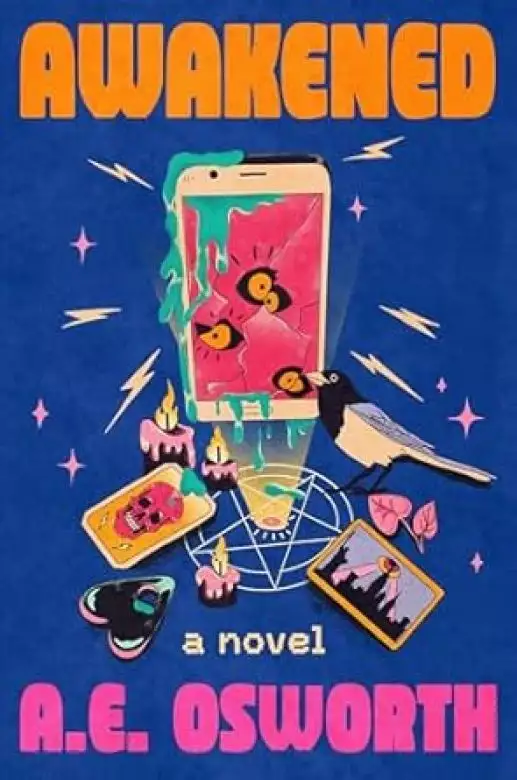
A coven of trans witches battles an evil AI in the magical coming-of-middle-age romp about love, loss, drag shows, and late capitalism.
On a morning much like any other, 30-something queer Brooklynite Wilder makes the miraculous discovery: suddenly, as if by magic, they can understand every language in the world. Dazed and disconnected, Wilder is found and taken in by a small coven of trans witches who have all become Awakened with mystical powers of their own. Quibble, a handsome portal traveler, Artemis, the group’s caretaker and seer, and Mary Margaret, a smart-ass teen with telekinetic powers all work to make the cagey and suspicious Wilder feel comfortable, both within their group and with the knowledge that magic is, in fact, real.
Just as Wilder is finding their footing, a malicious AI threatens to dismantle the delicate balance of the coven and the world as they know it. Newly assembled and tenuously bound, the group scrambles to stay united as they parse the difference between difficult and dangerous, asking themselves continuously: is any consciousness—be it artificial, material, or magical—too dangerous to exist?
Awakened is an exhilarating, hilarious and thought-provoking reflection on the ways that we are responsible for creating our own realities , a story of finding community, and a meditation on what it means to have a body (and if it might be far worse never to have had one at all).
Release date:
April 29, 2025
Publisher:
Grand Central Publishing
Print pages:
300
* BingeBooks earns revenue from qualifying purchases as an Amazon Associate as well as from other retail partners.
On the morning of their half birthday in their thirty-first year around the sun, Wilder wakes in possession of Magic.
One might contend that things don’t happen that way, that adults do not simply wake to Power. But one might consider this: adults often wake up to terrible things, like they have thrown their back out while sleeping or they have cancer or someone they know has perished in the night. Why shouldn’t it be something nice for a fucking change?
When Wilder pictures themself, they see only their conscious thought, a cascade of pure blue light, a being created of twisted, rain-heavy cloud made solid and brought to earth. But outwardly, they do live in a meat sack. They are pale, not quite so luminously white as linen sheets, but not far from it, with freckles that stand out against their skin like they’ve been drawn on. Their hair is naturally orange and sits atop their head in a wild, gnomish fashion. Like a Troll Doll. They have the crooked teeth of someone whose parents never dreamed of incurring dental fees. They have breasts they never think about, which are currently cocooned under a quilt made of old T-shirts and topped with a cat, her long fur just as marmalade as Wilder’s coiffure.
It is early for Wilder, which means it is a normal morning time for everyone else. They have six shitty gigs, and they squint at their cracked phone trying to decide which combination of them will net the most money today. Will it be Taskrabbit? Instacart shopping? It is very cold out; should they hop on Fiverr and try to get eight hours’ worth of transcription? Or copywriting? That way, they won’t have to leave.
Wilder loves not leaving their apartment. They are a rock in the middle of a river—everything rushes around them while they stay still. Or one might even think of them as the river. Ever-flowing, slow but impermanent and, therefore, aloof. At least that is what they tell themself when they try to narrativize why it is they have no friends, no family they speak to. The truth is, of course, much simpler and far harsher: they see other people only as rivals. Everyone is vying for the same limited resources, and resources are always limited. It is a very lonely existence, actually.
Their cat, the Lady Anastasia, makes biscuits on their chest, which gets them out of bed fast. They scoop food into her bowl and stretch their arms out to their sides. When they do this, they can put their palms flat on each wall. It is both depressing and comforting. Wilder likes a cave; their room certainly is one. Everything in their apartment is thin and long, railroad style. They have a twin bed shoved in a corner, a stack of library books next to it topped with a cold mug of tea from the night before. A wire rack of clothes. A small closet that can’t open all the way, its door impeded by the steam heater. Legally, this counts as a bedroom.
Something about the day (they do not yet know what) quivers with possibility; they hope it is some good omen that they are about to make a lot of money. They charge the most for research tasks and their bank account has fifty-two dollars in it because they just paid rent. So it is time, they think, for Taskrabbit above all else. They accept a “research” booking, which is personal assistant stuff, never truly interesting. Their task today: plan a vacation for two people with a budget of ten thousand dollars.
It turns out it is extremely demoralizing to plan a vacation for two when the budget is what takes them nearly a third of a year to make. They have never seen this number in their bank account balance, not ever, not once. They decide to fortify themself with coffee. Wilder jams their glasses, taped at the hinge, onto their face, wraps their quilt around themself, and steps into the cold kitchen-dining-living-room-foyer. The floor is freezing and the zing on their toes wakes them up enough to make it across to the kitchen in a pre-caffeinated state. On their way, they pass a tired man in a janitorial uniform—their roommate. He is eating cereal. They grunt “hey” at each other.
Wilder scoops coffee into a shitty percolator; their roommate watches Netflix on his phone and chews loudly. Wilder’s roommate is a gentle, quiet dude named Andy who works as a night janitor at New York University; he is just getting home now, and Wilder presumes he’s about to go to sleep. His phone rings while Wilder silently chugs a glass of water. Their roommate is as taciturn as Wilder is, as content (if one can call it contentment) to be alone, so when his phone rings and interrupts a confectionary war of some kind, it is the reasonable assumption that he will begin speaking in Spanish to his parents or his sister, the only people he regularly talks to, perhaps ever talks to. Indeed, he picks up the phone and says, “Hey, Mama.” His mother is a loud talker. Wilder can always hear her clearly, though the phone is never on speaker.
As they pour nearly expired milk into their coffee cup, the volume makes eavesdropping on the exchange unavoidable, which is less a conversation and more their roommate’s answering to rapid-fire grilling—how is the school, do you think you’ll ever go to the school, why is the school so expensive—in an exhausted tone that suggests this is, perhaps, the hundred and twelfth time he’s had this “conversation” with his mother. Something nags at Wilder, but they still fix their coffee, take one sip, and trot back to their room. They are so pre-exhausted by the day that Wilder has forgotten they do not speak Spanish, have never even studied it. Uneasy without explanation (or rather, with the usual explanation of “capitalism”), they close the door and set about planning a vacation to a place they will never visit.
Aside from not knowing they woke up bilingual, Wilder also doesn’t know they’re being watched. Doesn’t know they’ve been flickering, showing signs of Magic for days, doesn’t know that on someone else’s radar—someone with already Awakened Power—they’ve just lit up like a Coney Island Ferris wheel. Doesn’t know that there is, at this very moment, a calming presence being dispatched, albeit a little later than he would prefer, given a set of unforeseen circumstances.
Quibble is wending his way toward Wilder’s apartment the quickest way he knows how. He is a solid, steady man with sparkly brown eyes and generous lashes. He’s a gentleman of alto experience, now a buzzy bass, slow and deliberate in his words. But quick in his mind; everything he says is clever. A real juxtaposition. He has a nose like someone played Pin the Tail on the Donkey with a scalene triangle, stuck it wherever, and called it a day. The nose umbrellas over a lopsided smile. He dumps out onto Wilder’s street and intends to knock on their front door, introduce himself. Maybe take them out for coffee. Anything to ease the shock of what’s just happened. This is his first time intervening with someone newly Awakened, but he is confident he can improve the process. Make it more believable, less traumatizing. Make it kinder.
He remembers his own Awakening. It ripped through him like a stomach virus; he did vomit, actually. But that could’ve been the external circumstances. His parents had just died. Suddenly. A plane crash. He was seventeen, all alone. When his Power Awakened, no one came for him. For a decade, he thought he was the only one in the world. That he was crazy or a mutated freak or both.
His body begins to react to his flashback with a yawning void sensation, the floor dropping from under his feet until he buries the feeling. He notes that he has done it—something “maladaptive” his therapist is adamant he begin to mark—and he knows that later the feeling will poke its gnarled hand back up, undead, because one can never bury a live feeling without suffering the zombie repercussion. For right now, however, he has a job to do.
The building he faces is sad. Drab, with streaks of mold-esque black organic matter running down its block-concrete face. Quibble itches to power wash it, to watch the dirt run off the rough surface. He hopes it’s not mold, just the hot breath of the city marking the façade with grit. A dumpster in front of the building overflows. Baby fussing floats from a window. He speculates about who he’s going to meet—Artemis says this one is queer, trans. She’s always right about that. But is the baby theirs? Hers? His? What do they look like? What does their Awakened Power feel like—what does it do without them trying, if anything, or do they have to actively use it? And what does it feel like to cast with them?
He texts Artemis. anything else i should know?
Well. We missed them. They’re out
fuck.
Yeah
can you see where they went?
I’m working on it. Right now I can just See they’re not where you are
Quibble wonders if he’ll be able to clock this person. If, as a trans person himself, he would be able to tell who they were if he wandered around for a while. Immediately, he feels like a bad person for thinking he’d be able to use some kind of fucked-up trans radar—based on what sort of problematic clues, exactly? Based on who looks out of place? Who looks a little bit uncomfortable? Some kind of homogenized queer signaling? Then the internal (but not quite internalized) voice of his therapist says that’s all very human of him. And then the voice muses about how sometimes, for him, it feels good to be clocked. That it’s about intention, about who’s doing the seeing. He types to Artemis, again, laughing at himself.
i’m gonna go for a walk, i guess? it’ll be scary if they come home and i’m lurking outside their door.
Whatever else this is or winds up being, Quibble doesn’t want it to be scary (though it will be, despite his best efforts). Softness is the whole point.
Wilder is also taking a walk. A walk with purpose, the purpose being the library. Because they couldn’t shake the feeling that something was irrevocably weird, they couldn’t focus on their work. They decided to change their scenery even though the whole point of taking this job was to not go out in the cold.
They cut through the weekday smattering of pedestrians at speed, past the low-slung bakery that always smells of rising bread, of the butter melting in baking croissants. The woman on the corner selling tamales—Wilder can understand her, too, as she speaks with a customer in a suit, and yet they still do not notice (come on, guy). They round the corner to the elevated metro platform, the tracks aboveground this far out into Queens. At the base of the platform’s stairs, they see a very lost Japanese family speaking to each other, two adults arguing as the two kids helpfully point at the upside-down subway map in their hands, ignored by their parents. They argue about which way to take the train for Manhattan. They must be tourists. A strange time to come, February—New York City has a good six weeks on either end of summer where it doesn’t induce depression. The father (Wilder assumes this is the father) pulls aside someone and says, “Pardon me” in the careful way of someone who does not speak English but for a few phrases they learned on Duolingo. The someone that the father pulls aside: a man with lines on his face so pronounced that he may as well be the subway map. Wilder watches the ultra-concentrated look of someone who knows six phrases of English being confronted by one of those phrases in English spoken by someone else who also knows six phrases in English. It is a familiar look in this borough. In this man’s case the look is a stare of both fierce attention and resigned politeness.
Wilder does not generally speak to people. In fact, they generally go out of their way to avoid it. But something about the children, about the cute, stupid way they’re holding the map the wrong side up, that they have a paper map at all, and something, also, about the way the other stranger looks so pained, torn between the desire to be helpful and the shyness manufactured by linguistic distance, makes Wilder at least think about stopping (and today is different from every other day they’ve ever had, not that they’ve realized it, so why not do something a little bit out of character?). It is so against their nature that their body tries to walk past. The crosswalk lights up with a blinking orange hand and they nearly run to catch it, have to think about pausing instead.
First, they speak to the lone lined man. “Don’t worry,” they say. Their voice is crackly, husky with disuse. They have only grunted one word this morning. This is normal. Many days their voice never wakes up. They clear their throat and try again. “I’ve got this.” They—oh Christ—they still do not notice. Their mouth is making different shapes than it would normally make, their coffee has made them alert, they’re outside in the suck-the-breath-out-their-lungs cold, their cheeks turning red, their mind on their actual face and the air flowing in and out through their nose, all the parts where the words come from and yet they haven’t figured it out. What will it take? What will it take for them to notice that their life is forever different?
Then they turn to the family, who all turn toward Wilder, a bland politeness wiping their features clean of confusion. The mother looks like she is holding her breath. Wilder figures they better get to the point. “Manhattan is that way,” they say. “The entrance across the street. Over there.” They point and everyone, including the lone lined man, including Wilder, takes a second to turn and look at the opposing stairs, packed with people on their way into work.
Then the family turns back. The children’s reactions are what Wilder would expect: one of the children smiles a small, smug victory—she’d been correct about which train to take. The other hides his mouth from their parents, like he is whispering, as he sticks his tongue out.
The parents, however—their mouths open so wide they look like they are about to receive a train into them. They both quickly close and cover their pie holes, the father with the back of his hand and the mother with the tips of her fingers. Wilder’s brows furrow—had these two perhaps heard that New Yorkers were rude, that they would not receive help if they needed it? In Wilder’s estimation, it was far ruder to do what they had just done—interrupt someone, approach them. The rule of New York, they figure, is to pretend that everyone has privacy in public. Or—is this a gender thing? Now Wilder’s face echoes that same bland politeness, which isn’t politeness at all but rather the armor of expected microaggression (or, to be perfectly fair, macroaggression). If they just paid closer attention, they would realize neither of these options is the correct answer. If they looked at the lone lined man, a New Yorker, perhaps they would be helped along by a few more context clues. Or perhaps not, as it seems as though, this morning at least, Wilder is a fucking idiot.
The mother recovers first, closes her mouth but keeps the tips of her fingers over it and smiles from behind them, genuinely this time. “Thank you,” she says, and Wilder’s face relaxes. “Forgive my surprise, it’s just”—she gestures to them—“you’re American.”
“Uh,” Wilder responds, not understanding what social territory they are now in and worrying that they don’t understand precisely because they are “American” (white). “Yeah?” is all they manage to say, already wondering how to disengage and run away.
“Sorry,” the mother says, registering Wilder’s extreme confusion. “We just don’t expect Americans to speak Japanese so fluently. How long did you live in Japan?”
“I don’t speak Japanese,” says Wilder, in Japanese. And as the family’s mouths all drop open once again, Wilder notices. (Finally!) They notice the bend in their mouth that they’ve never had before, their tongue flattening to make a different set of glottal caverns. What they are hearing with their actual ears, the sounds pressing against their actual eardrums, slams into some new territory, an instant double consciousness that immediately gives them a headache. Sound pulses from ear to ear around them, like wearing bad headphones at the library. They unintentionally tilt their head to one side, trying to expel water that isn’t there.
“Uh,” they say, suddenly deeply aware of the pastiche of languages around them, the way they now innately understand the entire world as they argue, cajole, compliment, screech, whisper, rant, plead, cheer, ask, update, impress, answer, invent, predict, worry, and echo, echo, echo—it’s too much. “I meant to say I have never lived in Japan.” They say it very, very fast.
“Oh—well—your Japanese is very good.”
An awkward pause, which would usually make Wilder want to perish. But what Wilder is feeling now is so, so much worse than merely wishing for death. The mother saves them by saying, “Thank you!” The family turns around and heads in the correct direction.
There is just the lined man left. Wilder stares at him. He stares back. Normally, the lined man would just grunt and move on with his day—not because he isn’t cheerful. He actually is. Has a reputation in his family for being too nice, in fact, nice to stray dogs and strangers, chatty in queues even for unpleasant chores, but this country isn’t like back home and not everyone can understand him when he talks. It is precisely because Wilder spoke in Urdu that the lone lined man—who isn’t really lone at all, not really, not in the rest of his life—smiles warmly and asks, “How many languages do you speak?”
Instead of saying anything at all, Wilder’s hands fly to their mouth and they run. If Wilder were a cartoon, the ground underneath their feet would fold like fabric and their departure would make a gunshot sound. But they are not a cartoon. They are extremely real. And that is why this is not possible, they think. That is why they are absolutely one hundred percent going clinically insane. Except, they think, if they were going insane, no one else would be able to understand them, and these people do understand them. They are interrupted by the idea that maybe they are sleeping and, therefore, imagining the people, so they kick a trash can to be sure, the result of their extremely scientific experiment being that their foot hurts and they scatter garbage across the sidewalk.
“What the fuck?” they hear the woman selling tamales in front of the bakery say in Spanish, another language that Wilder doesn’t speak, and they scream—a quiet scream, high-pitched, and all the closest dogs begin to bark.
It’s Magic, of course, but they haven’t gotten there yet, which is hilarious because Wilder has spent so much of their childhood—all that time they should have been learning any of these other languages—reading fantasy novels, subconsciously preparing for this moment. Or perhaps unconsciously is the better word. They have packed so many narratives of magical discovery into their own head and the average of all the reactions is seated somewhere inside them, stuck in their rib cage and silently unfolding.
There is the doubt reaction, ranging from mild to hostile. Perhaps the first stage of magical discovery is denial. There is the patented and frequent but-I’m-not-special, and its opposite, the I-secretly-knew-I-was-special. There is awe, wonder. There is rocking back and forth, doubting sanity. There is joy at a crazier, happier world, the classic child-like acceptance of new circumstance. Protagonists have all sorts of reactions to being told they possess magic.
Alas, the average of all these reactions unfolding in their rib cage in the nonfictional world all at the same time is a panic attack.
Rarely are they surprised by panic attacks the way they used to be. Back when they were very small and had no language to describe gender dysphoria, their body would, instead, manifest a matrix of anxiety to house the dissonance. They never stopped getting panic attacks; they simply became expert in having them. Medication? Out of the question. Wilder didn’t grow up as a person with health insurance and they didn’t grow into one either, and even in the era of “universal” “health” “care,” being a person with insurance isn’t a quality one simply manifests overnight (like Magic). But what Wilder can do is breathe deep into their belly when they feel one coming. Count the number of things they can see, the number of smells they can smell. Pick at their cuticles until they feel the everyday manageable pain calling them to step from the undulating ocean of tooth-splitting worry back to shore. They can always mark the sensation of impending alarm. A swell like a tide in their stomach-chest. A hollow feeling in their bottom teeth. A shortening of attention span; a turning inward, unable to watch anything but their own sea-horizon.
So, just as none of the neat, received narratives fit the way they felt their body move through the world in a gender-sense, none of the neat, received narratives fit exactly the experience of discovering their own Power Awakened. But more. More extreme, more sudden, more alone—for who ever heard of magic really, actually happening? Plenty of trans people exist—you can throw a stone in any direction, really, and hit a trans person in the shins. But Magicians? Alone, alone, alone. And so. A volcano of dread-fluster-hysteria-cold-sweat-fight-flight-freeze explodes. Their hands shake with it, with the effort of seeming normal as they speedwalk, keeping themself as low to the ground as a slinking cat. The sounds around them become muffled and they struggle to breathe. Their face is numb. Their thoughts are light. They scream again, absent any trigger, and people cross the street to avoid them.
They finally reach their building’s front door. They do not notice a man across the street, watching them.
But there’s Quibble, squinting, watching them do a Monty Python walk because they are sick with worry-dread, not to mention a hurt foot from the trash can punt. Quibble texts, well i think we have a winner to his dispatcher.
Wilder claws at their keys with helium-filled fingers. They make their way to their bedroom, and Quibble can see them sit on their bed through the barred window. First floor. Easy enough, he thinks, if they don’t answer the door. Certainly easier than it was to get all the way here.
Wilder stares at nothing, all their coping mechanisms forgotten. Or perhaps the better way to say it: their coping mechanisms do not quite address this, the sudden return to smallness, the dropping away of agency and understanding. They fling their hands around, try to feel something in them, shake them awake. They breathe shallow. They rock side to side. They hear a wet ripping sound immediately to their right, bouncing loudly off their too-close walls, and this is not a symptom of anxiety they’re familiar with. And that’s because the sound is real.
Wilder jumps off the bed, backs up, trips back onto it. They grab their T-shirt quilt and hold it up in front of them as if it were a shield. They mean to hide their eyes with it, but they can’t look away. A—portal? Is that what they’d call it?—opens slowly, suckingly, in the middle of their limited floor space. It grows from penny-sized to human-sized in a matter of seconds, torn open like the air is cheap fabric instead of nothing. A man steps through, smiling crookedly under a large nose, holding his hands out and up. He opens his mouth, ready to speak some sort of words, but he is drowned out by the sound of screaming. Wilder does not realize they are screaming. They are enveloped by screaming. Only screaming.
Then flick. Dark.
Quibble catches them as they slide off the bed to the ground. He looks down at the body before him. He is unsure if he should be chastising himself for displaying Power before having the chance to talk about it. It may have been the wrong call. The thing is, though—what exactly is the right one? He and Artemis have been trying to figure it out for ages; they have gotten it “right” exactly zero times.
Quibble wonders if there isn’t a right way, never has been and never will be. That this is never a conversation that feels good or sane or fair. The other person will always react however it is they’re going to react, regardless. Still. He sought to be a comfort and he failed. He feels a way about that, even as he acknowledges the following: how else would he get inside their house? His knocks had gone unanswered.
Sometimes all one can do is make the next best decision in the moment, given all the givens. And not everyone can See the future. Quibble certainly can’t. He kneels. He does not yet know Wilder’s name. He thinks of them only as “this witch.” Their face is somehow both flushed and paper-white, the standard pallor of the recently fainted. Their lips stand out plum against their panic-boiled skin. Their cheeks are heavy, round with sudden onset muscle relaxation. Their mouth lolls open slightly. Their eyelashes, hard to see given how light red-blond they are, flutter. Quibble can see Wilder’s trying-to-swim-up-ness.
He can hear stirring in the next room. A roommate. Shit. Of course they don’t live alone. Nearly no one lives alone, except for him. He forgets sometimes. He tries to be thoughtful, but the sharing of space isn’t a mother tongue. Impossible to keep at the front of mind even at the most neutral of times, and this isn’t the most neutral of times.
He feels strange, grabbing their face. He doesn’t know them at all. But it would be ruder, he feels, to grab their Meta-Face with the internal Hands made of his own Awakened Power and yank. That is so much more personal than a mere body. So he touches them as gently as he can manage, tentative. He puts his palms to their cheeks. Taps. Strokes. “Hey—” Not knowing their name is awkward, and he draws the e and the y sounds out long. He tries to stay quiet. “Hey, buddy—”
He hears a muffled, sleepy “Wilder?” from beyond the wall. “What the fuck was that noise?”
“Hey, Wilder,” Quibble whispers, thankful for the name supplied. “Come on, bud. Up time.” The new witch, Wilder, stirs and Quibble eyes the closet. It is so small—will he be able to fit in there? Bouncing from the room will make the sound again. While the Unawakened will usually do anything not to notice Awakened Power, he doubts the roommate will be able to rationalize such a thing away, not when it happens in his own home. Twice.
Quibble spots a lock on the door and rocks back on his heels, clicking it quietly into place. He returns to Wilder. “All righty, let’s—up. I’m going to get you onto the bed.” He grabs them under their arms, can feel their ribs, their shallow breathing returning to something deeper. A short-circuit. A reset. Good. Perhaps they need it to readjust their world. Their head rolls on their neck and Quibble reaches out to support it with his hand as he struggles their no-help-weight up three feet, spilling them onto the bed as kindly as he can. He grunts. It’s a low sound, an almost-growl.
“What? Who—Wilder, are you okay?” The roommate raps at the door, polite but firm. “Wilder?”
The new witch’s face flinches at each sharp knock, which, ultimately, gets them to open their eyes. When they do, Quibble’s face swims into view. His eyes are doe-like and worried. A set of three small wrinkles sits between his eyebrows and they relax as Wilder wakes. Awakens.
Wilder shoots backward, sits up and pulls their quilt back around them. They do not yet know Quibble’s name. But he is handsome, and Wilder is surprised by the faraway small part of themself that wants to trust someone because they are beautiful. Then they remember with the weight of a falling anvil how he came to be in their bedroom. They open their mouth again, a sharp intake of air, ready to scream once more. But Quibble puts his finger to his lips and, for a reason Wilder can’t quite acknowledge, they shut their mouth around the sound they were about to loose. Both turn their heads toward the closed door and back to each other.
Quibble’s whisper is so quiet as to be almost entirely inaudible, merely a breath with syllables, an ASMR video. Wilder has to lean in to hear.
“Listen,” the man says, and Wilder clocks the buzz. They don’t have a lot of friends—any friends—but they’re not stupid. They’ve watched enough trans YouTube to understand Quibble is a trans man. “I know what you’ve been through this morning. It is very confusing. I am very sorry. Get us—” The knocks begin again and Quibble speaks even more quietly, a feat Wilder hadn’t considered possible. “Get us some privacy and we’ll talk about it.”
Wilder nods once, their movements restrained. They feel hungover and their head rings like a bell. They wince as they get off the bed, dragging the quilt with them, and Quibble plops down, sitting on the edge. Wilder clicks the lock open and cracks the door. “Andy—hi. Everything’s, um. Fine.”
Roommate Andy raises an eyebrow, then breaks into a wide grin of the shit-eating variety. “Ah,” he says.
“What?” Wilder responds, confused, as they look over their shoulder where Andy’s looking. “Oh, uh. I’m—um.”
“Nah, man, . . .
We hope you are enjoying the book so far. To continue reading...

 Please log in to recommend or discuss...
