- Book info
- Sample
- Media
- Author updates
- Lists
Synopsis
"The novella of the year has arrived!"―Mark Oshiro, #1 New York Times bestselling author, on In the Shadow of the Fall
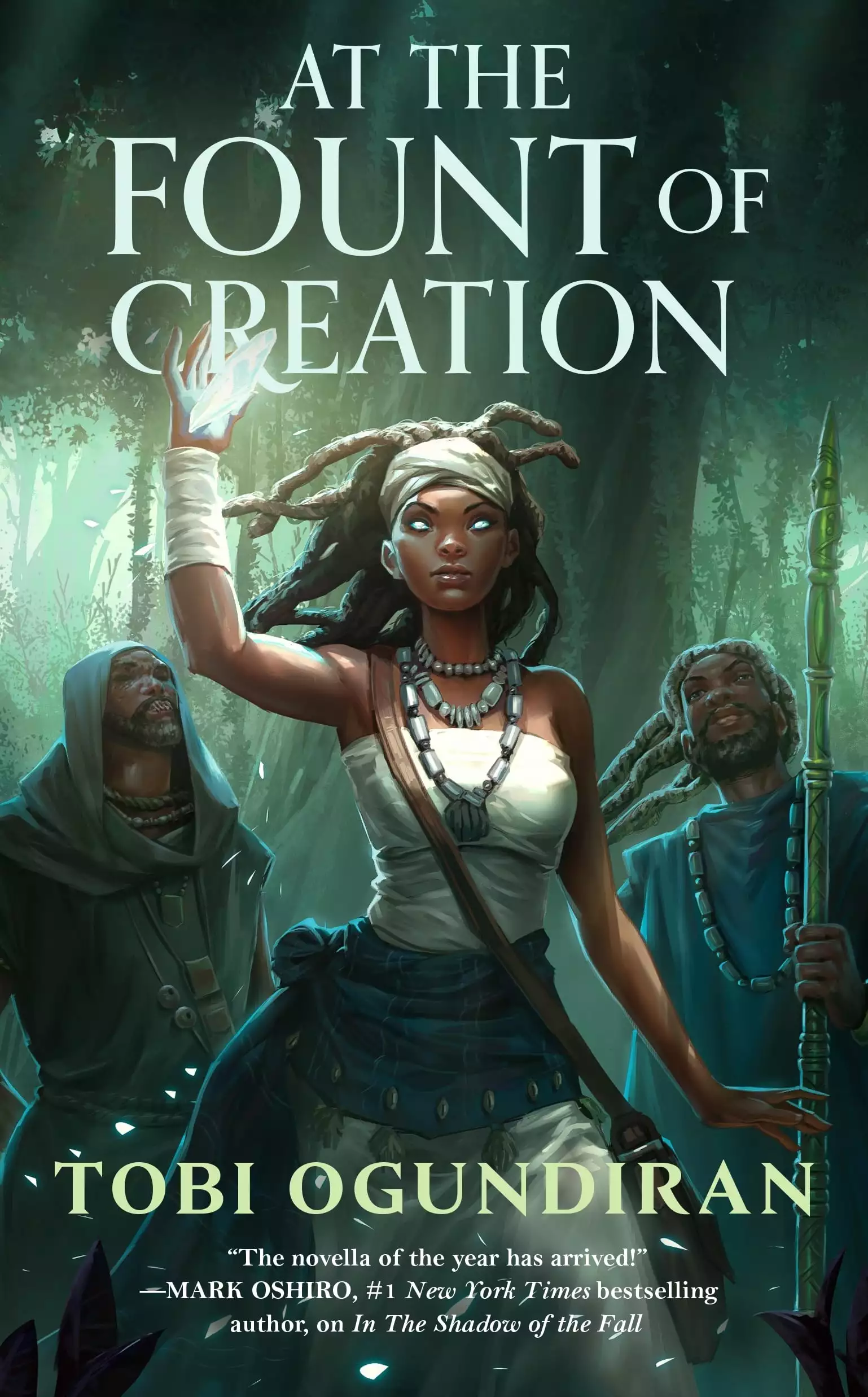
The fate of the Orisha will be decided in the concluding volume of the Guardian of the Gods duology by award-winning author Tobi Ogundiran.
For four hundred years, the world’s remaining Orisha have fought to survive the rapaciousness of the soul-stealing Godkillers and the charismatic words of the singular, mysterious figure who leads them, known as the Teacher. Now they seek to kill the one person whose existence defies their very mandate.
Now that Ashâke carries within herself the spirits of the surviving Orisha, she is on the hunt for allies who can help her defeat the encroaching army of Godkillers. But their influence is everywhere, and no one is immune―not even Ashâke. If she is to succeed, Ashâke will need to answer the question the Godkillers pose―are the Orisha even worth saving?
Guardian of the Gods
In the Shadow of the Fall
At the Fount of Creation
Release date: January 28, 2025
Publisher: Tor Publishing Group
Print pages: 160
* BingeBooks earns revenue from qualifying purchases as an Amazon Associate as well as from other retail partners.
Reader buzz
 Please log in to recommend or discuss...
Author updates
At the Fount of Creation
Tobi Ogundiran
FOUR HUNDRED SEASONS AGO
First came a terrible sound. The shriek of thunder, of fury, that rocked the world. Then came red lightning; night turned to day as a thousand bolts fractured the heavens and rained down on Aye. In the grand city of Ile-Ife, which is the first city, they cleaved the Tower, crushing thousands to death. And where they touched ground across the vast continent, the villages and cities and abodes of men went up in great flames.
Yet more lightning forked into the Endless Sea, travelling down, down, past schools of fish and herds of nameless beasts, past old swollen bones and ruins of long sunk ships. It went into the fathomless deep, until it touched the very roots of the world, which took its energy, which was the pure and righteous fury of terrible Shango.
The world broke.
The sea erupted and the continent succumbed to it. The sea churned and boiled and opened channels that became gullies that broke the continent into islands. And that which was in the sea was exposed to air.
At the bottommost part of the sea where old things lay was a rock the size of three elephants. Shaken from where it had lodged, it rolled and tumbled, buoyed by restless waves, by a sea come alive. Up and up it was raised, over the mountains that lurked in the deep, until it broke the surface and beached ashore beneath the barren limbs of an elder tree.
And there it glowed, beautiful, terrible; as white as the sun.
A crack appeared in the centre of the boulder. A hair’s breadth, such that only a keen eye might see it. Soon it widened, running in a seam down the length of the boulder. Bits of glowing rock broke off to hiss and smoke against the black beach. A hand emerged. It wiggled, a serpent’s tongue tasting air, then gripped the edge of the rock. Out came another hand that began to push, widening the crack until like a fruit, like a pod, with an almighty crack, the rock broke cleanly in two.
Out squirmed a figure. He was a hideous thing, neither man nor beast; he was gaunt, with ribs that strained against a paper-thin skin as he crawled from his prison. Farther and farther he dragged himself, his body cutting a track in the black beach. He raised his face to the sky. Where both eyes should be were ruined orifices, puckered and unseeing; where his mouth should be was a ruinous gash, sewn shut with copper threads.
This was his first face.
At the back of his head was a second face, whose eyes were black voids save for the fiery irises that burned like rings of fire in a starless night; whose lips were full of guile and cunning.
The orisha crawled through the black sand away from his rocky prison, away from the tree and down the meadow. He reached the dirt road and collapsed.
And here he remained for a few moments that might have been an eternity.
The Town Crier
Garuba flicked his tongue, probing the inside of his waterskin. He sucked desperately, but it was empty. The old leather was as parched as the desert around him. A strangled sound escaped his lips, something between a cry and a moan. Never had he been so thirsty in all his life, and that was saying something, coming from a kingdom where water was severely rationed. It didn’t help that the sun beat down relentlessly. He began to lick his skin. It was incredibly salty, and did nothing to quench his thirst, but he needed water and his sweat was the only liquid around.
Garuba couldn’t say exactly when he had lost his way. He had left Oyo with the other town criers, following the Oba’s Road before they were dispatched in various directions to other villages scattered across the kingdom. As a crier he had walked all over the kingdom; he knew the routes like the back of his hand, and could have found his way to any village even with his eyes closed. Which made it strange that he found himself lost in the desert, nothing but cracked, barren earth stretching as far as his eye could see. It seemed the world was just this desert, and he was the last man in it.
The sun bore down relentlessly, burning his skin, baking the earth so hard that the very air shimmered. Something appeared in the distance, silvery-white under the sunlight. A pool. Garuba blinked the sweat from his eyes. He closed his eyes, opened them. The pool still lay there, beckoning to him. But it wasn’t real. He knew better now. Oases and lakes did not exist where rain did not fall, not on this island, not in this kingdom. Garuba didn’t know if he was going mad from the heat, or from thirst, or from hunger. But he was going mad.
He stumbled and fell. His satchel flew from his shoulders, and out came his gong, two pieces of bitter kola, a fresh tunic and the embroidered kerchief that his daughter had made for him, and his empty waterskin. He lay there, cheek pressed against the cracked earth. He would not rise again. He had neither the will nor the strength.
“Rain,” he mumbled. “Rain…”
Ilorin hadn’t seen rainfall in seasons. To Garuba, rain was an alien phenomenon, as alien as the liquid fire that was said to have sputtered from mountains seasons ago. He couldn’t fathom water falling from the skies. Fresh water existed only in melo-pods, those hardy fruits that dug deep into the earth and extracted water.
But it hadn’t always been so. Countless seasons ago, as the elders said, they would pray and sacrifice to Oya, and she would conjure up strong westerly winds that blew rain clouds from the Endless Sea over the land. And it would rain, and crops would flourish, and fruits would grow. But most importantly, there would be an abundance of fresh water. Their lakes and streams and rivers would overflow. But here in Ilorin they had forgotten the gods. Well … not so much forgotten as believed them dead. And they had suffered for it.
He still remembered the sight of those boats sailing towards them. The alarm had sounded, and the small folk had clustered ashore, watching with apprehension as a small woman with kind eyes stepped off a boat and announced that they were griots, come to deliver good news. Ilorin was a small island so removed from the other kingdoms as to be isolated. They hadn’t seen an outsider in seasons, much less griots, who they believed had gone the way of the gods: a thing of an age past.
But here were real griots, insisting that the gods still lived. Garuba had heard the Song, seen firsthand the Memory of that girl covered in glyphs, of the orisha appearing next to her. But most importantly, he had seen her call the wind, and he had been caught in powerful rapture.
Oba Adeyanju had dispatched the criers immediately, to go to every corner of the kingdom ahead of the griots to deliver the news. The gods were alive.
They lived in the Guardian. And Garuba had been only too happy to go, to be the bearer of good news. As his baba had been, and his baba’s baba before him.
“Oya,” Garuba whispered, licking the crust from his lips. “Orisha iya mi. I ask for rain. Please.”
I am going to die, he thought.
His mind went to Tutu, his daughter. He began to weep; dry, weak heavings. Who would provide for her in his absence? Who would—?
A shadow fell over him.
Garuba mustered the last of his strength and flipped over. A man was standing over him; Garuba could not make out his features. As the darkness claimed him, Garuba told himself that like the disappearing pools, this, too, was a hallucination.
I’m dead, thought Garuba as he came to. Everywhere was dark. But then he made out the stars, twinkling in an ink-black sky, made out a jaundiced moon, and realised that he was not dead.
He was still in the desert. He sat up, nearly blacked out from the sudden movement. That was when he saw the stone basin, brimming with water. Garuba moved without thought, scrambling off the bench and towards the basin. He dipped a hand into it. The water was cool against his skin. It was real. Real.
And then he was drinking, scooping up handful after handful as he gulped. Great undead gods! Never had water tasted so sweet! He began to weep, slobbering as he drank, blessing the name of every orisha he could think of for sparing him. Garuba cupped his hands and spooned water to his lips. And, when that was not enough, dunked his head into the basin and lapped like an animal until his belly filled to where it hurt. Only then did he collapse against the stone bench, panting and slightly delirious.
That was when he saw the man.
“Ah,” said the stranger, grinning at Garuba. “Thirsty, are we?”
The stranger wore a flowing black kaftan, a red scarf wrapped around his throat. Seven heavy golden locs framed a face of indeterminate age. Sometimes when the fire moved just right he looked like a young man, and other times he looked old. An old scar ran down his face.
“Forgive me,” Garuba croaked at last.
“Nothing to forgive,” said the stranger amiably. “I know only too well what it means to thirst.” He reached behind him and produced a tray bursting with fruits. “Fruit?”
Garuba, tentative, picked an apple.
“I am Garuba Oyeyemi. Chief town crier of Ilorin. I set out from Ilorin”—what was it now, three, four days ago? He couldn’t tell. His memory was all a blur—“some days ago. At the behest of the Oba. He told us to deliver the griots’ message: the gods are alive.”
The stranger seemed unfazed by the news. He seemed instead like he had heard Garuba remark that the sky was blue. This was not the reaction Garuba had expected.
“Did you … did you already hear this?” asked Garuba. “The gods still live. I saw with mine own eyes! The griots—”
“Yes, yes. I heard you.” The man’s face shifted, and Garuba thought he saw a
flash of anger. But it was gone just as quickly, and he was offering Garuba another fruit.
“Apologies, my friend. I did not catch your name.”
“What is the point of a god?”
Garuba blinked, wondering what manner of question that was. “The point of a god? To … to provide,” he said with religious fervour. “What else? We owe them our lives. We owe them … everything.”
“But don’t you want a world where you are not beholden to the whims of a god? Don’t you want a better life for Tutu?”
The apple soured in Garuba’s mouth. “How do you … how do you know of my daughter? How do you know her name?”
“I know a great many things,” said the stranger.
“Who … are you?”
The stranger’s smile was terrible. “I think, Garuba, you know who I am.”
Garuba swallowed, asked in a quiet voice, “Are you … a god?”
The stranger looked irritated. “I am more than a god. The orisha are the moon. And I am the sun, enduring, everlasting.”
A cold current travelled down Garuba’s spine. Godkiller. Here was a godkiller before him, but Garuba could not bring himself to say the word.
“I have many names,” the stranger continued. “My parents named me Yinka, and I bore this name when I lived as a man. When I was born anew, I took the name Bahl’ul for myself.” He prodded the fire, flames dancing in his eyes. “My followers call me Teacher.”
“You!” Garuba scrambled backwards, the word bursting at last from his mouth. “Godkiller!”
“What is interesting,” the stranger continued, “is I have only ever killed one of the orisha. The Supreme Father himself. The others … well, they fell to the blades of my followers.”
Garuba was caught in a nightmare. Why did he have to meet this man? What manner of man would talk so casually about murdering the Supreme Father? But then … he said it himself. He was not a man. He was not even a god.
“You … you confused the road.” Of course, it made all the sense in the world now. These were roads he had travelled countless times, roads he knew like the back of his hand. And yet he had gotten lost. But he hadn’t, he really hadn’t. Garuba looked into the Teacher’s eyes and a fresh wave of terror poured over him. How did he manage such a thing? What kind of power did he possess?
The Teacher smiled and Garuba would have sworn on his baba’s dead bones that he had read his mind.
“What…” Garuba
licked his crusted lips. “What do you want with me?”
“To do what you do best, Garuba,” said the Teacher softly. “Deliver a message.” He pondered for a moment. “Do you know what I cherish most about mortals? Rationality. Gods, not so much. They do not think as mortals do, nor do they abide by our rules. But you, Garuba, are a rational man, yes?”
“Yes,” he croaked.
“Excellent. I am really glad that we understand each other. You will continue on to Akure. But when you arrive, you will not tell them that the gods still live. You will not sing of hope or any such nonsense. You must deliver instead the following news…”
He leaned in, and whispered in Garuba’s ear.
“But what of the griots?” Garuba asked, once the Teacher was done. “We are only the vanguard. They’ll show the Memory; the people will see for themselves.”
The Teacher rose to his feet.
“Do as I’ve told you, and leave the griots to me.”
The city, Ile-Ife, lay in ruins.
But that was to be expected, reasoned Ashâke, of a place that had suffered the brunt of Shango’s wrath. Half the city lay buried beneath rubble, and what must once have been formidable edifices were now small mountains of charred debris, barely distinguishable from the destruction that surrounded them. Still other structures remained oddly preserved: cracked, desiccated fountains that had not seen water for four hundred seasons; establishments that had once been the haunts of the citizens of Ile-Ife; here and there the odd bathhouse. And of course, the Tower—or what was left of it.
The Tower of the Orisha was a slender edifice of black granite that swelled from the city centre, its sleek length truncated to the tips of jagged edges that pierced the night sky. From this angle it seemed the moon balanced in a precarious perch right on the Tower, such that the slightest movement would send the globe toppling over onto the world below.
“Well,” said Arewa, lord of beauty and debauchery, a little too loudly. “Shouldn’t have built the blasted Tower, I’ll tell you that. But Father … he wanted to—what were his words?—‘enjoy direct communion with man.’” He hiccupped, then raised his gourd in the general direction of the Tower. “Here’s to communion.” And he burst into tinkling titters that carried across the silent streets.
“Shut up,” growled Ogun, lord of war and metalworking.
“Don’t tell me to shut up. I’m not some mortal—”
Ogun shot him a look and he fell silent. “Don’t think I’m scared of you,” he muttered, then, catching Ashâke’s eye, winked. He brought his gourd to his lips and took a messy swig, white foam dribbling into his beard.
Arewa was beautiful. Painfully beautiful. And he knew it. His rich ebon skin was unblemished and his lips were full and his kohled eyes were dark pools that seemed to suck in whoever was looking. Once or twice Ashâke had found herself gazing longingly into those eyes only to realise, slightly flustered, that he had been doing it on purpose! But Arewa was also the lord of wine and drunks, and as such always seemed just on the cusp of inebriation. It did not help that he drank constantly from a gourd—one that never seemed to empty.
Though Ashâke had now spent six moons with the orisha, constantly in their presence, hearing their voices in her head—or, when they manifested, interacting physically with them—she still found herself in awe of them. Ogun was near seven feet tall and always manifested wearing nothing but a loincloth, clutching a war hammer that was as long as Ashâke was tall, and looked twice as heavy. The prickly lord of war and metalworking, when not brooding, glared openly at everything and at nothing. He had been close to Shango and both had shared a quick temper. Ashâke knew Ogun was just spoiling to have his chance at revenge. Oya, goddess of winds and rain, was a vision of serenity, a beautiful collar about her neck. Once, when Ashâke had inquired about it, she had replied vaguely that a lover had gifted it to her. And then there was Yemoja. Calculating, vengeful Yemoja, whose shrewd leadership and singular vision of retribution had sent them across seven kingdoms in six moons.
The orisha were in Ashâke. In a way, they were her, as she was them. She felt each and every one of their emotions, could channel their powers. They were interwoven in every way that mattered. Thankfully, they could not read her mind. Ashâke was not sure she would enjoy having them privy to her thoughts. The others still slumbered; she felt their weak essence as they clung on to life. But these four were still strong enough to manifest physically, and it was these four who had been her companions these past six moons.
Six moons of travelling Aye, of questing after elusive answers. First they had gone to Ijesha, a small island kingdom off the coast of Akure. Then they had gone to Tesse. At each turn they came up with more questions than answers. Who were the followers? How did they grow so powerful?
What were the limits to their powers? How could they be destroyed? The lack of answers was frustrating. Ashâke felt and saw the orisha’s frustration grow each day. Her own frustrations only grew at the endless quest, sleeping in hard barns and on the rocky earth beneath open sky, constantly on the lookout for godkillers. No one knew who the godkillers were, nor did they know the man they followed, the one who called himself the Teacher. It was as though they had simply come into existence from nowhere.
Or they had always existed.
Dark structures loomed out of the night as they made their way towards the Tower. And here, closer to the heart of the city, a strange growth had taken hold. Woody and invasive, the growth climbed and curled over buildings, ripped through the streets, knitting and crisscrossing so it looked like the great web of some gargantuan spider, or the desiccated remains of some long-forgotten beast of yore.
“What is this?” asked Ashâke, picking her way down the street, stepping through the growth.
“Trees,” said Oya. “Dead trees.”
Their footfalls echoed on the broken street. Perhaps it was the strange quiet of the streets, or the strange emptiness of the houses, or the strange riblike growth, but Ashâke felt her eyes constantly wandering to the shadows that repelled moonlight, to the dark jagged windows that looked out like hollow eyes. A sense of uneasiness came over her, and after a moment or two she realised what it was.
“There are no animals,” Ashâke whispered. “We’re far into the city and I haven’t seen a single animal.”
“Smart creatures,” said Arewa. “Nothing good to be found here. Only reminders of our broken past. An absence of life. The sooner we abandon this graveyard—”
A woman stood in the middle of the street. She hadn’t been there a moment ago, Ashâke was sure of it. Yet here she was, a woman of about sixty seasons, leaf-green iro and buba draped across her tall, lean form. Several loops of coral beads adorned her neck and wrists, and a white circle had been drawn around her left eye. She gazed unflinchingly at Ashâke.
“Welcome, Guardian.”
Her voice rang loud. Too loud in the quiet street.
Cold hands clawed down Ashâke’s spine. She glanced at the orisha but they had vanished, relinquishing their physical manifestations. As they did not know who the godkillers were, the orisha had decided early on to err on the side of discretion, never manifesting in the presence of others, having Ashâke dress to cover her etchings so that anyone who looked upon her would not see her for what she was. The Guardian. Which made it all the more unnerving that this stranger
saw through her.
Do not speak, Yemoja hissed. Do not confirm that you’re the Guardian. They could be hunting us.
And there could be others lurking in the shadows, offered Arewa wisely.
Ashâke cast wildly around, panic stealing into her heart. She still suffered nightmares of the massacre on the riverbank, of the frozen, calcified griots, of Baale Jaha’s face curdling as he took in the etchings on her skin, as he realised that she was the reason for the massacre. She had spent moons dreading her next encounter with godkillers knowing she was not ready to face them.
“Something is not right…” she muttered. The woman stood a little too still, her back too straight, her gaze unblinking. And then Ashâke started towards the woman.
Alarm spiked through Ashâke as she approached; the orisha’s emotions overwhelming her even as they screamed at her.
What are you doing? Have you lost your mind?
But Ashâke was already in front of the woman. Up close she could see the tribal scarifications on her face, the gold ring that pierced her nose, the dark eyes full of sadness. They were so close now that Ashâke should feel the heat rising off her skin. But she felt nothing. She reached out a tremulous hand … and it passed right through the woman.
“She’s not real,” Ashâke whispered. Relief flooded her body, and it was only then she realised she had been tense, her muscles coiled for flight.
“A farahàn,” said Oya, who had manifested and was walking around the woman, inspecting her like some odd bird in a menagerie. “Old magic. I haven’t seen the like in … well, in a long time. This was how the griots of old left messages for themselves.”
“So … she’s a griot?” asked Ashâke.
“It would seem so. But griots don’t often leave impressions of themselves.”
“Why?”
“Because they die shortly after,” said Yemoja. She glanced slantwise at Ashâke. “Think of farahàns as spectres, tied to a place. They cannot leave until they have delivered their message.”
Ashâke looked back at the woman, even as she felt the gods quicken with excitement. Finally some answers. But what message could have been so important that she gave her life?
“Who are you?” asked Yemoja. “Speak, farahàn. I command you.”
The woman looked at Yemoja, then back at Ashâke. “I think … I think she’ll only respond to me,” said Ashâke.
Yemoja glowered. “And why is that?”
“Maybe because she addressed her?” said Arewa. “Called her Guardian?”
Yemoja’s eyes were chips of ice, and Ashâke felt her annoyance, a sour taste at the back of her throat. She did not like to be disobeyed and Ashâke had disobeyed,
endangered them all by approaching the farahàn. She was not likely to forget that soon. She waved her hand. “Go ahead, then.”
Ashâke bowed her head in deference, then turned back to the farahàn. “Who are you?”
“I am Oluremi Adebisi,” said the woman. “Master Griot of Jebba clan. I have waited a long time for you, Guardian.”
How long was a long time? As if reading her thoughts, the farahàn responded. “Three moons have passed since the Fall. Four since I took this message.”
“Stars above,” breathed Ashâke. “So you’ve been here for four hundred seasons just … waiting for me?”
“Three moons have passed since the Fall. Four since I took this message.”
“Ask what the message is,” said Yemoja.
Ashâke started to ask, then paused, frowning. “Only my mother knew I was—am—the Guardian. And she kept that secret close, even from other priests. Griots certainly did not know that a Guardian existed, much less know that it was me.”
“Certainly not three moons after the Fall,” growled Ogun.
“Precisely.” She turned to the farahàn. “How do you know who I am? And … why have you been waiting for me?”
The woman took a step forwards, then walked right through Ashâke and down the street. They scurried after her.
“After the Fall,” said the woman, “we remained here in Ile-Ife, picking through the rubble for survivors. In the ruins of the city we found some of our people who had attended the Conclave. Many of them perished, but not before they told us of the attack so we could make a Memory. Some of us tried to leave this place, but the sea still boiled and the skies still wept blood and Shango’s Flames still burned. So we remained here for moons and moons. We thought we were the last people alive … until he came.”
“The Teacher?” asked Ashâke.
“An orisha.”
A moment’s shocked silence followed as they digested the farahàn’s words.
“Impossible,” said Yemoja. “I rounded up every one of us.”
“Apparently not,” muttered Arewa into his gourd.
“Shut up,” she snapped. “You forget the reason I created her”—she jabbed in Ashâke’s direction—“was because Olodumare was dead. We needed a way to walk Aye, to exist without—without losing ourselves!”
“Then perhaps this orisha, whoever he is, has an idan,” Ogun suggested. “His own Guardian?”
Yemoja snorted in derision. As Ashâke had come to learn, the creation of an idan—a living, breathing idan such as her—was not so easy. With Olodumare and Shango dead Yemoja was the most powerful of the existing orisha, and it had taken everything to create Ashâke, weakened her so greatly that Iyalawo had been able to overpower her and
lock them away.
“He didn’t have an idan,” said Ashâke. “The orisha, he walks without an idan.”
They considered the implication.
“Who?” said Yemoja. “Ask her the name of this orisha.”
The woman cocked her head, eyelids fluttering like bird wings. “An orisha.”
“Yes but who? Which one?” Yemoja’s hair had ballooned out from her head. Ashâke repeated the question and once again the farahàn cocked her head, blinked rapidly a few times, and said, “An orisha.”
Yemoja cursed.
“Easy, Mother,” said Oya. “I don’t know of farahàns staying this long. It is probably decaying.”
They were now walking at a decline through what used to be the residential area, past crumbling houses. The broken remains of the Tower loomed ever in sight.
“Where is she taking us?”
“To our grisly end,” said Arewa, meeting their glares with a beautiful smile.
The farahàn led them into a small house, past a small room filled with broken furniture and a massive water pot, and into an even smaller room. As they squeezed into the low room Ashâke’s eyes adjusted to the dark and she saw, on a rotted bed, the remains of a body.
“It is her,” said Ashâke. “The farahàn.”
The woman’s clothes were now faded into a dull grey, the pattern barely discernible in the low light. Ashâke recognised her only by the loops of coral beads and nose ring.
“What is that?” asked Ogun.
In the skeleton’s hands was something. Ashâke reached out and took it, holding it up to the light. “A rock?”
It wasn’t quite a rock. As large as a chicken’s egg, it looked at once transparent, like frozen water, and like silver.
The farahàn’s mouth moved but words only came out sporadically, so that they could scarcely make sense of what she was saying. “… give … and take this … to find…”
“What?” cried Yemoja. “Find what?”
“… give … and take this … to find…”
The farahàn cast around one last time, and a look of peace came on her face. Then she dispersed, dissolving into smoke.
Half a moon after leaving Ile-Ife, they remained at a loss as to the nature or purpose of the object.
“It is not metal,” said Ogun, turning the transparent, strangely silvery piece in his hands. “At least not any kind that I know of.”
“Perhaps it is a … compass of sorts?” suggested Oya. “To help us find this orisha, whoever he is.”
There was also the matter of an orisha roaming free.
“If he hasn’t fallen to the godkillers,” said Yemoja. “I refuse to believe this orisha managed to survive on his own when…”
When they couldn’t. Yemoja was nothing if not proud, and Ashâke saw every day how their situation wounded her. Mighty gods reduced to running, depending on her, a mortal, for their survival. But there was no denying the rock.
They kept moving, never remaining in one place too long. One evening Ashâke saw Inysha in the distance, the mighty city clustered on the lips of the Endless Sea, and her heart yearned for Simbi. Six moons ago Ashâke had been there, but the orisha had been newly awakened, and she had just arrived with the survivors of the massacre and there had been so much on her mind that she had forgotten about Simbi. But now … they were so close. She did not know when next she might get such an opportunity. And she was tired of running in circles.
“We should go to Inysha.”
“Why?” asked Oya. She was lounging in the tall grass, several butterflies fluttering around her. She made a sport of catching and releasing them, her face awash with a child’s wonder and delight.
Ashâke licked her lips. The gods were not privy to her thoughts but they could tell when she was lying. “We may find answers there.”
“And we may find answers if we peered hard enough at the moon,” Yemoja remarked. Arewa snorted into his gourd.
“Ireti, Mama Agba’s sister—she’s a griot, and there are other griots in the city. She—they may … know something about this object.”
Yemoja was squinting suspiciously at her.
“I am here to serve,” Ashâke said quickly. “It may well be that there’s nothing there. But if there is, and we missed it because—” Because you are too hardheaded.
“She’s right,” said Ogun. He was leaning on his hammer and scowling into the distance.
And so it was settled. At the first crow of the cock they made their way towards Inysha to find Ireti. A giddy excitement overcame Ashâke the closer they drew to the city and she tried hard not to show it. She couldn’t let the gods know her real reason for wanting to visit Inysha. The prospect of seeing Ireti, of seeing Ralia … she would love to see how the children were faring; if, like her, they suffered nightmares. Though Ashâke could not imagine how one could witness such things and remain unscathed.
It was near noon when they entered Inysha and it didn’t take long for Ashâke to notice a change in the air. When last she had been here the streets had been alive with the tinkling laughter of playing children, the many-dialected cries of traders plying their wares, of friends and acquaintances calling out to each other, all commingling to provide the general air of a prosperous, if raucous, city. Now, though … all these still existed, but marred with a palpable undercurrent of malice, of fear. Fewer children roamed the streets, and what tradesmen remained peered out from their stalls with suspicion.
Something is not right, said Oya.
Ashâke pulled her scarf tighter and hurried into the next street.
Declarations like SEVEN CURSES UPON THE GODS and DEATH TO BELIEVERS had been
daubed over shops and taverns and other establishments, always in red paint, which Ashâke had first feared was blood. Just up ahead a young boy of no more than seven seasons was seated atop his baba’s shoulders as he smeared curses and blasphemous pronouncements over the lintel of their home.
It was madness.
Ashâke kept her head down, her scarf low as she kept to the shadows and tried as much as possible to draw no attention to herself. This was not the Inysha she had come to nearly six moons ago, two dozen orphans in trail, banging at Ireti’s door. This was not the Inysha she had dreamed of settling in with Simbi. It was … wrong. The very air seemed alive with malice.
This is the work of godkillers, growled Ogun. They have turned the people against us.
We must leave, said Yemoja. Now.
“But Ireti—”
We can trust no one.
As Ashâke came round the bend her heart stopped cold.
Nailed to a post was a charcoal drawing of her. She stood in a boat, her lifted arms vanishing into a cloud of dark scribbles, which she knew represented the wind. The wind she had summoned to buoy them to safety. And just beneath the crude rendering, scrawled in a vicious hand were the words:
DEATH TO THE GUARDIAN
Ashâke felt queasy. Her knees grew weak and it seemed as though the world were spinning. The sun was suddenly too bright, the voices too loud. She didn’t understand. Why did they want her dead? But the answer to that question was all too obvious: she carried the orisha within her. But why did the people want them dead? This was not the reaction she had expected. She had expected the people to rejoice as she had to learn that the gods still lived, that there was yet hope. Instead, it seemed that they had turned against them. Turned against her. And … how did they know what she looked like?
But of course the griots had Sang their Song, shown the Memory. That meant everyone knew what she looked like.
Including the godkillers.
Ashâke felt suddenly exposed. She cast about her, expecting godkillers to slink out of the alcoves and stalls, angling straight for her. She jumped at a sudden bark of laughter, but it was only a drunk and his friend, jesting as they staggered arm in arm down the street.
Gods, thought Ashâke. Good merciful gods.
She stumbled away, breathing hard, struggling to keep both feet beneath her. Walk, she told herself. Just keep walking and act normal. But how could she act normal when her breath came in short, strained gasps? How
could she act normal when it felt like a fist had closed around her throat, like an elephant was crushing her chest? She reached up, seeking her scarf, wanting to throw it off, rip it off, wanting for one gulp of fresh air to help clear her vision—
“Young woman,” a concerned voice said. “Are you okay?”
“Yes,” Ashâke gasped, throwing off the hand before it gained purchase. “Yes … I’m—”
She fled into the next street.
And suddenly she was surrounded, hemmed in by a sea of people. Around her was a swarm, a great horde, and they were moving in the opposite direction. Alarmed, she tried to push through, but the throng moved as if of a single mind, and then her feet were not on the ground, so that she was swept farther from the gates.
“Where—where are we going?”
“Didn’t you hear?” Someone’s fishy breath in her face; a spray of spit. “The Ogboni caught some priests!”
“What—?”
Ashâke had no idea who the Ogboni were. But they had caught priests, and she thought she had an idea what was coming.
She would use her powers. For some strange reason whenever she invoked her powers, though, the followers were not usually far behind. It had led them to her where they had slain the griots on the riverbank, and it had led them to her in Ijesha where she’d escaped by the skin of her teeth. The last thing she needed right now was to have godkillers—however many they numbered in Inysha—swarming towards her.
The crowd poured into the square. A vast circular space, flanked on the left by the stone facade of the House of Chiefs, and on the right by what used to be a temple, its sleek exterior defaced by paintings of a strange and vicious jackal head. Often used for festivities, or when the oba wanted to address his subjects, now the square teemed with Inyshini: men and women and children, old and young, all of them caught in the throes of a frightening, rabid fervour. In the distance Ashâke could just make out the palace, polished limestone walls gleaming in the sun.
A platform had been erected in the centre of the square, and three shackled priests were kneeling on it. Ashâke knew them by their white raiments, now bloodied and torn. An elderly priest knelt at the far end, his scalp shining a bright crimson, as though someone had dragged him so viciously by the hair that it tore from the roots. Next to him knelt a woman, and she stared so resolutely at the ground that she might as well have been in communion with the gods. The third was a boy so young that were he not garbed in priestly white, Ashâke might have taken him for an acolyte. He looked around, eyes wide with fear, tears leaking down oily cheeks. His eyes danced wildly over the crowd, as though seeking mercy, compassion. But there was no mercy to be found here, not from this pack of bloodthirsty jackals.
Several guards surrounded the platform, clutching long spears and bronze shields. Ashâke wondered if they were there to keep the crowd back or to stop the priests from escaping. But it did not matter. Their very presence confirmed what she had feared: the oba was complicit in this persecution.
A town crier clambered
onto the platform and struck his gong: a harsh clang rent the noon air, and in the wake of its resonance came a terrible hush. He withdrew.
Someone stepped onto the platform, brushing past the kneeling priests until he stood before the gathered crowd. And though he no longer wore a watchman’s light buba and shokoto but a rich kaftan of Kongi blue, and though he no longer wore his hair in a plait but let it hang loose around his shoulders, his face was one Ashâke would recognise anywhere.
Djola.
Ashâke gasped. For a moment her heart gave a lurch of joy at the sight of that familiar face. But the moment passed, as reason came back to her. Djola was dead, his body stolen by Yaruddin, that fucking parasite, who was now desecrating his memory.
A hot tongue of rage flared up Ashâke’s throat and she forgot her fear, forgot that she was surrounded by enemies. What she wouldn’t give to kill that bastard, that body-snatching leech. What she wouldn’t give to inflict such unimaginable pain on him that he begged for the release of death. She wished for Shango’s lightning, for his all-consuming flames.
“My brothers! My sisters!” Djola’s voice rang clear over the square. Overhead, vultures cried as they circled the platform. “Haven’t I shown you that we are all equal? Haven’t I shown that the riches of the world must not be in the hands of gods?” He touched a hand to his breast, affecting a wounded look. “But there remain some among us who insist on worshipping the orisha, who insist on placing gods above man, who would hold us subservient to them.”
“Boo!” someone cried.
“Death to believers!” another echoed.
“Death to sycophants!”
So this was why the orisha were growing weaker. Ashâke had felt a few orisha die. This was an attack, no longer from the shadows, whispering lies. They had come out in the open to unleash terror.
We need to get out of here, screamed Yemoja. Now!
“In the name of the Teacher,” said Yaruddin.
“IN THE NAME OF THE TEACHER!” the crowd bellowed.
Ashâke watched with growing horror as Yaruddin stretched a hand to his side, as that terrible scimitar condensed into his fist. He raised the blade above his head. He was going to kill them. He was going to execute every one of them to send a message. And she couldn’t just stand here and watch. She lurched forwards—
Don’t even think about it. Get out of here!
The crowd seemed possessed, and Ashâke did not doubt that some of them were.
Ashâke had the sudden feeling of being watched. She cast around surreptitiously and—
There! She locked gazes with one of the guards standing in the shadow of the platform. The one with the single plait running down the middle of his head. He was staring unmistakably at her, brows creased as he put two and two together.
And then, recognition flashed in his eyes.
Ashâke’s bowels
loosened.
Run, you fool, bellowed Yemoja. Run!
Ashâke turned and cut through the crowd. She elbowed them, ignoring their protests, their curses, their bloodthirsty braying. Her scarf slipped and she clutched at it in desperation. Any moment now she expected to hear the guard give a cry, and oh it would be so easy to subdue her in this nest of vipers—
She broke free of the crowd, stumbled into the street, and knocked into something—someone. An oof escaped Ashâke’s throat as they tumbled. Down and down she went, scraping her knees on the flagstones, before coming to a rest against a well. Ashâke sat up, mildly concussed. Opposite her the other person was extricating themself from the mess of tomatoes and palm kernels, clutching the ruins of a wicker basket as they turned to—
“Simbi?” ...
We hope you are enjoying the book so far. To continue reading...