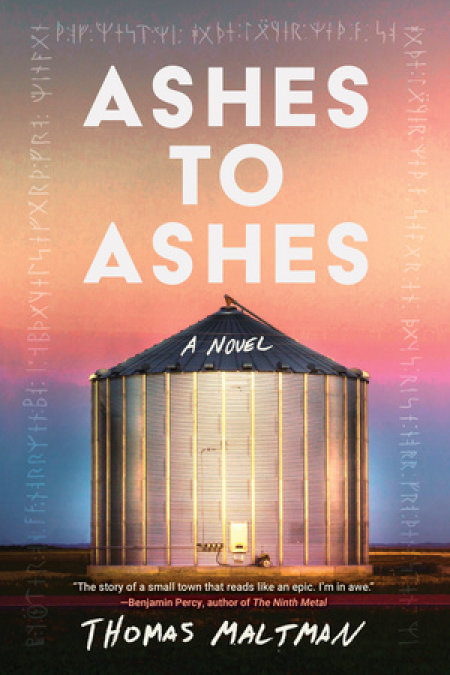
Small-town Minnesota teenager Basil “The Brute” Thorson—a shy, reluctant wrestling star and “special” tracked into special education classes—vows to make his family whole again in the wake of multiple tragedies, during a year in which his community is roiled by strange religious and mythological events.
Another perceptive and empathetic novel from the author of Indie Next and All Iowa Reads selection Little Wolves, blending myth, history, and religion with a nuanced look at contemporary rural life, perfect for fans of Marilynne Robinson, Richard Russo, and Paul Harding.
When the ashes from an Ash Wednesday service in the prairie town of Andwhen, Minnesota, refuse to wash off, members of a small congregation are left wondering whether they’ve been blessed or cursed. For Basil—a “gentle giant” of a teen reeling from a farming accident that shattered his family and haunted by his mother’s decade-long confinement in a state mental hospital—the ashes become a sign. He embarks on a secret ritual of fasting and prayer, seeking meaning in his unraveling world.
Meanwhile, Basil and his friends, Lukas and Morgan (who self-identify as “a gay, a goth, and a giant”), stumble upon what may be the centuries-old remains of a Viking explorer in a local meadow, a find that brings its own complications, as folk history clashes with the agendas of online racists. As Basil’s relentless fasting warps his grip on reality, the danger he poses to himself and his family escalates.
Blending the fragments of a Norse saga with a finely observed portrait of rural Midwestern life at the start of the pandemic, Thomas Maltman delivers a novel of narrative daring and profound empathy—his most inventive and compassionate work yet.
Release date:
July 15, 2025
Publisher:
Soho Press
Print pages:
336
* BingeBooks earns revenue from qualifying purchases as an Amazon Associate as well as from other retail partners.
The town of Andwhen sits on windswept prairies west of Alexandria. Away from town proper, gullies lead to hidden ravines carved by springs that bubble up from below. Here and there fists of limestone spike through the topsoil, and hummocks round as burial mounds nurture a remnant of ancient prairie no plow has ever touched. When the wind sways the tall grass you can almost hear the ghosts of bison herds on the move, and further back in time, the lumbering of mastodon.
They say that Andwhen is a place where nothing ever happens, but something always seems on the verge of happening. It’s happening now, in a church of all places, in the deepest part of winter, the dust of the dead reaching out through time to touch the living.
As night falls, Emmanuel Lutheran blazes like a beacon on the prairie. Within, the congregation rises to sing “The Old Rugged Cross” while moonlight rinses through the stained glass to paint the sanctuary in somber colors. After a reading from Psalm 51, they listen as Pastor Breen tells them about David’s great sin, his lust for Bathsheba, which drove him to murder Uriah. For his sins, David is called to repent by the prophet Nathan. Pastor Breen tells them that the same voice calls them here and now. This is their hour of atonement.
And when the congregation rises from their pews and shuffles toward the altar to take communion—the wafer like the thinnest slice of moonlight, the sweet wine that lingers at the back of the throat—it feels like Pastor Breen holds fire in his hands as he marks the cross on them with ashes. Later they will speak of it, the jolt as from static electricity, how they felt a faint burning impression when the mark seared into their skin. “From dust thou art,” the pastor says, “to dust thou shalt return.”
Outside, the wind presses against the stained glass and the figures in the windows shimmer and shift, alive in the half-light. The congregation sits once more, studying the marks on each other’s foreheads, Cyrillic cyphers as individual as their own thumbprints. Snow spindrifts in the night beyond as soft blue shadows stretch in the sanctuary. Where have the wind and snow come from? The night was clear on the way here, the fields barren. It’s as if the snow comes from the moon itself, these feathery flakes like goose down shaken from a pillow. The school nurse works the great pipe organ, a lovely lost hymn that no one in the congregation knows. It’s not found in the Lutheran green book of worship, and she won’t be able to explain it later, except to say she felt guided by the Spirit. They imagine rising to the very rafters of the church, the roof lifting as easy as a man taking off his cap, borne aloft.
The youngest among them discover it first. Soon after the service ends, the pastor’s daughter, Morgan Breen, emerges from the women’s restroom and is joined by two teenage boys in the narthex. The cross on her forehead remains fresh and bright as a brand. “Is it there?” she says to the boys, “or am I still stoned? It won’t wash off.”
“No, it’s there,” one of the boys tells her.
She scratches it like an itch. She sounds both miffed and mystified when she says, “What did we do? What have we done?”
*
The congregation files from church and steps out into a changed world, downy flakes muffling any sound, as if they are inside a snow globe shaken and held in the hand of a benevolent deity, one who stilled the north wind and sends them on their way. A caravan of cars, a slow pilgrimage toward home.
Hear the hush inside those cars. Lent is always a time of penance, of sheltering, but it becomes even more so now as within the vehicles they catch their spectral reflections in the windows, touching the cross and wondering how the ashes do not come away on their fingertips.
Maybe you have felt this, too, in the dark of February, no matter what you believe? How winter slows life, the way sap inside the barren trees congeals, blood thickening in the cold dreaming.
Even at home they must reckon with the face of a stranger in the mirror, one who bears an ashen cross. Few sleep, though the hour is late. They stare, baffled by a mark that won’t wash off, not for any who attended services that night. How they scrub with white vinegar, with mechanic’s soap designed to remove tough stains, or even with borax, but the mark endures. For all the darkest part comes off, but the gray ghost of the cross remains, and no one can explain it.
Some make vows. Like the Thorson boy, who walks out behind the farmhouse while the rest of his family sleeps. His family has never practiced Lenten sacrifices, but he feels called to make one now. At six foot four and weighing over two hundred pounds, he is more locomotive than boy his father likes to say. His body is a furnace and this furnace requires constant feeding. No more. He will give up what he loves more than anything. He will fast between sunup and sundown. No more breakfast with three eggs and diced ham and cheddar. No double-decker sandwiches of venison sausage for lunch. He will not eat by day. At night he will allow himself one meal with family. He won’t tell anyone, and like Sampson he will draw strength from his secret vow. In the hollow that grows inside him God will come, the way a seed grows down in the dark.
He won’t feel so alone. If you have the faith of a mustard seed, Pastor Breen has told him, you can move mountains. There are no mountains on the prairie. All Basil Thorson wants is for God to heal his wounded father’s body, and for God to bring home his mother, a woman wounded in her mind. He wants his family to be whole again, and to make it so he will give up the thing he loves the most for the next forty days, supping only after sundown.
The moon rides high over the ash grove, silvering a thin scrim of snow on the ground. A journey, the boy thinks. His family has never been anywhere, not even across the border to South Dakota, but he feels certain he is taking the first step tonight, like Peter called by Christ to leave the safety of his boat and walk out on a stormy sea. Ashes to ashes. That this cross will not wash away must surely be a sign. He has been called to return to God. The same God will return his father and mother to him, and they will be whole once more in body and mind.
Finally, chilled and certain, he turns inside to salvage what sleep remains in the small hours before he must rise for chores at dawn.
Chapter Two
In the bruising cold just before first light, Angus cattle shuffle closer to Basil Thorson, who is busy cracking the ice of their watering basin with a rusted hammer. The cattle brood, quiet in their thirst, their glistening black fur and eyes blending with the darkness. Their soft breathing makes its own weather, a warm fog in the barn. Basil moves through this mist, a broad-shouldered Bunyan of a boy, wielding his hammer evenly as he breaks the ice so water will flow again into the channel. When he is done, he steps away, allowing them to drink, and then he hangs the hammer from a nail near the barn door so he will be able to find it again in the murky dark. While a few cows tongue cold water from the basin, Basil slings out thirty-pound bales of hay into the circular cattle feeders on opposite ends of the barn, unlacing the twine as he does so. The cattle at the rear press forward, their lowing breaking the silence.
When there is enough for all thirty-three head to be fed and watered, Basil climbs a ladder into the barn’s loft. Here is where he keeps the kittens in a rubber tub turned upside down and packed with dry straw to keep them warm. The boy plucks all three from their nest and sits with his back against a post that bears awl marks from a previous century. The kittens stretch in his lap, their purring an engine of happiness. From a pocket of his coveralls, Basil removes a baggie of dried cat food—which he heated earlier in a pan along with diced sardines in oil—and shakes the mix into a Tupperware container on the floor. Basil has not named the kittens yet. Born too late in the season, they should have died when their mother was sucked into the dryer of the corn bin and beheaded by fan blades. An ill omen, his father said at the time. One they had not heeded. The kittens will remain nameless, captive in their tub, until the boy is sure they will survive into spring.
Basil sits with the feeding kittens, breathing in the cold pouring through a broken slat. In late February such cold feels wrong when there is only a thin layer of snow on the ground. Out in the grove, ash trees groan and pop in a frigid, below-zero wind.
Through the gap, he spots the morning star, Venus, a queen trailed by her loyal hound, the Dog Star, Sirius. The words on Basil’s lips are strange, but looking at the chill light leaking through the opening he can’t keep them bottled up any longer. “‘O look at all the fire-folk sitting in the air! The bright boroughs, the circle-citadels there!’” He hardly knows what any of it means, but the words have been stuck inside him this last week, having found purchase in the furrows and folds of his brain. “‘Down in dim woods the diamond delves! the elves’-eyes! The grey lawns cold where gold, where quickgold lies!’”
How he’d listened to it over and over in the A/V section of the town library, his lips moving, his eyes shut, because looking at the words on the page sometimes still makes him feel dizzy and sick. The poem crackled in the headphones as the record turned, grainy words from some gray old man, long dead. It didn’t mean anything. It meant everything.
Since he was born on February 29, Basil’s leap birthday happens today, which makes him either sixteen years old or only four. He thinks he would rather be four, his whole life spread before him, his mother still here at home. Before last year, Basil could only read at the fourth-grade level. If you believe his MCA state exams and his peers, he’s the dumbest kid in the whole school, but for the first time in his stupid, brutish life there is music inside him. Music he can hold and remember, the words alive on his tongue.
Once the kittens are finished, he tucks them into their tub and clambers down the ladder. He passes through the fog of the feeding cattle, feels this moisture harden into a rime of ice on his quilted coveralls when he steps from the barn into the frosty morning air.
Under the light of a halogen yard lamp, he walks to the henhouse to scatter seed for the guineas and check for eggs. Basil decides the hens can use some poetry as well, to brace themselves for the day. “‘Wind-beat whitebeam! airy abeles set on a flare! Flake-doves sent floating forth at a farmyard scare!’” The guineas are unimpressed with his delight in nonsense. Basil thinks the poem has the sound of a secret, a tale of elves and hidden treasure. He thinks it has the sound of a warning. Whoever finds the gold should leave it there. Something is quickening within him he doesn’t understand yet. He is not used to having so many words to hold in his mind.
His morning chores done, Basil climbs the creaking steps of the back porch and shucks off his barn boots and coveralls in the basement mudroom, setting the three small guinea eggs he found in the henhouse in a bowl for his father to rinse later.
He left a light on in the kitchen, which calls him up the stairs. His little brother, Davy, sleeps shut away in his room, while his father wheezes nearby in a recliner set before a television that bathes the room in flickering blue shadows. The news mumbles about chaos from some distant place, a virus spreading in China. His father’s breathing is so labored it sounds like a creature crouches on his chest. Nightmare. Mare night. Inside Basil, the flipped compound conjures an image of a soot-black horse with eyes of char, hovering over his father. He imagines banishing it. What an uncanny alchemy he has discovered. Letters become words and the words make pictures and stories, and you can live inside those stories. Learn the names of things and you have power over them. Basil stands in the blue light and wills his father’s breathing to steady and grow strong again.
In the bathroom down the hall, he strips and showers off the smell of the barn. After toweling himself dry, he wipes fog from the mirror and studies his reflection. It’s still there. A bent cross in the shape of a Z. He didn’t just dream it the night before. His leap birthday together with a cross that will not wash away must mean the universe is aligning for something extraordinary. He tugs on boxers, jeans, a Twins T-shirt, and a long-sleeved blue-checked flannel. He runs a hand through his coarse brown hair and pulls on a DeKalb seed cap.
Back in the kitchen, Basil pauses before the iron skillet. If this were any other day he would be firing the gas stove, dropping a dollop of butter into the skillet, and cracking in three or four eggs to whip together with a fistful of diced ham and cheddar. His mouth fills with saliva as he imagines it, but he has a vow to keep. He packs a lunch for his brother, deer sausage on spongy white bread, a baggie of potato chips with a single dill pickle crowning the works, all folded into a brown bag he leaves on the kitchen table for Davy.
Basil doesn’t have to wait long before the headlights of Lukas’s truck appear, a pale contrail of icy dust following him up the curving driveway. By the time he’s pulling into the circular turnoff, Basil is out on the gravel path. The door of the green Silverado, pitted with rust, creaks as he yanks it open and climbs inside, Morgan scootching over between the boys to make room for him. None of them bother with seatbelts or exchange greetings, Lukas accelerating as soon as Basil snaps the door shut.
We hope you are enjoying the book so far. To continue reading...

 Please log in to recommend or discuss...
