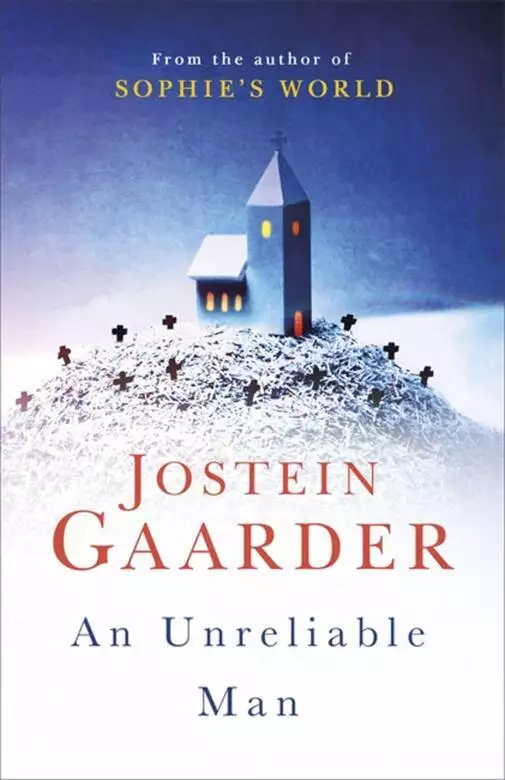
From the creative genius of Jostein Gaarder comes a beautiful novel about loneliness and the power of words.
Jakop is a lonely man.
Divorced from his wife, with no friends apart from his constant companion Pelle, he spends his life attending the funerals of people he doesn't know, obscuring his identity in a web of improbable lies.
As his addiction to storytelling spirals out of control, he is forced to reconcile his love of language and stories with the ever more urgent need for human connection.
An Unreliable Man is a moving and thought-provoking novel about loneliness and truth, about seeking a place in the world and about how language and storytelling give our lives meaning.
Decades after his global bestseller Sophie's World, Jostein Gaarder has written a poignant and funny audiobook for our times — full of life and hope.
Release date:
June 4, 2019
Publisher:
Weidenfeld & Nicolson
Print pages:
336
* BingeBooks earns revenue from qualifying purchases as an Amazon Associate as well as from other retail partners.
Dear Agnes. I was going to write to you. Remember? Or at least, I was going to try.
I’m sitting on an island in the Baltic Sea with a laptop in front of me. To the right of the laptop I’ve placed a large cigar box. It contains everything I need in the way of memory aids.
The hotel room is large enough for me to get up and take nine steps to and fro on the pinewood floor as I consider how to begin my tale. All I have to do is make my way past a three-piece suite, and I alternate between passing the slim teak table and pair of red armchairs, and moving down a similarly narrow corridor between the table and a red sofa.
I’ve been given a corner room, and have a view in two directions. From one window, to the north, I look down on a cobbled street in the old Hanseatic town, and from the other, to the west, I gaze out over Almedalen and far out across the sea. It’s warm, and both windows are open wide.
I’ve been standing here half an hour, looking down at the people passing on the street below me, most of them in dresses or shorts and loose, short-sleeved tops. Whitsun tourists. Many are walking along in pairs, often hand in hand, but others pour forth in great rowdy groups.
I can put to bed the myth that young people make more noise than people of my own age. As soon as they form crowds, especially if they’ve been enjoying a drink, middle-aged people can be just as boisterous as teenagers. Or just as human: Look at me! Come on, listen to me! Aren’t we having a wild time together?
We don’t grow out of our human nature. We grow with it. And we let it grow on us.
I like the perspective I have on the street life below me; at such a short distance I get quite close to the passers-by. Some scents find their way up to me too, because people do give off aromas, particularly in narrow alleyways on windless summer days. There is someone walking along with a lit cigarette in their hand, and I can feel the smoke irritating my nose. But at the same time, I am just high enough over the cobblestones that the objects of my scrutiny do not, as a rule, look up and catch sight of me. I am half hidden behind a blue curtain, which occasionally blows out through the window when a sudden gust of wind takes hold of it.
From one and a half floors above the hill I can enjoy my privilege: observing without being observed.
And I’ve been keeping an eye out for sailing boats far out on the water’s glittering surface; it’s the mild breeze through that window that on occasion makes the curtains of the street-facing window move.
In the course of the last half hour I’ve counted three white sails. It has been a beautiful day, almost completely calm. The sailing conditions have not been the best.
Today is not just Whitsun. It’s also 17 May, Norway’s very own national day. It makes me a little melancholic to think of it, almost like having one’s birthday in perfect secrecy among strangers: no one makes you feel special, and no one sings you ‘Happy Birthday’.
Here, no one has sung the national anthem either. I haven’t seen so much as a Norwegian flag, but I have noticed that there is a crocheted blanket on the hotel bed, and it’s as white as the snow on Mount Glittertind.
I mean: a red room, white bedclothes and bright blue curtains. That will do as a token of the Norwegian colours.
While noting down the date I realised that, at the time of writing, a month has passed since we saw one another in Arendal.
And a few hours after that you met Pelle. And you really hit it off, I must say.
We’d only met one another once, just over a year previously, a few days before Christmas 2011, and it’s the background to that first meeting I want to try and sketch. You’ve asked me to explain why I behaved the way I did. I shall attempt, to the best of my ability, to respond to that request. And I think too that now is an appropriate time to send you a question in return:
I had made a fool of myself at our first meeting, but you still kept me from giving up and leaving. It’s a little mystery I’m still pondering. I wasn’t the only one surprised by your response. I think everyone sitting round the table would have been in agreement. And many of them probably thought as I did: Why did you hold me back? Why didn’t you just let me head for the door?
Where should I begin?
I could take a chronological approach and describe my upbringing in Hallingdal. Or I could do the exact opposite: I could open with a few notable events that have taken place here on the island as recently as this afternoon – since those too must take their place in my tale – linking these back to our encounter in Arendal a month ago, then following the threads first to that upsetting dinner a year ago – one of the worst days of your life, Agnes – and then all the way back to Erik Lundin’s funeral in the early 2000s. That kind of retrospective orientation could finally pan out into a depiction of some of my childhood experiences, which might allow for a little understanding, not to mention forgiveness, once my confession is concluded.
What is the easiest way to make sense of our lives? Is it when we sum up from the beginning, or is it when we start from the present day, which of course is freshest in our minds, and from that point reminisce our way back to where it all began? The flaw in this second method is that there is no absolute causality in people’s lives.
It’s not possible to prove why one has become the way one has. Many have tried to do just that, but they haven’t got much further than underlining their humanity.
I’ve been over by the window again. The three sailing boats haven’t moved an inch in the still air. I know it’s a bizarre idea, but they make me think of the three of us: of you and me – and Pelle, he has to be included too.
It’s embarrassing, but an old Sunday-school song starts to hum itself in the very back of my head: My boat is so little, the sea is so wide …
And I come to a decision: I will open my narrative in the middle of the voyage. I will begin at the point I met your cousin at Erik Lundin’s funeral. From that point I will follow threads that lead directly to our first encounter almost ten years later. The burden I bear from Hallingdal – that will take second place.
My beloved Erik, our dear father and stepfather, our much-loved grandfather and great-grandfatherErik LundinBorn 14 March 1913Fell asleep for the last time todayOslo 28 August 2001
IngeborgJon-Petter LiseMarianne SverreLiv-Berit TrulsSigrid, Ylva, Fredrik, Tuva, Joakim and Mia Great-grandchildren and other family
The funeral will take place at West Aker Church Wednesday 5 September, 14:00
All those paying their last respects are welcome to join the memorial service at the church hall.
There were many of us paying our last respects to Erik Lundin that afternoon in early September 2001. Among us was your cousin Truls, and that’s why I have decided to begin my tale here. Ten years later I would meet him again, together with Liv-Berit and their two daughters. It was then I met you for the first time.
West Aker Church was packed to the rafters, and we walked in small clusters following the coffin down to the place where he was to be buried. The sun played in the leaves of the trees, but it shone in our eyes too, and for some it was a welcome excuse to take out sunglasses. In my head, the choir’s song was still ringing; majestic trumpet solos and exhilarating organ chords.
After the scattering of the earth, we trudged back up to the church and the church hall. It was mild for the time of year, perhaps twenty degrees. But the sun went behind a cloud, and we felt the odd gust of cool air come up from the fjord and the lowlands.
At such a well-attended funeral, wandering alone under the trees without approaching any of the bereaved goes quite unnoticed. The inner circle are taken up with one another and their nearest and dearest. Why would anyone notice the odd figure with no connection to the rest of the mourners?
I had, however, encountered some of those in the funeral procession before, and I nodded to one of them – a former student – now; we’d never had a good relationship, so I didn’t need to concern myself with him. I had also noticed the tall, dark man who I’d met on a handful of occasions, but he didn’t count. He was an extra, and I didn’t need to pay any attention to him. It occurred to me that I’d once dreamt of him. He’d been swinging a scythe around.
There was a good deal of waving and hugging, as well as more introductions and greetings, in the spacious forecourt in front of the church. Some of the oldest guests were led over to cars parked on the tarmac, which now moved, one by one, slowly down a slope that was already thronged with people in black finery.
I myself was set on staying and taking part in the memorial service. I was well aware that this social challenge might turn out to test my mettle, but pulling out didn’t strike me as an option.
In the church, I’d sat almost right at the front, near the aisle, on the right-hand side of course. Because of this, I had a good view of the priest, who began the ceremony by coming down and greeting the Lundin family, all four generations: first the widow, Ingeborg Lundin, then the three children in their forties and fifties, all accompanied by their spouses. The grandchildren and great-grandchildren also sat there.
I tried to guess which of the daughters was Marianne and which was Liv-Berit. I knew only that Marianne was the eldest, but quickly realised there was a significant age gap between the two sisters, so it was easy to figure out. Liv-Berit could have been in her early forties, while her sister, Marianne, was perhaps about my own age, around fifty. Jon-Petter, the oldest, was sitting very close to Lise, and it wasn’t hard to guess that she must be the daughter-in-law, since Jon-Petter, Marianne and Liv-Berit were all blonde, and quite astonishingly alike, but Lise’s hair was decidedly dark. I made the connection between Marianne and Sverre, who had been sitting hand in hand until the priest greeted them. A little later, I noticed that a man who must have been Truls passed Liv-Berit a hanky.
Then came the young people. It took me longer to identify them, but before we’d left the church, I had a certain degree of oversight here too. I’d found pictures of Ylva and Joakim online. If it had been now, I’m sure I would have found pictures of the whole clan on Facebook and Instagram. But the notice in the paper had at least given me useful pointers as to their order by age. So it was no insurmountable task to place Sigrid, Fredrik, Tuva and Mia as well. That must be Sigrid, the oldest grandchild, perhaps in her late twenties, with a three- or four-year-old boy in her arms – they were sitting with a man who must be the lad’s father. And the girl of about fifteen must be Mia, as the next-youngest was Joakim. Tuva, apparently a couple of years older than Joakim, was a young lady whom there was little chance of mistaking for a teenager.
That was as far as the priest’s hand-shaking went. But who of the young people was a sibling, and who was a cousin? The death notice hadn’t been much help on that front, so I let that puzzle lie for the time being. Neither did I concern myself with speculating over the parents of each of the grandchildren. Much would presumably become clear during the memorial service.
On the death notice, which I had in my inside pocket, the list of children and grandchildren was rounded off with ‘great-grandchildren and other family’. So I had no way of knowing how many of the young people had their own children, and therefore how many great-grandchildren the old professor had stayed around long enough to see. Because of a quirk of the Norwegian language, it could be just one, or it could be several. In many languages, it would have been abundantly clear, but in Norwegian, when we use the indefinite form, it’s very rare that we differentiate between neutral singular and neutral plural when the word has only one syllable, such as in the words ‘hus’ (house) and ‘barn’ (child). Moreover, I had no way of knowing which of the siblings, brothers-and sisters-in-law or nephews and nieces, both on the Norwegian and Swedish side, were in the church, since they were all covered by the grouping ‘other family’. Still, it struck me just how much one can glean from a death notice, and the priest’s eulogy gave me an opportunity to fill in more of the gaps. As I had guessed, it was Sigrid who was accompanied by a son of almost four. He was called Morten. But Sigrid and Thomas also had a one-year-old daughter, Miriam, who was the very youngest of the clan.
The priest painted a beautiful picture of the Swedish scholar who came to Oslo in the autumn of 1946 to complete his doctoral studies in Old Norse mythology and the Eddic poems in the context of Magnus Olsen’s half-century of studies. When he was a PhD candidate he met Ingeborg and started a family. He later became a university lecturer and reader, and for many years was a professor of Old Norse philology. It was this side of Erik’s life I represented. If questioned, I would inform the family that I had sat in his lecture theatre, but that we’d maintained informal contact over many years and, in time, became what I would call close friends.
As we filed into the church hall, the tall, dark-haired man cast an inadvertent look at me, but I immediately saw a different route and took a step to the side.
Most people were already seated around tables when I came up from the cloakroom, and in the background someone was rushing around, trying to find seats for the last arrivals. I remember I ended up standing slightly helplessly in the middle of the room, and now it was Tuva who got up and on behalf of the family came towards me and asked whether I had anywhere to sit. I can’t remember how I replied, or whether I got moved around, but in the end I was shown to an empty chair at the same table as the young people. There sat Tuva and Mia, occupying the head and foot of the table. Ylva was sitting diagonally opposite me, flanked by Fredrik and Joakim, who turned out to be her cousins, both a few years younger than her. Fredrik was the older of them, and I soon picked up the fact that he was studying law and that Joakim had started his third year at Fagerborg High School. I got the impression they were Sigrid’s brothers, the sons of Jon-Petter and Lise. To my right sat Liv-Berit and your cousin Truls. I soon realised that they were the parents of Tuva and Mia, and you, of course, have known them since they were little. I noted at once that your cousin had an old scar right across the right side of his forehead. It was so striking that I soon fell to wondering what might have happened to him. That story is one that you would tell me more than ten years later.
Let me now interject that I understand you’ve just been introduced to a lot of people – undoubtedly too many to keep track of at once. But you may be relieved to hear you’ll meet every one of them again. Because after Erik Lundin’s funeral, in the years that followed, I met all the old professor’s children, children-in-law and grandchildren in new settings, not as many at once as at this memorial service, but in smaller portions. For that reason, you can view this first chapter of my tale as an introduction to the Lundin family. How or why I met each of them again, I’ll let lie for the time being. I don’t need to explain everything at once. Indeed, that would be impossible.
Nor is this cast of characters so immeasurably extensive. And who knows: perhaps, through Truls, you know these names from before? But just to summarise briefly: Erik Lundin had three children, Jon-Petter in his mid-fifties; Marianne, who was a couple of years younger; and Liv-Berit, who was in her forties. Jon-Petter and Lise had a daughter, Sigrid, and two sons, Fredrik and Joakim, and it’s Sigrid in particular I will come to mention a few more times. Marianne and Sverre only had one daughter, Ylva, she was perhaps in her mid-twenties, and all these last three will, in time, come to play a central role in my story. There’s nothing more to say, because Liv-Berit’s husband is your cousin and, as you confided in me many years after this, you have been close ever since you were little. His wife has, in recent years, been like a friend to you, and you’ve known the two daughters, Tuva and Mia, since they came into the world. At their grandfather’s funeral that September day, Tuva was around twenty and Mia maybe fifteen, but you’ll know that better than me.
I looked out across the gathering and estimated that there must be over a hundred people. I had never thought, and neither of course had it been my intention, that I would be sitting so close to the bereaved. I had seen for myself a more withdrawn role, at a table further down the room together with a few other lone grievers – colleagues and acquaintances of Erik Lundin – and perhaps a niece or nephew with or without spouse. I disliked the situation I found myself in. I was cold, and my stomach felt unsettled.
Even though all those around the table were dressed in black, there was little about the Lundin family that was reminiscent of the Pietists of Victorian times. The smart, close-fitting dresses and chic suits cut in the best fabric were just the start. The young ladies had certainly not skimped on mascara, lipstick or nail polish that afternoon; in their ears and round their wrists, gold and precious stones glinted, and Ylva – I remember I noted it the very first time we met – had a sapphire-blue pendant at her throat. It looked almost like a third eye, for the jewel had exactly the same colour, and almost the same form, as her other two eyes. Another thing contributing to my bewilderment was the many scents around the table – a motley blend of different perfumes, eau de cologne and aftershave. I am perhaps particularly aware of such sensory impressions as I live alone. In the bathroom and the kitchen at home on Gaupefaret there are no smells other than my own.
At the next table, the rest of the immediate family had sat down. Sigrid, Thomas and little Morten were seated together with the young mother’s parents, Jon-Petter and Lise, and for a long time it was Grandpa who held the child. At one end of the table sat Ingeborg, a beautiful old lady with silver-grey hair. Then came Marianne and Sverre, who were the parents of Ylva, the family’s only child.
I felt a sting of déjà vu when I caught sight of Marianne and Sverre, this time at close quarters. Had I met them before? If so, it must have been a long time ago. I noticed that Sverre had a little red stone in his left earlobe – and there was something about that red stone that triggered my memory; I’d seen it before, and when I cast a glance over the table at Ylva, it was as though I inched closer to a memory of her mother in her younger years. I made note, meanwhile, of the fact th. . .
We hope you are enjoying the book so far. To continue reading...

 Please log in to recommend or discuss...
