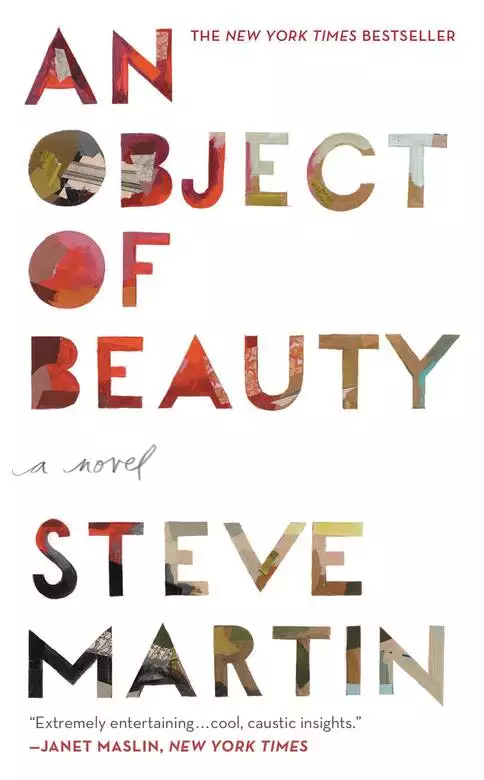
Lacey Yeager is young, captivating, and ambitious enough to take the NYC art world by storm. Groomed at Sotheby’s and hungry to keep climbing the social and career ladders put before her, Lacey charms men and women, old and young, rich and even richer with her magnetic charisma and liveliness. Her ascension to the highest tiers of the city parallel the soaring heights—and, at times, the dark lows—of the art world and the country from the late 1990s through today.
Release date:
November 23, 2010
Publisher:
Grand Central Publishing
Print pages:
297
* BingeBooks earns revenue from qualifying purchases as an Amazon Associate as well as from other retail partners.
“The expertise of Martin, himself a long-time collector, is dazzlingly in evidence here… As fiction, though, it is thoroughly delightful.”
—New York Times Book Review
“A sharp, entertaining morality tale… beautifully modulated… With this tart, amusing chronicle of wiles and willpower, Martin demonstrates an understanding about users and losers that approaches the profound.”
—People
“What was delightful about Steve Martin’s novella, Shopgirl, was its time-out-of-time quality, which rendered it both quaint and universal. AN OBJECT OF BEAUTY has a similar appeal… Martin’s perceptions are so dead-on, we can’t stop thinking about [Lacey Yeager].”
—O, The Oprah Magazine
“Martin offers keen, insider tidbits about dealers, collectors, and gallery slaves that are vicious, perceptive, and fun… with a sparkling wit.”
—Cleveland Plain Dealer
“An old-fashioned morality tale… It takes a certain nimbleness to play the dual roles of proxy art-history professor and compelling storyteller without falling off the literary balance beam. Martin, wry, wise, and keenly observant, rarely misses a step.”
—Entertainment Weekly
“A page-turner to keep bedside.”
—Marie Claire
“At first you think that AN OBJECT OF BEAUTY will be a romantic comedy, starring a strong-willed, very smart, and very ruthless heroine-adventuress in the New York art world; then, as its irresistibly rendered scenes unfold, you realize that you are experiencing, from the most intimate of perspectives, the quasi-tragic history of an era. Like Steve Martin’s heartrending Shopgirl, this very different novel will captivate your attention from start to finish.”
—Joyce Carol Oates
“A deep novel.”
—Time Out New York
“Top Pick… Martin’s great American novel… strong storytelling and alluring prose. Martin writes with the confidence and skill of other masters of American letters; the novel could easily hold center stage alongside writers such as Henry James or Edith Wharton.”
—BookPage
“Martin compresses the wild and crazy end of the millennium and finds in this piercing novel a sardonic morality tale.”
—Publishers Weekly
“Impressive.”
—Sunday London Times
“A smart, sexy comedy of manners.”
—St. Petersburg Times
“A rich and illuminating novel.”
—Daily Mail (UK)
“A novel so smart, funny, and insightful that, were it up to me, I’d insist Martin quit showbiz and write full time… Another object of beauty is Martin’s often elegant writing.”
—Minneapolis Star-Tribune
I AM TIRED, so very tired of thinking about Lacey Yeager, yet I worry that unless I write her story down, and see it bound and tidy on my bookshelf, I will be unable to ever write about anything else.
My last name is Franks. Once, in college, Lacey grabbed my wallet and read my driver’s license aloud, discovering that my forenames are Daniel Chester French, after the sculptor who created the Abraham Lincoln memorial. I am from Stockbridge, Massachusetts, where Daniel Chester French lived and worked, and my parents, being parochial Americans, didn’t realize that the name Daniel Chester French Franks read funny. Lacey told me she was related to the arts by blood, too, but declined to tell me the full story, saying, “Too long. Later I’ll tell you, French Fries.” We were twenty.
I left Stockbridge, a town set under the glow of its even more famous citizen, the painter of glad America, Norman Rockwell. It is a town that is comfortable with art, although uncomplicated art, not the kind that is taught in educational institutions after high school. My goal, once I discovered that my artistic aspirations were not accompanied by artistic talent, was to learn to write about art with effortless clarity. This is not as easy as it sounds: whenever I attempted it, I found myself in a convoluted rhetorical tangle from which there was no exit.
After high school, I went south to Davidson College in North Carolina, while Lacey drove north from Atlanta, and there, Lacey and I studied art history and had sex together exactly once.
Even at the age of twenty, Lacey’s entry into the classroom had the pizzazz of a Broadway star. Our eyes followed her down the aisle, where she would settle into her seat with a practiced hair-flip. When she left a room, there was a moment of deflation while we all returned to normal life. It was apparent to everyone that Lacey was headed somewhere, though her path often left blood in the water.
If one of her girlfriends was in a crisis, Lacey would rush in, offering tidal waves of concern. She could soothe or incite in the name of support: “Honey, get over it,” or, conversely, “Honey, get even.” Either bit of advice was inspiring. The emotions of men, however, were of a different order. They were pesky annoyances, small dust devils at her feet. Her knack for causing heartbreak was innate, but her vitality often made people forgive her romantic misdeeds. Now, however, she is nearing forty and not so easily forgiven as when her skin bloomed like roses.
I slept with her in our second year. I was on the rebound and managed to avoid devastation by reconnecting with my girlfriend days—or was it hours—later, and Lacey’s tentacles never had time to attach. But her sense of fun enchanted me, and once I had sufficiently armored myself against her allure by viewing her as a science project, I was able to enjoy the best parts of her without becoming ensnared.
I will tell you her story from my own recollections, from conversations I conducted with those around her, and, alas, from gossip: thank God the page is not a courtroom. If you occasionally wonder how I know about some of the events I describe in this book, I don’t. I have found that—just as in real life—imagination sometimes has to stand in for experience.
LACEY’S LIFE AND MINE have paralleled each other for a long while. When we were twenty-three, our interest in art as a profession landed us both in New York City at a time when the art world was building offshore like a developing hurricane. Our periodic lunches caught me up with her exploits. Sometimes she showed up at a Manhattan café with a new boyfriend who was required to tolerate my unexplained presence, and when she excused herself to the restroom, the boyfriend and I would struggle for conversation while he tried to discover if I was an ex-lover, as he soon would be.
In August 1993, she showed up at one of these lunches in a summer dress so transparent that when she passed between me and a bay window hot with sunlight, the dress seemed to incinerate like flash paper. Her hair was clipped back with a polka-dot plastic barrette, which knocked about five years off her age.
“Ask me where I was,” she said.
“And if I don’t?”
She made a small fist and held it near my face. “Then socko.”
“Okay,” I said. “Where were you?”
“At the Guggenheim. A furniture show.”
The Guggenheim Museum is Frank Lloyd Wright’s questionable masterpiece that corkscrews into Fifth Avenue. Questionable because it forces every viewer to stand at a slant.
“ ‘The Italian Metamorphosis,’ ” I said. “I wrote about it. Too late to get into a magazine. What did you think?”
“I’d rather fuck an Italian than sit on his furniture,” she said.
“You didn’t like it?”
“I guess I was unclear. No.”
“How come?”
“Taste?” she said, then added, “Only one thing could have made it better.”
“What’s that?”
“Roller skates.”
Lacey talked on, oblivious to the salivations that her dress was causing. She had to know of its effect, but it was as though she’d put it on in the morning, calculated what it would do, then forgot about it as it cast its spell. Her eyes and attention never strayed from me, which was part of her style.
Lacey made men feel that she was interested only in that special, unique conflation of DNA that was you, and that at any moment she was, just because you were so fascinating, going to sleep with you. She would even take time to let one of your jokes sweep over her, as though she needed a moment to absorb its brilliance, then laugh with her face falling forward and give you a look of quizzical admiration, as if to say, “You are much more complicated and interesting than I ever supposed.”
“Come with me,” she said after coffee.
“Where to?”
“I’m buying a dress. I’m interviewing at Sotheby’s tomorrow and I have to look like a class act.”
The New York heat baked us till we found the inside of a moderately cooler downtown dress shop that featured recycled class-act clothing. Music blared as Lacey zeroed in on a dark blue tight skirt and matching jacket. She winced at the price, but it did not deter her. She pulled the curtain of the changing room, and I could hear the rustle of clothes. I pictured the skirt being pulled on and zipped up. She emerged wearing the jacket loosely opened, with nothing on underneath—which created a sideways cleavage—and started buttoning it up in front of the mirror, surveying herself. “I’ve got a blouse at home I can wear with this,” she muttered to me. She straightened up and pulled the barrette from her hair, causing the blond mix of yellows and browns to fall to her shoulders, and she instantly matured.
“They’re going to love you,” I said.
“They goddamn better because I’m broke. I’m down to seven thousand.”
“Last week you said you had three thousand.”
“Well, if I’ve got three, I’m fucked. So let’s call it seven.”
Lacey turned from the mirror for the first time and struck a pose in the preowned Donna Karan.
“You look great. A lot of people our age don’t know how to go in and apply for a job,” I said.
Lacey stared at me and said, “I don’t go in and apply for a job. I go in and get a job.”
And so Lacey joined the spice rack of girls at Sotheby’s.
Sotheby’s and Christie’s, the two premier auction houses in New York, drew young, crisp talent from Harvard and its look-alikes. Majors in art history were welcomed over majors in art making, and pretty was preferred in either sex. The houses wanted the staff to look swell as they crisscrossed the busy galleries on exhibition days, holding in their arms files, faxes, and transparencies. Because the pay was low, the young staff was generally financed from home. Parents thought well of it because their children were at respectable firms, working in a glamorous business, with money of all nations charging the atmosphere. The auction houses seemed not as dull as their financial counterparts on Wall Street, where parents of daughters imagined glass ceilings and bottom patting. Sotheby’s was an institution that implied European accents and grand thoughts about art and aesthetics coexisting with old and new money in sharp suits and silk ties. This was a fresh and clean New York, where you dressed nicely every day and worked in a soaring, smoke-free, drugless architectural building filled with busts, bronzes, and billionaires. What the parents forgot about were the weekends and evenings when their children left the Cézannes and Matisses and crept underground, traveling back to shared downtown spaces where they did exactly the same things they would have done if they had joined a rock band.
Lacey’s first assignment was in the bins, cataloging and measuring nineteenth-century pictures in a dim basement that was largely unpopulated. Her Donna Karan was wasted on the shippers and craters, but she kept her wardrobe keen for her occasional pop-ups to the fourth-floor offices. An ivy-embraced college may have been her education in the high ground of art, but Sotheby’s basement was her education in the fundamentals. She hoisted pictures onto a carpet-covered table, stretched her tape measure over their backs, and wrote down everything she could. She flipped them over and noted signatures and monograms, trying to decipher artists’ illegible scrawls, and she scratched around in the cumbersome reference dictionaries, Myers and Benezit, to find listings of obscure artists so she could report a successful attribution to her superiors. During her first year, she saw the fronts and backs of thousands of paintings. She learned to precisely tap a painting with the back of her finger: a hard, stiff canvas indicated the picture had been relined, usually a warning sign about a painting’s poor condition. She was taught to identify varnished prints that were trying to pass themselves off as paintings—a magnifying glass would reveal printer’s dots (to the disappointment of excited sellers who believed they owned an original). She learned to distinguish etchings from lithographs by raking the print in a hard light, looking for telling shadows in the groove of the etched line.
The paintings in the basement were generally dogs; the finer works remained upstairs, hung over a director’s desk or in a private room until their grand display in one of the large galleries. The masterpieces were examined by conservators bearing loupes and black lights, while Lacey toiled downstairs in the antique dust like Sneezy the Dwarf. The subject matter she faced every day was not the apples of Cézanne, but the kitsch of the nineteenth century: monks tippling, waifs selling flowers, cardinals laughing, cows in landscapes, Venetian gondoliers, baby chicks in farmyards, mischievous shoeshine boys, and still lifes painted so badly that objects seemed to levitate over the tabletop on which they were supposed to be gravitationally attached. On her rare visits upstairs, she found serenity in the sight of the occasional Seurat or Monet and, sometimes, Rembrandt. However, through the drudgery downstairs, Lacey was developing an instinct that would burrow inside her and stay forever: a capacity to know a good painting from a bad one.
Her walk-on role at Sotheby’s stood in contrast with her starring role in the East Village bars and cafés. After her practiced and perfected subway ride home, which was timed like a ballet—her foot forward, the subway car doors opening just in time to catch her—she knew the bar lights were coming on, voices were raised, music edging out onto the sidewalks. She felt like the one bright light, the spotlit girl scattering fairy dust, as she walked the few blocks to her walk-up. Once inside, she slumped sideways on her bed, cocked the phone against her head, and sipped Scotch while she phoned Angela or Sharon, or sometimes, me.
“Hey… God, I miss you! Where are you? Meet me at Raku for sushi. Goddamn it! Sorry, I sloshed Scotch on me. Meet me now… No, now.”
Raku was the mystery restaurant of the Lower East Side. Large portions, low prices, and never more than four customers no matter what time of the day it was. Tables waited for Lacey like kennel puppies hoping to be picked. She rolled in at seven p.m. and sat down in solitude.
Lacey was just as happy alone as with company. When she was alone, she was potential; with others she was realized. Alone, she was self-contained, her tightly spinning magnetic energy oscillating around her. When in company, she had invisible tethers to everyone in the room: as they moved away, she pulled them in. She knew who was doing better than she was, what man she would care to seduce just to prove she could. She was a naval commander knowing the location of all her boats.
The East Village mixed the fast life with the slow life, and the two were sometimes indistinguishable. Actors huddled and chatted in crappy bars, while old-timers to whom the neon beer sign was not a kitschy collectible but simply a neon beer sign sat on stools and remained unaware that they would be, this year or next, pushed out of the increasingly younger neighborhood. Sometimes the newer crowd would clumsily light up cigarettes, and Lacey occasionally joined them.
The contemporary art scene was the left bank suburb to Lacey’s right bank, uptown art world. Her connection to it was the numerous young hyphenates that would drift across the barroom floors: artist–house painter, artist–art mover, artist-musician. One of her favorites, Jonah Marsh, had a rarer label, artist-deejay. He could be a good artist but made paintings that no matter how much he changed them or developed them still looked derivative of someone better. However, as a deejay, he was very, very cute. One night at a bar, he was circling around Lacey, trying to appear smart, funny, impetuous, raucous, pathetic, anything to get her in bed, that night, now. Lacey, giving in, said to him, “Look, I just want to get off.” They went to her place and afterward he conveniently said, “I have to get up early,” and left, to Lacey’s relief.
ONE TUESDAY, near starvation caused Lacey to finally splurge in the Sotheby’s lunchroom, a smartly done, packaged-sandwich place with Formica tables and uptown prices. Here, the staff mingled with the department heads and Lacey could easily discern one class from the other based on thread count. The department heads were usually less alluring than the staff, since they were hired on expertise, not glamour, and they were usually less haggard than the tireless employees who were sent running from floor to floor. At one table was Cherry Finch, head of American Paintings, while at another was Heath Acosta, head of European Paintings and natty in a gray suit and tie, sitting with an obvious client. Obvious because of his black hair that hung in short ringlets and was laden with product. His Mediterranean skin and open silk shirt said clearly that he was not an employee. He was mid-thirties, foreign, and handsome enough that Lacey’s inner critic did not object to his playboy rags.
With regularity, the client’s eyes strayed to Lacey. Lacey ate more and more slowly, trying to stop the clock before she had no further excuse to stay. Eventually, when their check was paid, Acosta and the client made a deliberate move to her table.
“Hello, I’ve seen you, but we haven’t met. I’m Heath Acosta, from European Paintings.”
“Well then, you’re like everyone in the company: my superior. I’m Lacey Yeager. I work down in Hades.”
“Ah, the bins.”
“Hence my lack of tan.”
The client lurched in: “Better than leather skin at forty. Hello, I’m Patrice Claire.” His face was a bottle bronze, and his French accent surprised Lacey; she was expecting Middle Eastern. “Do you enjoy European painting?”
“I’m sure I will one day,” Lacey said.
“Maybe you haven’t seen the right ones,” said Patrice. Then to Acosta, “It’s unfair that you separate the Impressionists into their own group. Aren’t they Europeans?”
Acosta replied, “Impressionists aren’t tidy enough for our European collectors.”
“Well then, they wouldn’t like me, either,” said Lacey. Patrice’s face signaled the opposite.
“Have you been to an auction yet?” said Acosta.
“I didn’t know if I was allowed…”
“Come to the European sale next week,” he said. “Ten a.m. Thursday. We can excuse you from Hades that day.”
“Do I need to get there early for a seat?” said Lacey.
“Heavens, no, not for European. The recession has seen to that.”
Acosta turned to go, and Patrice added, “Be sure not to cough, sneeze, or scratch.”
She had no doubt that the visit to the table was at Patrice’s request, to make contact and take a closer look. Lacey gave him a look back that said she was fuckable, but not without a bit of work.
THURSDAY MORNING, Lacey slipped into one of the folding chairs at the European sale. The hall was half-full, and the rumored excitement of a live auction was belied with every tired raise of a paddle, followed by bidders’ early exits. The art market had collapsed a few years ago and was still sputtering. By 1990 the boom had withered, but before that date, carloads of inferior French paintings had been sold to the Japanese and then hurriedly crated and shipped overseas before the buyers realized that perhaps their eye for Impressionism had not been fully developed. Sotheby’s, Christie’s, and dealers along Madison Avenue had found a repository for their second- and third-best pictures, and they all feared the moment when the Japanese would decide to sell the gray Pissarros and the fluffy, puffy Renoirs—proudly hung in Japanese department stores to impress . . .
We hope you are enjoying the book so far. To continue reading...

 Please log in to recommend or discuss...
