'If I could work my will,' said Scrooge indignantly, 'Every idiot who goes about with "Merry Christmas" on his lips, should be boiled with his own pudding, and buried with a stake of holly through his heart.'
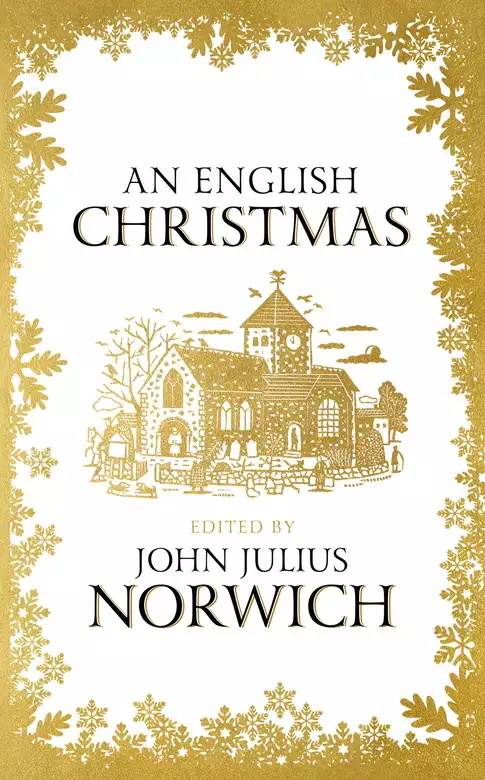
A Christmas anthology from legendary historian and Christmas Cracker compiler, John Julius Norwich.
This year go carol-singing in the Cotswolds with Laurie Lee or attend church with a grumpy Samuel Pepys. Make plum puddings for bemused French villagers with Elizabeth David; go present shopping with Virginia Woolf or eat far too much with Agatha Christie. Celebrate Christmas at Chatsworth, in the workhouse or marooned in the ice with Shackleton ...
For the last forty-five years, the arrival of John Julius Norwich's latest Christmas Cracker has become as essential a part of the Christmas experience as holly and mistletoe. In An English Christmas the legendary popular historian has finally gathered all the best writing about this strangest and most memorable time of year into one book and his brilliant eye for a story is evident on every page.
Vividly evoking all the good things about the festive season, this unexpected anthology is just as entertaining about its darker aspects. Eight-year-old Princess Margaret's thank-you list jostles with moving letters home from the trenches. Sherlock Holmes solves his trickiest case. George Orwell writes about indigestion; Jane Austen about reluctant socialising and Thomas Hardy about the old folk belief that all animals kneel at midnight on 24 December. There are ghost stories, games and bizarre recipes. Diary-entries, recipes and letters sit alongside poems and short stories. An English Christmas could convert any Scrooge into an instant enthusiast.
Release date:
November 16, 2017
Publisher:
John Murray Press
Print pages:
288
* BingeBooks earns revenue from qualifying purchases as an Amazon Associate as well as from other retail partners.
from South: The Story of Shackleton’s Last Expedition,
How to Serve Up a Boar’s Head
Christmas Shopping on Oxford Street
Christmas Plum Pudding
Mole’s Christmas
The Christmas Decorations
A Song Against Bores
A Fenland Carol
The Anticipation of Christmas
A Child’s Christmas in Wales
A Christmas Carpet Trip
At Windsor Castle
Christmas Eve
A Further Thought
Country-house Christmas
Christmas Eve Ceremony
To Make Sack Posset
The Christmas Tree at Windsor Castle
The Christmas Mummers’ Play
Bertie’s Christmas Eve
The Christmas Tree
Christmas Eve, 1667
Letter home from Italy, 1919
The Curate’s Christmas Eve
Harking Back Long Ago
The Stock Exchange Carol
A Reproof for King Arthur
The Ghost
A Land Girl’s Diary, 1939
Christmas Invitation
Going a Hodening
Humbug
The Carol of the Poor Children
The Father Christmas letter, 1941
The Oxen
Christmas Day
On the Morning of Christ’s Nativity
Hark the Herald Angels Sing
Christmas Day Sermon
Christmas with Lady Bobbin
The Mistletoe Bough
Dolphins in the Thames
The Glastonbury Thorn
Fine Old Christmas
Letter from the Trenches
Christmas Day in the Workhouse
Christmas with the Pooters
A Disappointing Christmas Dinner
The Mahogany Tree
A Visit from Uncle Pumblechook
The Masque of Christmas
Heathcliff’s Christmas
A Christmas Carol
Letter from the Western Front, Christmas Day 1914
The Holly on the Wall
Christmas on the Terra Nova
Christmas at ValleNar Roads
Letter to her brother
A Slice of Plum Pudding
Xmas Day in the Desert
Christmas Dinner at the Cratchits’
Christmas at Chatsworth
King John’s Christmas
Diary, Christmas Day 1955
The Christmas Dinner
The Christmas Pudding is a Mediterranean Food
Under the Mistletoe
Christmas Day, 1843
The Shop of Ghosts
Christmas is a Debauch
Glutton’s Paradise
Boxing Day to Epiphany
An Intense Frost
Sir Gawain and the Green Knight
Thank You Letter
Season’s Greetings
The Fool Plough
The Adventure of the Blue Carbuncle
Like a Christmas Comedy
These Strained Rejoicings
A Christmas Present
I Sat Next to the Duchess
Princess Margaret’s Christmas Present List
1914: A Point of View
Letter home from Ceylon
Boxing Day Hangover
On A Christmas Carol
In Memoriam
Melancholy Christmas
A Christmas Masque
Journey of the Magi
The Rightwise King of All England
Sermon on the Journey of the Magi, 1622
We Three Kings
The Twelve Days of Christmas: A Correspondence
Credits
Introduction
Christmas – or something very like it – was thousands of years old by the time Jesus Christ was born, and no wonder: humanity has always celebrated a midwinter festival. On or around the shortest day of the year we all need cheering up; and fortunately, in earliest times, this was about the only time of year that we might expect a fairly plentiful supply of fresh meat, as the farmers slaughtered the livestock that they would be unable to feed in the hungry months to come. And there was another reason too, in which many found consolation: that most of the wine and beer made during the year would now be nicely fermented and ready for drinking, so that we could make a really good feast of it.
Yuletide, Saturnalia, Hogmanay – almost every religion, every civilisation of the cold North has taken the idea to their hearts; but the Christians have made a far better job of it than anyone else. They were not content with settling for Christmas as just a winter tradition; instead, they welded it into the very fabric of their religion, making it Christ’s birthday. No one of course has the foggiest idea when he was actually born; but who cares? Like the Queen, he has an official birthday which suits us, and that’s what counts.
I have celebrated a good many Christmasses of my own – that of 2017 will be my eighty-eighth – and I have always been fascinated, occasionally enchanted and sometimes faintly appalled by the wildly extravagant trappings that have grown up around this former pagan barbecue. Already in 1377, guests at the first Christmas feast given by King Richard II were consuming a total of twenty-eight oxen and three hundred sheep; it must have been quite a party. But, inevitably, there have been other rulers who preferred something simpler; Oliver Cromwell, indeed, went rather too far in his Puritan way and banned Christmas altogether; but this was not a success, and there were protests all over the country. In some towns, it was said, there was more holly and mistletoe to be seen than before the Commonwealth began, and the formerly innocent carols – now transformed into songs of protest – were bellowed out with such raucous enthusiasm that on Christmas Day 1656 members of parliament complained that they had been kept awake all night by the noise. One suspects, even then, that the celebrations four years later, after the return of Charles II, may have been noisier still.
The festival that they knew, however, would have been very different from what it is today, for Christmas as we know it is a largely nineteenth-century phenomenon, the joint invention of two very different men: Albert, the Prince Consort, and Charles Dickens. It was Albert who popularised the Christmas tree; the tradition of the Yule log, a huge block of wood which was kept burning throughout the twelve days of Christmas, was already known in England and went back, probably, to Anglo-Saxon times; but the idea of bringing a whole tree into the house, not to burn but to decorate and to make the centre for the exchange of presents, was unknown in England until his day. (The Prince is also often wrongly credited with the invention of the Christmas card; but the first bunch of these was despatched in 1843 by Sir Henry Cole – who went on to be responsible, far more than Albert who again took most of the credit, for the Great Exhibition of 1851.) And then there was Dickens. But for him, our traditional Christmas might have remained a royal idiosyncrasy; it is thanks to him, and above all to A Christmas Carol, that we know how Christmas should be celebrated. It certainly galvanized the Victorians. Upon finishing A Christmas Carol reclusive philosopher Thomas Carlyle ‘was seized with a perfect convulsion of hospitality, and actually insisted on improvising two dinner parties with only a day between’ – cue Jane Carlyle’s very amusing letter about her struggles to prepare the turkey. Like the Carlyles we may ourselves fall somewhat short of the ideal. Or, like my Uncle John, we may go well beyond it. Let me explain why.
Everyone has their own idea of Christmas – based, very largely I suspect, on those that they remember from their childhood. With increasing age the annual celebrations become somehow less important, if only because one has gone through so many of them that they seem to have all telescoped together. To a child, on the other hand – and particularly to a child as ridiculously lucky as I was – Christmas was a wonderful thing indeed, looked forward to at least since the previous midsummer. For the first decade of my life, up to the beginning of the Second World War, it was always spent at Belvoir Castle, the home of Uncle John, Duke of Rutland, my mother’s older brother. Even now, the scale of his hospitality astonishes me. The entire family would be there, including those of his four siblings, together with several more elderly relations – mostly, as I remember, bachelor uncles and maiden aunts. Nearly all, in those days, would bring their valets and ladies’ maids. For lunch and dinner there would thus be twenty or more grown-ups in the dining room, with perhaps a couple of dozen extra in the servants’ hall, over and above the countless staff of the Castle itself. Then there were all the children, with their nannies and governesses, divided between the nursery and the schoolroom – perhaps another twenty altogether. All told, there cannot have been fewer than fifty or sixty extra mouths to feed – most of them for more than a week, since we nearly all stayed over the New Year.
The excitement began on around 20 December, with the arrival from the cellar of several enormous cabin trunks to be packed. Looking back on it, I am staggered by the sheer amount of packing that took place, every item meticulously wrapped in tissue paper. By the time it was finished on the 23rd, it took two men to carry the by now unbelievably heavy luggage down to the waiting taxi, in which my parents, my nanny and I took a taxi to King’s Cross – in those days still grey, cavernous and caked with grime – and boarded the train to Grantham. It would be pitch dark by the time we arrived at the gas-lit station, where two huge Rolls-Royces lurked ready to receive us. On to these, with the help of a regiment of porters – there was no shortage of them in those days, long before wheel-less suitcases had been invented – the trunks would be slowly and painfully loaded, and off we went. To a five- or six-year-old, still unused to being out at night, the twenty-minute journey was wildly exciting, watching the rabbits scuttling away from the headlights and then suddenly catching one’s first sight of that tremendous floodlit castle, standing high and immensely impressive on its hill, visible for miles from any direction. Ten more minutes would bring us to the immense door, from which a short passage led to the entrance hall, known as the Gun Room, its walls bristling with swords, spears and blunderbusses, with, in its centre, the Tree. And what a tree it was – in my memory a good twenty feet high, gloriously decorated, piled with presents and lit with real candles, a hundred or more of them. Liveried footmen, in dark blue tail coats with brass buttons gleaming, stood around holding long poles with wet sponges on the ends, ready to act in an emergency. Then at last to the bedroom that I always shared with Nanny, warmed by a roaring coal fire (no central heating, in that wing at any rate) and on to a quick supper and bed.
The following days were completely traditional: carol singers, Christmas stockings at the foot of the bed, While Shepherds Watched and O Come All Ye Faithful in the Chapel, opening of presents around the tree, Christmas pudding (how many of them must have been consumed?) and mince pies galore. The rest of our days were taken up with visits to the stables, with apples and lumps of sugar to hold out flat-handed to the horses; to the kennels, slightly less popular merely because the hounds couldn’t be fed; to the dairy, with its wonderful milky smell, its butter churns and its huge dishes of cream, where one was given glasses of warm, foaming milk straight from the cow; to the sawmill, where for the first – and very nearly the last – time in my life I planed a piece of wood; and to the forge, where I was allowed to work the bellows. Best of all was the Boxing Day meet of the Belvoir Hunt – all pink coats and excited, yelping dogs and stirrup-cups and ladies sitting bolt upright on side-saddles, with top hats and veils and flowing black skirts descending to the heels of their riding-boots.
Then came New Year’s Eve – still very much a part of the Belvoir Christmas – and the huge treat, from the age of about seven or eight, of being allowed to stay up till midnight to sing Auld Lang Syne and to see the New Year in. The children didn’t actually have dinner with the grown-ups – that would have been purgatory for all involved – but went into the dining room when they had finished but while they were still sipping their port. There would still be an hour and a half or so before midnight, the space being filled by party games. Charades was the favourite, though I personally preferred The Game, which involved trying to express a well-known book title or proverb in dumb show. There was another too, in which two people assumed historical roles and had a short conversation, during which each had to guess the identity of the other. I still remember one session, which lasted only a few seconds. It began with one lady saying ‘I think the smell was the worst thing of all.’ ‘Mrs Noah,’ said the other lady, and she was right.
It suddenly dawns on me that as yet I have said not a single word about Father Christmas. Who, I wonder, invented him? He’s originally St Nicholas, we all know that. We also know that his body was removed from the church of Myra (now Demre in Turkey, where I have seen his empty grave) but by whom? According to one account, the body-snatchers were sailors from Bari, where a large and most magnificent church – even better than the Cathedral – was erected in his honour; but the Venetians also claim responsibility, firmly maintaining that he is buried in the rather more modest church on the Lido that bears his name, to which the Doge and his Signoria took part in a solemn procession every year on his feast day. Oddly enough, both versions may be right: recent scientific investigations suggest that the relics in the two cities may belong to the same body.
But when did St Nicholas become Father Christmas? Probably in the reign of Henry VIII, when he was represented as a fat, jolly, bearded gentleman in scarlet (or sometimes green) robes, trimmed with white fur. As now, he typified the spirit of Christmas good cheer, but there was a lot of work to be done before he assumed the ho-ho-ho shape and figure we know today. All the later accoutrements, the reindeer and the sleigh, the descent down the chimney, the filling of the stockings, all this is nineteenth-century and even early twentieth, with, probably, not a little American influence thrown in.
In a long life – containing plenty of parenthood – I have always managed to avoid dressing up as Father Christmas. My word, how I would have hated it. It was bad enough creeping into my children’s bedrooms in the dark to hang up their stockings, always terrified that they would wake up to see what an imposter their father really was. As a boy, I think I managed to maintain my own unquestioning belief until I was five or six. (Shirley Temple used to claim that she lost hers at about the same age, when she met Santa Claus in a large department store and he asked her for her autograph.) Few children, I fear, could say the same today; a single glance at one of those photographs of a Father Christmas reunion – a hundred or so of them all milling around together – would disenchant them for ever.
Christmasses like those we had at Belvoir don’t come like that any more, and I’m not sure that I could take them if they did. The world has changed – on the whole, I believe, for the better (though I could perhaps suggest one or two minor improvements). Nowadays Christmas is for me a quiet, family affair, staying with my daughter or step-son – not so exciting, perhaps, as in the old days (how could it be? As birthday succeeds birthday one loses, alas, the capacity for excitement) but every bit as enjoyable. There have been the occasional exceptions; some twenty or thirty years ago Mollie and I spent Christmas on the coast of Kenya, sharing our room with a couple of dozen hermit crabs and frequently meeting a herd of baboons when we went down to swim. The heat was intense, the pudding was late arriving, and we had our Christmas Dinner on the 27th. More recently, by way of contrast, I went with my grand-daughter, my son-in-law Antony Beevor and my son Jason to the Antarctic on a Russian ice-breaker. That was unlike any Christmas I have ever known. It was, very largely, a Christmas of silence. In the world in which we normally live, silence simply doesn’t exist. Even when we think we have found it we are, as like as not, subconsciously shutting our ears to the ordinary sounds of nature – the rustle of branches, the trickle of water, the song of a bird. In the Antarctic, even these sounds are exceptions: silence stands no longer as a negative concept but as a present, positive thing, wrapping itself round you like a cloak. Occasionally, however, it would be rudely broken by a party of Finns among our fellow passengers, who daily stripped to the buff and splashed about among the icebergs. The evenings, too, tended to get a trifle noisy – particularly after our Christmas dinner, when we were all asked to song a song. I obliged with one about the Titanic – which, I felt, was only fairly well received.
But there: you won’t find much about baboons or icebergs in the pages that follow. Some of the pieces we have chosen will probably be familiar; but I like to think that a good many of them at least will be new to you. I have spread the net as widely as I could: fact and fiction, verse and prose, from the middle ages to the present day. Letters and diaries, I find, are a particularly fruitful source of treasure, diaries in particular (Among these, I would particularly like to draw your attention to the entries by that unlikely pair, the Reverend Francis Kilvert and Sir Cecil Beaton. The two have little enough in common apart from their nationality, but that is enough.)
Which reminds me: perhaps I should say a word about the title of this book, An English Christmas; admittedly, not every item is set in England; but whether we are reading about Sir Ernest Shackleton trapped in the polar ice or about Elizabeth David struggling with her Christmas pudding for those profoundly ungrateful French villagers, we are I think always conscious of their essential Englishness. Reading their accounts, we instantly recognise them as our compatriots. For the truth is that Christmas as we know it is still an essentially English feast. Even in America it isn’t quite the same, while on the continen. . .
We hope you are enjoying the book so far. To continue reading...

 Please log in to recommend or discuss...
