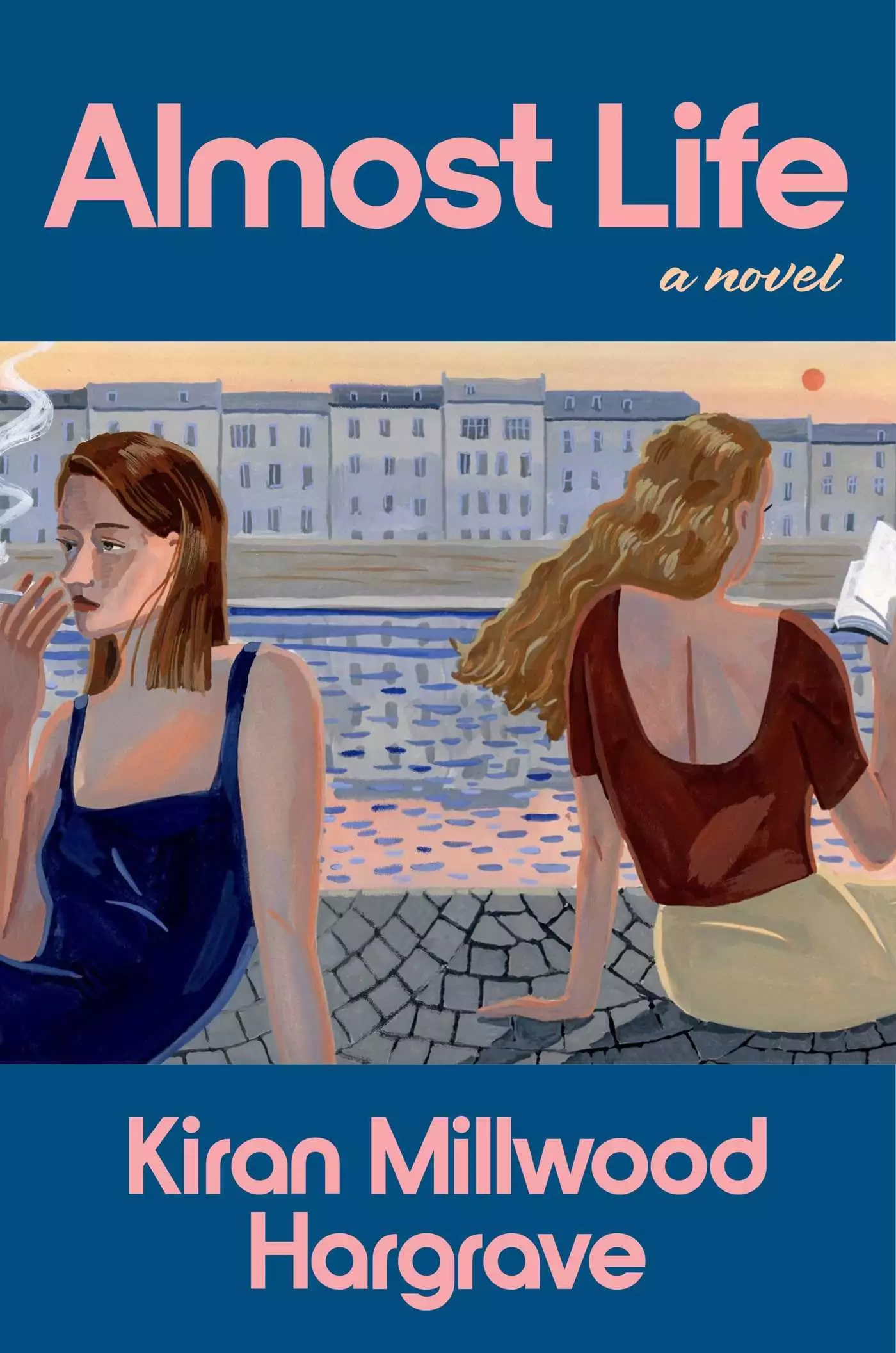
Two young women meet in Paris in this decades-spanning tour de force about the enduring power of young love and the poignant heartbreak of missed chances—perfect for fans of One Day and Normal People.
Erica and Laure meet on the steps of the Sacré-Coeur in Paris, 1978. Erica is a student, relishing her first summer abroad before beginning university at home in England. Laure is studying for her PhD at the Sorbonne, drinking and smoking far too much, and sleeping with a married woman. The moment the two women meet, the spark is undeniable, but their encounter turns into far more than a summer of love. It is the beginning of a relationship that will define their lives and every decision they have yet to make…
Erica and Laure’s love story spans decades, marriage, children, secret trysts, and the agonizing changes—both personal and political—that might mean they can be together, after all. But when life brings them within touching distance again, will they be brave enough to seize a future together?
Beautifully capturing young love and all its complexities, Almost Life is a story of longing for the paths not taken, and the almost lives we live.
Release date:
March 24, 2026
Publisher:
S&S/Summit Books
Print pages:
352
* BingeBooks earns revenue from qualifying purchases as an Amazon Associate as well as from other retail partners.
Chapter One Chapter One They met on the steps of the Sacré-Cœur beneath a sky of the most fierce and unerring blue, so without variation or hesitation it was as though a painter had brushed cerulean across the horizon, no shade or blight anywhere, yet undeniably a cover up. Or perhaps it was only so blue by contrast to the dome and cupolas of the Sacré-Cœur, which too seemed arranged, virgin white paper cut out and laid across the perfect wash of the sky.
Laure was reading and smoking on the left staircase, her long legs thrust out before her, her prematurely greying hair flipped over and hanging across her narrow face. Erica approached, sweating from the ascent through Montmartre’s cobbles in her polyester skirt printed with great bunching florals, rippling and sticking to her thighs. She swears it was the right staircase, remembers turning to her left to look up at the dome pinned against the sky. Smoke in her eyes, an instinctive irritation that did not serve her well in Paris. Each will remember it differently, but on this fact they agree: it was Erica who smiled first, and said—
“Bonjour.”
Laure did not smile easily at the best of times. She was hungover, and the walk in the July swelter to this reading spot a punishment she was still recovering from, a pilgrimage to atone for the previous night’s sins. She hadn’t expected to meet an angel at the basilica’s steps, only to read and watch people and grouse inwardly at the tourists swarming her city. But when she looked up, this girl was singularly beautiful. Long auburn hair, tanned skin, a hint of Laforêt in the wide set of her eyes, her askance doe demeanour. These judgements Laure made rapidly and without self-awareness. She was adamant she didn’t set much store by appearance. Everything about hers was calculated to suggest this, from her man’s shirt to her grey trousers, a little short at the ankles. Her hair was lank and stank of beer and smoke, but she was aware of the girl’s—the tourist’s—nervous expression as she tried again, her accent stronger, more careful, and knew she was experiencing what Michel called Laure’s ravissement, the strong and slightly terrifying aura Laure exerted as though she were a wolf pinning a prey animal.
“Bonjour.”
“Hi.”
“Je m’appelle Erica.”
Laure raised her eyebrows. “Laure. English?”
“Yes,” said the girl, with a slump of disappointment and relief. And then, a flare of defiance: “Française?”
Laure did smile then. “Parisienne.”
She did not find tourists charming, and certainly not English ones, but she thought this girl darling. How old was she? Seventeen? Her skin glowed that undeniable golden that came from youth and health, true health from walks outdoors and sleeping well and eating vegetables and not drinking. Laure did none of these things, except walk when she wanted to punish herself. Her particular, slouching thinness came from these frequent atonements and from her father, who ate butter as though it was a sin to leave a scraping in the dish and was rangy as a whippet. Her build bought her a certain kind of cachet—that rapture Michel alluded to—but Laure knew she smoked too much, drank too much, ate too little with colour, or indeed anything that was not bread and butter. Her skin broke out around her bleeds, her jaw rough and bumpy, and her face looked grey in early light.
She propped her glasses onto her chin, an affectation also learned from her father, and looked more squarely at the girl.
“Je suis ravie de vous rencontrer.”
“No,” said Laure. “You would say, enchanté. Or, ravie.”
“Ravie,” repeated Erica, her mouth parting to show a kitten-pink tongue, white teeth. Laure ran her own furred tongue over her own furred teeth, took another drag on her roll-up and blew the smoke out in a pointed stream. Erica scrunched up her nose, and Laure knew she was a thought away from coughing and wafting her hand.
“Your accent is too tight. You need to let your words fall.”
“Your English is good.”
Laure shrugged. Of course.
“I am sorry to bother you.” Her voice was posh, clipped. Perhaps the formal address suited her better after all. She was sweet.
“It’s only I saw you reading, and it’s not the sort of thing I would normally do, but it’s hot and it’s Paris, isn’t it?” She gave a silly laugh, and it occurred to Laure that here was a clever girl told it was better to be beautiful than clever.
The girl pulled her bag around to her front, a severe leather satchel in light brown, the sort of thing a schoolboy would carry. Laure watched her struggle with the buckles. There were no creases on the straps—the thing was brand new. A gift? It did not fit with her floaty skirt, the Bardot top—was that cheesecloth?—and in fact none of it fitted. It was a costume, a thing put on to walk around Paris and do things she would never normally do. Her nails were unpainted.
She’d managed to wrestle a book from her bag, a poor reveal too long in the making, but she lifted aloft a copy of Fragments d’un discours amoureux, the exact same edition Laure held loosely in her own mauled fingertips, from the Collection Tel Quel. Laure’s was marked with wine-glass rings across the white background, the image of tense and searching fingertips, the spine cracked and binding perilous, made thicker by her dog-eared pages. Erica’s was pristine, as though never opened, though a metro ticket marked a third of the way in.
“And honestly, I thought I was mad. Pretentious, you know, to buy this let alone try to read it in public. I was talked into it by the bookseller. But then I saw you reading here, and smoking, and it made me laugh…” Erica trailed off, realizing she had been insulting, but not realizing Laure loved to be insulted. “Only, I thought if a proper Parisienne were doing it, I could too.”
“Which bookshop?” asked Laure, knowing it would be Shakespeare and Co.
“Le Divan.”
Laure did not betray a flicker of surprise. “My friend works there.”
“Oh! Perhaps she was the one. Dark hair?”
“No. Blonde.”
“Ah.” Erica dithered. “And I hope you don’t mind—” She rummaged in her satchel and pulled out a camera, a boxy Canon AE-1 with a black lens cap. “But I took a photograph from back there, because you do look very French. The picture I had in my head, anyway.”
Laure did not blink.
“I hope you don’t mind,” she repeated. “I can destroy the film if you do.”
Laure let her gaze trickle down Erica’s face to the camera in her hand and back again, knowing she would blush, and she did, deliciously, from her slick collarbones to her round cheeks. She shrugged to show she didn’t care, as though she was used to people taking her photograph and telling her they had done so. “First time in France?”
“And Paris! Well, yes of course in Paris. Paris and France. First time anywhere actually, other than England. I’ve been to London, to the British Museum and the National Gallery, but I knew I couldn’t think myself an art lover until I had been to Paris. I’ve been to the Louvre and the Petit Palais. There’s the Pompidou of course, but I go there tomorrow. Today the weather is so good, I thought, why not walk to the Sacré-Cœur, see the church and sit on the grass and see the city from up here. I’m staying on the Rive Gauche, and it was further than I thought, and hotter too.”
She fanned herself for emphasis, and the camera strap flapped against her cheek. She blushed even more furiously. Laure wondered what she would look like naked.
Laure smiled perfunctorily, and pushed her glasses back up onto her nose. She meant that to be a dismissal, and was glad when the girl tripped up past her, up the left-hand steps of the Sacré-Cœur, and a little disappointed too, when she lost her scent—girlishly sweet, the sort you would get in a pharmacy—and turned to watch her disappear into the crowd making for the church.
Erica collected her skirts in her hand as she moved up the steps against the flow of people, her cheeks hot. She was burned on her shoulders and nose, could feel the skin there stretched and sore. She didn’t understand what had happened to her. It was as though she’d left her body and watched another, bolder self walk towards that woman and attempt to talk to her. It was how she’d felt at school, arriving at a conversation already underway, laughing a beat too late and too loudly. She glanced behind her as she entered the cool of the basilica, but she—Laure, a perfect French name—was out of sight. The way she’d looked at her, with such disdain. Erica had felt like a child again.
But she was not a child, she reminded herself, as she took a paper shawl from the stack and covered her tender shoulders. She was eighteen, an adult, travelling abroad with her own money in her pocket. Aside from that woman on the steps, her attempts at French had been greeted with tolerance and sometimes praise, though her dreams of blending in with the students around the Sorbonne were dashed the moment she arrived at Gare du Nord. She had painfully misjudged the style—there were no Bardot tops and bright skirts as Girl About Town promised. French women wore leather jackets even in the sun, and turtlenecks, tailored trousers and skirts. Their breasts were small and free under thin knits and shirts, nipples pointed and pert.
Erica shifted her bra strap, feeling sweat soaking the lace. Her own breasts were large and heavy, her nipples indistinct. Her disgust at her own body had been bred into her at school, where the girls would take turns placing pencils under their breasts, praising each other if they fell and retching when they did not. Naked she was too much: too saggy, too expansive, too solid. She did not mind herself in clothes so much, but she felt very self-conscious in her holiday outfit, and wished she’d brought her pleated skirts and work shirts, the tea dresses she’d inherited from her mother and let out at the chest and hips.
But she’d spent all her weekend earnings on these clothes precisely because they were the sort of things she’d never wear. When she’d got the idea into her head a couple of years ago to spend the summer after leaving school in Europe, Paris arrived at her like a flurry of wings, a beating flight of fancy. She’d sold it to her parents on the libraries and galleries, but she envisaged drinking red wine and kissing French men, walking the cobbled streets and lounging in the grounds of the Palace of Versailles, sitting on benches near the Seine, reading Sartre.
Paris was beautiful but faded, the Seine stinking for streets around and the benches beds for drunks and tramps. A single glass of red wine made her stomach bloat and her head spin, and it was too hot for wine anyway. The Palace of Versailles had been bombed by Breton nationalists the month before and would not open this summer. Her sandals chafed and slipped on the cobbles. The pension she booked was dingy, the sheets damp and the walls sweating. The women-only bathroom was shared with Spanish students who laughed when she said hello, and the plughole was always clogged with hairs, and she was sure someone else was using her toothbrush. At least she was not on her period and would not be for her whole stay, thanks to a miracle in a sugar shell taken from the blister pack of pills borrowed from Lucy and swallowed diligently each morning.
But, she told herself, you are here. The magic of being somewhere no one knew her was intoxicating. She had found a café on the corner of her street where she could look in four directions and watch the women with their dogs and the men with their bicycles, the students talking intensely or reading and smoking, all of them smoking. She’d been every afternoon, so now the owner started her order without asking, a café au lait like Hemingway and a palmier, and was content to leave her be and let her read and eavesdrop until closing. She loved the hand gestures, the shapes the smoke made in the air as it got dark. She loved the names of the streets: Rue Saint-Sulpice, Rue de Rivoli, Rue Crémieux. She loved the bakeries and the bars, the way the streets wrapped and sprawled and reached for each other, the river.
And as she stepped into the Sacré-Cœur, she loved that too. She had regretted choosing such a hot day to climb the steps, but the immersion into the shaded cool was all the better for it. It smelled of old stone and lit candles and was smaller inside than she’d expected. The benches were flooded with light from the cupola, and she sat on the warm wood and tipped her head back, eyeing the celestial figures of the North Dome, the gold-backed Jesus in Majesty and his attendant angels, more carved into the grey stone, wings stretched wide. She’d spent hours poring over the highly saturated photographs in the library’s copy of Paris on Film, but they’d blurred the colours into a garish glare. The small squares of the mosaics seemed to glow with light, the interaction of stone and tile creating an oscillation, a ripple that lent breath to the saints’ faces, a quiver to the angels’ feathers. She sighed, the hairs on her arms standing up. She felt something akin to what those long-ago devout must have felt: transcendence laced with the necessary twinge of fear.
A man sat beside her, a little too close, and Erica stood though she’d have liked to sit longer. She moved away to join the slowly circling crowds and, glancing behind her, saw the man move to where she’d sat. She imagined the warmth she’d left behind meeting his legs. As she read the inscriptions she felt his eyes on her. She dropped a centime in the collection box and lit a votive candle for her grandmother, peered inside the fonts and queued to climb the dome. She’d have preferred to see the crypt, but there was something about the idea of descending while being watched that felt threatening. After five minutes in the queue she changed her mind. She knew it was due to the man’s scrutiny, for he had joined the queue too, and now stepped from it to follow her.
It was nothing new, being followed. In King’s Lynn it happened sometimes, usually when she was in school uniform, but in Paris it had become a daily occurrence, men of all ages, boys too, openly whistling and making kissy sounds, sitting at her table, or linking arms with her if she let her guard down. She didn’t mind too much, and when it made her heart race and her anxiety spike, she remembered her mother’s advice to smile smally and shake her head.
This man was insistent though, she could feel it from the moment he’d sat beside her. He was only a few years older, with full lips and thick curly hair, and though he was handsome when he smiled at her, she felt exhausted, already, at what was to come.
“Salut,” he said. She smiled at her feet, and tried to move away. He caught her elbow. “Tu es belle.”
“Merci,” she whispered, and pulled from his grip. The paper shawl ripped and came apart as though doused in water. She crossed her arms over her chest, holding her shoulders, but he was drinking her in, eyes dripping over her.
“Parlons.” It is not a question.
“Non, merci.”
“Anglaise? English? Hey, cherry, you want to talk to me?”
She walked quickly away from him, could pick out his footfall on the stone behind her. It was all she could do not to run. Not knowing what else to do, she hurried down the right stairs, hoping the woman would still be there. She was, her book held languidly in her hand, a roll-up between her lips, her eyes concealed behind her sunglasses. Erica threw herself down beside her. The woman lowered her glasses to her chin once more, shifted her cigarette to the side of her mouth.
“Back again?”
“Please. I’m sorry.” Erica looked around. There was her admirer, coming to a halt on the step beside them. He smiled at the woman, Laure.
“Elle est rapide, ta copine.”
Laure said nothing, staring him out. He made to sit down beside Erica but without warning, without changing her expression, Laure barked once, twice. The man laughed uncertainly, but she growled and he hovered in a half crouch. Scenting victory, Laure increased her snarling. People were looking, shaking their heads, but Erica joined in, both of them hissing and growling, and the man said,
“Putain.”
And Laure said, “Casse-toi.”
And he left.
Erica gripped Laure’s knee. “That was brilliant.”
Laure could see the girl was shaken. Her pallor, her overly bright eyes. She felt the warmth from Erica’s hand on her knee, the liquid pooling in her belly. She heard Michel’s voice in her mind. Invétéré. She had work to do, an essay to write, this book and others to read. But she was bored, so she put her book down, and turned the full force of her gaze on Erica.
“OK?” She placed her hand on top of Erica’s. The touch brought Erica’s laugh to an abrupt halt, the girl’s expression suddenly sober.
“Yes, I’m all right. Thank you. I really am sorry to have troubled you again.”
She started to get up and Laure steered her closer instead, so their thighs were touching, Laure’s thighbone overshooting Erica’s by inches. She liked shorter women. Michel said if she were a man she would be a brute. As it was, she was only a pervert.
“It’s fine. I was thinking it was a shame not to see you again. What are you doing now?”
Erica was flustered, blushing again. Laure hoped she didn’t play poker.
“I thought I’d read for a while.” She pulled the Barthes from her satchel. “Perhaps I could sit with you?” Laure stuffed her own copy into her pocket and stood up, offering her hand.
“It’s too hot. Let’s get a drink.”
After a startled pause, Erica let her pull her to her feet, and Laure abruptly dropped her hand. They walked down the steps, past the green stretches of grass, and from Erica’s glances at the people stretched out, Laure could tell she would rather lie down and rest there. But she followed her down the steps and onto the cobbles, which made Laure feel tenderly towards her. Laure’s body was stiff and she pulled her hair across her neck to hide the love bite Hilde had given her the night before. She smiled down at Erica, who was focused on her feet, which were plump and poorly clad in cheap thin sandals.
“Would you like coffee? Wine?”
“Maybe a beer?” ventured Erica, and Laure took her to a small bar on Rue Jean-Baptiste Pigalle she had been to with one of the history students last year. She’d been drunk, and it was darker and dingier in the midday sun than she’d remembered. She ordered them two beers and they sat at a sticky table on cushionless metal chairs outside. Laure took the beer like it was medicine, and Erica sipped.
“Barthes then?” Laure tapped the book in her breast pocket. “What do you think?”
“I’m reading slowly, and I have to look up some of the words,” said Erica, “but I think it is so romantic. So beautiful.”
Laure laughed into the final swallow of her beer. “Romantic? I don’t know what dictionary you are using, but I don’t think it is romantic.”
“Maybe I am misunderstanding.”
Laure didn’t care to educate her. “What did you think of the Sacré-Cœur?”
“Beautiful,” and then, “It was peaceful. It felt smaller inside, like it wrapped around me. And the light is everywhere, with the gold. It bounces it, doesn’t it? The angels, they seem to quiver. It was lovely.”
They were weak words. Laure was disappointed, mostly in herself. What had she expected from this tourist? They should have stayed at the steps, read until they were sun drunk and gone back to hers. She could no longer see the path forward, how to navigate this girl into bed before she stopped desiring her. She could leave, but that had the feeling of abandoning a puppy. She smiled perfunctorily.
“Another beer?”
“I’ll get it.” The girl leapt up and went back inside. Laure got out her tobacco and papers. She heard Erica speaking her godawful French, heard the barman flirting bluntly and badly, Erica’s nervous laughter.
What must it be like, to have men everywhere want to fuck you? Laure was convinced it wasn’t as fun as those girls made out. Maybe some of them relished it, revelled in seducing men, knew how to turn them on and enjoyed it. Her own allure was made solely for her own sex and she had never questioned it, even as a girl with boys trying to see up her skirt or futilely grabbing her flat chest. None of them did it because they desired her, but out of a sort of calculated curiosity, much as they would squash ants in a line to see what the others would do.
The girls though—that was different. It was as if Laure spoke a language only they understood. She could make them laugh and blush and later, come as they never had before. But that was when she discovered sex could exist for her. For a long time she thought she did not like it, as a concept and certainly not an act. She toyed with becoming a nun, the silence and the clean mountain air and the robes, and the women of course. It all appealed. The first girl Laure kissed told her she was Mama, and Laure Papa, and for a while Laure wondered if this was in fact it, if she was a boy and that was why the sight of the girls in their swimming costumes made her throb, why when she listened to Françoise Hardy she thought of her classmate Sarah Lebroy’s freckled collarbones and not, as her friends did, Jean-Pierre from the year above’s veined forearms.
It was a relief, then, to come to university and to Paris and discover women fucked women without either party pretending they were men. Laure had not needed to try to find the others—they swarmed to her; something in her essence, her body language, her scent. She settled into her new, expanded life with none of the guilt and unease others experienced—this choice came at a cost, of course. But one she told herself she was happy to pay.
Erica finally emerged with the beers, and two shot glasses balanced between her fingers, at the sight of which Laure lit her cigarette.
“Gin,” said Erica, apologetically. “He insisted.”
Ah. Free drinks though. That was a benefit that did not come her way often.
Laure raised the glass to her and downed the warm gin. Erica followed suit, eyes watering.
“That’s disgusting,” she gasped, and Laure laughed and agreed. Buoyed by her amusement, Erica asked, “What do you do?”
“Smoke. Speak to strangers.”
Erica grinned. This was good. Laure was warming up. Maybe she should brave the bartender again, get them another gin.
“I mean for work.”
“I’m studying.”
“You’re a student?”
Another shrug. Of course.
Erica had misjudged her age. She’d thought Laure much older, late twenties at least. She had lines around her mouth, a worldliness in her gaze. “Of what? Oh! Let me guess. English.”
“Non.”
“French. Literature, I mean.”
Laure shook her head, squinting against her own smoke.
“Philosophy.”
Laure tipped her hand side to side in a sort of gesture. Scenting victory, Erica chewed her thumbnail. It tasted of the clear polish her mother had bought her to stop her chewing her nails.
“Anthropology? Some sort of social science?”
“Art Theory,” said Laure, and though she delivered it as a throwaway, Erica read the pride in her voice. It was a chink in her cool that Erica could chisel away at.
“I didn’t know you could do a degree in that.”
“It’s a thesis. I’m studying for my doctorate.”
“I’m going to university in September. English.”
“Here?”
“No!” Erica was thrilled at the idea. “England. Norfolk.”
“Norfolk University?”
“University of East Anglia.”
“I don’t know it.”
Erica absorbed this blow. “Where are you studying?”
“Sorbonne.”
Of course. It explained the ease, the obvious intelligence, the belonging. Erica fancied she could pick out the Sorbonne students on sight. They emerged only in the evening, their days spent in libraries or their halls, and swarmed the parks and bars, carrying books, smoking, drinking carafes of wine. Erica’s French was not strong enough to understand all she overheard, but it was an eavesdropped mention of Sartre that sent her to the bookshop where she was instead talked into buying Fragments d’un discours amoureux from the bookseller who was not Laure’s friend, a book only published the year before and already mesmerizing to her. Romantic, she’d said to Laure, and still she felt it. She’d like to know why Laure disagreed, but she didn’t want to feel stupid. The gin and the heat were thickening her blood, making her limbs heavy and loose. She liked the feeling, liked sitting on this wonky chair on the hot pavement next to this intimidating and handsome woman. It made her feel more settled by association, almost as though she belonged.
“Alors.” Laure clapped her hands together, making her jump. “I must go. It was a pleasure to pass the time with you.”
She said it drily, and with a rush of shame Erica realized she had not passed some unspoken test, that after her initial dismissal on the steps she had failed to improve matters. Her mind flicked through every stupid thing she’d said, every graceless action, every immature laugh. Laure was stubbing out her cigarette with deft fingers, licking the end and stowing it in her pocket.
“Yes,” said Erica. And without knowing what she was saying, with the impulse that comes with desperation, she said, “May I have one?”
It caught Laure visibly, a yank on a cord.
“A smoke.” Erica gestured at the pocket the half-smoked cigarette had disappeared into.
“Sure.” Laure took out a small blue tin and a cardboard box. She placed both on the table before Erica, who understood with mute horror she was expected to roll her own. After a moment’s hesitation, Erica opened the tobacco tin, peering inside uncertainly.
Laure seemed amused, but she did not embarrass her further. “Allow me.” It was an act of unimaginable kindness, Erica thought, that she licked her thumb, pulled a paper from the box and stacked tobacco into it, spiralled up a strip of cardboard into a filter, licked the paper and rolled it tightly. It was a perfect cylinder, a work of art really, and she took it as such, reverently.
“Light?”
Erica had not thought this far ahead. She did not want to actually smoke the thing. She’d only wanted to keep Laure with her a little longer, to linger awhile in her orbit.
“Non, merci.”
“Rien.”
There was nothing left to keep her. Erica smiled, looking as though being left was of no consequence. But she felt more alone as Laure walked away than she had been before they met.
Laure turned, and the light was brilliant on her face, short, downy hairs on her cheeks, her eyes a deep-water grey. She saw Erica was staring at her, and gave a goofy smile, performative and true. She called,
“There’s a reading, tomorrow at Le Divan.”
“OK,” called Erica, too loudly, so relieved not to be saying goodbye for ever.
“Eight o’clock.” Laure raised her hand in a salute, and was gone.
Le Divan was in the sixth, at the corner of the Rue de l’Abbaye and the Rue Bonaparte, barely twenty minutes from Erica’s pension, but there was too much to do to spend a leisurely day getting ready. She rushed her time at the newly opened Centre Pompidou, though it was to be the
We hope you are enjoying the book so far. To continue reading...

 Please log in to recommend or discuss...
