
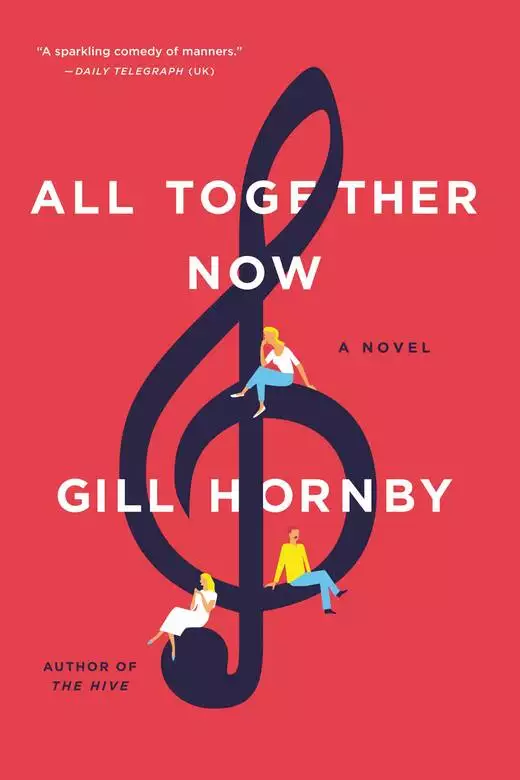
All Together Now
- eBook
- Paperback
- Audiobook
- Hardcover
- Book info
- Sample
- Media
- Author updates
- Lists
Synopsis
The small town of Bridgeford is in crisis. The high street is half empty, businesses are closing and the idea of civic pride seems old-fashioned to the commuters rushing home from work. Somehow, it seems to have lost its heart.
But there is one thing that might just bring the town together: music. The Bridgeford Community Choir has a chance of winning the county championship. First though, the small band of singers must find a lot of new members and a whole new sound.
Enter Tracey - one of life's soloists, and hiding a secret past; Bennett - a church choir refugee, baffled by the modern world. And Jazzy - who sees her voice as her passport straight out of town to a future of fame and fortune. Can they really fit in with dependable old regulars like Annie? Can they learn to work together, save their singing group and maybe even their community?
All Together Now is a funny, sharply observed and moving novel about the joys of singing, about living in harmony, about falling in love... and about the importance of finding your own, true voice.
Release date: July 26, 2016
Publisher: Little, Brown and Company
Print pages: 336
* BingeBooks earns revenue from qualifying purchases as an Amazon Associate as well as from other retail partners.
Reader buzz
 Please log in to recommend or discuss...
Author updates
All Together Now
Gill Hornby
‘Here.’ The parking attendant knocked on her window. ‘Something’s up.’ She wound it down. ‘It’s terrible out there tonight. Keep away from Bridgeford if you can help it.’
‘Ugh,’ Tracey tried to say, but nothing came out. ‘Wish I could.’ She cleared her throat. ‘But thanks…’
She slumped back against the car seat and clutched at her hair. She’d already put up with a bog-standard, run-of-the-mill, utterly dehumanisingly normal day at ONS Systems–emails, contracts, emails about contracts–sitting alone, sit-offishly, in the corner. She coughed again–her vocal cords were in serious danger of atrophy. There had been a ‘Bless you’ to a sneezing junior and a twenty-second sing-song for a birthday–it being the office and there being the law of averages, it was bound to be somebody’s birthday–but apart from that, nothing. She needed–she really, properly needed–to hear the sound of her own voice. Something shouty, that was what she wanted tonight–straightforward and shouty. She found just the disc, flicked it out of its cover and into the machine and waited. The driver of the car ahead stopped to take on a couple more passengers; windows opened, hands stuck out, fingers waved. Someone called, another laughed; Tracey growled. At last, it was her turn. She passed through the barrier, back into the world and pressed Play. ‘Meat Loaf,’ she announced, ‘you may escort me home.’
… paradise by the dashboard light
Tracey emerged and scanned the dark sky. It throbbed with the rhythmic blue of the emergency lights but was giving no sign of what sort of day she had missed. Tracey, as usual, had no clue. They didn’t really go in for weather at ONS: it didn’t bother them, so they didn’t bother with it. The enormous metal-box structure had its own climate, permanently set to ‘very pleasant’; a little patch of northern California, just handy for the M4. Still, the roads were sodden, it was the middle of England in the depths of winter: it could only have been grim.
She took to the slip-road, thumping on the steering wheel, singing–bellowing–along until she came out to the roundabout and a sudden stop. Craning her neck to look ahead, Tracey saw straight up and into the van in the next lane. Three young blokes, all lined up on the front seat, still in their overalls, were laughing away at her. So she shouted a bit louder. Not what they expected from a woman in her forties dressed in her sensible office clothes? Didn’t they like it from someone old enough to be their mum? Just because she didn’t look like a rocker, didn’t mean she wasn’t a rocker. She stuck out her tongue, showing them her stud, pressed it to the window and pulled her Ozzy Osbourne face. She might even have mooned them, but then they inched forward and her sport was over.
‘Oh, come on.’
Nearly twenty years she had been doing this commute, and it generally pulled some sort of trick on her at least once a week. It had caused her no end of trouble in the past–especially when Billy was little–and yet she had never been tempted to look for some sort of job on her own doorstep. Living in Bridgeford was dismal enough; she couldn’t possibly work there, too. It might not be exactly exciting coming out here every day but it did at least throw in another dimension to her existence, increase her imprint upon the earth, just a bit. Tracey tried to imagine her days and years without it and felt a shiver–her whole life would seem such a little thing. She leaned forward, switched off Meat Loaf and fiddled with the tuner.
Officially, Tracey never listened to Dave at Drivetime–soft pop and local radio being, obviously, landmarks in the Valley of Musical Death. Unofficially, though, she had to tune in quite often for the traffic updates, so she always made sure to keep her guard up. For the more vulnerable listeners, the traffic update could just be a dangerous beginning, like a gateway drug. Tracey worried about them, innocently tuning in to hear about a pile-up on the A-whatever and suddenly find themselves filling their brains with all that other stuff: humming along to Maroon 5, smiling dopily to a bit of Michael Bublé… She shook her head in sorrow. Of course, that could never happen to her, but still, even as she waited her own brain was being filled with ‘News from Your Neighbourhood’. ‘Ugh, please, spare us,’ she muttered, drumming her fingers on the gearstick.
‘… the demonstration tomorrow night at the proposed site of the new superstore planned on the London Road…’
That reminded her: she needed to stock up the fridge yet again. The sooner they built a superstore the better, and London Road would be very convenient. She would be able to swoop in on the way home without battling into town, so let them get on with it. Honestly, of all the things to protest about. Third World hunger all sorted then, was it? World peace in the bag? People round here could do with some real problems.
An air ambulance clattered into the sky and one by one the cars ahead of her started to move.
‘… recruitment drive. Yes, the Community Choir has announced that they are going BACK to the County Championships this year after a few quiet seasons. And this time they are in it to win it for your town. But they really need some new voices. So come on, you lot. We know you’re out there. All you belters of Bridgeford…’
Tracey hooted as, at last, she shifted up into second gear. ‘Belters of Bridgeford!’ There was an image. She must remember to tell Billy when she got home. They would have a right laugh at that one.
She crawled on to the motorway–past the wreckage piled on the hard shoulder, the flashing lights, the police in high-vis jackets and the traffic cones–and pulled out into the middle lane.
‘Where can she have got to?’ asked Annie. ‘Let me try her again…’
‘What are we going to do?’ worried an alto.
‘We’ll just have to start without her,’ shrugged Lewis, stamping his feet to keep warm.
‘Without her?’ echoed a soprano. ‘Sing? Without Constance?’
The Choir had arranged to meet outside the supermarket at six o’clock, but it was now quarter-past, the turn-out was still low and even their leader wasn’t there yet. She was always a little bit late, but not quite this late. Annie fiddled in her bag for her phone as she scanned the dark High Street and the damp Market Square. All the other shops were shut: most just for the evening, of course, although a few had closed for good in the weeks since Christmas. The rain had just stopped, so the usual kids were back in their customary position on the war memorial, waiting out the years, swigging out of tins, until they could get served in the pub. Otherwise, there was almost nobody around. She dialled Connie’s number again, listened to the tone, frowned and shook her head: it really was quite out of character. Still, Lewis was right: they were here now and they would have to carry on regardless. Annie tried to put on the sort of inspirational, mood-changing, charismatic leader’s voice that Constance always used. ‘Shall we start?’
It had seemed like such a good idea after choir practice, but then everything seemed like a good idea after choir practice: they always came out on a high. Even with their sadly depleted membership they still sounded so amazing to themselves that at the end of every number they burst into wild, spontaneous applause. There might not be many of them at the Tuesday-night session in the Coronation Hall, but it always felt electric, ground-breaking, a whole new dawn for music–like the opening night of Cats.
So when Constance announced her recruitment drive, it had seemed the easiest thing in the world. All they had to do was get out there and put on a cracking performance to the hundreds of potential new young members and there they would be, back to the highest levels of competition standard, like they were in the glory days. To be fair, even in that atmosphere of buoyant self-confidence, nobody had actually suggested a proper concert. They knew, from the past few attempts, that the whole bookings-and-tickets-and-bums-on-seats thing was not exactly the right vehicle for the Commun ity Choir at the present moment and they had accepted that. Well, most of them had. There was still a little residual bitterness in some sections after that rather grim business with ‘The Magic of Les Mis’. But they did agree that if Bridgeford wouldn’t come in for the music, then the music should go out to Bridgeford, and so here they were. They shuffled into a semicircle. Annie clung to its outer edge.
A bit of everything, that was what they had decided on for tonight’s showcase. They were, as Connie was fond of saying, an eclectic bunch and Lewis, one of their more outspoken members, did like his folk music. He stepped forward and raised his hands. Annie–she had perfect pitch; town tuning-fork was one of her many voluntary roles–hummed the note and they began.
Earl-y one mo-or-ning, just as the sun was ri-i-sing
They sang up and out into the empty night. A few members had argued in favour of a lunchtime event, but they were all the sort of people who were out of town all week working, and had no real understanding of how nearly everybody these days was out of town all week working. It was in a perfect position, Bridgeford, handy for everything–and that was its problem. There was an excellent train service and a choice selection of arterial roads and only the residents left behind who didn’t get on one or other of them, like Annie, could really understand quite how they sucked the life-blood out of the place every single day.
So they came up with this idea, to catch the commuters on their way home, and the last-minute shoppers popping in to what was still, just, the only supermarket. And everyone did agree that Bridgeford was at its best in the evening. A bit of darkness did the town centre a favour. You couldn’t immediately see that most of the shops sold only posh knick-knacks or second-hand clothes, that the bakery was now a tattoo parlour, that the gutters were full of scratch-cards. Of course, it didn’t do quite as good a job as snow. Bridgeford in the snow was Annie’s absolute favourite–when you couldn’t tell which century it was or even if it was the real world; you could pretend you lived in a period drama. Shame it only happened once a year. But still, the dark nearly did the trick. Standing out here, they could almost, at a pinch, through a squint, kid themselves it was the 1950s.
… a po-or maiden so?
It was always a little dispiriting to finish a song to no applause whatsoever. But onwards and upwards and they decided to do musicals next. There was a little hiatus, as they all had to change positions, even Katie in her wheelchair. Lewis came forward, fiddled about with the brakes and tucked the rug around his daughter’s knees. Once that was sorted, it was time for Maria’s big moment. The rest stood back in deference as she pointed her mouth towards the streetlamp, took careful aim and belted:
Sum-mertiiiiiiiiiiime
And the liv-ing is…
Maria’s soulful performance had brought tears to the eyes of past audiences. Tonight, though, all that could be heard was that ugly, barking laughter peculiar to the adolescent boy–half man, half sea-lion–slicing through the beauty of the song.
Over on the war memorial they were, rather deliberately, seeing the funny side. The boys were pretend-fishing, the girls were lying back for a sunbath. Annie’s spirits sank a little further. It might not be the perfect set for a Wednesday night in January, but it was still the best set they could come up with for a Wednesday night in January. That was what happened when you did something for everyone–not everything was perfect. Anyway, what was the alternative? No singing at all? Was that what these people really wanted?
There was a deep rumble as the 6.18 pulled out of the station and the first consignment of commuters started to rush through. Most of them kept their heads down and their eyes averted; several crossed the road; a few took leaflets, but then dumped them in the bin down the street, by the cashpoint. Annie watched Jazzy, in her waitress uniform, standing at the door of the Copper Kettle, leaning on a broom, looking deeply unimpressed. She just caught the retreating back of a chap in a suit–now who was that?–carrying one large potato and pressing past in a hurry. Like everyone else around, he was not in the mood for music tonight. They were all just desperate to get home.
One of the many beautiful things about a choir of long standing is that the members can develop a telepathy, a corporate sixth sense–as Annie, who had been one of the Choir for over thirty years, understood only too well. She knew what it felt like, to be able to sense what your colleagues are thinking while they are singing. And she knew that, right then, what they were thinking was: this is a right waste of time.
Tracey signalled and turned left on to the High Street, towards the shop. They were bound to be low on bread and milk, they always were–Billy had, apparently, to consume one or other at all times simply to stay alive. It was but one of the many similarities between having a young adult son and keeping a baby bird. Billy was, basically, a baby bird just on an epic scale. She parked across the road from the supermarket and reached down for her bag. The 6.18 was just leaving, and there was a rush of commuters walking through, so she did not immediately notice that there was a small crowd over there. In fact, she was dangerously close to getting out of the car and walking straight into them. She might have had to listen or talk to someone or accept a leaflet or something. Thank God she spotted them just in time. She sank back into her car seat, locked the car for good measure: safe. Trapped, but safe.
She couldn’t quite work out what was going on at first. Bridgeford was famously–or not at all famously–the town where nothing happened, and yet clearly something was happening right in front of her this very evening. Her mind ran through the most obvious options–hunger riot; extremist political rally; wild midwinter Home Counties Mardi Gras–until the truth finally hit her. They were the actual belters of Bridgeford. And, what’s more, they were actually belting. What were the chances? This was her lucky night.
A home-made sign was propped precariously in the corner of a young woman’s wheelchair: THE BRIDGEFORD COMMUNITY CHOIR, it said. Hardly, thought Tracey. She would concede they were in Bridgeford, but ‘choir’ was pushing it. And as for ‘community’, well… who did they think they were kidding? This was not exactly a representative sample: it was mostly women, for a start, and they all looked pretty ancient; well, certainly middle-aged. Tracey peered more closely. The few that she recognised straight off, she knew to be certifiably bonkers. There was that swimming teacher who put Billy off water for good, and the weirdo who ran Cubs, and the woman who poured tea at Outpatients–and that was just the front row.
The only person who wasn’t about 120 was the girl in the wheel-chair. She must be the same age, or thereabouts, as the kids taking the piss over on the war memorial, but that was where the similarities ended. While she was singing out with uninhibited enthusiasm, the others were heckling at the tops of their voices. And while she could only dance along with her arms and rock in her seat, their long, nimble bodies were thrashing around in exuberant mockery. Tracey shook her head. Life: even for an irony fan like her good self, sometimes it went way too far.
The number came to an end and, in the absence of any immediate audience response, the Choir clapped themselves. For a happy moment it looked like they might have finished; sadly, they had even more to share. Tracey wound down the window to have a listen–
Sing, sing a song
Make it simple…
–and wound it up again quickly. Criminal, that was. It should be on ‘News from Your Neighbourhood’. Forget the superstore; here was the real story. She should call in, do an on-the-spot: This is Tracey Leckford, with an eye-witness report, live from the High Street, where right now The Carpenters are being MURDERED on the pavement outside Budgens…
It was time for their showstopper. They often discussed how it might be better to open with ‘The Rhythm of Life’, but the choreography was pretty ambitious and some of the older members–Lynn, Pat and the like–needed to warm up to it first, especially this winter with the rush of joint replacements. Only the other day, Dr Khan had said to Annie there was more titanium than calcium in the altos these days. They did have to be careful, but it was worth it. The audience–when they had one–always loved the actions, all the swimming and the crawling and the flying. It was an absolute scream.
Yes, the rhythm of life is a powerful beat.
However, it was always a bit nerve-racking for the sopranos, because at least two of them had to stand next to Katie’s dad, and while Lewis was indisputably one of the finest human beings on the planet, he was not one of the finest dancers.
They click-click-clicked, did a shimmy and a shake…
The 6.42 came and went and another delivery of people started to pour down the station steps. This was lucky timing: they were just hitting the ‘swim to Daddy’ verse. Two basses broke through the ranks and did the crawl across the front. Katie, positioned right in the middle, was doing the breast-stroke. They knew their joy to be infectious when they did this one; they had been told exactly that a million times. And what was this? A smartly dressed chap was heading straight for them. This could be the breakthrough. Annie felt a prickle of optimism. He might be a whole new tenor…
Rhythm in your bedroom, rhythm in the street
He took some change out of his pocket and looked around Katie for a collection box. Then he stepped forward, gave her an encouraging nod, smiled at the rest of them and placed the money on the blanket in her lap.
Tracey swung off the busy road straight into her garage, turned off the ignition and sat for a second. That girl in the wheelchair, the raw pain in her poor dad’s face–she couldn’t get any of it out of her mind. Why did she always feel things so much more when she saw them reflected through a parent? It was the same watching all those talent shows on the telly: when acts got through, they were always pleased, but their families were ecstatic; when they got thrown out, well… the visceral agony of those mums had Tracey all choked up every time. The girl herself made a joke of it when that bloke threw his change at her–she tugged at her forelock, thanked him for noticing her, promised not to spend it on booze–but the dad… He looked like a man having his heart torn out. She wouldn’t be telling Billy about the belters now; they wouldn’t be having a right laugh; the joke had gone clean out of it.
Music was thumping through the building as she got out of the car. Keys between her teeth, carrier bags hanging from both hands, she kicked the door to and closed the garage by flicking the switch down with her nose. With this much shopping, she always had to take a sideways approach up the internal stairs to the living room. Space was at something of a premium in their housing development, but even with just the two of them, it was certainly cosy.
Billy was deep in the sofa, holding a half-gallon of milk in his lap, his feet perched up in front of him on a kitchen chair. The music was pretty loud up there. Tracey crossed in front of the TV, forcing him to pivot in his seat.
‘Hey, Mum.’He didn’t take his eyes off the game.‘How was work?’
‘Yeah. Brilliant, ta.’ She stopped to take in what was going on. Billy was controlling a heavily armed figure walking down a burnt-out street in some post-apocalyptic horrorscape and playing against one of his little cyber-mates from the other side of the world–Japan by the looks of it.
‘Sorry, love.’ She stepped over a pizza box on her way through to the kitchen, dumped the shopping on the table and went back in to pick it up. ‘Haven’t heard this before,’ she shouted, putting the crusts in the box and closing the lid. The song–a string of expletives with a bass undertone–was pounding somewhere in her solar plexus. ‘Who’s it by?’
It was a matter of pride to Tracey that not only did she listen to the same music as Billy, they listened to it together. Music was for sharing. They didn’t have many house rules, but one of them was No headphones–the iPod stayed in its dock. Billy never disappeared into his own audio bubble as all the other kids did, and Tracey never screamed, ‘Turn that bloody racket down’, as her parents had done. She was not that sort of mother. She wanted, needed, to know what her son was listening to. She liked to embrace his choices.
‘WHO’S IT BY?’ she shouted again, more loudly.
‘THE BLOODSHITTERS,’ he roared over his shoulder, and swigged some milk. ‘NEW BAND. NOT BAD.’
‘COOL.’ She put the rubbish in the bin and started to unload the shopping. ‘WHAT DO YOU FANCY FOR SUPPER?’ she bellowed, her head in the fridge.
‘NOTHING.’ Billy rose, turned the volume down a notch and hitched his trousers a little closer to his buttocks. ‘Got a job. Start tonight.’
Tracey span out into the room, astonished. ‘A job?’
‘Yeah,’ he sniffed. ‘Look, Mum–I can’t live off Dad’s money for ever, you know.’
‘Yes, of course.’ Finally. Thank Christ. ‘What? Where? When? How? That’s so great, Bills!’
‘All right. Calm it. It’s no big deal. Me, Curly and Squat are taking over the bar down at the Square.’ He grabbed his jacket off the table and in two strides was through the door. ‘I’ll be late.’
‘Hey. Good lu—‘
But he was already down the stairs, through the garage and out in the street.
Tracey picked up the milk, screwed on the lid, turned off the TV and silenced the music. To be totally honest, she wasn’t really in the mood for The Bloodshitters right now. Billy’s career path so far had been paved with disappointment and Tracey knew, from long experience of his various job opportunities, that this one was unlikely to last beyond the week. Still, she must hope for the best. ‘My son, the barman…’ It had a certain ring to it. And even if it didn’t turn out to be his thing, she did at least have the place to herself for the evening.
She looked around her. The L-shaped kitchen/lounge was nowhere near big enough for both of them now there was so much more of Billy than there used to be. She picked up one cereal bowl from the floor, stepped over a games console and reached down for a second. Of course, it would be much easier to live in if it were actually tidy. When you looked at these places–ground-floor garage beneath first-floor living area, with two beds and a bath on the second–they were a masterclass in space management: such a small footprint on the earth, yet just enough room for living crammed up above. No doubt they had neighbours who were even rattling around, but as they had never spoken to any, they couldn’t possibly know. She balanced a third bowl on top of the others and picked her way back to the kitchen.
There was more cereal detritus in there. She poured herself a glass of wine, took a hearty swig and started to potter around the work surfaces.
La, la, la, la-la
Le la la le la-la
She picked up two knives caked in butter with crumbs stuck on, removed the spoon poking out of the peanut butter and put them in the dishwasher.
La, la, la, la-la, le
An unfamiliar sense of contentment began to creep over her while she wiped down the counter. Of course, her relationship with Billy was about the best between mother and son since… since… Her memory scanned through the respectable amount of history and literature that she had taught herself, but came up with no positive example. Surely there must be one famous one where they didn’t end up either shagging or killing each other? Anyway–she squirted neat washing-up liquid on to the filthy frying-pan–the thought of an evening at home without him was not an entirely unpleasant one. Her wine glass was unaccountably empty; she poured herself some more.
Tum tum ti tum tum
Tracey became aware that, rather than the raspy, throaty one that she used when she was singing along with Billy, she was using her chest voice for once, and she could feel the calming, anti-depressant effect of it on her stressed-out body. But it wasn’t until she was back in the living room, tucked up with her glass and the bottle on the sofa, that she realised exactly what it was she was singing. Christ almighty. Those bloody belters had wormed into her ear, through to her brain, down to her lungs. They had regressed her. She was regressing. For the first time in nearly thirty years, she was spending the night in alone pretending to be Karen bloody Carpenter. How sad was that?
Tragic, she thought, as she bounded out of her seat. The one great thing about being Tracey Leckford was that she was so much cooler in her thirties and forties than she ever had been in her youth. She opened the cupboard under the iPod and rootled around in the back. Billy had no idea about her past, and she was determined it would stay that way. Aha, there they were. Their unit–such a depressing little word, ‘family’; she never used it–was founded on rock and metal, hard and heavy; strong, firm, reliable. And that was how they both liked it.
She pulled out the ghetto blaster with the box of her old cassettes and blew off the dust. The sense of recognition and familiarity was almost overpowering–like being reunited with an amputated limb. The music of her youth had been so hard-won, looking back on it. All that saving up and borrowing and hanging out in record shops; all that transferring and . . .
We hope you are enjoying the book so far. To continue reading...
