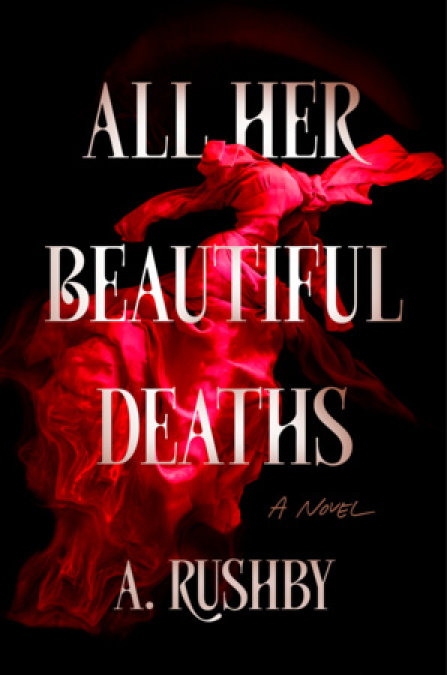
A gothic tale in two timelines in which the lives of two women intersect through a series of mysterious, eerily beautiful photographs of the dead
London, 1865. Minnie has been sent to Culpepper House to work as a maid. She’s been told that the Culpepper twins are odd, and odd they are. Edmund and Edith seem to do as they please, with Edmund running a laboratory from the house and Edith running about with glass plates in order to create photographs. When Minnie spies what Edith is photographing—a young woman and swan, both dead—she is horrified. But with nowhere else to go, there is nothing to do but remain and try to unlock the mystery of Culpepper House’s secrets before she becomes the victim of such a photograph.
London, present day. When Sydney-based artist Hadley is involved in an art world scandal revolving around an album of exquisite Victorian death photographs, she’s met with a flurry of media attention and the offer to create an installation centering on a heartbreaking image of a young woman and a swan. Then comes a shocking offer from the enigmatic Kit Culpepper of the Culpepper Trust…an eye-watering sum of money, with the condition that Hadley sell him the album and never speak of its contents again. As Hadley digs deeper, she begins to suspect Kit Culpepper is guarding a deathly secret…and she’s not entirely sure how far he’ll go to keep it.
Release date:
September 22, 2026
Publisher:
Berkley
Print pages:
464
* BingeBooks earns revenue from qualifying purchases as an Amazon Associate as well as from other retail partners.
My best friend dies at 3:07 a.m. on a Monday, and I realize instantly that it's a strategic move.
I don't expect the call when it comes. I thought Elke had a few more days. Maybe even a week. I didn't factor in her stubbornness when it came to timing. The fact that she would want to spare me being with her and reliving my mother's death, which had happened just over a year before in the very same care home.
I rush to her bedside anyway but wind up hovering in the doorway to her room, unable to enter, not wanting this to be real. But then Gus begins to whimper, and I remember I have him to think about.
"I'm so sorry, Gussie," I say to Elke's sweet rust-colored cavoodle, who is tucked neatly into the large blue IKEA bag under my arm. He's been living with me since Elke moved into Chelsea Gardens just over two years ago (it's got nothing to do with Chelsea, and there's no real garden to speak of). He's not been allowed inside since a family member complained about his presence, saying Gus was dirty. Since then, Elke and Gus have had to meet up in the assisted living facility's outdoor area. Until Elke couldn't get outside anymore. I've had to request special permission and employ the oversize-tote-bag technique for Gus and Elke's final few meetings.
And this. Their very final meeting. Our final meeting.
"Why don't you pop him onto the bed, Hadley?" Lily says, encouraging me to enter the room. Lily is (was) Elke's favorite carer. "I don't think anyone will be making any complaints."
Not today, the words go unspoken.
I nod and enter briskly like I've got this (I don't). I put the bag down gently on the bed, and Gus-the goodest, cleanest boy in the world-steps out gingerly, my heart breaking for him.
Gus sniffs one of Elke's neatly placed hands.
And then he curls up into a little ball beside her cotton-blanket-covered legs.
He knows. Of course he knows.
Maybe he knew even before we got here?
"It was very peaceful," Lily tells me. "At the end."
I nod again. I'm not sure if this is true, but it's what they tend to say at Chelsea Gardens. It's probably what they would have told me about Mum's death if I hadn't been there. It had been a lot of things. Loud. Labored. Intense. And then . . . awfully quiet. Too quiet. Peaceful? Not so much.
Mum died in the evening. But Elke? Three o'clock in the morning on a Monday? She had definitely planned it this way. It means everything will be sorted within the week. By the time Saturday rolls around, the funeral will be over, her belongings packed up. Someone new will be moved into her room. Her memento mori photograph may even be hanging on the wall in my house.
Months ago she carefully selected the dark antique-walnut frame and the custom charcoal mat board that would cradle the two side-by-side photographs. One side has been made ready-it showcases her living photo. The other side awaits the death photograph that will soon be taken, then slipped inside the frame in a few days' time, ready to be hung on my wall.
Remember you must die, it will whisper to me each time I walk past it.
Life is short. And fragile.
Do not waste it.
Elke's final work of art.
This is also very her-to be creating art from beyond the grave. Art that will watch over me when she can no longer.
"If only I could stay a little longer to see what you do. What you become," Elke said to me just last week. She had slowed with the increased pain medication, but she was still lucid when she was awake. "I know there will come a time when you are ready. To speak up. To use your voice. And when that time comes, I also know you will have much to say. It will be glorious. Breathtaking."
No pressure or anything.
"I don't know if I have anything left to say," I told her, flopping into the room's armchair. "And even if I did, even if I yelled whatever it was out from the rooftops, I'm not sure anyone would hear me. Last time I spoke up, I only ended up managing to silence myself, remember?" I argued. Elke knew full well I'd destroyed my first major installation. Literally. With my own hands.
Elke shrugged as if this were no big deal. "You won't do it again. You won't need to."
"I'll give you all a moment," Lily says, returning me to the present and Elke's motionless form. She places a hand on my arm as she passes by, drifting silently from the room.
Only then do I force myself to look past Elke's hands and up to her face. I haven't been able to bring myself to do it yet.
She looks surprisingly . . . peaceful.
As I look at her, I will myself not to cry.
Not because Elke wouldn't want me to cry . . . "I expect floods of tears from you at my funeral," she'd told me when she'd truly begun to weaken at the age of ninety-six years and eleven months. "Floods! And none of that rubbish about no flowers. I want wreath upon wreath. So many that you must stagger out with them after. And perhaps four black horses to pull the glass funeral carriage."
She was joking, of course, but I couldn't help it-I'd stiffened when she'd said this. Not because we had been talking about her impending death but because we'd been straying far too close to something else. Glass funeral carriages and black horses. The image she had created had made me force my gaze away from the hard silver lockable briefcase in her room. It housed a specially constructed foam inner that protected an antique album-a strange Victorian book that contained four memorial photographs of beautiful young women who had all died far too young. It was a curious item that had been gifted to her by a friend of a friend. A bound book covered in rich mahogany leather with beautifully marbled edges-swirls of gold and autumnal hues-it had been found when some floorboards had to be taken up in a historic home in the Blue Mountains. The album had found its way to Elke because a friend knew she was a photographer with a strong interest in death portraiture.
When the album was given to Elke, she was still living in Surry Hills, in the terrace next door to the one Mum and I lived in. She'd owned two of the terraces, and she'd sold one of them to Mum when I was just a toddler. She had taken Mum's offer-lower than two others-in order to have another artist live next door.
I was just on sixteen when the album found its way to Elke. We were, of course, both obsessed with it. Mesmerized by it. Time and time again, Elke explained the expensive and laborious wet-collodion process to me-how the photographs had been made. The fragile glass plates, the toxic chemicals, how the sitter would need to keep quite still for between three and five minutes. She also explained how people back then did not have thousands of photos of their everyday lives-of their friends, their pets, their lunch. That there might be no photos of a person at all. A photograph made after death might be all you would have to remember a person by, and even then only if you could afford it.
We would pore over these visions of long-dead girls reclining in everlasting slumber, wondering at their names. How they might have perished. Pneumonia? Cholera? Scarlet fever? Some of them were surely not that much older than me. We made up lives for them. Families. Best friends. Favored pastimes. Backstories. We searched for similar portraits online. For any information. Surely someone knew who these women were. Or knew who the incredibly talented photographer was. They had to. These portraits were far more beautiful than any others we could find out there. Far more artistic. Far more private and personal.
Elke showed me some of the more common styles of Victorian death photographs. A man laid out neatly in a coffin. A young woman with her parents, each clutching one of her lifeless hands as she reclined in a chair. A small child with its five living siblings surrounding it.
"It's so sad," I told her.
"It is," Elke said. "Death truly surrounded the Victorians at all points of their lives. Death and grief. It's funny how people often seem to think that because of this, they didn't feel loss in the same way we do or they were numb to it. Immune to it. But I've never believed that for a second. Of course they felt loss in the same way. But what choice do we have but to move forward in this life, carrying our grief with us?"
The photos in Elke's album were sad, too, but they were also many, many other things-rich with layers. They were uncanny. Intimate. Provocative. As if the photographer had attempted to shake you to attention. Look! she was saying. Look at this! Here!
It was a she who had taken them. Elke was certain of it.
"Yes, a woman took these," Elke would assert every time she flipped the pages of the album. "These images. These women. They are not Victorian objects. Possessions. There is no voyeurism here. We are with them, and they are with us. They speak to us. Live on in these images. Do you feel it?"
I did feel it. The women in those photographs-their voices reached out across time. Reminded me that they had walked this earth. Lived. Breathed. Wanted. Desired. Laughed. Cried. They would always be alive, in a way. In that album.
What neither Elke nor I could understand was how such finery could have slipped through the fingers of history.
The photographs themselves provided no clue, nor did the album. There were no names. No location. No photographer or studio details.
Over the years Elke made a few tentative research inquiries, but only through trusted friends. There was something about the album that demanded privacy. She came up with nothing. "Perhaps it is better it remains a mystery?" she mused. "That we are left to wonder and dream? Perhaps that is what the artist wanted all along-for us not to question too hard. For when we focus hardest on the hunt for answers, we lose sight of the beauty. The love. First and foremost those photographs show us love. And there is never anything rational about love."
I hadn't been convinced. I must have been about twenty then. Always in a rush. "Do you think we should try harder?" I'd asked her, intent on knowing everything all at once. "Maybe in the UK? Not just here?"
"No. I don't think it's the right time," she told me gently. "Sometimes it's best to wait for the right time."
Elke had been telling me she didn't have the energy to pursue this. That she wanted it to be my project. A legacy she would leave me.
As time passed, Elke and I began to discuss how I might use one particular image as the basis of my final project at art college. Given that it was a yearlong assessment, I knew I needed to begin thinking about it early-as early as my first year in art college. Give it the time and the space it needed to blossom. Put my heart and soul into it. My everything. I needn't have wasted my time. Because life got in the way. Mum got sick. I dropped out of art college. Then things really spiraled out of control. Thanks to Ivo. Well, thanks to me and Ivo. I'm willing to take my share of the blame.
Even now, almost a year on from the incident, I find it difficult to think about what happened. I'm not sure I'll ever be able to forgive myself for bringing Ivo here. For letting him into this part of my life. For allowing him to sully my relationship with Elke.
Not that she ever saw it that way.
Anyway, as Elke joked about the magnificent Victorian-style funeral she wanted to have, I managed to force out a stiff laugh, playing along. "A glass funeral carriage pulled by black horses. Could you even get something like that in Sydney?"
Elke simply shrugged. "I honestly have no idea. And it won't be my problem, as I'll be dead. So you'd better start looking into it, hadn't you?" She chuckled. "Don't waste too much energy on it, though. The most important thing is a decent wake. With at least three different types of gin."
I let out a strained laugh. I'd need three kinds of gin to get through that funeral.
And now here we are.
There.
We've arrived at the end, and it's time for Elke's final portrait.
"Okay, Gus," I say. "Let's do this."
And then I am all movement. In the corner of the room, neatly packed away, is everything I will require. We've gone over this a hundred times, Elke barking instructions at me from her bed, unrelenting until I got every last detail right.
"This is beyond morbid," I would tell her time and time again as we set up for a photograph that would not be taken until she was gone.
"I know." She would grin at me. "And don't forget-make sure you don't sob or do anything silly like that. There will be plenty of time for sobbing after the photograph."
Such a bully.
And so I do not sob as I piece everything together. Put it in its proper place. Lights. Tripod. Camera.
This is a good death, I tell myself, like a mantra. Elke was almost one hundred years old. She was able to access good care when she needed it. She was loved. Her final wishes fulfilled.
And it must be perfect.
It must be perfect for Elke.
I pause only when it comes time to take the actual photograph.
Gus is still upon Elke's bed. We never discussed this. Didn't consider it. But he's not in the frame, and I think . . . I think she'd like it. And so I don't move him.
I inhale. Take the shot. Inspect it.
It is, of course, incredible (not my doing).
The black and white. The shadows in her cheeks. It's afterlife old-school Hollywood glamour.
"It's stunning, Elke," I tell her, and then I get ready to sob.
Except I can't. So I pack everything up. Swiftly. Efficiently. Telling myself I should keep moving. That there will be a lot to do.
We hope you are enjoying the book so far. To continue reading...

 Please log in to recommend or discuss...
