
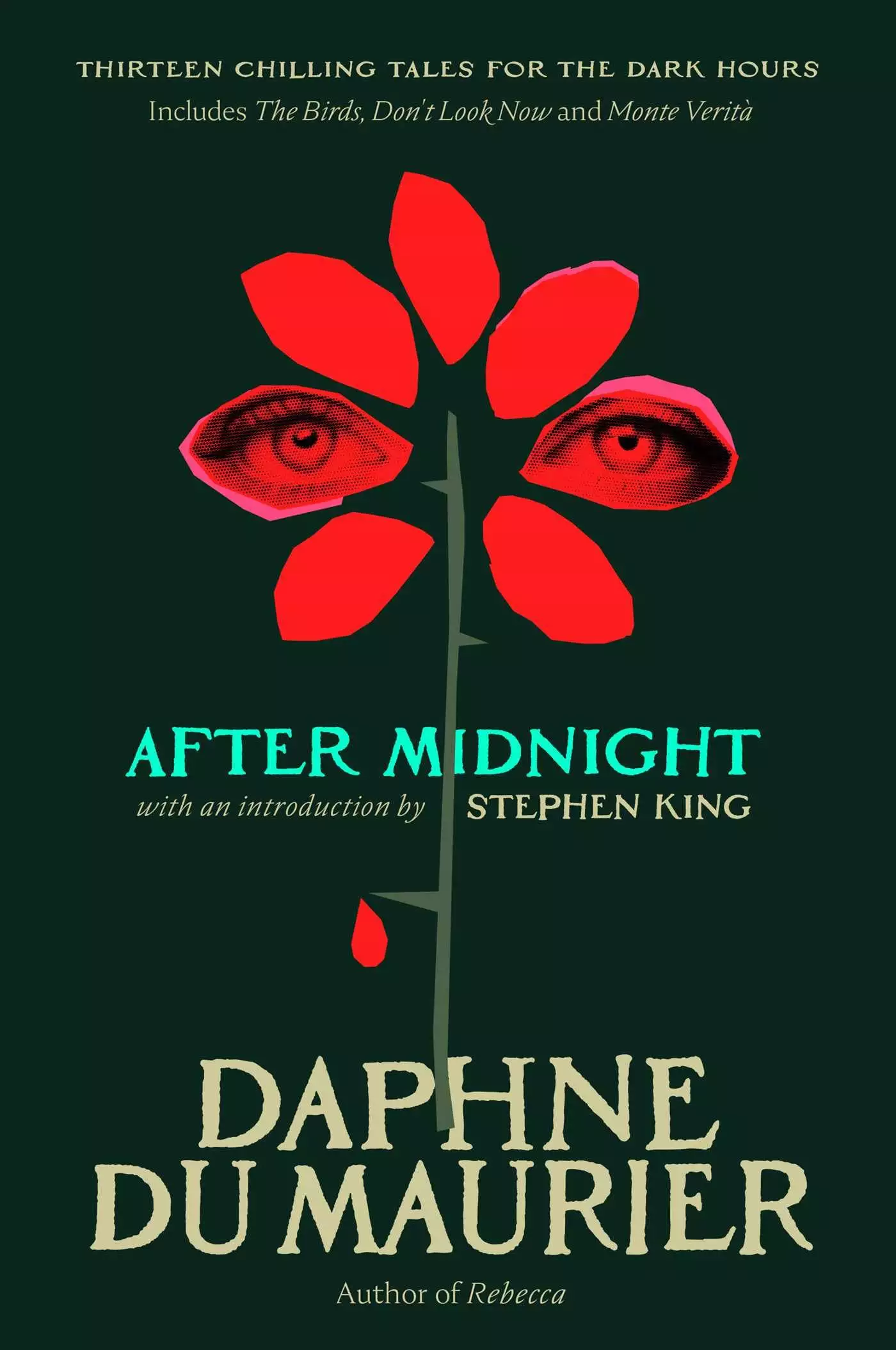
After Midnight
- eBook
- Paperback
- Hardcover
- Book info
- Sample
- Media
- Author updates
- Lists
Synopsis
From Daphne du Maurier, “a writer of fearless originality” (The Guardian), comes a collection of her thirteen most mesmerizing tales—including iconic stories such as “The Birds” and “Don’t Look Now”—with an introduction by Stephen King.
Daphne du Maurier is best known for Rebecca, “one of the most influential novels of the 20th century” (Sarah Waters) and basis for Alfred Hitchcock’s iconic film adaptation. More than thirty-five years after her death, du Maurier is celebrated for her gothic genius and stunning psychological insight by authors such as Ottessa Moshfegh, Maggie O’Farrell, Lucy Foley, Gillian Flynn, Jennifer Egan, and countless others, including Stephen King and Joe Hill.
After Midnight brings together some of du Maurier’s darkest, most haunting stories, ranging from sophisticated literary thriller to twisted love story. Alongside classics such as “The Birds” and “Don’t Look Now,”—both of which inspired unforgettable films—are gems such as “Monte Verità,” a masterpiece about obsession, mysticism, and tragic love, and “The Alibi,” a chilling tale of an ordinary man’s descent into lies, manipulation, and sinister fantasies that edge dangerously close to reality. In “The Blue Lenses,” a woman recovering from eye surgery finds she now perceives those around her as having animal heads corresponding to their true natures. “Not After Midnight” follows a schoolteacher on holiday in Crete who finds a foreboding message from the chalet’s previous occupant who drowned while swimming at night. In “The Breakthrough,” a scientist conducts experiments to harness the power of death, blurring the line between genius and madness.
Each story in this collection exemplifies du Maurier’s exquisite writing and singular insight into human frailty, jealousy, and the macabre. She “makes worlds in which people and even houses are mysterious and mutable; haunted rooms in which disembodied spirits dance at absolute liberty” (Olivia Laing, author of Crudo). Daphne du Maurier is mistress of the sleight of hand and slow-burning menace, often imitated and never, ever surpassed.
Stories include:
-“The Blue Lenses”
-“Don’t Look Now”
-“The Alibi”
-“The Apple Tree”
-“The Birds”
-“Monte Verita”
-“The Pool”
-“The Doll”
-“Ganymede”
-“Leading Lady”
-“Not After Midnight”
-“Split Second”
-“The Breakthrough”
Release date: September 30, 2025
Publisher: Scribner
Print pages: 544
* BingeBooks earns revenue from qualifying purchases as an Amazon Associate as well as from other retail partners.
Reader buzz
 Please log in to recommend or discuss...
Author updates
After Midnight
Daphne du Maurier
This was the day for the bandages to be removed and the blue lenses fitted. Marda West put her hand up to her eyes and felt the crêpe binder, and the layer upon layer of cotton-wool beneath. Patience would be rewarded at last. The days had passed into weeks since her operation, and she had lain there suffering no physical discomfort, but only the anonymity of darkness, a negative feeling that the world and the life around was passing her by. During the first few days there had been pain, mercifully allayed by drugs, and then the sharpness of this wore down, dissolved, and she was left with a sense of great fatigue, which they assured her was reaction after shock. As for the operation itself, it had been successful. Here was definite promise. A hundred per cent successful.
‘You will see,’ the surgeon told her, ‘more clearly than ever before.’
‘But how can you tell?’ she urged, desiring her slender thread of faith to be reinforced.
‘Because we examined your eyes when you were under the anaesthetic,’ he replied, ‘and again since, when we put you under for a second time. We would not lie to you, Mrs West.’
This reassurance came from them two or three times a day, and she had to steel herself to patience as the weeks wore by, so that she referred to the matter perhaps only once every twenty-four hours, and then by way of a trap, to catch them unawares. ‘Don’t throw the roses out. I should like to see them,’ she would say, and the day-nurse would be surprised into the admission, ‘They’ll be over before you can do that.’ Which meant that she would not see this week.
Actual dates were never mentioned. Nobody said, ‘On the fourteenth of the month you will have your eyes.’ And the subterfuge continued, the pretence that she did not mind and was content to wait. Even Jim, her husband, was now classed in the category of ‘them’, the staff of the hospital, and no longer treated as a confidant.
Once, long ago, every qualm and apprehension had been admitted and shared. This was before the operation. Then, fearful of pain and blindness, she had clung to him and said, ‘What if I never see again, what will happen to me?’ picturing herself as helpless and maimed. And Jim, whose anxiety was no less harsh than hers, would answer, ‘Whatever comes, we’ll go through it together.’
Now, for no known reason except that darkness, perhaps, had made her more sensitive, she was shy to discuss her eyes with him. The touch of his hand was the same as it had ever been, and his kiss, and the warmth of his voice; but always, during these days of waiting, she had the seed of fear that he, like the staff at the hospital, was being too kind. The kindness of those who knew towards the one who must not be told. Therefore, when at last it happened, when at his evening visit the surgeon said, ‘Your lenses will be fitted tomorrow,’ surprise was greater than joy. She could not say anything, and he had left the room before she could thank him. It was really true. The long agony had ended. She permitted herself only a last feeler, before the day-nurse went off duty – ‘They’ll take some getting used to, and hurt a bit at first?’ – her statement of fact put as a careless question. But the voice of the woman who had tended her through so many weary days replied, ‘You won’t know you’ve got them, Mrs West.’
Such a calm, comfortable voice, and the way she shifted the pillows and held the glass to the patient’s lips, the hand smelling faintly of the Morny French Fern soap with which she washed her, these things gave confidence and implied that she could not lie.
‘Tomorrow I shall see you,’ said Marda West, and the nurse, with the cheerful laugh that could be heard sometimes down the
corridor outside, answered, ‘Yes, I’ll give you your first shock.’
It was a strange thought how memories of coming into the nursing-home were now blunted. The staff who had received her were dim shadows, the room assigned to her, where she still lay, like a wooden box built only to entrap. Even the surgeon, brisk and efficient during those two rapid consultations when he had recommended an immediate operation, was a voice rather than a presence. He gave his orders and the orders were carried out, and it was difficult to reconcile this bird-of-passage with the person who, those several weeks ago, had asked her to surrender herself to him, who had in fact worked this miracle upon the membranes and the tissues which were her living eyes.
‘Aren’t you feeling excited?’ This was the low, soft voice of her night-nurse, who, more than the rest of them, understood what she had endured. Nurse Brand, by day, exuded a daytime brightness; she was a person of sunlight, of bearing in fresh flowers, of admitting visitors. The weather she described in the world outside appeared to be her own creation. ‘A real scorcher,’ she would say, flinging open windows, and her patient would sense the cool uniform, the starched cap, which somehow toned down the penetrating heat. Or else she might hear the steady fall of rain and feel the slight chill accompanying it. ‘This is going to please the gardeners, but it’ll put paid to Matron’s day on the river.’
Meals, too, even the dullest of lunches, were made to appear delicacies through her method of introduction. ‘A morsel of brill au beurre?’ she would suggest happily, whetting reluctant appetite, and the boiled fish that followed must be eaten, for all its tastelessness, because otherwise it would seem to let down Nurse Brand, who had recommended it. ‘Apple fritters – you can manage two, I’m sure,’ and the tongue began to roll the imaginary fritter, crisp as a flake and sugared, which in reality had a languid, leathery substance. And so her cheerful optimism brooked no discontent – it would be offensive to complain, lacking in backbone to admit, ‘Let me just lie. I don’t want anything.’
The night brought consolation and Nurse Ansel. She did not expect courage. At first, during pain, it had been Nurse Ansel who had administered the drugs. It was she who had smoothed the pillows and held the glass to the
parched lips. Then, with the passing weeks, there had been the gentle voice and the quiet encouragement. ‘It will soon pass. This waiting is the worst.’ At night the patient had only to touch the bell, and in a moment Nurse Ansel was by the bed. ‘Can’t sleep? I know, it’s wretched for you. I’ll give you just two and a half grains, and the night won’t seem so long.’
How compassionate, that smooth and silken voice. The imagination, making fantasies through enforced rest and idleness, pictured some reality with Nurse Ansel that was not hospital – a holiday abroad, perhaps, for the three of them, and Jim playing golf with an unspecified male companion, leaving her, Marda, to wander with Nurse Ansel. All she did was faultless. She never annoyed. The small shared intimacies of night-time brought a bond between nurse and patient that vanished with the day, and when she went off duty, at five minutes to eight in the morning, she would whisper, ‘Until this evening,’ the very whisper stimulating anticipation, as though eight o’clock that night would not be clocking-in but an assignation.
Nurse Ansel understood complaint. When Marda West said wearily, ‘It’s been such a long day,’ her answering ‘Has it?’ implied that for her too the day had dragged, that in some hostel she had tried to sleep and failed, that now only did she hope to come alive.
It was with a special secret sympathy that she would announce the evening visitor. ‘Here is someone you want to see, a little earlier than usual,’ the tone suggesting that Jim was not the husband of ten years but a troubadour, a lover, someone whose bouquet of flowers had been plucked in an enchanted garden and now brought to a balcony. ‘What gorgeous lilies!’, the exclamation half a breath and half a sigh, so that Marda West imagined exotic dragon-petalled beauties growing to heaven, and Nurse Ansel, a little priestess, kneeling. Then, shyly, the voice would murmur, ‘Good evening, Mr West. Mrs West is waiting for you.’ She would hear the gentle closing of the door, the tip-toeing out with the lilies and the almost soundless return, the scent of the flowers filling the room.
It must have been during the fifth week that Marda West had tentatively suggested, first to Nurse Ansel and then to her husband, that perhaps when she returned home the night-nurse might go with them for the first week. It would chime with Nurse Ansel’s own holiday. Just a week. Just so that Marda West could settle to home again.
‘Would you like me to?’ Reserve lay in the voice, yet promise too.
‘I would. It’s going to be so difficult at first.’ The patient, not knowing what she meant by difficult, saw herself as helpless still, in
spite of the new lenses, and needing the protection and the reassurance that up to the present only Nurse Ansel had given her. ‘Jim, what about it?’
His comment was something between surprise and indulgence. Surprise that his wife considered a nurse a person in her own right, and indulgence because it was the whim of a sick woman. At least, that was how it seemed to Marda West, and later, when the evening visit was over and he had gone home, she said to the night-nurse, ‘I can’t make out whether my husband thought it a good idea or not.’
The answer was quiet yet reassuring. ‘Don’t worry. Mr West is reconciled.’
But reconciled to what? The change in routine? Three people round the table, conversation, the unusual status of a guest who, devoting herself to her hostess, must be paid? (Though the last would not be mentioned, but glossed over at the end of a week in an envelope.)
‘Aren’t you feeling excited?’ Nurse Ansel, by the pillow, touched the bandages, and it was the warmth in the voice, the certainty that only a few hours now would bring revelation, which stifled at last all lingering doubt of success. The operation had not failed. Tomorrow she would see once more.
‘In a way,’ said Marda West, ‘it’s like being born again. I’ve forgotten how the world looks.’
‘Such a wonderful world,’ murmured Nurse Ansel, ‘and you’ve been patient for so long.’
The sympathetic hand expressed condemnation of all those who had insisted upon bandages through the waiting weeks. Greater indulgence might have been granted had Nurse Ansel herself been in command and waved a wand.
‘It’s queer,’ said Marda West, ‘tomorrow you won’t be a voice to me any more. You’ll be a person.’
‘Aren’t I a person now?’
A note of gentle teasing, of pretended reproach, which was all part of the communication between them, so soothing to the patient. This must surely, when sight came back, be forgone.
‘Yes, of course, but it’s bound to be different.’
‘I don’t see why.’
da West must be prepared for surprise at the first encounter, the tilt of the head, the slant of the eyes, or perhaps some unexpected facial form like too large a mouth, too many teeth.
‘Look, feel …’ and not for the first time Nurse Ansel took her patient’s hand and passed it over her own face, a little embarrassing, perhaps, because it implied surrender, the patient’s hand a captive. Marda West, withdrawing it, said with a laugh, ‘It doesn’t tell me a thing.’
‘Sleep, then. Tomorrow will come too soon.’ There came the familiar routine of the bell put within reach, the last-minute drink, the pill, and then the soft, ‘Good night, Mrs West. Ring if you want me.’
‘Thank you. Good night.’
There was always a slight sense of loss, of loneliness, as the door closed and she went away, and a feeling of jealousy, too, because there were other patients who received these same mercies, and who, in pain, would also ring their bells. When she awoke – and this often happened in the small hours – Marda West would no longer picture Jim at home, lonely on his pillow, but would have an image of Nurse Ansel, seated perhaps by someone’s bed, bending to give comfort, and this alone would make her reach for the bell, and press her thumb upon it, and say, when the door opened, ‘Were you having a nap?’
She would be seated, then, in the cubby-hole midway along the passage, perhaps drinking tea or entering particulars of charts into a ledger. Or standing beside a patient, as she now stood beside Marda West.
‘I can’t find my handkerchief.’
‘Here it is. Under your pillow all the time.’
A pat on the shoulder (and this in itself was a sort of delicacy), a few moments of talk to prolong companionship, and then she would be gone, to answer other bells and other requests.
‘Well, we can’t complain of the weather!’ Now it was the day itself, and Nurse Brand coming in like the first breeze of morning, a hand on a barometer set fair. ‘All ready for the great event?’ she asked. ‘We must get a move on, and keep your prettiest nightie to greet your husband.’
It was her operation in reverse. This time in the same room, though, and not a stretcher, but only the deft hands of the surgeon with Nurse Brand to help him. First came the disappearance of the crêpe, the lifting of the bandages and lint, the very slight prick of an injection to dull feeling. Then he did something to her eyelids. There was no pain. Whatever he did was cold, like the slipping of ice where the bandages had been, yet soothing too.
‘Now, don’t be disappointed,’ he said. ‘You won’t know any difference for about half an hour. Everything will seem shadowed. Then it will gradually clear. I want you to lie quietly during that time.’
‘I understand. I won’t move.’
The longed-for moment must not be too sudden. This made sense. The dark lenses, fitted inside her lids, were temporary for the first few days. Then they would be removed and others fitted.
‘How much shall I see?’ The question dared at last.
‘Everything. But not immediately in colour. Just like wearing sunglasses on a bright day. Rather pleasant.’
His cheerful laugh gave confidence, and when he and Nurse Brand had left the room she lay back again, waiting for the fog to clear and for that summer day to break in upon her vision, however subdued, however softened by the lenses.
Little by little the mist dissolved. The first object was angular, a wardrobe. Then a chair. Then, moving her head, the gradual forming of the window’s shape, the vases on the sill, the flowers Jim had brought her. Sounds from the street outside merged with the shapes, and what had seemed sharp before was now in harmony. She thought to herself, ‘I wonder if I can cry? I wonder if the lenses will keep back tears,’ but, feeling the blessing of sight restored, she felt the tears as well, nothing to be ashamed of – one or two which were easily brushed away.
All was in focus now. Flowers, the wash-basin, the glass with the thermometer in it, her dressing-gown. Wonder and relief were so great
that they excluded thought.
‘They weren’t lying to me,’ she thought. ‘It’s happened. It’s true.’
The texture of the blanket covering her, so often felt, could now be seen as well. Colour was not important. The dim light caused by the blue lenses enhanced the charm, the softness of all she saw. It seemed to her, rejoicing in form and shape, that colour would never matter. There was time enough for colour. The blue symmetry of vision itself was all-important. To see, to feel, to blend the two together. It was indeed rebirth, the discovery of a world long lost to her.
There seemed to be no hurry now. Gazing about the small room and dwelling upon every aspect of it was richness, something to savour. Hours could be spent just looking at the room and feeling it, travelling through the window and to the windows of the houses opposite.
‘Even a prisoner,’ she decided, ‘could find comfort in his cell if he had been blinded first, and had recovered his sight.’
She heard Nurse Brand’s voice outside, and turned her head to watch the opening door.
‘Well … are we happy once more?’
Smiling, she saw the figure dressed in uniform come into the room, bearing a tray, her glass of milk upon it. Yet, incongruous, absurd, the head with the uniformed cap was not a woman’s head at all. The thing bearing down upon her was a cow … a cow on a woman’s body. The frilled cap was perched upon wide horns. The eyes were large and gentle, but cow’s eyes, the nostrils broad and humid, and the way she stood there, breathing, was the way a cow stood placidly in pasture, taking the day as it came, content, unmoved.
‘Feeling a bit strange?’
The laugh was a woman’s laugh, a nurse’s laugh, Nurse Brand’s laugh, and she put the tray down on the cupboard beside the bed. The patient said nothing. She shut her eyes, then opened them again. The cow in the nurse’s uniform was with her still.
‘Confess now,’ said Nurse Brand, ‘you wouldn’t know you had the lenses in, except for the colour.’
It was important to gain time. The patient stretched out her hand carefully for the glass of milk. She sipped the milk slowly. The mask
must be worn on purpose. Perhaps it was some kind of experiment connected with the fitting of the lenses – though how it was supposed to work she could not imagine. And it was surely taking rather a risk to spring such a surprise, and, to people weaker than herself who might have undergone the same operation, downright cruel?
‘I see very plainly,’ she said at last. ‘At least, I think I do.’
Nurse Brand stood watching her, with folded arms. The broad uniformed figure was much as Marda West had imagined it, but that cow’s head tilted, the ridiculous frill of the cap perched on the horns … where did the head join the body, if mask it in fact was?
‘You don’t sound too sure of yourself,’ said Nurse Brand. ‘Don’t say you’re disappointed, after all we’ve done for you.’
The laugh was cheerful, as usual, but she should be chewing grass, the slow jaws moving from side to side.
‘I’m sure of myself,’ answered her patient, ‘but I’m not so sure of you. Is it a trick?’
‘Is what a trick?’
‘The way you look … your … face?’
Vision was not so dimmed by the blue lenses that she could not distinguish a change of expression. The cow’s jaw distinctly dropped.
‘Really, Mrs West!’ This time the laugh was not so cordial. Surprise was very evident. ‘I’m as the good God made me. I dare say he might have made a better job of it.’
The nurse, the cow, moved from the bedside towards the window and drew the curtains more sharply back, so that the full light filled the room. There was no visible join to the mask: the head blended to the body. Marda West saw how the cow, if she stood at bay, would lower her horns.
‘I didn’t mean to offend you,’ she said, ‘but it is just a little strange. You see …’
She was spared explanation because the door opened and the surgeon came into the room. At least, the surgeon’s voice was recognizable as he called, ‘Hullo! How goes it?’, and his figure in the dark coat and the sponge-bag trousers was all that an eminent surgeon’s should be, but … that terrier’s head, ears pricked, the inquisitive, searching glance? In a moment surely he would yap, and a tail wag swiftly?
This time the patient laughed. The effect was ludicrous. It must be a joke. It was, it had to be; but why go to such expense and trouble,
and what in the end was gained by the deception? She checked her laugh abruptly as she saw the terrier turn to the cow, the two communicate with each other soundlessly. Then the cow shrugged its too ample shoulders.
‘Mrs West thinks us a bit of a joke,’ she said. But the nurse’s voice was not over-pleased.
‘I’m all for that,’ said the surgeon. ‘It would never do if she took a dislike to us, would it?’
Then he came and put his hand out to his patient, and bent close to observe her eyes. She lay very still. He wore no mask either. None, at least, that she could distinguish. The ears were pricked, the sharp nose questing. He was even marked, one ear black, the other white. She could picture him at the entrance to a fox’s lair, sniffing, then quick on the scent scuffing down the tunnel, intent upon the job for which he was trained.
‘Your name ought to be Jack Russell,’ she said aloud.
‘I beg your pardon?’
He straightened himself but still stood beside the bed, and the bright eye had a penetrating quality, one ear cocked.
‘I mean,’ Marda West searched for words, ‘the name seems to suit you better than your own.’
She felt confused. Mr Edmund Greaves, with all the letters after him on the plate in Harley Street, what must he think of her?
‘I know a James Russell,’ he said to her, ‘but he’s an orthopaedic surgeon and breaks your bones. Do you feel I’ve done that to you?’
His voice was brisk, but he sounded a little surprised, as Nurse Brand had done. The gratitude which was owed to their skill was not forthcoming.
‘No, no, indeed,’ said the patient hastily, ‘nothing is broken at all, I’m in no pain. I see clearly. Almost too clearly, in fact.’
‘That’s as it should be,’ he said, and the laugh that followed resembled a short sharp bark.
‘Well, nurse,’ he went on, ‘the patient can do everything within reason except remove the lenses. You’ve warned her, I suppose?’
‘I was about to, sir, when you came in.’
be in on Thursday,’ he said, ‘to change the lenses. In the meantime, it’s just a question of washing out the eyes with a solution three times a day. They’ll do it for you. Don’t touch them yourself. And above all don’t fiddle with the lenses. A patient did that once and lost his sight. He never recovered it.’
‘If you tried that,’ the terrier seemed to say, ‘you would get what you deserved. Better not make the attempt. My teeth are sharp.’
‘I understand,’ said the patient slowly. But her chance had gone. She could not now demand an explanation. Instinct warned her that he would not understand. The terrier was saying something to the cow, giving instructions. Such a sharp staccato sentence, and the foolish head nodded in answer. Surely on a hot day the flies would bother her – or would the frilled cap keep insects away?
As they moved to the door the patient made a last attempt.
‘Will the permanent lenses,’ she asked, ‘be the same as these?’
‘Exactly the same,’ yapped the surgeon, ‘except that they won’t be tinted. You’ll see the natural colour. Until Thursday, then.’
He was gone, and the nurse with him. She could hear the murmur of voices outside the door. What happened now? If it was really some kind of test, did they remove their masks instantly? It seemed to Marda West of immense importance that she should find this out. The trick was not truly fair: it was a misuse of confidence. She slipped out of bed and went to the door. She could hear the surgeon say, ‘One and a half grains. She’s a little overwrought. It’s the reaction, of course.’
Bravely, she flung open the door. They were standing there in the passage, wearing the masks still. They turned to look at her, and the sharp bright eyes of the terrier, the deep eyes of the cow, both held reproach, as though the patient, by confronting them, had committed a breach of etiquette.
‘Do you want anything, Mrs West?’ asked Nurse Brand.
Marda West stared beyond them down the corridor. The whole floor was in the deception. A maid, carrying dust-pan and brush, coming from the room next door, had a weasel’s head upon her small body, and the nurse advancing from the other side was a little prancing kitten, her cap coquettish on her furry curls, the doctor beside her a proud lion. Even the porter, arriving at that moment in the lift opposite, carried a boar’s head between his shoulders. He lifted out luggage, uttering a boar’s heavy grunt.
The first sharp prick of fear came to Marda West. How could they have known she would open the door at that minute? How could they have arranged to walk down the corridor wearing masks, the other nurses and the other doctor, and the maid appear out of the room next door, and the porter come up in the lift? Something of her fear must have shown in her face, for Nurse Brand, the cow, took hold of her and led her back into her room.
‘Are you feeling all right, Mrs West?’ she asked anxiously.
Marda West climbed slowly into bed. If it was a conspiracy what was it all for? Were the other patients to be deceived as well?
‘I’m rather tired,’ she said. ‘I’d like to sleep.’
‘That’s right,’ said Nurse Brand, ‘you got a wee bit excited.’
She was mixing something in the medicine glass, and this time, as Marda West took the glass, her hand trembled. Could a cow see clearly how to mix medicine? Supposing she made a mistake?
‘What are you giving me?’ she asked.
‘A sedative,’ answered the cow.
Buttercups and daisies. Lush green grass. Imagination was strong enough to taste all three in the mixture. The patient shuddered. She lay down on her pillow and Nurse Brand drew the curtains close.
‘Now just relax,’ she said, ‘and when you wake up you’ll feel so much better.’ The heavy head stretched forward – in a moment it would surely open its jaws and moo.
The sedative acted swiftly. Already a drowsy sensation filled the patient’s limbs.
Soon peaceful darkness came, but she awoke, not to the sanity she had hoped for, but to lunch brought in by the kitten. Nurse Brand was off duty.
‘How long must it go on for?’ asked Marda West. She had resigned herself to the trick. A dreamless sleep had restored energy and some measure of confidence. If it was somehow necessary to the recovery of her eyes, or even if they did it for some unfathomable reason of their own, it was their business.
‘How do you mean, Mrs West?’ asked the kitten,
smiling. Such a flighty little thing, with its pursed-up mouth, and even as it spoke it put a hand to its cap.
‘This test on my eyes,’ said the patient, uncovering the boiled chicken on her plate. ‘I don’t see the point of it. Making yourselves such guys. What is the object?’
The kitten, serious, if a kitten could be serious, continued to stare at her. ‘I’m sorry, Mrs West,’ she said, ‘I don’t follow you. Did you tell Nurse Brand you couldn’t see properly yet?’
‘It’s not that I can’t see,’ replied Marda West. ‘I see perfectly well. The chair is a chair. The table is a table. I’m about to eat boiled chicken. But why do you look like a kitten, and a tabby kitten at that?’
Perhaps she sounded ungracious. It was hard to keep her voice steady. The nurse – Marda West remembered the voice, it was Nurse Sweeting, and the name suited her – drew back from the trolley-table.
‘I’m sorry,’ she said, ‘if I don’t come up to scratch. I’ve never been called a cat before.’
Scratch was good. The claws were out already. She might purr to the lion in the corridor, but she was not going to purr to Marda West.
‘I’m not making it up,’ said the patient. ‘I see what I see. You are a cat, if you like, and Nurse Brand’s a cow.’
This time the insult must sound deliberate. Nurse Sweeting had fine whiskers to her mouth. The whiskers bristled.
‘If you please, Mrs West,’ she said, ‘will you eat your chicken, and ring the bell when you are ready for the next course?’
She stalked from the room. If she had a tail, thought Marda West, it would not be wagging, like Mr Greaves’s, but twitching angrily.
No, they could not be wearing masks. The kitten’s surprise and resentment had been too genuine. And the staff of the hospital could not possibly put on such an act for one patient, for Marda West alone – the expense would be too great. The fault must lie in the lenses, then. The lenses, by their very nature, by some quality beyond the layman’s understanding, must transform the person who was perceived through them.
A sudden thought struck her, and pushing the trolley-table aside she climbed out of bed and went over to the dressing-table. Her own
face stared back at her from the looking-glass. The dark lenses concealed the eyes, but the face was at least her own.
‘Thank heaven for that,’ she said to herself, but it swung her back to thoughts of trickery. That her own face should seem unchanged through the lenses suggested a plot, and that her first idea of masks had been the right one. But why? What did they gain by it? Could there be a conspiracy amongst them to drive her mad? She dismissed the idea at once – it was too fanciful. This was a reputable London nursing-home, and the staff was well known. The surgeon had operated on royalty. Besides, if they wanted to send her mad, or kill her even, it would be simple enough with drugs. Or with anaesthetics. They could have given her too much anaesthetic during the operation, and just let her die. No one would take the roundabout way of dressing up staff and doctors in animals’ masks.
She would try one further proof. She stood by the window, the curtain concealing her, and watched for passers-by. For the moment there was no one in the street. It was the lunch-hour, and traffic was slack. Then, at the other end of the street, a taxi crossed, too far away for her to see the driver’s head. She waited. The porter came out from the nursing-home and stood on the steps, looking up and down. His boar’s head was clearly visible. He did not count, though. He could be part of the plot. A van drew near, but she could not see the driver … yes, he slowed as he went by the nursing-home and craned from his seat, and she saw the squat frog’s head, the bulging eyes.
Sick at heart, she left the window and climbed back into bed. She had no further appetite and pushed away her plate, the rest of the chicken untasted. She did not ring her bell, and after a while the door opened. It was not the kitten. It was the little maid with the weasel’s head.
‘Will you have plum tart or ice cream, madam?’ she asked.
Marda West, her eyes half-closed, shook her head. The weasel, shyly edging forward to take the tray, said, ‘Cheese, then, and coffee to follow?’
The head joined the neck without any fastening. It could not be a mask, unless some designer, some genius, had invented masks that merged with the body, blending fabric to skin.
‘Coffee only,’ said Marda West.
The weasel vanished. Another knock on the door and the kitten was back again, her back arched, her fluff flying. She plonked the
coffee down without a word, and Marda West, irritated – for surely, if anyone was to show annoyance, it should be herself? – said sharply, ‘Shall I pour you some milk in the saucer?’
The kitten turned. ‘A joke’s a joke, Mrs West,’ she said, ‘and I can take a laugh with anyone. But I can’t stick rudeness.’
‘Miaow,’ said Marda West.
The kitten left the room. No one, not even the weasel, came to remove the coffee. The patient was in disgrace. She did not care. If the staff of the nursing-home thought they could win this battle, they were mistaken. She went to the window again. An elderly cod, leaning on two sticks, was being helped into a waiting car by the boar-headed porter. It could not be a plot. They could not know she was watching them. Marda went to the telephone and asked the exchange to put her through to her husband’s office. She remembered a moment afterwards that he would still be at lunch. Nevertheless, she got the number, and as luck had it he was there.
‘Jim … Jim, darling.’
‘Yes?’
The relief to hear the loved familiar voice. She lay back on the bed, the receiver to her ear.
‘Darling, when can you get here?’
‘Not before this evening, I’m afraid. It’s one hell of a day, one thing after another. Well, how did it go? Is everything OK?’
‘Not exactly.’
‘What do you mean? Can’t you see? Greaves hasn’t bungled it, has he?’
How was she to explain what had happened to her? It sounded so foolish over the telephone.
‘Yes, I can see. I can see perfectly. It’s just that … that all the nurses look like animals. And Greaves, too. He’s a fox terrier. One of those little Jack Russells they put down the foxes’ holes.’
‘What on earth are you talking about?’
He was saying something to his secretary at the same time, something about another appointment, and she knew from the tone of his voice that he was very busy, very busy, and she had chosen the worst time to ring him
up. ‘What do you mean about Jack Russell?’ he repeated.
Marda West knew it was no use. She must wait till he came. Then she would try to explain everything, and he would be able to find out for himself what lay behind it.
‘Oh, never mind,’ she said. ‘I’ll tell you later.’
‘I’m sorry,’ he told her, ‘but I really am in a tearing hurry. If the lenses don’t help you, tell somebody. Tell the nurses, the Matron.’
‘Yes,’ she said, ‘yes.’
Then she rang off. She put down the telephone. She picked up a magazine, one left behind at some time or other by Jim himself, she supposed. She was glad to find that reading did not hurt her eyes. Nor did the blue lenses make any difference, for the photographs of men and women looked normal, as they had always done. Wedding groups, social occasions, débutantes, all were as usual. It was only here, in the nursing-home itself and in the street outside, that they were different.
It was much later in the afternoon that Matron called in to have a word with her. She knew it was Matron because of her clothes. But inevitably now, without surprise, she observed the sheep’s head.
‘I hope you’re quite comfortable, Mrs West?’
A note of gentle inquiry in the voice. A suspicion of a baa?
‘Yes, thank you.’
Marda West spoke guardedly. It would not do to ruffle the Matron. Even if the whole affair was some gigantic plot, it would be better not to aggravate her.
‘The lenses fit well?’
‘Very well.’
‘I’m so glad. It was a nasty operation, and you’ve stood the period of waiting so very well.’
That’s it, thought the patient. Butter me up. Part of the game, no doubt.
‘Only a few days, Mr Greaves said, and then you will have them altered and the permanent ones fitted.’
‘Yes, so he said.’
‘It’s rather disappointing not to observe colour, isn’t it?’
‘As things are, it’s a relief.’
f you only knew, thought the patient, what you look like, with that tape under your sheep’s chin, you would understand what I mean.
‘Mrs West …’ The Matron seemed uncomfortable, and turned her sheep’s head away from the woman in the bed. ‘Mrs West, I hope you won’t mind what I’m going to say, but our nurses do a fine job here and we are all very proud of them. They work long hours, as you know, and it is not really very kind to mock them, although I am sure you intended it in fun.’
Baa … Baa … Bleat away. Marda West tightened her lips.
‘Is it because I called Nurse Sweeting a kitten?’
‘I don’t know what you called her, Mrs West, but she was quite distressed. She came to me in the office nearly crying.’
Spitting, you mean. Spitting and scratching. Those capable little hands are really claws.
She was determined not to say more. It was not her fault. She had not asked for lenses that deformed, for trickery, for make believe.
‘It must come very expensive,’ she added, ‘to run a nursing-home like this.’
‘It is,’ said the Matron. Said the sheep. ‘It can only be done because of the excellence of the staff, ...
We hope you are enjoying the book so far. To continue reading...
