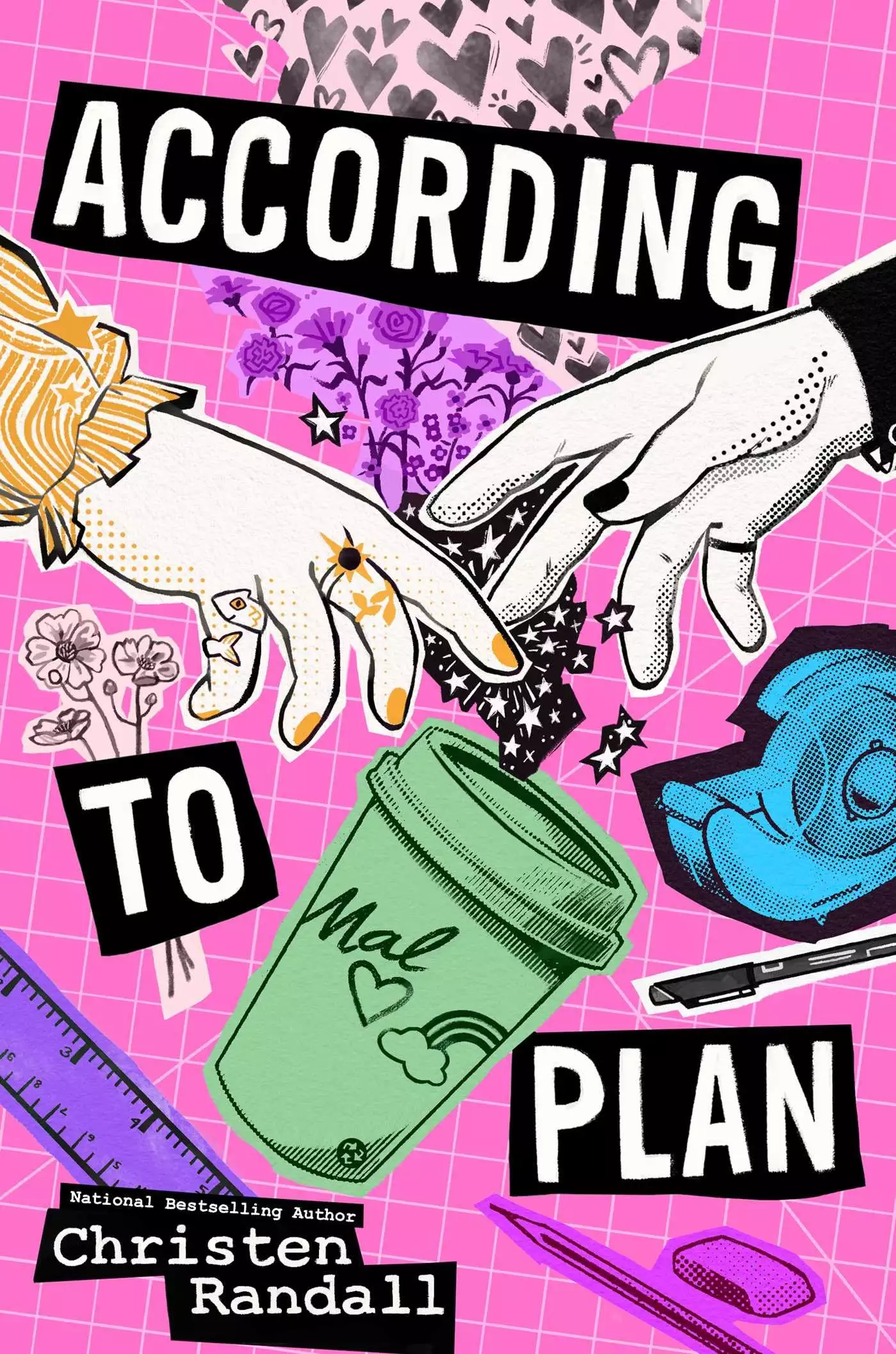
From USA TODAY bestselling author Christen Randall comes a cozy, feel-good queer romance about self-discovery, finding your person, and carving out a space for yourself in unexpected places—perfect for fans of Heartstopper, Felix Ever After, and Julie Murphy.
As editor in chief of their school’s literary magazine, Mal Flowers expected senior year fall to be full of cozy sweaters, good coffee, and copyediting. They just want to stick to The Plan to graduate and get out of their small Midwestern town—a place where, as a broke, fat, queer person with ADHD, they’ve never really fit in. But when budget cuts result in the lit mag’s cancellation, Mal is suddenly scrambling to fill the hole in their college application.
That is, until Emerson Pike—who also has ADHD but is loud, confident, and Mal’s complete opposite—suggests the staff go rogue and create a zine instead. Which would be cool, except that making and selling contraband isn’t exactly what Mal envisioned as the extracurricular activity on their college application. A zine would be unofficial, unapproved, and definitely not in The Plan.
But a zine is also a good way to spend more time with Emerson, whose playful banter and bad jokes Mal can’t seem to get enough of. And maybe, with a group of new friends, the back of the charming coffee shop where Emerson works could be somewhere Mal does belong. Because breaking the rules with Emerson—and flirting with her over coffee—is fun.
Maybe The Plan isn’t the only way to find happiness, but can Mal let go of something they’ve depended on for so long?
Release date:
February 3, 2026
Publisher:
Atheneum Books for Young Readers
Print pages:
320
* BingeBooks earns revenue from qualifying purchases as an Amazon Associate as well as from other retail partners.
Chapter One: The Plan, in Shambles CHAPTER ONE THE PLAN, IN SHAMBLES Mal Flowers had not expected their world to end so early on a Monday morning.
“I’m sorry,” they said, clutching tightly to their disposable coffee cup, “what?” Like their voice, Mal’s hands shook. Hot black coffee sloshed out and all over the top of the desk where they sat.
“I truly hate to say it, but Collage is canceled,” Ms. Merritt repeated. “I’m sorry, kiddos.”
The rest of the magazine staffers started to make noise—disappointed oh maaaans and disbelieving whaaaats and at least one well, whatever—and Mal was suddenly thankful their coffee spill gave them something to do. It was easier to focus on fixing a mistake than on what was happening around them. Mal went through the motions of cleaning up, mechanically mopping up their mess with a brown paper towel.
Though they looked calm on the outside, Mal felt the inside of their brain rage with the pure chaos of too many audio files playing all at once. It screamed with so many voices—some from the classroom around them, some their own panicked thoughts, at least one inevitable I told you so that sounded suspiciously like their mom—that they couldn’t fully process a single one. Here and there, something would break through: Someone was packing up their bag and leaving, Collage was canceled, Ms. Merritt was launching into an explanation about budget cuts that Mal didn’t want to hear, Collage was canceled, their fingers were burning from the hot coffee spill, Collage was canceled.
Mal cleared their throat, trying to dislodge the uncomfortable urge to scream.
“I’m sure you all have questions,” Ms. Merritt said from the front of the classroom. “Anyone? Mal?”
Mal pursed their lips around responses like What the fuck? and How could you? and that silent scream of AAAAAAA. What came out of their mouth—almost ten seconds later—was “I need more coffee, I think.”
If anything could get them through this, it was coffee.
They stood up, carefully sliding their round hips out of their desk. With stiff, robotic steps, they walked away from the rest of the magazine staffers (or what was left of them, anyway). As everyone who hadn’t left right after Ms. Merritt’s announcement began launching into questions, Mal marched behind their (now-former) Collage sponsor, through the doorway into her cramped office, and toward the student editor’s desk.
It was purposeless now. Just like Mal.
They had expected to spend the first few weeks of school correcting roll-call pronouns to they/them and reminding teachers it was just Mal, not Mallory. Instead, the first day of the first week had started with their one and only extracurricular—Holmes High School’s long-running literary magazine, Collage—being canceled. They hadn’t even had time to settle into their official role as editor in chief, a title they had inherited in this very office at the end of last school year.
Even thinking about this ratcheted up the noise of Mal’s mind another two decibels. They tried to quiet it with the routine of making a fresh pot of coffee. They carefully avoided looking at the now-useless editor’s desk, seeking out the ancient coffee maker on the back counter instead. Beside it were all the accompaniments Mal had carefully laid out this morning before the meeting: compostable cups and lids left over from last year, a lone shaker of cinnamon Ms. Merritt had brought in once, powdered creamer and sugar packets from Dollar City that they themself had splurged on. But the carafe in the drip machine was empty, so now their hands went through the motions of making a fresh pot.
For a moment, their thoughts were drowned out by the familiar hiss and sputter as the cycle ran. It was louder than it should have been—or maybe that was just Mal, because everything felt loud right now. The drip, drip, drip of the coffee maker. The distant sounds of conversation in the classroom. Their breath inside their head, rumbling around with the dull roar of their own thinking, like their internal volume was turned up to eleven.
But Mal knew a fresh cup of coffee could make it better—could make them better, with caffeine to sharpen their focus and routine to keep them steady. Before the cycle finished, they removed the carafe and refilled their cup, holding on to it as if doing so would hold them together. The heat of the cup against their palms grounded them in their body rather than the conclusions their brain wanted them to leap to.
Still, they couldn’t reconcile the comfort of their cup with the cacophony outside. How were they supposed to give up this office? These four taupe walls, and their fading motivational posters, formed the one place in Holmes High where Mal didn’t feel like Too Much. Tucked away in the dusty, poorly lit corner of Ms. Merritt’s office, they felt safe.
They had been counting on this refuge.
Beneath them, in their secondhand Doc Martens, their feet were sluggish. But Mal took a deep breath, letting the rich scent of the coffee grounds fill their lungs, and did what they often had to do when they felt close to melting down: They took a sip of coffee and did what they were Supposed To Do.
They walked back into the classroom—and into the bargaining phase.
“But there has to be something we can do.”
Mal knew most of the literary magazine staffers by their writing—the mistakes they made, their particular quirks—more than they knew them by name, but there were some staffers they’d come to know off the page too (mostly those who’d stuck with the magazine as long and as passionately as Mal had). This plea came from James, who wrote literary fiction and overused semicolons. Mal always liked his work because it featured fat people as complex main characters instead of as the punch line to a joke. When they’d first started editing his work, they had been curious about him and had looked for him in the halls. Like his main characters, James was also fat, as Mal had suspected. There were details in his short stories that Mal, who was fat too, was sure someone wouldn’t think to mention unless they’d lived in a larger body—like the uncomfortable experience of narrow restaurant booths or taking up just slightly more than one city-bus seat.
“We can… I don’t know.” James threw his hands up in frustration, sweeping his blond hair out of his eyes with a flick of his head. “Have another bake sale or something.”
“I don’t mind baking extra cupcakes,” volunteered a girl named Nylan. “The pistachio-rose ones were a big hit last year.”
Mal returned to their seat and frowned down at their coffee. The bake sale was their least favorite part of the Collage year. Although, to be fair, Nylan’s cupcakes (decorated with rosettes piped in baby pink buttercream) were almost as beautiful as her lyrical poetry, which was also often nature-themed. Last year Mal had spent their assigned lunch hour at a table with Nylan, and while she was easy to chat with (about cosplay and coffee and the chilly weather that meant fall was on its way), having to talk to so many other students back-to-back over baked goods meant the annual bake sale was A Lot. Mal had been hoping to get out of it this year since they were now the editor in chief.
Guilt twinged in their stomach. They hadn’t wanted to get out of it in a the-magazine-is-over-so-there-is-no-bake-sale kind of way.
“I’m sorry,” Ms. Merritt said, shaking her head. “The bake sale was really just to cover some of the gap in the school funding, and now that it’s cut, I’m afraid that sort of fundraising won’t make much of a difference.”
“But what if we sell more magazines?” asked Parker.
Mal’s frown deepened. Selling Collage to the students of Holmes was already a challenge. While the students in this room adored it, the general population was fairly indifferent. Editing Parker’s short story about a Black girl adventuring in space had been fun (if challenging—made-up planet names were hard to spell-check, especially with dyslexia), but Mal doubted that even another epic, interdimensional odyssey like that could bring in enough readers to save Collage.
“That’s how it works, right?” Parker went on, oblivious to Mal’s gloomy thoughts. Her hands waved through the air animatedly while she spoke, making her many pastel plastic bracelets rattle on her wrists. “Sell more copies, make more money?”
“We could raise the cover price too.”
This suggestion came from Stella, one of the few staffers Mal actually knew knew outside of Collage. Or had known. In freshman year, Mal and Stella had both joined the magazine and become fast friends, but they’d fallen out just as quickly. There had never been a particular moment that did it; Mal’s rules and social irregularities had just added up over the year as Too Much for Stella to handle. Since sophomore year, Mal’s interactions with her had mostly been confined to passing snarky comments back and forth on the pages of Stella’s serialized romantasy (which was, as Stella pointed out in the comments every few pages, the most popular feature in every issue). At the end of last year, Stella had also made it known that she did not approve of Mal’s promotion to editor in chief. Now, with that same snooty air, she pulled her thick brown French braid over her shoulder, her pale fingers combing through its end. “Then we’d earn more for every issue we sold.”
“But five bucks is already a lot,” a staffer chimed in from the middle of the room. It took Mal a moment to recognize her as Kodi. Her low, unassuming speaking voice always felt incongruous with the smooth sapphic poems she wrote. If Mal’s mind had been any quieter, they would have nodded in agreement; the price of Collage was already a big ask for many students, Mal included. If it hadn’t been for their free staff copy, there were some semesters—especially the ones before they were old enough to work at Dollar City—when they wouldn’t have been able to purchase it at all.
But their mind still raged with thoughts, so Mal just scrunched their nose, gripped their cup harder, and took a jerky sip of their coffee.
“I mean, if it’s what we have to do,” Parker said, her high voice going squeakier with distress. “If we sell enough, maybe we could fund the print run ourselves, without school support.”
“We’d have to do the math,” Nylan chimed in quietly, “but it’s worth considering.”
“Again, I’m really sorry I don’t have better news, team, but I don’t think that’s something we can manage,” Ms. Merritt said. “The printing cost alone wasn’t even covered by the cover price—that’s why our funding was so important—and there’s a lot that goes into producing a magazine like Collage beyond that cost too. And you know I believe in what we do here, but I don’t have that sort of funding hanging around, unfortunately.”
A collective sigh went around the room—in phases, deflating and then sharp with an intake of breath and then deflating again—until everyone finally went quiet. Mal got lost in their coffee, blinking down at their reflection in its still surface. It had started to cool—and with it, so had Mal’s last hope of finding a solution. The noise of their brain turned up again, threatening to pull them down into the depth of overwhelm.
“What if we DIY it?”
The words were so loud that Mal looked up from their coffee. They came from a girl named Emerson Pike. Unlike most of the other Collage writers, Mal had always known Emerson on sight, without question. Minus the month and a half Emerson had missed during freshman year, she had been everywhere for Mal’s entire high school career: in their English classes, having loud opinions about American literature; in the margins of Collage, pushing back on Mal’s corrections every single issue; in the windows of the coffee shops Mal passed on their walks, deep in animated conversation; under a bridge with a big group of community volunteers, painting a mural on an overpass wall as Mal rode by in the back seat of the Flowerses’ minivan.
Mal knew Emerson because she was bright. Not just her colors—though she was bright that way too, with big, bushy, naturally red hair and a vibrant wardrobe full of loud patterns and bold colors that called attention to her fat body instead of hiding it. Emerson was bright in who she was as a person. Her default expression was a smile so radiant, it bordered on blinding, and her voice was often snorty with laughter at some secret inside joke she would probably share if you asked. It was like she was turned up brighter than everyone else in the room, that one bulb on a string of lights that glowed a touch more yellow than the rest. You couldn’t miss her.
All of this made Emerson stand out, and not always in a good way. She was so wildly different—from Mal, especially. Emerson’s brightness made Mal’s plain blond bob, muted gray T-shirt, and quiet, considered voice seem downright dull.
Emerson also seemed incapable of sitting still, ever, like she was a bomb at risk of going off if she didn’t wave her hands enough when she talked. They danced through the air in front of her as she went on, somehow managing to smile around her words.
“We could make it a zine. Zines are easy and cheap to make. They’re a hyperfixation of mine right now, so I’m trying not to info-dump on y’all, but, like, literally, we could do a first run with, I don’t know, fifty bucks? A hundred, tops? Then we could make more with what we earn back, like you were saying, Parker.” Emerson waved a welcoming hand to Parker when she said her name, like she was inviting her in. “And, sure, it’s different from the actual magazine, but they’re really rad, and we could still get our words out there—and that’s what matters, right?”
Stella huffed and rolled her eyes from her seat nearest Ms. Merritt.
But Parker nodded and said, sounding hopeful, “Right.”
“It’s true,” echoed James.
“That does sound like a neat idea,” said Nylan.
“I don’t disagree,” said Ms. Merritt. “But since it’s a school-led program, we have to get our funding through official channels.” Several students groaned, and Ms. Merritt waved her hands placatingly. “I know, I know. Very square and bureaucratic of me. But we have to do things by the book.”
From their desk in the middle of it all, Mal nodded glumly.
“Or we could not,” challenged Emerson, with a casual shrug and a wicked grin, “and fully do it ourselves. Take it rogue.”
Mal scoffed, but they were the only one. Most students were entirely checked out, waiting for the meeting to be over, but the small, core handful were nodding in agreement with Emerson’s suggestion. Mal’s lips pressed into a frown.
This was entirely too much. Emerson was entirely too much. She was acting very much like her writing: kind of all over the place, with too many exclamation points and, as she defended in the edits Mal made, artful comma choices.
But Parker didn’t seem to think so. She leaned back in her chair, grinning at Emerson, and said, “We could totally do that.”
And Kodi said, “That would be cool as f—uh”—she threw a glance to Ms. Merritt—“farts.”
“Yeah,” said Nylan, turning from Emerson to face Mal instead. She smiled. “What about it, Mal?”
“Huh?” they said elegantly.
“You’d be the editor.” Emerson said it with an implied duh, and a very small piece of Mal buried somewhere beneath the near meltdown glowed with pride. “So, what do you think?”
“I…” The two cups of coffee they’d had that morning shifted awkwardly in their stomach. With the eyes of most of the classroom on them, it was harder to hold what was happening at arm’s length. The panicked, hot feeling of a meltdown swelled inside their chest, tightening their throat. “Don’t?”
Smooth, for a first—and last—editorial ruling.
Ms. Merritt stepped forward, reclaiming the attention and saving Mal from whatever words were about to come out of Emerson’s mouth, which had opened (with a quirk of her eyebrow) for a retort.
“I’m afraid the official, final word is: We’re shuttered, folks,” she said, and to her credit, she looked as distraught about this as Mal felt. “Collage has been a Holmes High School institution for almost fifty years. I wrote for it when I was a student here, so I wish I had better news for this first meeting of the year.”
Ms. Merritt paused, looking at each of the students in turn. When she met Mal’s eyes, they could feel their own go wide, their chest hammering like they’d been caught by the red flashing hand halfway across a street’s crosswalk. Ms. Merritt had always had a keen editorial eye—but more than that, she had seen Mal’s potential back in sophomore year, when she’d brought Mal onto the editorial side of Collage. She had seen Mal, which was not something they often felt.
But now, under her brief but piercing stare, they felt almost too exposed—as if, should Ms. Merritt look too closely, she would see the truth: Mal Flowers was absolutely nothing without Collage.
It was only after her eyes moved away that Mal was able to catch a breath, quickened by that horrible thought.
Ms. Merritt spoke again, as if things were not, in fact, The Worst. “But I don’t want this meeting to be our last. I think we owe it to the magazine—and ourselves—to send Collage out in style. How would we feel about a potluck-style farewell party this Friday after school?”
“We’ll be here,” said Nylan, and Parker nodded beside her.
“You know it,” said Emerson, more than a little too loudly.
Mal couldn’t muster anything more than a nod.
“All right, team.” Ms. Merritt nodded too, resolutely. “We’ll see each other Friday.”
Mal wasn’t sure whether this gave them something to look forward to or to dread. But they had more pressing worries than what to bring to the farewell party (though they would worry about that later too). Much more pressing was the truth that without Collage, The Plan—and Mal—was ruined.
The Plan was one of Mal’s many proper nouns: a concept they’d carried with them since third grade, when they’d first learned that a proper noun was a specific person, place, thing, or idea. They knew it was meant for terms like Aunt Tina, Roebling Bridge, and Holmes High School, but for Mal, nouns like Too Much Noise, Good Coffee, and A Mental Health Walk had always felt just as important.
The Plan was the most important proper noun of all, because it was Mal’s framework for their future, the structure that kept their neurodivergent brain in line and on time, focusing on an End Goal rather than meandering off on random, late-night hyperfixations or spiraling into a labyrinth of homework avoidance. Before The Plan, Mal had been directionless, simply hopping from one interest (biology, for example) to another (vegetable gardening, via an interest in cozy video games). While Mal felt more fulfilled—or at least less bored—by those sorts of things, the forward motion of The Plan helped them achieve something even more important: what mattered to their parents.
The Plan consisted of a few simple steps, which Mal aspirationally wrote down every year in a secret, taped-in back page of their planner:
Do the best you can at school.
Work at Dollar City to save money.
Edit Collage for Common App activity.
Go to University of Kentucky with Maddie.
With 25 percent of those steps no longer an option, The Plan was in shambles. They needed to get it back together before they fell apart too.
For Mal Flowers, that meant one thing:
They needed Maddie.
“And she dropped it on you just like that, right before school?” Maddie asked, raising an eyebrow at Mal.
Mal gave a curt nod, their lips pressed into a hard line.
It was only now, during lunch, that they were finally able to tell Maddie what had happened with Collage that morning. Maddie—Mal’s sister—was a year younger than them in age but was in the same graduating class after Mal had been held back in eighth grade. Earlier on, they had often been confused for twins, since they both had identical blond hair and brown eyes—but then Maddie hit her growth spurt, becoming tall and athletic while Mal stayed short and round.
Sometimes, especially in the beginning, Mal had been embarrassed to be in the same grade as their little sister, but their embarrassment was far outweighed by the perk of having a ready-made best friend in all their classes. But in a cruel twist of senior-year fate, the two siblings hadn’t been scheduled for any shared classes until their lunch hour. All day Mal had carried Collage’s cancelation around with them like a private rain cloud. Now that they were finally with Maddie, it all came storming out over the round lunch table.
“The whole magazine done, just like that,” they said, flicking their hands outward as if to shoo the words away. “And the money isn’t even going anywhere. Just… away.”
Not unlike The Plan. The feeling of Too Much pulled hard at Mal’s edges. They dropped their hands to their lap, fingers drumming on their thighs.
“Well,” started Maddie, teeth snapping into a baby carrot, “it was really shit of Ms. Merritt to drop all that on you right before school started. Especially over coffee.”
“Right?” Mal still felt betrayed. Coffee time was a sacred time—and so was Mal’s space within it. “I could hardly pay attention in AP Bio, and during the get-to-know-you thing Ms. Woodmore did in Econ—the one where you have to think of a word that starts with the same letter as your name and also repeat everyone’s back—I said I had to go to the bathroom when it got close to my turn.”
It was worth the embarrassment, honestly. The cool water of the sink on their wrists had been a welcome distraction from their racing thoughts.
“You know, fair. I can never remember half of those on a good day.” Maddie was being nice. She always made a stellar first impression with her icebreaker answers. “Okay, so, do you want to know what I think you should do?”
“Yes,” Mal burst out, almost before Maddie finished her sentence. This was the whole reason they’d wanted to talk to Maddie. When Mal’s brain got Like This—worked up, overwrought, close to imploding, turning them into a useless and unpleasant pile of goo—they turned to Maddie’s much-calmer brain for advice. Maddie’s mind could take all the tangled-up typos and key-smashes of Mal’s thoughts and smooth them out into words and sentences, into solutions. They could already feel the shimmering cool of calm relaxing their tight shoulders with the promise of actionable steps.
“I think you should pivot,” Maddie said plainly, like it was that simple.
Mal rolled their eyes. “Yeah, okay.”
“Yeah, okay.” Maddie swatted playfully at Mal’s knee. “This direction is a dead end right now—and, really, I am sorry, I know you would have kicked ass as editor in chief, Mal—but you can definitely find another direction and just… pivot to that.”
As helpful as she could be, this was also what happened sometimes with Maddie: She gave answers Mal didn’t fully understand. Or, well, that wasn’t true. They understood the words she was saying, the concept. Sure, find something else to do instead of Collage and do that.
But the disconnect was that, while it might be that simple for Maddie, for Mal it was not.
“I can’t just pivot.” They had a hard enough time following the straight lines they were supposed to, even with The Plan to guide them. Trying to follow whatever shape a pivot made… Mal could feel their body tensing just at the thought.
“Mal,” Maddie said, her voice calm. “You can absolutely pivot. You are a smart and capable badass.”
No, thought Mal, that was Maddie, with her straight A’s and soccer captainship and probable scholarship to University of Kentucky in Lexington for one or both of those—the Way Out of Covington that she talked about like it was an incantation that would change them both for the better. Their sister made it all look easy, banging out last-minute papers after practices and still managing to show up at the kitchen table with coffee for late-night sibling study sessions. But Mal often struggled even with simpler things—like remembering to brush their teeth, which Maddie insisted Mal should add to their morning routine. When she explained that for her, this was not something she had to actively think about, just something she did automatically, Mal’s mind was blown. They had to run through their morning routine every day in their head like a checklist. But they were always losing parts of it, erased by their anxious thoughts.
Pivoting sounded similarly mythical to Mal. But Maddie was trying to help, and so they tried—they always tried—to listen.
“What could I even pivot to?” they asked.
“Anything, really,” Maddie said matter-of-factly. “Any club here would be lucky to have you. You get things done.”
That was not all the way true. Mal got Collage things done. They had prioritized it in The Plan because it was the thing they were best at. And, to be honest, sometimes they didn’t even think they were good at Collage. They hadn’t been good at the writing part, certainly. In fact, they had fallen into an assistant editor role in sophomore year because they were so bad at the writing part that Ms. Merritt had taken pity on them when they asked for it. She said she “recognized potential in Mal’s editorial eye,” whatever that meant.
The truth was, Collage was just the place in school where Mal felt the most like they fit, or the least like they didn’t.
But Mal couldn’t explain this to Maddie, because Maddie didn’t know about The Plan. While Mal shared everything else with their sister, anytime they got close to sharing this, their skin suddenly felt like it was on too tight. Telling Maddie about The Plan would mean admitting they needed one. That all those things that came so naturally for Maddie didn’t for them. That Mal’s Way Out of Covington was uncertain at best.
And that there was something so fundamentally Incorrect with Mal that they needed an elaborate system in place to mitigate it.
Walking the thin line of The Plan alone was frightening, but it was nothing compared to the horror of having to invite someone else into it. Mal shook their hands out to release the tension, caught themself, and stopped.
Sensing Mal’s impending spiral, Maddie added, “Would it help if we made a plan?”
Mal nodded frantically.
“Perfect,” Maddie said, scooting their lunch tray aside to make space on the table. “Let’s do this.”
And so Mal fished out their planner from their backpack, folding the planner in half at the spiral binding. Mal’s planner was a bit like their brain. It was
We hope you are enjoying the book so far. To continue reading...

 Please log in to recommend or discuss...
