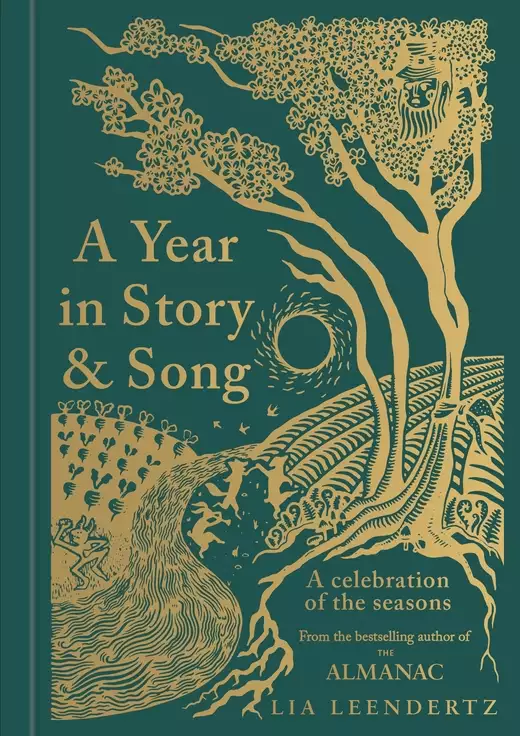
A Year in Story and Song is a captivating collection of stories and songs that celebrates the seasons.
We humans love stories. We love to hear them and to tell them, around fires and by bedsides, and we love to use them to make sense of the world around us.
The seasons, in all their ever-changing variety, give us many opportunities for storytelling: the full moons and their names, Epiphany in January, St Patrick's Day in March, May Day, Midsummer, Halloween and more. They feature mischievous boggarts and fairies, saints and sailors, leprechauns and dragons, pilgrimages and charms, milk maids and rose queens, Robin Hood and the green man. The songs range from shanties and love songs, to bawdy ballads and wassails, to carols and rounds, and have been sung for hundreds of years, often at particular moments in the calendar.
This is a book to treasure all year, every year.
Release date:
July 29, 2025
Publisher:
Octopus
Print pages:
160
* BingeBooks earns revenue from qualifying purchases as an Amazon Associate as well as from other retail partners.
Januar (Scots/Ulster Scots) | Eanáir (Irish Gaelic)
Jerry-gueree (Manx) | Ionawr (Welsh)
Genver (Cornish) | Janvyi (Jèrriais)
Iveskero (Romani)
The word Faoilleach in Scots Gaelic originally referred to a period of winter, but has come to mean specifically January in modern Scots Gaelic. It comes from faol-chu which means ‘wolf’, and this gives a glimpse into Scotland’s wilder past Januarys, as there have been no wolves in Scotland for hundreds of years (the last wolf having been slain by legendary deerstalker MacQueen of Findhorn in 1743). Wolves’ howling reaches its height in January in mating season as the males compete for mates, before falling quiet during the denning season.
All of the other words for January from the various languages of the British Isles appear to be variants on the Latin Januarius. This may have arisen from either the Latin for ‘door’, ianua (the door onto the year), or the Roman god Janus, the god of transitions and beginnings, traditionally depicted as having two faces, one looking back into the past and one looking ahead to the future.
Since the 16th century, following their migration from continental Europe, there have been Romani families and communities living in the UK. Romani, spoken by many Romanies in the UK, is a language with movement at its core. It is a mixed language that has picked up influences wherever the Romanies have travelled, and so incorporates aspects of Indian, Greek, Persian, Slavic and Romance languages, creating a philological map of their wanderings north and west from, it is thought, the Indian subcontinent. In Britain and Ireland this is mixed with English and with elements from the language of Irish Travellers (known as Gamin, Shelta or Cant).
The Romani words for the months have fallen out of common use now, but records of the Welsh Romani month names exist, and these were possibly once used by Romani communities all over Britain. They show a pattern of deep connection to the land and the seasons, as well as to work and food.
The word for January, Iveskero, means ‘month of the snows’. The name dates from before ‘wagon time’ – the time when the Romani started living in wagons – and from a period when they would travel by walking alongside their wagons, which carried the makings of simple tents. These were constructed from willow wands bent and pushed into the ground and then covered with serge, a thick woollen fabric. Snow would have meant great hardship, as well as a struggle to look after their beloved horses, which would have been covered in cloths stuffed with straw to keep the cold away.
Some days are naturally more strongly invested with meaning than others and so have held particular weight when it comes to luck and charms, and 1st January is one of them, acting as a hopeful microcosm for the whole year. Charms have always lent a sense of control and security where little existed, or have been used to hold on to the special qualities of certain moments of the year. On New Year’s Day throughout the British Isles, charms must be carried through doors to carry in luck for the year ahead. In the southeast of Wales, children carry from door to door an apple skewered with sticks, cloves and pieces of evergreens, thought to bring luck and prosperity, and in return they are given ‘calennig’ – New Year’s gifts of pennies or sweets. Sometimes the apples are then placed on windowsills to bring the household good luck through the year. In Scotland and the north of England, ‘first footing’ relates to the first person through your door on New Year’s Day. Ideally it should be a bachelor, and he must have been out of the house at midnight. He should bring coal, bread, a coin, a piece of greenery, salt or whisky over the threshold.
On Burns Night on 25th January, cullen skink, haggis and tatties followed by cranachan are eaten, and the poems and songs of Robert Burns are recited, to celebrate the life of the great Scottish poet. ‘Ae Fond Kiss’ is one of his most beautiful songs and was written after his final meeting with his adored friend Mrs Agnes McLehose, known to her friends as Nancy, on her leaving Scotland to attempt a reconciliation with her estranged husband in Jamaica.
Who shall say that Fortune grieves him,
While the star of hope she leaves him?
Me, nae cheerful twinkle lights me;
Dark despair around benights me.
I’ll ne’er blame my partial fancy,
Naething could resist my Nancy;
But to see her was to love her;
Love but her, and love for ever.
Had we never lov’d sae kindly,
Had we never lov’d sae blindly,
Never met – or never parted,
We had ne’er been broken-hearted.
Fare-thee-weel, thou first and fairest!
Fare-thee-weel, thou best and dearest!
Thine be ilka joy and treasure,
Peace, Enjoyment, Love and Pleasure!
Ae fond kiss, and then we sever!
Ae fareweel, alas, for ever!
Deep in heart-wrung tears I’ll pledge thee,
Warring sighs and groans I’ll wage thee.
This is a traditional wassailing song for Twelfth Night. There were two distinct types of wassailing. One involved moving from door to door singing and carrying a wassail bowl, and the other was held in orchards, singing to and blessing the trees for a fruitful year ahead. It is the second type that is now more widespread, the rise in community orchards sparking a revival, so look out for one near you on or around Twelfth Night.
Here we come a-wassailing among the leaves so green,
Here we come a-wassailing so fair to be seen.
Love and joy come to you
And to you a wassail too,
And God bless you and send you a happy New Year
And God send you a happy New Year!
Call up the master of the house, put on his golden ring,
Bring us all a glass of ale and better we shall sing.
Love and joy come to you …
We have a little purse and it is made of leather skin,
We want a silver sixpence to line it well within.
Love and joy come to you …
God bless the master of the house and bless the mistress too,
And all the little children that round the table go.
Love and joy come to you …
Balthazar was the King of Ethiopia. A new and bright star appeared in the sky, as had been foretold in the Star Prophecy: a prediction of the coming of a new Messiah. And so Balthazar gathered myrrh, the precious resin of the small thorny tree Commiphora myrrha, which grows in eastern and northern Ethiopia, and set off for Bethlehem with two other great kings – Caspar and Melchior – to pay their respects.
Rastafarians celebrate the birth of Christ, who they believe was Black, on 7th January, and call it Lidat, which means ‘birthday’ in Amharic, the main language of Ethiopia. Rastafari is intricately connected to Christianity but based upon a particular reading of the Bible that centres on its many mentions of Ethiopia, including its role as the ‘promised land’. The Ethiopian Orthodox Church is after all one of the oldest churches in the world: Christianity has existed in Ethiopia since AD 330. Rastafari itself is a young religion, originating among impoverished African–Jamaican communities in the 1930s, its Africa-centric vision emerging partly as a reaction to British colonialism and as a way of reclaiming an African identity lost through slavery. Rastas believe that the Bible was originally written in Amharic and is an authentic account of early Black history and Black Africans’ place as God’s favoured people, the Israelites, but that this original meaning has been warped by mistranslation to deny Black Africans their true history.
This date of 7th January is in tune with the Julian calendar followed by the older Orthodox churches, but Rastas do not insist that this was the actual date of Jesus’ birth (merely rejecting the date of the 25th December, which they consider a later construct to convert midwinter-worshipping pagans to Christianity). They do, however, consider this as the date upon which the Magi visited Jesus. A feast is prepared, children are given simple presents and they play games. The main decoration is that of the manger with the three Magi. . .
We hope you are enjoying the book so far. To continue reading...

 Please log in to recommend or discuss...
