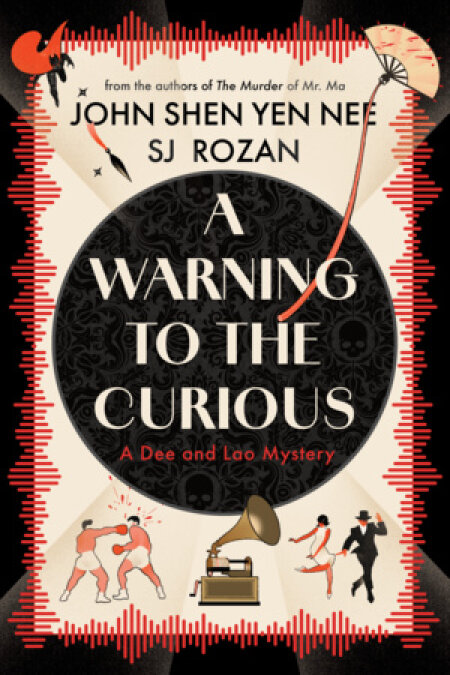
A missing shipment of weapons for China and the murder of an aspiring scientist kick-start a madcap dash through the world of seances, prizefighting, cutting-edge technology, Holmesian cameos, and many disguises.
London, 1924. Judge Cheng Gao Shang has been sent by Sun Yat Sen’s government to look into the death of Dee Ren Jie, the larger-than-life investigator who had kept the local Chinese community safe. But Dee isn’t dead; he’s hiding out with his friends Lao She and Sergeant Hoong while keeping a close eye on Cheng’s activities. Has Cheng actually come to London to track down a shipment of arms covertly sent from England, intended for Sun Yat Sen as he attempts to unify China?
Judge Cheng’s daughter, Irene, is also in London, and the intrepid, intellectually curious young woman quickly falls in with some very interesting associates. But tragedy soon strikes—or is it something more sinister? To find out, Dee Ren Jie will have to rise from the dead in this action-packed kung fu caper, the third installment of the Anthony Award–winning Dee and Lao Mystery Series.
Release date:
November 17, 2026
Publisher:
Soho Crime
Print pages:
272
* BingeBooks earns revenue from qualifying purchases as an Amazon Associate as well as from other retail partners.
I have said every tale of Judge Dee Ren Jie seems to begin with a fight. In the case of the events I will recount in this book, which transpired in London in November of 1924, that statement once again holds true. The fight in question, however, took place neither in the streets of London, nor, in fact, in Britain at all. And Dee took no part in it, because he was dead.
I hasten here to reassure the readers of this tale: Of course Dee was not wholly dead. Not in point of actual fact, not as instruments could measure. His death had been reported and was assumed; no body had been found, but given the circumstances, this was regarded as a small inconvenience, easily explained. The governments of Russia and Japan, the warlords battling in the north of China, and most of the constables and officers of the London Metropolitan Police were eager to believe in Dee’s passing and were well satisfied to dust their hands of him.
This suited Dee. Before he “died” he had been accused of causing a number of fatalities and a certain amount of mayhem in London. That havoc had, in fact, been the work of others. Now that he was presumed by all except his friends to be residing in the spirit realm, he was free to attempt to clear his name and take up his next mission.
What that mission was to be, neither he nor any of us yet knew.
Chapter One
London, November 1924
All was bustle and talk around me at the Palaseum Cinema in White Horse Road, Stepney. No moving picture would be shown this afternoon, yet the auditorium was far from empty. Comfortably seated beside Sergeant Hoong Liang on the maroon plush of the first row of seats, I watched as young Jimmy Fingers hopped about the stage in front of the proscenium curtain assisting Anthony Cartwright, a recent addition to our small group of friends. Jimmy, Cartwright, and Gao Feng (and her Chuandong hound, Mei Qiang), also recently added to our circle, were participating in the connection of a radio telegraph receiver to the electroacoustic transducer Cartwright had developed in his laboratory.
“Oh, but the design’s not mine, Lao,” he’d said, when I expressed admiration upon my visit, a week prior, to his workplace. Cartwright, in this large-windowed wondrous place of equipment and apparatuses, wires and switches, liquids and powders with beakers and test tubes to mix them in, was giving me a preview of the nearly completed device. “Two American fellows, Rice and Kellogg, have a patent on this magnetic moving-coil business. I made a few improvements, that’s all. Oh, hello, you.”
That last was directed to a large gray cat that had jumped onto the sill of the open window. It twitched its tail in reply.
“That’s Young Scorpion,” Cartwright told me, as he lifted a screwdriver to an attachment on the device. “He chases off the mice but he demands a fee. Pour him some milk, would you?”
I extracted the bottle from the laboratory’s ice-box and decanted it into a saucer. Young Scorpion watched gravely.
“Doesn’t Feng help you out in the laboratory on occasion?” I asked. “How do Young Scorpion and Mei Qiang get along?”
“Oh, they’re great friends. They teach each other fighting skills and then share long periods of silent meditation.”
The cat primed himself to leap down to the floor, but suddenly arched his back and hissed, staring wide-eyed behind me. In some alarm, I turned. Nothing was there.
“Oh,” I said. “British cats also see ghosts, then, as Chinese cats do?”
“Why would they not? Oh, blast.” Frowning, Cartwright leaned into the large metal cone before us. I peered into it beside him. He reached to twist a wire more securely around a peg.
“If those Americans hold a patent,” I said, “how is it you’re able to use their invention without compensation?”
“Am I? Have I? Perhaps I paid a king’s ransom! Perchance I promised my firstborn! Also my second born, one to Rice and one to Kellogg. The moment those offspring come to be, I’ll ship them over. Do me a service and hold this.” As his head and shoulders moved deeper into the cone, he passed a small spanner back to me. “Well, I’ve done none of those things. I studied the patent drawings, altered this, modified that, and revised the other, and have emerged with a louder, clearer, and more subtle version of their device which, although we’ll test its efficacy at the Palaseum, will earn me not a sou and therefore be no infringement upon their rights. If I may have that back?” As his head was now buried inside the cone and his words thus both indistinct and echoing, it took me a moment to realize his hand, outstretched behind him, was ready to grasp the spanner again. I placed it there and, from the corner of my eye, saw the tail of the cat vanish out the window. I looked to the saucer; it was empty.
Now a week had passed, and we were at the Palaseum waiting to experience this marvelous device. Just as the original design for the transducer had not been Cartwright’s, neither had the choice of the day nor the content of the transmission. That content was the attraction that had brought us all together here. And not solely, or even principally, the content itself: rather, its point of origination.
A middleweight prizefight was to take place at noon Eastern Time at an arena known as Boyle’s Thirty Acres, in Jersey City, New Jersey, America. And we, at 5 p.m. Greenwich Mean Time at the Palaseum Cinema, in Stepney, London, England, proposed to listen to an account of it as it happened.
Some in our party were, in fact, primarily focused on the prizefight itself. These included the Palaseum’s proprietor, Ben Hur. A man of the Hebrew faith born Henry Ben Solomon, Ben Hur had been a boxer and stage strongman in his younger years. He was long since retired from the ring and was now a landlord and philanthropist; but he continued to follow what has come to be called the sweet science.
Also with a great deal of curiosity about the event was my brother-in-arms Sergeant Hoong, who took a strong interest in any pugilistic art.
Another group concerned, primarily, with the fight and the fighters—a concern I suspected to be to some extent financial, as the London bookmakers had lately been doing a healthy trade in wagers in both directions on the result—were some men of Ben Hur’s acquaintance, scattered through the rows of seats. They were shopkeepers and market stall traders by the look of them. One or two of these proved also to be intimates of Jimmy’s, who greeted them with gusto; this made me suspicious as to their actual professions but they seemed an affable enough lot. A few journalists also sat among us, men—and one woman—skeptical of our experiment in trans-Atlantic connection but attracted by the attempt, itself newsworthy. Should it succeed, I was sure we’d see them trampling one another up the aisles in their eagerness to “scoop” their fellow correspondents.
To be sure, the upcoming fight was not without significance. An American Negro known as “Fist” Fitzhugh would be battling an Italian boxer, Giuseppe Gelatino. The Italian was a great favorite of Benito Mussolini, the Fascist ruler of Italy. As such, sentiment in the Palaseum ran high against him.
The fight aside, however, many of the people in attendance—and I included myself in this number—were more intrigued by the possibility of hearing a voice from America reverberating through the London air than by whatever it might be saying. Aside from Feng, Cartwright, and myself, in this category I also placed the students Cartwright had invited from the university. Though traveling seemed to be, in some ways, Cartwright’s profession, he’d chosen to remain in London for a time and had secured an appointment as a lecturer in the natural sciences at the University of London, where I also taught. Cartwright was charged with explicating the complex phenomenon of electricity for the young. My task was to teach them very basic Chinese. Whose mission was the more difficult was a vexed question.
Hoong and I watched the team on the stage making their final preparations. “I’m sorry Dee’s not here,” I said in a low voice to Hoong. “I’d have been interested in his comments on what we’re about to witness.”
“Dee will reappear at a time he feels is right,” Hoong said. He smiled and added, “And no doubt he’ll have comments on today’s events.”
I thought all the audience had long since arrived in the auditorium and seated themselves, but two young women now burst through the curtain from the cinema lobby and bustled down the aisle. Seeing them, Cartwright cried, “Ladies!” He jumped from the stage. “You’re here! Lao, Hoong, let me introduce you.”
I turned and stood, as did Sergeant Hoong.
As the pair approached I was struck by their beauty, very different from each other yet both enchanting. The shorter was a curvaceous European of perhaps thirty, with a bouncing bob of blond curls. Her mouth was painted crimson, the blush of her cheeks had been heightened with powder, and some women’s magic had been effected around her eyes, which amplified their already vivid blue. The taller woman, willowy and a bit younger, had the pale, high-cheekboned face of Han Chinese aristocracy. Her delicate lips were ruby red, in the way of the Modern Girl, but she wore no other color on her features, nor needed any. Her glossy black hair was also bobbed, but in a style that was almost mannish, shorter than the other’s and as sleek and austere as the other’s was exuberant. Both ladies wore cloche hats, the blonde’s with a spray of feathers, and their coats were open, suggesting they’d emerged from a motorcar directly in front of the theater. Within the open coats one could detect clothing of the most up-to-date style. The loose pale-gold blouse of the blonde was beribboned with peach bows at the hips, while the Chinese woman wore a simple, severe white shirtwaist tucked into a slim black skirt. Neither woman’s hem seemed willing to venture below her knee.
“Lao She, Sergeant Hoong.” Cartwright spread his arms when the ladies reached us. Hoong and I bowed to both ladies. “Allow me to present Irene Cheng, a very serious student at the university who’s not enrolled in Lao’s course because she doesn’t need it. She is, however, enrolled in mine.”
He seized Irene Cheng by the shoulders and kissed her upon both cheeks. She blushed a fiery scarlet, though she smiled behind her hand.
“I take liberties,” Cartwright declared, “but it’s due to the cleverness and persistence of Miss Cheng that we’re here today, about to make history. I’ll detail all this for you straightaway, but first you must meet Miss Cheng’s illustrious friend, Olga Aparova.” He gestured to the blond woman.
“I was afraid you had forgotten me, Professor Cartwright.” With an impish smile, Olga Aparova held out her hand; Cartwright kissed it. The lady’s Russian accent—I vas afrait—was charming, as was the twinkle in her eyes.
“Oh!” I said, taking her gloved hand in both of mine. “You are Olga Aparova? The renowned soprano? You made a sensation in Spain in Jardín de Oriente last season. I’m honored to be in your company.” Quickly, realizing my comment might be construed as impolite to her companion, I added, “And yours, too, of course, Miss Cheng.”
“Of course.” Irene Cheng smiled and extended her hand. I was unsure as to whether I was meant to kiss it or shake it. I made a bobbling attempt at both and, to her amusement, succeeded at neither.
“Ladies.” Cartwright came to my rescue. “This is Lao She, a fellow professor at the university but one with actual credentials, unlike myself. He instructs befuddled Britishers in the finer points of the Chinese language.”
“Really, only the most basic points,” I responded. “Which, I’m sorry to say, seem to be quite enough to produce befuddlement.”
“And this is Sergeant Hoong,” Cartwright said. “He’ll tell you he’s just a Limehouse shopkeeper, but I wouldn’t advise you to believe that.”
Hoong, with no change of expression, bowed again to both women. They regarded him with interest. Well they might, as he was clothed in his shopkeeper’s heavy blue cotton tunic and trousers, and his Chinese slippers. The rest of the population of the Palaseum, including myself and Cartwright’s students, some of whom were of Chinese or Japanese descent, wore European clothing. The exception was Feng. She was dressed, as always, in black silk trousers and tunic and a green embroidered waistcoat with, I had learned, many pockets.
“As I told you, Miss Cheng is a serious student,” Cartwright said. “Her interest in advances in the instruments of communication has led her to my course in electricity, and she’s become adept at using the newest radio telegraphy equipment. It was she who made contact with the ‘ham’ radio operator in America who will be sitting ringside and sending us today’s fight as it happens.”
“I must admit to a certain trepidation on this topic,” I said, addressing both Cartwright and the young women. “People do not always find it easy to understand one another at the current speed of communication. It seems to me not at all certain that an increase in velocity is what’s needed.”
“Oh, but this apparatus offers so much more than speed!” Irene Cheng said. “Perhaps you’d take some time from your own classes to cross the university campus and allow me to show you the laboratory, Professor Lao?”
“I’d be delighted.”
She gave me a bright smile.
Cartwright glanced at his wristwatch. “Come on, Irene, it’s getting close. We need to fine-tune the set.”
Irene excused herself and trotted up the stage steps after Cartwright.
We hope you are enjoying the book so far. To continue reading...

 Please log in to recommend or discuss...
