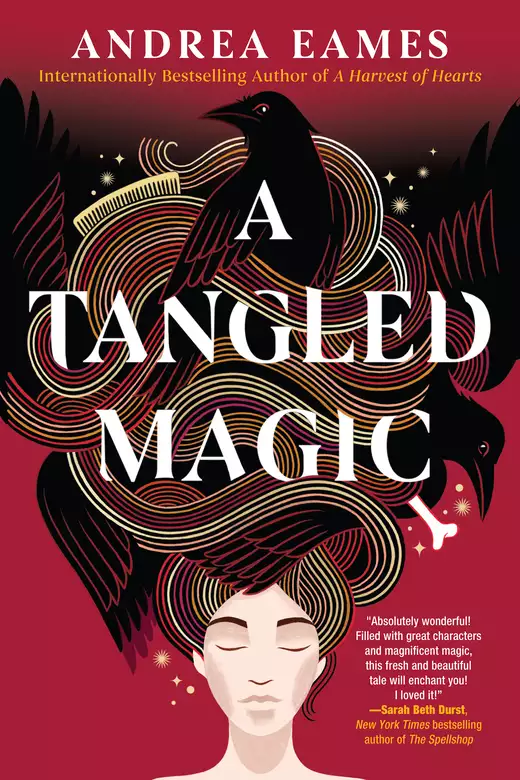
Rapunzel meets Six of Crows in this darkly imagined high fantasy for fans of T. Kingfisher’s Nettle & Bone, The Bone Shard Daughter by Andrea Stewart, Naomi Novik’s Uprooted, and Disney’s Tangled, as a woman with amnesia—and magical hair—searches for her lost memories while navigating a web of royal intrigue, bone magic, and secret monasteries.
All her life, Netta has only known the Tower—its musty shelves of books she cannot read, ink-splattered quills, and endless scrolls of paper. Her mother, ambitious and analytical, has spent decades perfecting her greatest masterpiece: a spellbook of unspeakable power. Netta’s only companions are her long red Hair, which moves of its own accord, and a telepathic raven named Baldbeak. Her only amusement lies in crafting intricate embroidery from scraps of silk and thread.
When attackers storm the Tower, her mother and the spellbook vanish. Determined to find her, Netta ventures into a kingdom on the brink of civil war. The monarch lies dying, while pious Temple fanatics and the noble elite scheme for the throne, forging secret alliances and building hidden armies. For reasons she cannot yet fathom, all these factions seek Netta—and the dangerous, uncontrollable magic in her Hair.
But whom can she trust? The sharp-eyed pickpocket bent on revolutionizing the use of magic? The elusive black market trader known only as the Book Man? The charming magician who slips between shadow and light? From masked carnivals to opulent ballrooms, from hidden monasteries to catacombs, Netta must untangle a web of lies and intrigue - not only to find her mother, but also to uncover the true nature of the power that has shaped her life.
Release date:
July 28, 2026
Publisher:
Erewhon Books
Print pages:
464
* BingeBooks earns revenue from qualifying purchases as an Amazon Associate as well as from other retail partners.
‘The simplest of the stitches, and the first any novice must learn as they master the art of dipping the needle in and out of the cloth with the required smoothness and fluidity. Without mastery of this most essential stitch, no great work can begin.’
—An Exhaustive Compendium of Stitches Both Holy and Base, 4th Edition
I woke with my head hanging out the Tower window and my arms pinned behind me.
I’d had many a miserable awakening over my years spent in the Tower, as I was a heavy sleeper—Mother pulling the bedcovers off me and baring my naked toes to the frozen air, Baldbeak scraping at the window with his beak, or my Hair twining itself around my wrist to yank me into a sitting position. This one, however, was easily the worst. The Tower, well, towered above the landscape, and the ground was a long way down.
I realized there was hot breath on the back of my neck and started to panic. Who was dangling me out the window? I struggled weakly, but my mind and body alike felt clogged up and slow. My Hair seemed unusually groggy as well—limp about my shoulders and only twitching at the very ends, as if it, too, were barely awake. Even my panic felt sluggish.
“Stop struggling,” said a gruff voice behind me, and the grip on my arms tightened.
I tried to look behind me, but my captor’s head was so close behind my own that I couldn’t turn. Breath huffed on my neck again, turning my stomach. My struggling dislodged a little shower of pebbles from the stone sill, and I watched them fall fifty feet to the gravel below.
“Let me go!” I gasped, trying to twist in their grip. A hoarse laugh was my only answer.
Fighting through the strange malaise that leadened my limbs, I drew my head forward and then whipped it back as hard as I could, so hard that I saw stars. There was a satisfying crunch of cartilage, a loud curse, and the grip on my arms loosened—not for long, but for long enough to allow my reviving Hair to curl itself about whoever stood behind me and wrench them off-balance.
The stone underfoot was slick from all my years of polishing. My attacker’s feet shot out from under them, and they landed on their back with enough force to slam their skull against the stone with a crisp, wet sound, like an egg cracking against the lip of a bowl. My assailant was a man, I saw now—a frighteningly large one. He snatched at my skirts as he fell. I almost went down with him, but I had always been exceptionally good at keeping my footing—my Hair acting something like a cat’s tail, throwing itself out to counterbalance me if I threatened to wobble—and I managed to stay upright.
An undignified scuffle followed as my attacker, bleeding profusely from the head, tried to pull me down to the floor, and I attempted to scramble away from him. He was a large man, heavily muscled, and would easily have overpowered me if he were uninjured. As it was, though, he seemed dizzy and disoriented, blood from his wound running into his eyes. I kicked at his hands as he grabbed at me and backed away towards the window again, but still he crawled after me with a drunken, dogged determination, like a landed fish trying to flop its way back to the river. If I could only think! My thoughts felt so numb and stilted.
My Hair rose about me as I staggered backwards, and my addled mind landed on a desperate idea. I kept moving, and when I felt the stone sill at my back, I let the man clutch at my legs and hips to use me to climb to his feet, although his hands on me made my skin crawl. I wouldn’t be able to lift him on my own, and I needed him standing again for the next part of my hasty plan.
When he was up, swaying slightly, his breath rancid on my face, I twisted so that his body was against the sill of the large window, waist-height for him. My Hair coiled itself around his arms, fixing them to his body so tightly that he looked like a baby in swaddling clothes.
“Who are you?” I asked, my voice rough and unfamiliar.
His mouth set in a grimace as he strained against his bonds.
“Who are you? What are you doing here?”
“You’re not supposed to be here,” he grunted, still squirming.
“Answer me!”
A thick strand of Hair uncurled itself from his torso to snake up towards his neck. I hadn’t planned that part, but sometimes the Hair improvised. The man’s eyes bulged out as he watched its approach.
A noise from behind made me spin round. There was another man standing in the stairwell, even larger and more muscular than the first.
“You have it?” said my attacker hoarsely.
“On the horse,” said the other man briefly. He hesitated, looking at me with almost superstitious fear—why?—then darted back into the stairwell and made a sudden, violent gesture with his hand. The Tower shook. The great stones above the threshold worried themselves loose like rotting teeth and collapsed in the doorway to the staircase, entirely blocking it. I threw my arm over my face to protect it from the flying chips of rock as the rumbling continued down the stairs, like a great snoring breath traveling down a giant’s throat. The whole stairwell was caving in behind the intruder as he ran, making sure that I couldn’t follow him—and that there was no way out. My attacker seemed just as surprised as I was. He looked behind to the impassable doorway and bared his teeth in fury.
“He left me behind,” he rasped.
“Tell me who sent you,” I said again. My Hair tightened about his torso. He cried out. A thick tendril closed about his throat and squeezed.
“Quell,” he managed to say. “Quell.”
I had studied Mother’s maps long enough to know the city of Quell, but I had never heard her speak of it.
“Who in Quell?”
He summoned all his strength to lunge at me one last time. I flinched, expecting a blow, but, acting of its own volition, my Hair gave a powerful, snapping movement like the cracking of a whip and flung him backwards.
He tumbled over the sill.
The sound as he hit the ground was rather like the fwoomp of fluffing up a goose-down pillow. It was such an anticlimactic noise that I peered over the edge to make sure he really had fallen. Sure enough, he lay still, far below. Somehow he had landed with his head on top of one arm, like a sleeping child. I could see no blood, not from up here, but I was pretty sure no one could survive that fall.
I put my shaking hands to my Hair and smoothed it back, soothing both it and myself. It poured itself over my hands and around my wrists, sleek and shining as a red-furred otter, soft now and compliant after its fury of a moment before. I could feel its concern.
“I’m all right,” I said, hearing the tremble in my voice. “Are you?”
It put up a strand to touch my cheek.
“Thank you,” I said.
I turned to face the mess behind me.
“Mother!” I called out, as I should have done at once. There was no reply. The Tower air hung stale and still, the only movement the tiny scurryings of a spider in one corner, no doubt overcome by all the unaccustomed excitement. Where was she? Last I remembered, we had been sitting down to our morning meal together in relative peace—or as close as Mother ever got to it, preoccupied as she always was with her work.
The place was a ruin. Our little rooms were modest to say the least, and we owned very little of value besides Mother’s spellbooks, but seeing our few possessions so disarranged made my stomach ache. Even my sewing basket, which held my precious needles and hard-won thread, had been upended and its contents strewn around the room. I found myself falling to my knees to gather them up—as if needles mattered in this moment! Still, it gave my trembling hands something to do as my thoughts drew themselves back from whatever strange and distant place to which they had been banished.
I had no idea how I had come to be pressed against the window. I had no memory of anything immediately before the attack, in fact. Where my memories should have been was a white, crowded space, full of furious movement but no words or images. Maybe I had fallen, or been knocked down, and hit my head? Perhaps that was why there was this strange gap in my mind, this swirling, chaotic mess where my memories should be, like dust disturbed by vigorous cleaning?
The last thing I remembered was breakfast, but I could see that the kitchen table was bare, and our plates were clean. Well, clean, but smashed into pieces, as the shelves we used for our few cups and plates had been dashed from the wall. Still, it meant that Mother and I had eaten and tidied away our things—some time ago, it seemed, for the basket I used to take our washing-up to the stream was dry and still hanging on its hook. How much time had I lost, and why?
I felt something tucked into the long sleeve of my dress and pulled it free. A grubby tangle of silk. When I opened it, it bloomed like a flower—a cream square embroidered in a riotous tangle of color and pattern. A piece of my own embroidery—I recognized my own stitches as you know the sound of your own voice. I ran my finger over the silk and dislodged what at first I thought were loose threads, but finer and glossier than any threads I’d ever used. Three of them. I rolled them beneath the pad of my index finger—three slender strands, two dull copper and one gray. Mother’s hairs, folded into the handkerchief like a keepsake. I stared at the strands for a minute, their familiar gleam, and then gathered them back into the fabric and stuffed the whole package into my pocket. I would find out what that meant later, I hoped, but first I had to look in Mother’s workroom, on the chance that she might be there—injured, or worse.
I hitched up my skirt and climbed the ladder to her workspace at the very top of the Tower. I didn’t spend much time there, as she didn’t like me hovering while she worked, but on the few occasions she allowed me up, I loved looking out the row of narrow, deep-silled windows that ran around the perimeter and gave a patchwork-quilt view of the fields, forest, and river that separated us from the rest of Virelith. It looked like you could reach out and pluck a tree from the ground between finger and thumb. Right now, the clouds hung heavy and threatening with rain that had not yet fallen.
Mother’s workroom was also a mess. Not its usual mess—open books and loose papers scattered everywhere, cobwebs and crumbs—but a violent tumult of ripped paper and splintered wood. And, in the middle of the stone floor, a few spots of fresh blood.
Blood. My stomach turned.
The spots were already dark and sticky at the edges where they were starting to congeal. I stepped around them carefully, pulling the hem of my skirt aside, and moved to the desk where Mother’s wooden book wheel stood—a contraption she had built herself that looked something like a mill wheel, allowing her to have many spellbooks open at once and to rotate them up and down as she consulted them. All the books had been dashed from their shelves, and the wheel itself lurched at a crazed angle, thrown off its treads.
The largest stand, where she kept the great spellbook bound in pale, flesh-toned leather that was her life’s work—her life’s purpose—was empty. It had lain there so long that the wood beneath it was still dark red-brown, while the table around its edges had faded to almost orange in the light from the many windows. So—someone had come here for the book, and Mother had fought them … or at least got in their way. And she had been injured, or worse. And taken. Alive or dead.
A sharp toc-toc-toc came at one of the windows and nearly made me jump out of my skin. A familiar beady eye glared in at me, distorted by the thick glass.
“Baldbeak!” I cried in relief.
In in in, he insisted. He was always eager to come inside the Tower when Mother wasn’t there.
I creaked open the window and he hopped in, clacking his formidable beak. Even for a raven, he was large—easily reaching my knee when he stood on the ground. He looked around the room with mild curiosity.
For why the blood? he asked silently. His speech, or whatever it was, had gotten a lot better over the last several months, but there was still something stilted about it.
“I don’t know,” I said. I sent him the images as best I could—the man holding me. The struggle. My Hair throwing him out the window. The other man who had caused the stairwell to cave in. It was quicker than speech, and he understood it just as well.
I saw him on the ground, said Baldbeak. I ate his eyeballs.
I tried to avoid picturing it. “Er … thank you.”
He gave the quick ruffle of his wings that usually meant you’re welcome.
“Mother is gone,” I told him.
Good.
Baldbeak didn’t like Mother, and the feeling was mutual. Mother had always hated ravens, although I was never sure exactly why. Her wards were meant to keep them out, but, like the spiders, Baldbeak seemed to be an exception. She said often that ravens were bad luck, and untrustworthy, and had been absolutely furious when Baldbeak first appeared in my life. Even after all this time, she still shooed him away from the window whenever she saw him and called him vermin. It was a wholly inaccurate word for Baldbeak—a dignified, darkly gleaming bird with a powerfully solid beak, dangerous claws, and intelligent, coin-bright eyes.
“No, I mean she’s missing. Those men—I think they took her.”
He hopped onto my shoulder. The Hair didn’t like it when he did that and slithered about his gray legs, trying to push him off. He worried at it with his beak, tasting the strands.
Have to go, he said to me. Not safe.
“I know. Not if someone knows where we are, now.” I shivered. “No one has ever known where we are.”
Except me.
“Well, you don’t count. In a good way,” I added hastily.
They had come for Mother’s work, as she had always feared—but they had taken her, too. Perhaps they would have taken me as well, if I hadn’t woken. Had they drugged us, perhaps, to put us to sleep?
I saw them coming, said Baldbeak. He showed me a succession of images—two men on horseback, seen from above, at tree-height. They looked small and unthreatening from Baldbeak’s bird’s-eye point of view, but I felt a chill as the picture shivered behind my eyes. These men had come into our safest, most secret place and left it desecrated. One of the men in the vision—the one who now lay dead beneath the Tower window—turned his head to the other and said something with a smile. It was a nice smile. It seemed wrong for them to be smiling and laughing like two ordinary men out for a ride when with every hoof step they had brought doom closer to our door.
A flash of black, and then another mind-picture—one man, the one who had brought down the stairwell, moving at speed. I could see that there was a large bundle tied to his horse’s back, but it was difficult to gauge its size. It could be Mother’s large spellbook in sackcloth, or Mother herself tied to the saddle, or both. I shook my head in frustration.
“He is going to Quell,” I said. “I will go after him.”
Baldbeak looked at me sidelong.
“Well, I have to,” I said.
He cocked his head. For why?
“She’s my mother!” I said. “I know you don’t like her, but I do.”
He managed to exude a general sense of skepticism. Mother pushed me from First Nest when I was fledged, he said.
“Well, humans are different.” I sighed. “And I’ve never left the nest.”
You leave now?
I felt a tingle of fear and excitement both. I had never been farther from the Tower than the little stream that ran along the bottom of the hill and marked the placing of Mother’s wards. I had never even crossed it. Now it looked like I was going to be walking across half of Virelith. Quell was the nearest large city—although, of course, nearest was relative, as our Tower was in the middle of nowhere. I had spent my whole life staring at the map of Virelith that Mother had nailed to the wall, and so I had a pretty good idea of Quell’s direction. I did not know what I would do when I got there, but what choice did I have?
Maybe she is dead, said Baldbeak. He always spoke so casually of death, as if it were merely hopping from one perch to another (and the death of others meant a potential good meal, I supposed).
“Maybe,” I said, feeling cold creep across my chest. “But I need to at least know what has happened to her, or I will spend my life wondering.”
He seemed to accept that, making his raark sound of agreement.
I went back downstairs to get the worn knapsack that Mother had owned for as long as I could remember and stuffed it with anything I fancied might be useful. I couldn’t bear to part with any of my skeins of silk thread, nor any of my needles—I would go mad without my stitchery, I was sure—and so I packed the full contents of my sewing basket, hoops and squares of fabric and all. I told myself that I could sell them if need be. I kept my favorite needle, a slender sliver of bone, between my fingers as I packed. It always soothed me. I also selected a small cooking pot, the few coins we had, a thin blanket—then cast about, looking for anything else that might prove useful. We had so little, really, and so much of it had been destroyed by the intruders.
I climbed the ladder once more to look around Mother’s room, in case there was something I had missed that I could use on my journey. The books might have been valuable, of course, but I had no way of telling one from the other—and so many had been damaged. Not for the first time, I felt a shame-filled burn of frustration with myself at being unable to read. There was undoubtedly information here that would prove useful in finding Mother’s contacts in Quell, but what did any of these scrawls mean to me? Absolutely nothing. They might as well have been the scratchings of hens in the dust.
Part of me, a secret and spiteful part, was glad to see Mother’s precious books so scattered and torn. They had never let me in, no matter how hard I tried, and she had always preferred to spend her time with them rather than me.
I walked over to the little chest that Mother kept in the corner of the workroom—the one she opened with her magic key. It had enchanted me since I was a little girl. She used to tickle my nose and cheeks with the little key she made from a strand of her magical hair—but I had never been allowed to look inside. I did not know how to open it.
The needle quivered in my hand, pulling my fingers towards the lock and seemingly inserting itself without any movement on my part. I heard a snick as the chest unlocked itself. My mouth dropped open. How on earth …?
The needle fell to the floorboards with a tinkle, lifeless again. I picked it up cautiously, as if it might swivel its head like a snake and bite me—but it was just a needle. I put it into my pocket and lifted the lid of the chest.
Papers—bundles of them. I shuffled through them. I could sometimes recognize individual letters, although I was unable to replicate them. I found a few papers that had a Q in the address and put them in the pack in case they would be useful. If they had come from Quell, perhaps they would give me some idea of who might have taken Mother, or, failing that, some contact of hers in the city who could prove to be of assistance in my search. Surely I would come across someone to help me read them. I selected all that looked promising.
Underneath the papers was a pouch containing what looked like a good deal of coin to my unpracticed eyes, and I took that as well. As almost an afterthought, I tore the large map of Virelith from the wall and wrestled it into a manageable shape, stuffing it into the top of my pack before climbing down the ladder again.
Now—how to get out? It was a long way down from the Tower. The lifeless shape of the intruder sprawled on the grass and gravel at the bottom was indisputable proof of that. I looked again at the caved-in threshold that led to the stairwell and sighed. Short of suddenly being able to control my magic, or discovering some superhuman strength that had lain dormant for twenty years, I wasn’t going to be able to shift those rocks. So, then, I had to find a way to climb down. The old masonry was uneven, with some missing patches of mortar, so there were footholds and handholds … But how secure they might be was another matter. Just one slip and I would be down on the ground with my attacker. I didn’t flatter myself that Baldbeak would refrain from eating my eyeballs, either. He would probably consider it bad manners not to eat my lifeless body.
“Right,” I said, trying to sound decisive. I threw my Hair over one shoulder and started to tie it up. It shivered under my touch.
“Look, you’ll just have to put up with it,” I said under my breath as I wrested the sections one over the other. “Unless you have any better ideas.”
If it did, of course, it couldn’t share them, and so it lay, practically vibrating with dissatisfaction, while I plaited it into a long, ropelike braid.
Better to have wings, said Baldbeak.
“Yes, very helpful, thank you.” I examined the braid. It looked strong enough, and it was impossible to pull my magical Hair from my scalp—so it would hold. It would be painful, but it would hold. Baldbeak watched with head cocked and an expression that mourned the uselessness of wingless humans as I fastened the end of the braid to a hook protruding from the stone and hefted the very full pack onto my back.
I took a deep breath and climbed over the windowsill, straddling it for a moment. I knew I shouldn’t look down—the dead body at the base of the Tower was the opposite of the encouragement I needed. I swung my legs over the sill and found footholds, hands still clinging to the sill. Baldbeak flapped around me, watching with more interest than concern as I lowered myself inch by inch, making sure to test each crevice before I let it hold my weight. There were a few unexpected crumbling patches, and once a whole chunk of rock slid out from under my foot, but I made it to within a survivable distance of the Tower base without injury.
“All right, you can let go now,” I whispered to my Hair. There was a complicated slithery sound from above as it extricated itself from the hook, and then the whole coppery mass came down about my shoulders, seizing the opportunity to unwind itself from the braid, as well, and hang loose again. I had to cling tightly as the heft of it threatened to pull me off the wall, but I hung on, and when it stopped swinging, I was still plastered flat to the stone like a terrified lizard. I clambered down the last several feet and then jumped down to land with an ignominious whump in the tangle of weeds at the base of the Tower. Baldbeak fluttered gently down beside me and landed with great care, as if to make a point.
I took a moment to feel a small glow of pride at having managed to escape the Tower on my own, with no help. The Hair twitched a little at that thought.
“Besides you, of course,” I said to it.
The air had that odd stillness that comes before a storm, which made my voice sound very loud in my ears. I knelt beside the body of my attacker, trying not to look too closely at his face and his complete absence of eyeballs—although I was curious to see a man’s face in detail, having never seen one before. I got a general impression of “hairy” and “ugly” before I had to look away. I took one of the silk pieces from my sewing basket and draped it over his head so I wouldn’t have to look at him while I gleaned what information—or goods—I could.
As it turned out, the intruder had precious little to help me. I emptied his pockets and found a handful of coins in a leather bag, which I kept. When I had finished, I stood and looked up at the only home I had ever known.
The Tower looked just as it always had from the outside—tall, dark, and lonely. The attic window was open for the pigeons, so they would be able to come and go as they pleased, and there was plenty of food for them to find in the meadow. There was nothing else living for which I was responsible—nothing keeping me here, without Mother. It was time to leave First Nest. I feared my wings were terribly stunted, however, and I wasn’t sure if they would carry me. Still, what else could I do?
I took a deep breath.
“Goodbye,” I whispered, and I turned my back on the Tower.
The Running Hare
‘A simple straight stitch designed for tacking down pieces in preparation for more complex work later; or for covering distance at speed if a work must be completed rapidly.’
—An Exhaustive Compendium of StitchesBoth Holy and Base, 4th Edition
I understand a talking raven needs a great deal of explanation. He surprised me, too, when he first showed up. But to understand Baldbeak, you first have to understand the nature of the life we led in the Tower—my mother, Margotte Edevane, and I—and something of my own nature as well.
Silly. Soft. Slow. I heard these words more often than my own name (which is Persinette, shortened to Netta for my mother’s sanity), as a child and all the way into young adulthood. I knew Mother loved me, but I also knew I was not the sort of daughter she had imagined, and that my vagueness and tendency to daydream often frustrated her.
Silly girl, because I was preoccupied with songs and stories, pretty stitchery and gowns. Prone to dreaming. Fond of staring out the window. Always humming under my breath. Generally driving Mother to distraction. Head as full of feathers as a pillow.
Soft, because I cupped spiders in my hands and carried them outside rather than squash them with the broom-end, and because of my love for the pigeons, ducks, and geese that were our only livestock (of a sort). And because of Baldbeak—but more on him later, as I have said.
Slow, because no matter how hard I tried, I was completely unable to learn to read—a cardinal sin in Mother’s world. The letters scattered like ants under my gaze, too quickly for me to see them clearly, let alone decipher their meaning. When Mother tried to get me to recall the shape of one letter, just one, it would immediately seem to curl away from my mind like smoke. Put a quill in my hand, and it would wobble, refusing to press its tip steadily onto the paper, as if I held nothing more substantial than a thread.
I wanted desperately to be able to read. I could feel the words inside the books all around me, almost hear them knocking against their covers, full of stories and knowledge that I could not access. And more than that—Mother’s whole life was books and words. She spent every day working in her upper room, poring over her spellbooks and crafting that one unimaginably complex spell that she had been working on since before I could remember, a hundred or more pages long it seemed, wrestling it into shape and crafting the physical book that would be its vessel.
“It’s all right,” Mother told me when I was much younger and weeping in frustration at another failure.
“It’s not!” I would storm, pulling at my Hair as if it were to blame. “I want to be like you! I want to be a mage!”
“There are other ways you can serve, my little helpmeet,” she said. “Not everyone can be a spellcaster.”
“But I want to be one!” I said. “What’s the point of having this”—I gave my long-suffering Hair another tug—“if I can’t use it? You can’t do spells without spellbooks!”
“Well,” said Mother, always a stickler for accuracy, “that is not strictly true. But yes, it is dangerous and ill-advised.”
“I’m never going to be able to do anything!”
Mother sighed. “Come.”
She opened her arms to me. Reluctantly, I went to her, sitting in her lap and resting my head against her chest. My wet cheeks made two dark patches on the workaday canvas apron she wore day in and day out.
“I’ll never do magic,” I sniffed.
“Magic is a demanding thing, little helpmeet,” she murmured. She ran her hand over my Hair. “It takes and takes, and rarely gives. That is why we must cage it with books and words, to limit the damage it can do to us. But even so, every time I cast a spell, a little more of me is depleted. My hair grows back, to be sure, but each time it grows back weaker. In sooth, I am glad you have escaped that fate.”
I shivered. “What will happen to you?”
“To me? Why, nothing. I will be around for a very long time yet.” She squeezed me. “But there will come a time when I have nothing left to sacrifice in the service of magic. That is why it is so important for me to complete my book—so that my spell can live on, even if I am no longer here to cast it.”
“And what is your great spell, Mother?” I asked daringly.
She pursed her lips. “I will tell you one day,” she said. “But not for a long while. You must be patient, and you must trust me.”
“Of course, Mother.”
Spellbooks were crucial to the practice of magic, she had taught me. A powerful spell had to be transcribed and bound perfectly, just as it had to be read and recited perfectly, in order to be cast without harming the mage. And even then—even if the book was flawless and the practitioner studied and studied—just one flubbed syllable, one mispronounced or omitted word, could result in either failure or a disastrous result far from the original intention of the spell. A well-woven spell could last for centuries, like that which created the glims, lantern-like creations that still lit all the cities across Virelith—but a misspoken spell that caused destruction or da
We hope you are enjoying the book so far. To continue reading...

 Please log in to recommend or discuss...
