The Tuscan Child meets Beneath a Scarlet Sky in this bittersweet tale of wartime heroism, love, and redemption, spanning two generations and encompassing a real-life mystery, from the author of The Long Flight Home and Churchill’s Secret Messenger.
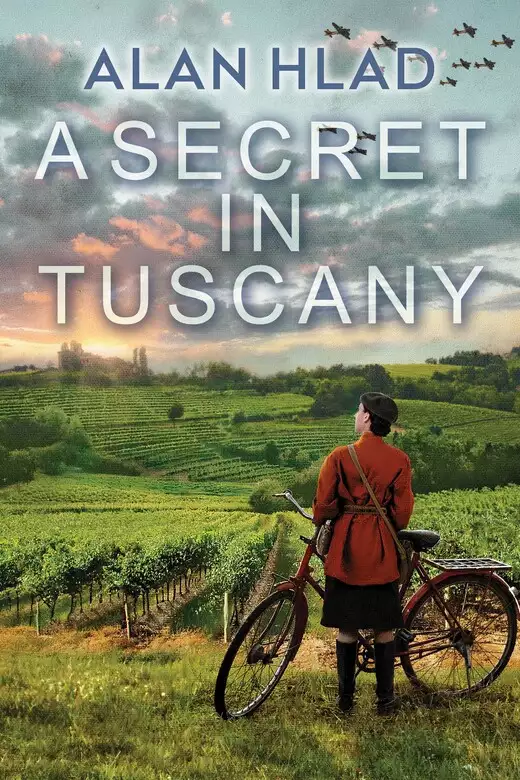
Italy, 1943: With war blazing through Europe, nowhere is entirely safe—not even the remote hills of the Tuscan countryside. It’s here that Italian partisans, including thousands of women, risk their lives to provide Jewish refugees with an escape route to Switzerland. And it’s here, too, that Gianna Conti travels to join the Italian Resistance in the wake of her brother Matteo’s death at the hands of German soldiers. Her father has been hiding Jewish refugees on their family’s vineyard in Chianti, but now Gianna is bringing the fight directly to the enemy.
While delivering weapons and intelligence for partisans, Gianna meets Tazio Napoli, an American working undercover for the Office of Strategic Services. Despite the growing odds of discovery, Gianna and Tazio conduct high-risk missions to sabotage German operations. With the aid of Tazio’s OSS codebook, they encrypt secret messages to each other while apart, hiding them at a dead drop in an abandoned mine.
But as the Allies steadily fight their way toward Florence, occupying German forces grow more desperate, leading to a shocking, unthinkable act of vengeance. And Gianna’s fate will rest upon her cunning, her resilience, and her willingness to keep hope alive, even through the decades that follow . . .
Release date:
October 28, 2025
Publisher:
Kensington Books
Print pages:
304
* BingeBooks earns revenue from qualifying purchases as an Amazon Associate as well as from other retail partners.
On the day of the discovery that would change her life, Gianna Farro, an eighty-three-year-old widow and retired art teacher, was painting pictures with her grandchildren in the kitchen of her rowhouse. She retrieved a box of metal tubes from a closet and squeezed globs of blue, red, yellow, black, and white tempera paint onto two plastic palettes—one each for Bella, age seven, and Enzo, age five. While Gianna covered a table with sheets of newspaper, her grandchildren rummaged through a mason jar of brushes, their bristles stiff with paint residue.
Gianna—a spry gray-haired woman wearing rimless glasses and a casual teal linen dress—plucked long-sleeved, paint-spattered aprons from a basket and turned to her grandchildren. “Let’s put these on,” she said, with the Italian accent she had never lost.
Enzo—a boy with a small barrel chest and plump cheeks—drooped his shoulders. “Do I have to wear a bib?”
“It’s not a bib,” Gianna said. “It’s an artist’s smock, and it’ll keep your clothes clean.”
Bella—a thin, wiry girl with curly chestnut hair and a gap where she’d lost a baby tooth—fiddled with a paintbrush. “Nonna, the teachers at school don’t make us wear a smock, and it’s hard to paint with long sleeves.”
“Please, Nonna,” Enzo said. “I promise not to get paint on me.”
It was her daughter Jenn’s idea for the children to wear Gianna’s old aprons while doing artwork. Unlike Jenn—who, even as a child, had an aversion to getting her clothes dirty—Enzo and Bella didn’t mind getting messy. And neither did Gianna.
The paint is washable, Gianna thought, tossing the smocks into the basket. “All right. We’ll be careful.”
The children hugged her around the waist and got into their seats.
Gianna put a record, Antonio Vivaldi’s Four Seasons, on a vintage console stereo in the living room and joined Bella and Enzo. Using a color wheel, she guided the children in producing shades of purple, orange, and green paint. She put down sheets of white sulphite paper and, with the sound of violins mimicking birdsong in spring, she joined the children in painting pictures. While Bella liked to create images of green cats and rainbows, Enzo—whether working with paint, chalk, or clay—was fond of making bugs.
The time with her grandchildren was the best part of her life. Gianna relished learning about their lives and encouraging their curiosity, and she loved teaching them to read, bake, and make crafts. Although she was a part-time instructor at a center for creative individuals with developmental disabilities, much of her time was spent helping her only child Jenn to care for her two children. She was a bit old to have young grandchildren. She’d given birth to Jenn later in life, and her daughter had adopted Bella and Enzo after many years of infertility and miscarriage. Several times a week, Gianna either went to Jenn’s apartment in Manhattan or the grandchildren were dropped off at her home.
Gianna, a first-generation Italian immigrant from Tuscany, had lived in her rowhouse in Park Slope, a tree-lined neighborhood in western Brooklyn, for nearly a half century. After the passing of her husband, Carlo, who had died from stomach cancer several years earlier, she remained in her home, much to Jenn’s disappointment. “Maybe you should consider moving to a retirement community,” Jenn had said, helping Gianna clean out Carlo’s closet. Although she respected her daughter’s opinion, it was her life. And most of her life, at least to this point, had been dedicated to being a wife, mother, and teacher.
She’d decluttered the house by having a tag sale and hired a handyman to remove old wallpaper, refinish hardwood floors, and paint the rooms white. Rather than rehang old decorations, she moved paintings that she’d made as a young aspiring artist from the attic and displayed them on the walls. And although Jenn didn’t like her childhood residence being transformed into an art gallery, Gianna’s grandchildren had grown quite fond of hanging their paper drawings next to their nonna’s artwork.
“Nonna,” Enzo said, turning his paper. “How do you like it?”
Gianna looked at his painting and smiled. “I love it. It’s a beautiful spider.”
Enzo rubbed his nose. “It’s supposed to be a ladybug.”
“Mamma mia! My lenses need to be cleaned.” Gianna adjusted her glasses and leaned in. “Oh, now I see it. It’s splendid.”
Bella peeked at her brother’s artwork. “It has too many legs. It looks like a spider.”
Enzo put down his paintbrush and furrowed his brows.
Gianna scooched her chair next to him. “Want me to show you a trick to make a ladybug?”
He nodded.
Gianna held Enzo’s thumb, dipped it in red paint, and pressed it to his paper. She lifted his hand to reveal a thumbprint. “Use some black paint to make a head, six legs, and dots on the shell.”
He dipped his paintbrush and drew a ladybug with a plethora of polka dots.
“Bravo!” Gianna said, clapping her hands.
Enzo grinned.
“Can I try, too?” Bella asked.
“Of course,” Gianna said. “What color are you going to use?”
“Aren’t ladybugs red?”
“Most are, but you’re the artist, and you get to decide which color it will be.”
Bella’s eyes brightened. She dipped her thumb in green paint and pressed it to her paper.
For the next hour, the trio made thumbprint ladybugs while talking about their plans for the summer, which included going to the Prospect Park Zoo, Coney Island, and the American Museum of Natural History. Eventually, when the papers were covered with bugs, they set down their brushes and admired their work.
“Your pants,” Bella said, pointing at smears of red paint on Enzo’s khaki pants.
He looked up at Gianna. “Sorry, Nonna.”
“It’s all right.” Gianna ruffled his hair, and her eyes gravitated to green splatters on Bella’s white shirt. “You got some on you, too.”
Bella lowered her chin. “Oops.”
“It’s okay,” Gianna said. “Let’s leave our paintings to dry, clean up, and get a snack.”
Enzo smiled and followed his sister and Gianna to the washroom, where they cleaned the brushes and palettes, and scrubbed paint from their hands.
They snacked on prosciutto and mozzarella sandwiches and homemade lemonade in the dining room. For the remainder of the afternoon, they planted flower seeds in small garden pots, made sugar cookies with colorful sprinkles, and played a board game called Trouble.
A knock came at the door.
The children got up from their seats in the living room and waited by the door while their grandmother checked the peephole.
“It’s your mom.” Gianna opened the door and looked at her daughter. “Hi Jenn.”
“Hi.” Jenn put down a leather briefcase and hugged her children.
“You’re early,” Gianna said.
“I have a work event tonight, remember?”
“It must have slipped my mind,” Gianna said, noticing her daughter’s designer navy dress, pearl necklace with matching earrings, and coiffured brown hair. Jenn, an accomplished corporate attorney—as well as a divorced single mother raising two children—always seemed to be rushing off somewhere.
“Can we stay with Nonna?” Bella asked.
Jenn shook her head. “I’ve arranged for a sitter.”
“They could spend the night with me,” Gianna offered.
“Please,” Enzo said, pressing his hands together.
“Another time.” Jenn looked at the stains on the children’s clothing, turned to Gianna, and frowned. “Mom, why didn’t you use aprons?”
Gianna shifted her weight. “I will next time. The paint is washable.”
Enzo lowered his chin and placed his hands over red streaks on his pants.
Jenn glanced at her watch. “We need to go.”
“But you haven’t seen our artwork,” Bella said.
Jenn picked up her briefcase. “I will when we come back. We need to leave.”
The children reluctantly nodded and gave their grandmother a hug.
Gianna gave them a big squeeze and felt them slip away.
“See you on Friday,” Jenn said. “Would you like me to give you a call so you won’t forget?”
“No need,” Gianna said. “I’ll remember.”
She watched her walk away with Bella and Enzo en route to the subway station. She adored Jenn, and she believed that her daughter was fond of her. But they were, quite simply, two women with different personalities. As the trio disappeared down the street, she thought of Enzo and Bella’s designer clothing, likely purchased by their mother at Saks or Bloomingdales, spattered with paint. She closed the door and chuckled.
She made a cup of jasmine tea and placed an Ornella Vanoni record on the stereo, hoping that the Italian singer’s angelic voice would deaden the loneliness that always accompanied the departure of her grandchildren. She put the children’s artwork on a shelf in the laundry room, and as she was removing the protective newspaper from the table, her eyes locked on a partially paint-smudged headline and froze.
TUSCAN METAL DETECTORIST DISCOVERS ENCRYPTED MESSAGE HIDDEN IN WORLD WAR II BULLET!
Gianna, staring with wide eyes, adjusted her glasses and read the article.
1944. While Allied forces were fighting to liberate Florence from Hitler’s army, an unknown soldier encrypted a secret communication and placed it inside an empty bullet casing. The hidden message has gone undiscovered for nearly six decades, until Aldo Ajello, an amateur metal detectorist, found the object in a remote area of Tuscany.
“I was searching a hillside with my metal detector,” Ajello said to reporters. “I received a strong signal near the base of an old cypress tree and began to dig. At first, I thought it was an empty ammunition shell. But after I cleaned away the soil, I saw that the bullet was inverted into its case.”
Mr. Ajello pried open the bullet and discovered an encrypted note. Copies of the message have been sent to cryptologists in Rome, London, and Washington, D.C., and most of the experts think that the message was encrypted with a British or American field cipher. To date, the code remains undeciphered.
Images of German soldiers, raiding a Tuscan village, flashed in Gianna’s brain. A chill ran down her spine. She turned over the page of the newspaper to reveal a photograph of the coded message, and her breath stalled in her lungs.
“Oh, mio Dio,” Gianna whispered. Her hands trembled as she stared at the code that she had last seen many years ago. She recognized the handwriting of Tazio, an American operative who perished in the war—and a man who remained in her heart regardless of the passage of time. And given the communication’s last two letters, she had no doubt that the message was intended for her.
This can’t be real! Gianna slumped into a chair and tears welled up in her eyes. Horrid memories of German occupation swirled in her head, resurrecting the pain of the past. She’d never spoken to Jenn, or her late husband, for that matter, about her life during the war. The tragedy that she’d experienced in Tuscany, and her role in the conflict, were matters that she had planned to take to her grave. How does one talk about unspeakable things?
The music stopped and the needle scratched, over and over, on the record.
Gianna’s mind toiled, contemplating what she needed to do. She weighed the pros and cons and, after careful consideration, she made her decision. She wiped tears from her cheeks, rose from her seat, and turned off the stereo. Before she changed her mind, she thumbed through a telephone book, called a travel agency, and booked the next available flight to Rome, Italy. She went to her bedroom and packed a suitcase, all the while struggling to find the words to explain things to her daughter and grandchildren.
Gianna Conti—a slender twenty-three-year-old Catholic woman with a dimpled chin and wavy hair the color of coffee—entered the door to a long stone cellar that was embedded into the hillside of her family’s vineyard. An earthy, dried-fruit aroma of aged wine filled her nose. She adjusted her grip on a basket that held a jar of olives, a hunk of cheese, a canteen of water, and a loaf of bread. Her eyes gradually adjusted to the dim space, and she made her way past rows of stacked oak wine barrels to the end of the tunnel, where her father, Beppe, was speaking with a young Jewish couple in well-worn clothing.
“Buongiorno,” Gianna said, approaching them.
Beppe—a middle-aged man with salt-and-pepper hair and a stubble beard—turned and adjusted his grip on his wooden walking cane. “Any sign of soldiers?”
“No—the road and countryside are clear.”
“Va bene,” Beppe said, sounding relieved.
Gianna approached the couple, a man named Davide and his wife, Sara, who’d arrived two days earlier. “I brought you food and water.”
“Grazie,” Davide said.
Gianna handed the basket to Sara. “It’s not much. I’ll get more food when I go to Firenze to secure your travel papers.”
“Bless you,” Sara said.
“Tonight,” Beppe said, “my son Matteo will arrive from the north and lead you on the first leg of your journey to Switzerland. A few weeks from now—you’ll be free.”
Tears pooled in Sara’s eyes, and her husband placed an arm around her shoulder.
A feeling of hope swelled inside Gianna.
Under the Italian Racial Laws—established in 1938 by Benito Mussolini’s Fascist government—Jews were banned from positions in government, banking, and education. Soon after, they were stripped of their assets, restricted from travel, and confined to internal exile. Also, sexual relations and marriages between Italians and Jews were forbidden.
Gianna and her family despised fascism and racial laws. And when war erupted in Europe, she resigned from her studies at the University of Florence to help her father, a widowed wine-maker, run the family vineyard, while her brother, Matteo—who had refused to enlist in the army—joined the Italian Resistance. Gianna, like her brother, was determined to fight Italy’s authoritarian regime, and she convinced her father to help an Italian and Jewish resistance group called DELASEM (Delegation for the Assistance of Jewish Emigrants). The organization, which was supported by international Jewish institutions and members of the Catholic church, provided aid to Jewish refugees. Also, it helped many of the refugees to flee Italy and reach sanctuary in neutral countries. The Conti family was a small but crucial cog in the wheel of DELASEM’s Florence network. Gianna and Beppe provided food and shelter on their vineyard, and Matteo served as an escape line guide to help refugees reach Beppe’s only sibling, Uberto, a priest who lived in Switzerland.
Initially, DELASEM was viewed as a legal organization by the Kingdom of Italy, and the Fascist government did not always enforce the Racial Laws. But this past July, things began to change when the Allies invaded Sicily. The Grand Council of Fascism—with the support of King Victor Emmanuel III—overthrew and arrested Benito Mussolini, the Italian dictator and prime minister. And at the beginning of September, when the Allies invaded southern mainland Italy, the country dropped out of the war and signed an armistice with the Allies. Hitler had retaliated by ordering German troops to seize control of the northern half of Italy, forcibly disarm Italy’s armed forces, and free Mussolini from prison to establish a Nazi German puppet state. DELASEM was declared to be an illegal organization, and its members were forced to go underground. And now, the German occupiers were free to execute their own plans to persecute Jews—and those who protected them.
“After you eat and stretch your legs,” Beppe said, “it’s best that you stay hidden. Gianna or I will give you breaks when we are sure that the area is clear of German soldiers.”
Sara and Davide nodded.
Gianna felt horrible for them, and her eyes shifted to a wall of wine barrels. Behind it was a hidden chamber that had been constructed by Beppe. The room was accessed by removing a bottom barrel’s chime hoop and head cover, and then crawling through the empty barrel to the hidden space, big enough to hold three or four refugees. In addition to this chamber, she and her father had created another secret hiding place in the attic of their farmhouse.
“Do you need any more blankets?”
“No,” Davide said. “We have more than enough to keep us warm.”
“How about more books and candles?” Gianna asked.
“We have plenty,” Sara said.
Gianna and Beppe remained with them while they ate, and they stood lookout while the couple scurried away to the nearby outhouse. Afterward, Davide and Sara hunkered into their hiding spot, and Gianna and Beppe secured the barrel’s head cover and left the wine cellar.
Outside, the morning sun illuminated the Tuscan sky with hues of yellow and orange. The rolling hills of the Conti vineyard were lined with rows of plump, dew-covered Sangiovese grapes that were nearly ready to be harvested. In addition to grapes, scores of olive trees covered the landscape. The vineyard was far too much work for Beppe and Gianna, and for the past several years they had enlisted part-time help from farmers, mostly old men and women, during the pruning and harvest seasons. The remote property, with no other residents in sight, provided Gianna and her father the privacy that they needed for harboring refugees. But with the swelling number of Wehrmacht troops occupying Florence and surrounding areas, it was merely a matter of time, Gianna believed, before German soldiers took notice of their vineyard.
Gianna walked with Beppe, limping as he used his cane, to their two-story stone farmhouse with a weathered terra-cotta tile roof. They entered the front door to a living room with an old green-upholstered sofa and a matching chair, which were placed on opposite sides of a fireplace, its stone marred with soot. Timber beams spanned the ceiling, and the place was quite rustic and drab, except for the walls, which were decorated with several bright-colored oil paintings created by either Gianna or her late mother, Luisa.
Beppe entered the kitchen and slumped into a seat at the table.
“How’s the leg?” Gianna asked, scooching a wooden chair next to him.
Beppe grimaced as he propped his right leg on the chair. “It’s fine. A little rest, and I’ll get to work.”
During the Great War, Beppe was an infantry soldier who served on the Italian Front, and he was shot in his right leg while fighting German and Austro-Hungarian forces. Despite chronic pain and needing to use the aid of a cane, he never complained, nor did he let his lack of mobility get in the way of tending to the vineyard and, more important, hiding refuge seekers.
“I’ll warm the caffè,” Gianna said, approaching a wood-burning cast-iron stove.
“No need,” he said. “I’ll drink it cold.”
She retrieved a tarnished aluminum moka pot from the stovetop, poured an espressolike coffee substitute—made from ground roasted barley—into a cup and gave it to him.
“Grazie.” He took a sip. “It’s good.”
“You and I both know it tastes like tar.”
Beppe smiled. “Have some with me.”
“No thanks. I need to get on the road to Firenze.” She glanced out the window to rolling hills, and a memory of German Panzer tanks, rumbling southward, flashed in her head. Her shoulder muscles tensed. “Do you think the Allies are strong enough to break through the German lines?”
“I do.”
She shifted her weight. “But countless divisions of Hitler’s troops have flooded into Italy. His army appears invincible.”
Beppe looked into his daughter’s eyes. “It might take a year or more, but I have faith that the Americans and British will battle their way up the boot of Italy and liberate the kingdom.”
Gianna clasped her arms.
“Someday,” he said, “Italy will be free from fascists, and Jews will no longer need to hide.”
Gianna thought of Sara and Davide, and the many other refugees that they’d hidden on the vineyard. “I hope so.”
“And when the war is over,” Beppe said, “you’ll resume your studies at the university and create a beautiful future.”
“Right now, that’s the last thing on my mind.”
“Understandable,” Beppe said. “But you must hold onto your dreams.”
Gianna nodded, appreciative of her father’s efforts to raise her spirit.
Beppe looked at a framed black-and-white photograph that hung on the wall: his late wife, Luisa, wearing a wedding dress and holding a bouquet of flowers. “I wish your mamma was here to see what you and Matteo are doing. She’d be so proud to see her children protecting people in terrible times.”
Gianna clasped her necklace, which held her mother’s wedding band engraved with the words Amore Mio (My Love) and matched the one on her father’s finger. “She’d be proud of you, too, Papà.”
He rubbed his eyes and nodded.
Gianna’s mother had died from influenza when Gianna was fourteen years old. She was a gifted grape grower and an amateur artist, and the love of her father’s life. Despite the passing of years, her father’s heartache remained raw.
Gianna placed a hand on her father’s shoulder. “I should go.”
“Take extra wine with you. It might be helpful if you’re stopped by the Germans.”
“I will.”
Beppe rose from his chair and hugged her. “Catch the moment.”
She squeezed him.
Catch the moment, Gianna thought. It was her father’s phrase of affirmation, spoken seldom, but when she needed it most. He had always been supportive of her aspirations, instilling a sense of confidence that she could accomplish anything through persistence and optimism. And he always encouraged her to make the most of a situation, no matter how bleak things appeared to be.
“Be attentive,” he said.
“I will.”
Gianna left the house, retrieved bottles of wine from the cellar, and wrapped them in old newspapers. She loaded the wine, along with jars of olives and bottles of olive oil, into the front and rear wicker baskets of her bicycle, and hiking up her gray wool skirt, straddled the seat and pedaled away.
For several kilometers, she rode her bicycle over a dirt road that wound through rural hills that were filled with umbrella pines and tall, thin cypress trees. She passed a few farmhouses and vineyards but saw no people other than an elderly woman named Ida who was walking away from a chicken coop with a wire basket of eggs. At the base of a hill, she reached a paved road and turned north toward Florence.
The rumble of an oncoming vehicle engine grew louder and deeper. She pedaled faster, sending a burn through her thighs and calves. As the bicycle crested a hill, a dark gray transport truck—emblazoned with an iron cross and filled with German soldiers—came into view. A chill ran down her spine and her foot slipped from the pedal. She regained her footing and gripped the handlebars as the truck passed her, blasting her body with wind and forcing her bicycle to the berm of the road. Whistles and jeers arose from the soldiers. She ignored their calls, steered onto the roadway, and continued her journey.
An hour later, after passing several German transport and supply vehicles, the skyline of the medieval city came into view. She saw the Florence cathedral and its immense, Gothic-style red dome. Catch the moment: Beppe’s words echoed in her head. A wave of determination rose up inside her. Gianna coasted down a hill and traveled along the Arno River, which glistened with sunlight, and then crossed the Ponte Vecchio, a medieval stone arch bridge.
She weaved through the narrow streets of Florence, which were cluttered with pedestrians, most of whom were stoic-faced women and old men. A swastika flag hung from the side of the Palazzo Vecchio, the town hall of Florence, and the laughter of German soldiers emanated from a nearby café. As she traveled through the city, she passed three Waffen-SS officers, wearing field-gray uniforms, who were exiting a hotel that appeared to have been requisitioned by the Wehrmacht. In the past weeks, the number of German military personnel in Florence had swelled. Italian soldiers were nonexistent. They’d been disarmed, taken prisoner, and deported by German forces.
She went to a basement apartment of an elderly couple and bartered her goods—save two bottles of wine—for zucchinis, a half loaf of brown bread, a small dry salami, and a hunk of pecorino cheese. Heavy rationing made it difficult to acquire many items, such as meat, grain, and butter, and Italians often turned to the black market for better food. Afterward, she traveled to a narrow street, far too small for motorized vehicles. She got off her bicycle and pushed it—all the while scanning her surroundings for onlookers—to a small weathered door of a stone building. When she was certain the area was clear of people, she clasped a tarnished brass ring mounted on the door and knocked.
She fidgeted with the ring on her necklace. Seconds passed and a metal mesh peephole, reminiscent of a confession booth window, slid open.
“Are you alone?” a familiar male voice asked.
Gianna glanced down the passageway. “Sì.”
A lock clicked, the door swung open, and Gianna pushed her bicycle inside. The door abruptly shut behind her and a bolt was slid into place. She turned and was greeted by Nathan Cassuto, a doctor and rabbi in his mid-thirties with a clean-shaven face, round-rimmed glasses, and neatly trimmed brown hair that was parted on the side.
“Any chance you were followed?” Nathan asked.
“It’s possible, but I don’t think so.”
He slipped his hands into his pockets. “How are Davide and Sara?”
“Okay,” she said. “They’ll be leaving with my brother tonight.”
“Lilla is working on their travel documents,” Nathan said.
She turned to the sound of approaching footsteps in the hallway.
Don Leto Casini, a tall Catholic priest in his early forties who was wearing a black suit with a clerical collar, approached Gianna. “Ciao.”
“Buongiorno, Don Casini.”
“How is Beppe?” the priest asked.
“He’s well.”
“Please send him my regards, and inform him that we have three refuge seekers that we want to move out of the city. Do you think that you and Beppe could accommodate them?”
“Of course.”
The priest smiled.
“Grazie,” Nathan said. “We’ll be in contact when we are able to move them.”
Gianna left her bicycle with the rabbi and priest, both of whom were leaders of the DELASEM network in Florence. As she traveled down the hallway, she felt a deep admiration for Nathan and Casini. Under the oppression of Fascist rule, leaders of different faiths have united to protect Jews from persecution. She buried her thought and ascended a narrow stone stairway to a third-floor room. The odor of glue and chemicals filled the air. The window shutters were closed, and a lantern cast amber light over the space and a young woman, who was seated at a long table covered in writing supplies.
“Ciao,” Gianna said.
Lilla, a Jewish woman in her late twenties with fair skin and beautiful long black hair, rose from her seat and hugged her. “It’s good to see you.”
“You too,” Gianna said, releasing her.
“I won’t be finished with Davide’s and Sara’s papers for several hours. I’m sorry. I’ve been inundated with work. Do you want to come back later?”
“I’ll wait.” Gianna sat in a spare wooden chair at the table, which had on it a typewriter, bottles of ink and chemicals, wax, glue, carved wood stamps, real and replica passports and birth certificates, and an array of paper. “It’ll give us a chance to visit, and for me to watch the best forger in Firenze at work.”
Lilla smiled.
Gianna was a student at the university when she first met Lilla, who’d been terminated from her job as a clerk at the Florentine State Archives because of the Racial Laws. They’d become close friends, and it was Lilla who had recruited Gianna to join DELASEM. Most members of DELASEM provided financial aid or safehouses for Jewish refugees, but Lilla created and altered passports, birth certificates, and travel papers.
While growing up in Rome, Lilla worked at her family’s dry-cleaning business, where she learned a special technique, using lactic acid to remove permanent blue ink. . .
We hope you are enjoying the book so far. To continue reading...

 Please log in to recommend or discuss...
