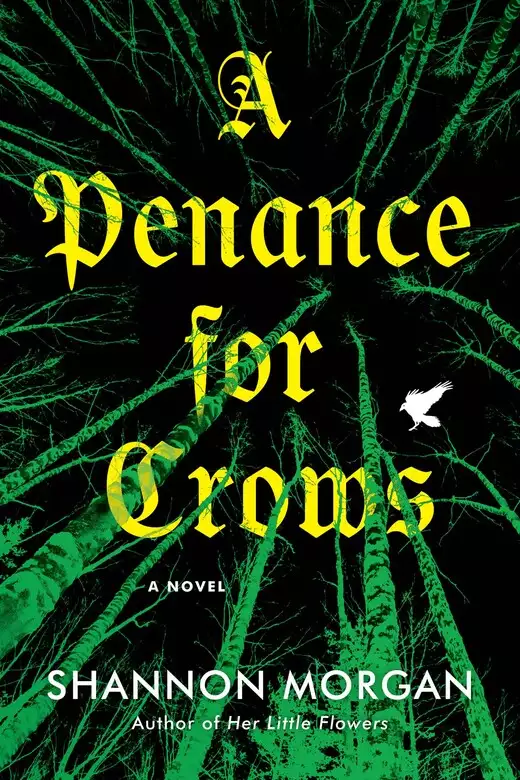
An unnerving, hypnotic, modern gothic thriller set on a remote Irish island, where an artist is caught between deadly secrets, ancient superstition, and echoing madness . . .
Off the southern tip of the Beara Peninsula lies Beanna Dubh, an island of savage beauty, its jagged cliffs lashed by Atlantic winds and infested by thousands of crows. Untouched by 21st-century advances, the islanders live under the strict rule of the church, while clinging to old superstitions of the crows as harbingers of disaster. To this desolate, unforgiving place Grizela Urquhart fled, seeking sanctuary from brutal bullying in her native Glasgow.
40 years on, Grizela still remains an outsider—the eccentric painter viewed with distrust and barely tolerated. The feelings are mutual, for she has discovered there are as many secrets on Beanna Dubh as there are crows.
When she stumbles upon the body of a young priest with a diabolical symbol drawn on his chest, the crows darken the skies, and Grizela is plagued by demonic whispers only she can hear. The islanders’ suspicions fall on her, but she fears the answers lie in her tortured past.
As mass hysteria grows, Grizela scrambles to protect the innocent—a quartet of young girls she has taken under her wing. When she uncovers dark truths behind the girls’ mysterious midnight gatherings, her grip on reality unravels and she is faced with an impossible choice: do the unthinkable to protect the girls as the whispers urge, or come out of hiding to face the sins of her past.
Release date:
July 28, 2026
Publisher:
Kensington Books
Print pages:
336
* BingeBooks earns revenue from qualifying purchases as an Amazon Associate as well as from other retail partners.
Like tatters of black cloth, the crows whipped and tossed on the cruel wind, shrieking defiance at the storm amassing over the Atlantic.
As stubborn as the crows, Grizela Urquhart forged onwards, the chill in her aging bones making her long for the merry fire banked in her cottage, awaiting her return. Clutching the bag containing her easel and paints to her chest, she trudged doggedly on, along the cliff path towards the southern tip of Beanna Dubh, determined to reach the Silver Wood before nightfall.
Grizela loved the beautiful savagery of this remote, windswept island on the southernmost tip of the Beara Peninsula of Ireland. She loved the coves that fringed the island, dashed eternally by briny violence whatever the weather. She loved the treacherous heart of the island where heather hid peat bogs in the valley between sheer mountains. But mostly she loved the crows, their darkness in legend and nature, their curiosity, their intelligence, and their proud independence in the face of adversity.
She rarely saw the islanders on this end of Beanna Dubh; most of the three-hundred-strong population lived in the more sheltered north, in the village of Abbandine. This suited Grizela. She liked the islanders well enough, most of them anyway, but she was selective with the company she kept.
In the near distance, she could make out the Widows—five standing stones teetering on the cliff edge of a narrow inlet, now dimmed to little more than tall shadows in the gloom of the winter afternoon.
Grizela squinted at the crows when their screeches stilled. They gave up their battle with the wind and plummeted over the cliff edge.
Hurrying past the Widows, she looked down at the inlet below, stung by the spray as the waves hit the cliffs with youthful vigour, an omen of the lashing the island was in for that night. The crescent of pebble-dashed shingle seemed unnaturally still beside the thrashing waves. The crows had settled there, not moving but for the wind ruffling their feathers.
Not sure what had attracted the birds’ attention, Grizela paused, her frizzled, grey hair whipping about her face, a fine sleet grating her skin. A hoarse whispering rose above the churn of air and water. Faint, but there, like the murmur of the sea gods protesting the vehemence of the storm.
The crows were all staring at a large dark shape on the narrow beach. They made no move towards it. They just stared. Unmoving. Silent.
Grizela thought it was a seal that had pulled itself out for a respite from the ocean’s snarl and thrash. Seals were a common sight on Beanna Dubh, and assuming this seal’s respite might be permanent to garner the crows’ undivided attention, she half turned to continue on her journey.
The crows croaked in unison. Just once. She stopped. Already cold, an icy finger scraped down her spine when she peered at the cove again, to find the crows had changed position. Now facing the Widows, they stared at Grizela with corvine intensity.
“You’re freaking me out,” she muttered, when the sleek heads swivelled back to stare at the dead seal. It lay oddly, sort of flattened, not a blubbery heap. A flipper flapped above it.
Grizela stepped cautiously off the path to the edge of the cliff and searched for the movement that might have been a trick of the miserly light or an errant wave. It came again in the next sea-drenched gust; the seal moved in a most unseal-like manner, rather like the snap and slap of material caught in the wind.
The problem with curiosity was it led with a decided lack of caution. Still, Grizela followed her curiosity. She quickly found the roughly hewn steps leading to the cove and was instantly soaked by the spray.
The crows hopped to either side, opening a small corridor for Grizela to walk through, watching her with their own insatiable curiosity.
“Oh, sweet Jesus,” Grizela whispered. Her words set the crows off, their croaking echoing off the sheer cliffs of the tight inlet.
In this wild place where the wind raged and the Atlantic thundered, she knelt, pebbles digging into her knees, and looked down at the young face of Father William. His body had been swept halfway up the shingle, and recently too, for his cassock was saturated and his flesh was untouched by crabs and crows.
He had been handsome in life, though youth was beautiful for its own sake to Grizela with the passing of her own years. Now, slack with death, his face had lost some of its attractiveness.
Grizela’s throat tightened with an unexpected sob, the hoarse whispering of the sea gods pressing against her ears until it was all she could hear. Stumbling across an unexpected death dredged up unwanted memories of another death, another face from another time, another place. Stifling the urge to scream, she breathed deeply of the stinging air and pulled herself together enough to put her head close to the priest’s mouth, hopeful she was mistaken, knowing she wasn’t.
She leaned back and grimaced at the crows, their dark eyes fixed on the dead priest. A shudder of unease rippled across Grizela’s skin when something more interesting than death captured the birds’ curiosity, their heads twisting to peer up at the cliffs, granite grey with lashings of white guano and little to impede a downward trajectory.
Perhaps it was the crows’ peculiar behaviour, perhaps something more innate, but Grizela sensed it too. She was being watched. She searched the cliff’s sharp edges for the watcher, at the spaces between the Widows. No one was there yet the crows still stared up at the cliffs.
A sharp gust of wind brought her attention back to Father William. His usually tightly buttoned cassock had come undone and flapped open to reveal his thin chest, the skin marbled in death and quite beautiful to her artist’s eye. Frowning, she used the tip of a finger to push the cassock away from his skin further, wincing at the invasion of the young man’s privacy while trying not to touch his fish-cold skin by accident.
The hoarse whispering in her ears rose to a cold susurration as she stared in astonishment at the faint marks dusted on the dead man’s chest. Not marks he might have received from the churn of the waves, but a circle drawn in what looked like charcoal enclosing three crosses above a half-moon. Peering more closely, she noted letters around the diameter, smudged and unreadable.
Her gaze snapped up to the cliff tops again. Someone had drawn on the priest’s chest after he had been in the water. Her first thought on finding the body was it had been an accident, a fall from the cliffs … second thoughts begged the question: Had he been pushed?
The newly arrived night, a week short of the winter solstice, hung like a shroud above her as the faint pealing of Beanna Dubh’s many church bells announced the time as four o’clock and drew Grizela back into the outside world after her sad discovery. She wasn’t sure what to do about Father William. She couldn’t carry him all the way to Abbandine, but she worried that the impending storm might wash him back into the sea before she could return with help.
Feeling every one of her sixty-two years, Grizela stood up in a creak of joints. Recoiling at the cold, dead skin through the priest’s cassock, she hooked her hands under his arms and pulled him further up the beach, into the shelter of the cliff. With a last look down at the face that would never grow old, she picked up her discarded bag.
“You lot can sod off,” she hissed, and flapped her arms to shoo the crows away.
They ignored her, only taking to the air when Grizela hurried back up the rough-hewn steps. Pushing against the wind, the crows followed her like a ragtag cloak of feathers.
Beanna Dubh was unmarred by the twenty-first century. There was little modern technology, enforced by the church that treated the island as its personal fiefdom. Grizela had been forced to keep her foot in modernity by setting up a mobile system in direct opposition to Father Murphy, who all but ran the island. She suppressed a surge of annoying guilt and pulled out her mobile, waved it about until she had a signal, then quickly scrolled through her few contacts. Putting the phone to her ear and hoping the signal stayed constant for once, she shifted from foot to foot, eyeing the crows circling above her, as she listened to the ringtone. She had almost given up hope when Sean O’Sullivan picked up.
“Is that yourself, Grizela?”
“It is. Sean, you must come out to Beanna Dubh immediately. Something terrible has happened.” Grizela quickly launched into her discovery of Father William’s body, but bit back a confession that she thought the crows had led her to the body, not wishing to feed the islanders’ superstitious awe of the birds.
Silence, then a sigh from Sean. “I saw Niall O’Dwyer down the pub earlier. I’ll catch a lift with him.”
“Good luck with that.” Grizela’s hope was heartfelt. It was no secret that Niall O’Dwyer, a fisherman from Beanna Dubh, was useless when the drink took him, and abusive to boot. She doubted the man would be able to steer his boat from Berehaven Harbour on the mainland if he’d been in the pub for any length of time, especially with a storm to keep things interesting.
“Don’t say a word to anyone until I get there,” warned Sean before he disconnected and left Grizela biting her lip and wondering what to do now. Should she stay with the body or wait for Sean in Abbandine? The decision, however, was an easy one to make. While she was not superstitious or scared of the dark, she had no desire to wait in the fierce, cold wind with a dead body.
Switching on her torch, she headed up the path that led inland at a fast trot, the crows keeping pace above her. Moving past the ruined monastery of St. Abban, her heart clenched wistfully as she entered her beloved Silver Wood, but didn’t dare stop to press her hands against the peeling bark of the birch trees as was her custom.
She passed through the valley between the Bellows—two towering mountains running parallel down the length of the island—that protected her from the snatching wind. She kept her eyes on the path lit by torchlight, the shadowed quilt of peat bogs on either side that had claimed more than one life in years past. She was still mindful of the advice she had received when she’d first arrived on Beanna Dubh: Never underestimate a puddle.
It took half an hour to hurry the length of the island, with quick glances over her shoulder, unable to shake the burning sensation that someone was following her until the welcome sight of Abbandine brightened the darkness.
The Beanna Dubhish had a practical approach to street-naming in Abbandine. What was technically the main street in a village of only four streets was Harbour Street, which ran down to the only viable harbour on the island. It had a post office, a few shops and a pub called the Smoke Crow after one of St. Abban’s many miracles; the name had stubbornly stuck despite the church’s best efforts to change it to something they considered more suitable. Harbour Street ran parallel to The Deep, a road running along the deep channel with the same name. The road furthest from the harbour was Church Street, which ran up to the vast doors of St. Abban’s Church that was so big it really should have cathedral status. The last and most suburban street was Back Road, sheltering in the lee of the mighty Bellows that overshadowed the huddle of narrow houses that was Abbandine.
But for all its lack of originality in street names, Abbandine made up for it in garish colour. It was a point of pride that no house was the same colour as any other, which created a cheerful waterfront that did not match the generally sombre disposition of the islanders themselves.
Grizela stood on the pier, squinting at the three-mile channel that separated Beanna Dubh from Dursey Island and the Beara Peninsula beyond. The ocean was a wild tangle of flailing waves and spray that came up and over the pier to swim around Grizela’s sturdy walking boots before retreating in a rasping hiss over the weathered wooden boards.
She hadn’t expected to see anyone about. The islanders were the early to bed, early to rise sort; most were fishermen or shepherds, governed by the hours of their livelihoods. Yet the moment she arrived in Abbandine families crept out and stood just beyond the pier. They didn’t come any nearer but kept an eye on Grizela and a more fearful eye on the crows, which had settled on the nearest roofs. She had lived on Beanna Dubh for forty years, but she had never grown used to the islanders’ continued bafflement by everything she did.
She knew how she was viewed—the crazy artist who kept unusual hours, living on the fringes, and refusing to conform. Nonconformity was probably her biggest sin in the eyes of the church. It didn’t help that Grizela found it hard not to interfere, and like a maddened ram, she butted in when she wasn’t wanted, probably doing more harm than good, although her intentions were always sound.
Hunching under the weight of the curious stares, Grizela silently cursed the storm, the island and Sean O’Sullivan for taking so long to sail from Castletownbere. She shuffled from foot to foot unconsciously, especially aware of the attention of Father Murphy in the hovering crowd.
Tall, thin and sallow with a hawkish stern face and dark eyes, Grizela considered the priest to be a menace and had clashed with him on numerous occasions over the years. One of three priests—well, two now, she amended—over a flock of some three hundred parishioners, he had a spiritual influence over the island that she found quite frightening.
Father Murphy had not brought a merciful god to Beanna Dubh; a follower of the hell and damnation school of thought, he was charismatic in the way a snake was to a mouse. Grizela had often wondered if that wasn’t why the church had sent him to a backwater like Beanna Dubh, in the hope of containing his particular brand of religious zeal.
Grizela especially hated Father Murphy for his hypocrisy. There was none of the charity the church was renowned for in the man. Though he ate little and plainly and was always praying or going about the island to check on his flock, he consistently turned a blind eye to the problems within the community; anything that did not reflect his Catholic view of Beanna Dubh was hushed or ignored.
A light appeared out to sea, bucking like a bronco on the rearing waves. It seemed an age before the silhouette of O’Dwyer’s fishing boat hove into view, then grew large enough to distinguish its canary-yellow hull.
The moment the boat bumped none too gently against the pier that spoke of an unsteady hand at the helm, the crows took to the air to resettle on the pilings and the ramshackle, faded red building that served as warehouse and office for the tiny harbour, to better watch the proceedings. When Sean leapt onto the pier and tied the boat to the nearest mooring ring, Grizela charged up to him, her worry lifting at the sight of one of her favourite people.
It was hard not to like Sean O’Sullivan with his big open face that invited confidences under an unruly thatch of rust-coloured hair the fierce wind had swept into an even bigger mess. He wasn’t a tall man, and rather stocky, but he radiated calm and friendliness, looking younger than his thirty-five years.
“I told you not to say anything until I got here,” said Sean, eyeing the islanders watching his arrival with solemn interest.
“I didnae,” said Grizela. “I dinnae think they know yet. You know they always watch me when I come into Abbandine.”
Her Scottish burr was a harsh contrast to Sean’s gentler Irish lilt. It had taken years for Grizela to tone her strong Glaswegian accent so the islanders could understand her enough that she no longer had to resort to mime.
“Not this much. You’re sure no one else has seen the body?”
Grizela opened her mouth to say she rather thought someone had found Father William before her but was prevented from saying anything when Niall O’Dwyer chose that moment to stumble off his boat and vomit copiously all over the pier.
“Jaysus, Niall! Pull yourself together, man!”
There were indrawn breaths from the crowd at Sean’s careless blasphemy.
“Sean O’Sullivan,” came the low, raspy voice of Father Murphy. “You shall not take our Lord’s name lightly or in vain.”
Sean’s mum stood next to Father Murphy, her usual expression of disapproval deepened into lines of severe displeasure at the sight of her eldest son. She hadn’t spoken to Sean since he had left the island for good in his late teens, only returning in his capacity as a garda when the need arose or to visit Grizela.
“Sorry,” mumbled Sean, reduced to a little boy’s shame in the face of the priest and his mum’s glares. He cleared his throat, trying to claw back a little of his authority, and turned to O’Dwyer.
The inebriated fisherman gazed at Sean vacantly, then tottered off the pier, where his wife grabbed hold of one arm and his daughter, Nessa, the other.
“Gerorfme wimmin!” he roared, shrugging off his womenfolk, and zigzagged up Harbour Street barely under his own steam.
Nessa caught Grizela’s eye and grimaced. It broke Grizela’s heart that secrets and hidden bruises were something the young girl understood too well, even as she darted after her staggering father.
“That man will be the death of himself,” said Sean, shaking his head. He frowned at the roiling clouds, then eyed the silent crows with a shudder. “You’d best show me where you found the good Father. I’ll be wanting to get back to the mainland tonight before the storm breaks.”
Grizela nodded and hurried beside him through the crowd that parted without a word.
It was only when they were clear of Abbandine and switched on their torches to lead them through the valley between the Bellows that Sean broke the silence with,
“What’s got me mam’s face puckered up like a cat’s arse?”
“You, of course … and you’re in my company.”
“I am that.” He sighed, then immediately brightened. “But the crows are quiet. That’s something at least.”
Grizela’s snort of disbelief belied her own worry at the crows’ peculiar behaviour, which had followed her and Sean from Abbandine. They hopped along the surface of the bogs in dark patches to keep pace with the humans but were otherwise utterly silent. “Bollocks!” she said with more force than she’d intended. “Their silence has got nothing to do with a silly old miracle and everything to do with the storm.”
Sean’s big, ruddy face broke into a smile. “Well, you know what everyone says.”
“The only people who say it live here on this blasted island.” Grizela shook her head. It didn’t matter that Sean was one of the few islanders who had escaped Beanna Dubh with any success; those deep-rooted superstitions and beliefs were so innate in the islanders’ psyche that even Sean still believed in St. Abban’s miracles.
St. Abban was the patron saint of Beanna Dubh, as well as the saint for artists, dyers, librarians and, not surprisingly, crows. He was famous for creating the most beautiful illuminated manuscripts of his time and the number of miracles he had performed. There was a miracle for every day of the year; impressive for a man who’d lived largely as a hermit fifteen hundred years ago. But perhaps his most famous miracle was that of the Penitent Crows.
According to legend, St. Abban had saved Beanna Dubh from an attack by a chieftain from the Beara Peninsula—though some theories suggested it might have been Vikings—with the power of prayer and turned all the attackers into crows. As a further penance for their murdering ways, these crows were forevermore to guard the island. Even now it was said the crows set up a ruckus to warn the islanders of looming danger.
Grizela believed none of it. In her view, the miracle had been a parable for the times. But because of the legend the crows had been allowed to thrive in safety. Of course they would create a ruckus if the island was attacked; they were merely protecting their territory. She couldn’t say this to the islanders, though. They would drive her into the sea if she dared try, so deep was their belief in the Miracle of the Penitent Crows.
But for all that Grizela liked the legend, perhaps because she felt like a penitent crow herself, always on the fringes of this insular community, while serving a self-imposed penance of her own.
Grizela and Sean left the shelter of the Bellows to be battered by the sleet-sharp wind that bit into their exposed skin with renewed malice. The storm was rushing towards the island, blotting the horizon like a livid bruise.
They paused on the cliff top. Father William’s body was still nestled in the shelter of the cliff where Grizela had dragged him, though the thrashing waves were drawing ever nearer. The crows flew past them in a hiss of wings, down onto the shingle, then turned as one to stare up at the two humans.
Grizela felt Sean stiffen. She eyed him sidelong, noting his Adam’s apple bob as he swallowed his fear. “Jaysus. The crows …” he murmured.
“Aye.” Without waiting for more, she hurried down the rough-hewn steps. Sean followed more slowly, his boots sending a small cascade of stones onto Grizela’s back.
Once more the crows hopped aside to leave a corridor for the humans, then watched silently as they crouched beside the dead priest.
Sean shook his head in sorrow. “Poor bugger.”
Grizela shivered as a gust shook the inlet, setting the waves to tangle more violently. Above the wind came the hoarse whispering she’d heard before, louder now, more insistent, like the buzz of flies around a corpse. It made her ears itch. A wordless chattering, and oddly appealing. She leaned into the wind to listen harder, but the harder she listened, the fainter the whispering became.
“Can you hear that?” she said.
“Hear what?”
She paused then, knowing what was about to come out of her mouth sounded crazy. “Whispering.”
Predictably, Sean gave her an old-fashioned look. “You won’t hear the slam of heaven’s doors in this storm.”
“No, of course not,” said Grizela, wishing she’d kept her mouth shut when Sean eyed her with concern. She cleared her throat when his attention returned to the body and added, “I had to move him before the sea took him.” She stepped closer to the thrashing waves. “I found him there.” She pointed to the spot now covered in water.
Sean nodded. “It couldn’t be helped.” He squinted at the narrow cove, the cliffs, then up to the Widows. He nodded again, slowly. “I reckon he fell from there, pushed by the wind no doubt.”
“Or a human hand,” said Grizela.
Sean frowned. “On Beanna Dubh? There’s not one as would harm Father William. He was well-liked.”
It was a truth Grizela could not deny. Father William had been a cordial man and moderate in his spiritual dealings with the islanders. But perhaps that had been the problem: his moderation.
“Except by Father Murphy,” said Grizela.
“Why would Father Murphy push one of his priests off a cliff? Because they didn’t always agree on some religious triviality?” Sean scoffed.
It was another truth Grizela could not deny. “What about suicide?”
Sean’s eyes widened in shock. “Suicide is a sin! And him a priest! It was an accident,” he said firmly, then crossed himself as though the mere mention of the sin could taint him. “He’d not been on the island long enough to know the danger of the weather here. Though what he’d been doing here at all …” He left the thought hanging as he squinted again into the blistering cold darkness, then down at the roaring waves. “He must’ve been up near the Widows. The wind is always fiercer up there, could’ve taken him by surprise, then the current would’ve swept him up here.” He glanced up at the cliff and scowled.
Grizela followed his gaze; she wasn’t surprised to see the islanders gathered above them. A death on the island not from natural causes was excitement enough for everyone to brave the foul weather to see what was happening.
She shifted closer to Sean, and said, “There’s something I need to—”
“Why was I not informed of this tragedy?”
Grizela’s mouth snapped shut and she resigned herself to a night of interruptions as she and Sean turned to face Father Murphy striding across the shingle towards them. Looking like an emaciated, wind-battered stork, his cassock flapped around him with the sound of a wet cough. The crows parted for him in a hopping shuffle, and followed his progress, their eyes glinting more like evil omens than the benevolent guardians of Beanna Dubh. Sean’s usually open face shuttered in the presence of the old priest’s fury, but Grizela watched him suspiciously.
Father Murphy’s mouth opened to castigate Sean, then sagged in disbelief, taking in the body, the cassock, the young features of Father William. Crossing himself, he muttered a prayer under his breath that went unheard in the unholy row the wind was making, before his gaze flew up to the islanders crowding the edge of the cliff top.
The islanders stared back in silence. None whispered or demanded explanations. They reminded Grizela of sheep, vacant and noncomprehending of the tableau unfolding below them. It was a moment before she realised Father Murphy’s attention wasn’t directed at his flock as a whole, but on a group of four teenage girls standing to one side.
Grizela was fond of the girls, a like-minded minority who rebelled against the church’s hold over the island.
“It was an accident, Father,” said Sean. “I think Father William was pushed off the cliff by the wind, probably near the Widows.”
Father Murphy nodded almost absentmindedly at Sean’s gentle intrusion and turned to frown at the standing stones barely visible in the hiss of spray. He nodded again, more firmly. “That makes sense.” Then he stalked back up the shingle without another word.
The wind screeched its unearthly warning as everyone watched the priest pass through the crows and climb up the cliff steps. He marched through his parishioners without acknowledging them, and turned inland, towards the Bellows.
The moment the priest had vanished into the night, Sean released a pent-up sigh and wondered aloud, “What was that about?”
Grizela shrugged. She had been genuinely surprised by Father Murphy’s distress at the young priest’s death; it was no secret the two priests had not liked each oth. . .
We hope you are enjoying the book so far. To continue reading...

 Please log in to recommend or discuss...
