
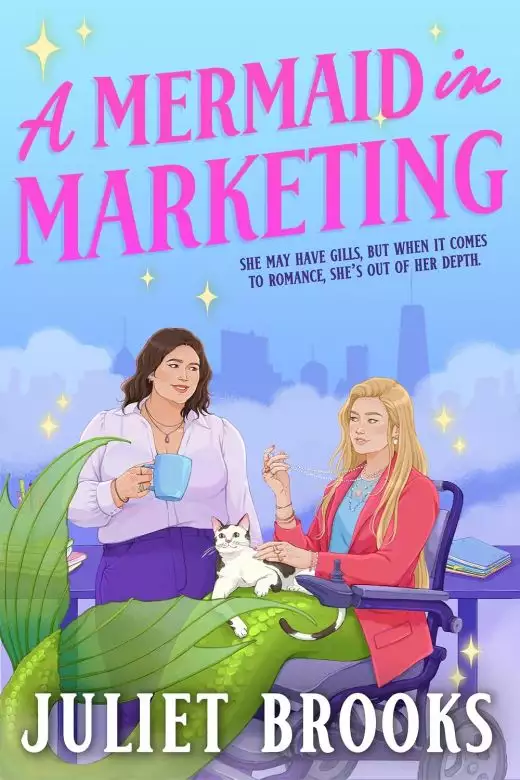
A Mermaid in Marketing
- eBook
- Paperback
- Audiobook
- Book info
- Sample
- Media
- Author updates
- Lists
Synopsis
Scales meets sales in this hilarious fantasy novel from the author of A Fae in Finance!
Coral, a half-mermaid, has been building up the courage to leave the ocean behind and pursue her wildest fantasy: working in the marketing department of a corporation on land. When she's finally given her shot by the aloof and noticeably curvy Ali, Coral will do her best to balance the needs of her magical clients and put her unique talents to great use.
Release date: October 27, 2026
Publisher: Orbit
Print pages: 384
* BingeBooks earns revenue from qualifying purchases as an Amazon Associate as well as from other retail partners.
Reader buzz
 Please log in to recommend or discuss...
Author updates
A Mermaid in Marketing
Juliet Brooks
The third had described her greatest strength as “setting up my colleagues.”
“Setting them up for… success?” Ali had asked, because Ali sometimes drank milk past its sell-by date and liked to live dangerously.
“No, like, romantically!” the candidate had replied, with the enthusiasm of a high school cheerleader. “Like, the two of you have mad chemistry.” She’d gestured between Ali and her boss, Bob.
Ali and Bob had chemistry, all right—they had the same chemistry as an alkali metal and hydrogen peroxide.
Before Ali could politely end the interview, Bob had guffawed. When she shot him a glare, he shrugged. “It was pretty funny,” he said.
“See?” the candidate had asked, definitely not getting the joke.
So they weren’t hiring any of the morning candidates.
The elevator doors dinged and Ali stepped out into the lobby.
She kept her eyes on her phone—three p.m. on the dot. Ali valued punctuality in others, perhaps because it was a trait she’d never developed herself.
The lobby was almost empty, except for two security guards and a young blond woman in a wheelchair wearing a black suit jacket.
Though—was blond even the right word for a pale white like the foam-capped wake behind her dad’s little fishing boat in the waters off the shore where she’d grown up?
She shook her head once to clear it; that was such an odd thought.
“Coral… Waters?” she called out, frowning down at the résumé on her screen.
“That’s me,” the woman said. Her slender right hand rested on a knob on an arm of the chair; she pushed it forward and rolled toward Ali with a quiet whirring sound.
Ali had never seen a chair like this before—not that (she admitted to herself with an involuntary grimace of discomfort) she spent much time with people in chairs. Instead of leg pads, the bottom part of the chair was made of the same stretchy vinyl backing as the top. The vinyl extended around the front, where the user’s shins would normally go, like some kind of black sleeping bag. The black sleeping bag bulged slightly at the bottom.
At the top, it tightened around Coral’s waist with a drawstring. The drawstring bisected the shell shirt she wore under her smart jacket, so the lower half of the thin white top disappeared into the bag.
Ali realized she was staring at her candidate’s navel.
“Hi, Coral, I’m Ali Fox,” she said, plastering a smile on her face and sticking out a hand. She directed her eyes at Coral’s face, though they were burning and unfocused with the heat of her own embarrassment. What was wrong with her?
Coral lifted her right hand and grasped Ali’s. She had such smooth skin, sliding like silk beneath Ali’s fingertips. Ali almost rubbed her thumb along Coral’s knuckles, and stopped herself with difficulty. Instead, she examined Coral’s features.
She had a small nose for her face. And the most golden eyes Ali had ever seen, almost yellow—something was unusual about those eyes. She couldn’t quite place it.
“It’s a pleasure to meet you,” Coral said, frowning at their clasped hands. Ali let go with alacrity.
Fumbling for something to say, Ali looked down at her again. She was so pale, with wispy eyelashes and almost invisible eyebrows. Her suit jacket was slightly too big, and—was it ombre? Were people doing ombre suits now?
Ali nodded abruptly, feeling awkward. “Well, come up, please,” she said, gesturing toward the elevator banks. She fell into step next to Coral, her eyes flicking to her phone. 3:01 p.m.
“I hope you’ve been having a good day so far,” Coral said. She had a melodious voice, the sentiment almost a song. Ali jammed the corner of her phone on the up button.
“Oh, yes,” Ali lied, like a liar. “A very interesting day,” she amended. She led the way into the elevator and Coral whirred in behind her.
Ali once again misused her personal communication device to jab at the number 44. An awkward silence hovered around her ears, threatening to descend on them both with the grace of a very determined hailstorm.
“I am so excited to interview at Blue,” Coral said as they ascended, keeping the awkward silence at bay. Ali smiled at her, tight-lipped. “It’s my dream to work in marketing.”
“It’s a great field,” Ali said, continuing to lie lyingly. “A lot of opportunity and exciting work. So many career paths.”
Why was she saying these things?
“There’s nothing like a creative job, really.” Okay, there. That was true enough.
The elevator doors dinged again and Ali led the way into the office. She guided Coral around the rows of desks in the dreaded open floor plan, and brought her into the conference room where Bob waited for both of them.
Bob had reserved Cerulean, the most impressive conference room in their offices: It was in the southwest corner on the forty-fourth floor, and looked toward the Empire State Building to the south, and the Hudson River to the west. There were obviously several enormous buildings between them and the Empire State Building, so you could mostly only see the people in the office across the street. The people in the office across the street had a ping-pong table, which no one ever used, and a coffee machine, which they used often.
But to the west she could see the ferocious blue-gray of the river, and along the proud stretch of avenue to the south, the glittering sunlight against the windows in the skyscrapers downtown. The glass and concrete called to her, some inescapable siren song, the lure of forests made of steel. What was going on with her today? She blinked the thought away.
Bob stood at one of the windows, his back to the door and his hands clasped behind him, his coiffed brown hair adding two vertical inches to his silhouette.
Ali glanced around the room and then dragged one of the chairs away from the conference table so that Coral could roll up to it. She did, a bland smile still plastered to her face. Her gold eyes flicked back and forth—no sclera?
Mermaid, Ali thought, and then felt guilty. You weren’t supposed to speculate on species in interviews; the latest spate of HR trainings had made that incredibly clear. Doesn’t matter, she reminded herself. Work ethic matters. But it did explain the sleeping bag around her waist, and the ombre jacket. Not ombre, just damp at the bottom. And not a sleeping bag—a bag full of water to contain her tail.
While Coral settled herself at the table, Ali walked around to the other side.
Bob took his seat next to her, his expression bland. As he sat, Ali braced herself for the overwhelming waft of aftershave that would inevitably follow. Three… two… She didn’t gag. The synthetic smell of chainsaws and metal and Man dissipated as he settled into his seat, unbuttoning his navy suit jacket.
“I’m Bob Roberts,” he said, giving Coral a regal nod.
She smiled close-lipped back at him, apparently uncowed. “Coral Waters,” she said, and Ali saw a flash of serrated white teeth.
They all sat in charged silence. Ali watched Bob’s face carefully—he only smirked for a half second before he pulled himself together. “Pleasure,” he said.
Ali waited for Bob to introduce himself further or ask a question.
Bob had laid his phone down by his right hand and was attempting to angle his chin in such a way that he could read the screen while pretending to look at Coral.
“So Coral,” Ali said, having affirmed that Bob would continue not to be useful, “tell us about yourself.”
Coral pulled a folder from a discreetly slung briefcase bag on the left side of her chair and opened it. She removed a crisp white résumé, a notebook, and a pen.
“Of course,” Coral said, in that same musical voice. “Last spring, I graduated from New York University with a bachelor’s degree in business and a focus on marketing. I’ve wanted to be in marketing since I was a child, when I was hit with a billboard advertising an Elvis impersonator in Atlantic City during a storm.”
Ali felt Bob shift next to her. Don’t don’t don’t don’t don’t, she prayed fervently.
Bob cleared his throat. “Why were you in Atlantic City?” he asked. Ali gritted her teeth, clenched every muscle in her abdomen, and thought about a tropical island.
“We were migrating south for the winter, I think,” Coral replied breezily. “Anyway, in college over the past four years, I have had opportunities to practice marketing through internships, where I handled social media and viral campaigns. I also won the award for Most Innovative Marketer in my senior year capstone.”
“You were migrating?” Bob asked, raising an eyebrow.
“Yes,” she confirmed. Bob sat in silence, his quirked brow an invitation for Coral to continue. Ali sometimes thought Bob should get Botox on one side of his face so he could maintain the expression permanently. She shifted in her seat, wondering if she should intervene.
Most people lasted about fifteen seconds before the silence got to them.
Coral just stared back at him, her round gold eyes unblinking.
“You said the billboard was for an Elvis impersonator?” he tried.
“Yes, and it introduced me to the idea that marketing can make people want things just as much as a siren song can. That’s why I made it a point to intern with a different marketing firm every summer I spent in college, and I especially enjoy working on ad campaigns for billboards and banners. I like the challenge of saying as much as possible in such a limited medium. That said, I’ve honed my skill set and remained agile. Last summer, in my internship with CoCoPuffery, I tripled their TikTok followers in two months and my Instagram posts got five times as much interaction as previous posts.”
Bob tilted his head. Maybe he was done with—
“You’re a mermaid, right?” He was not done. “That’s why you were migrating? You don’t look like a mermaid.”
Bob was tactless but correct, though Ali hadn’t clocked it before: Coral was neither green, nor scaly, nor webbed in any visible way.
“I’m a half mermaid,” Coral said. “So I probably look like a half mermaid.” She smirked just a bit, like they were all in on the joke.
As far as Ali knew, mermaids tended to stay in the ocean. She didn’t know much about half mermaids, because until fourteen seconds ago, she would’ve said they didn’t exist.
“Have you ever used a siren song in marketing?” Bob asked, instead of asking about any of Coral’s accomplishments. The question made Ali uncomfortable, though she couldn’t say why. Did Bob even know what a siren song was? Did she know what a siren song was? Were siren songs real?
Ali wished she’d paid more attention when the Office of the Mayor created the reading materials on supernatural species several years back. Unfortunately, their design team had chosen Garamond as the font for the pamphlets. Thus, Ali had chosen not to educate herself further.
“Oh, no,” Coral said to Bob, still smiling cheerfully.
Ali blinked. Oh, no? Oh, no, Coral hadn’t ever used a siren song in marketing.
“Of course not. That would be unethical!” Coral tilted her head, sizing Bob up. A thin coil of white-blond hair fell forward over her shoulder, unspooled itself like corn silk across the top of her chest. “And anyway, where’s the fun in that?” she added, with a cheeky wink.
Ali’s jaw dropped, her tongue unexpectedly dry. People usually found it difficult to stay on track when the Bob Question Caboose came into the station. And if they did stay on track, it was a mildly offended track, or a track that resulted in an express train to Eric in Human Resources for a reminder about workplace boundaries.
Bob cleared his throat. “Yes, well, when you go the extra mile, you sweat even more.”
Ali kept her eyes on Coral’s face, which remained open and unfazed. “I think I’ve heard that… Was it Aristotle?” Coral asked, folding her hands atop the paper on the table. Her smile was pleasant, bland.
Ali had never met a woman as strong as Coral Waters in her entire life.
Even without looking at her colleague, Ali could feel Bob’s grin. “No, I came up with it,” he said proudly.
“Oh wow, I’ll need to keep that in my back pocket,” Coral said, and patted the bag on the side of her wheelchair. “It’s a good one.”
Bob chortled, pleased. “Do you have any samples of your work?” he asked.
So Ali knew that they were going to hire Coral Waters.
6 months later
Coral woke up to a sort of snuffling by her ear.
She’d grown used to her brother’s wake-up routine over the past six and a half years, so she neither flailed nor shrieked; she only raised one sleep-heavy arm to catch Emmet in a headlock. In doing so, she also only splashed herself in the face a little bit.
“I was waking you up with kisses!” he protested, his voice high and excited.
She cracked open an eyelid and stared at him with every ounce of skepticism she could muster.
He had a pimple on his cheek. A single startling red dot on the smooth skin of his face—not yet age-rough in the way of older humans.
A pimple. When had that happened?
Coral adjusted her arm until she had a firm grip on his far shoulder. Rivulets of water ran down her arm and along his cheek and chin.
“Wait, Coral—” He was already giggling in anticipation, his eyes scrunched shut with delight. “Coral, I’ll fart on you,” he threatened, still snorting and laughing so hard she could barely understand him.
“You’ll fart on me either way,” she said, in the long-suffering tone of a woman who has learned a hard, sad lesson. She pulled him down into her tub, making sure to keep his head aloft on her shoulder as she snuggled his wriggling body close. His tiny body made a huge splash, which slopped over the side of the tank and into the drainage ports installed to catch spillage.
“Waking—me—up—with—kisses—you—liar,” she said, punctuating each word with a kiss to his forehead. She glanced down at him—he was wearing his water shirt and his favorite swim trunks, which had dancing pink flamingos with rainbow sunglasses on them. He’d clearly anticipated his morning swim.
He cackled and wormed out of her arms, splashing.
“Dad will be mad if you get water everywhere,” she warned. “I’ll tell him it’s your fault.”
Emmet was still giggling, and clearly unconcerned about their dad’s wrath. Coral gave him a light push and he rolled out of the tub and onto his feet with the bonelessness human children seemed to display. Coral wondered if they had bones, or if they just had gelatin until they reached adulthood. Maybe she should’ve taken anatomy for her required science class in college, instead of astronomy.
Her friend Divya had been confident that astronomy would be a great place for them to pick up women, and convinced her to sign up for the class in their senior year. The astronomy class had been full of men excited about physics. Coral and Divya had each picked up exactly one woman—the other—and then gone about the merry business of a first relationship with all of the grace usually exhibited by a kitten who’s just figured out that he can walk.
Her brother ran from the room, leaving wet footprints in his wake. She watched him fondly. Their dad was going to be mad about the water, but he’d get over it: Emmet woke Coral up at least twice a week, and pestered her until she gave him an aquatic snuggle.
Emmet had learned not to move her chair to get to her; it sat where she’d left it at the side of the tub so she could reach it without flopping along the floor. She hoisted herself onto the porcelain edge, thinking about how strong her arms had become since she came out of the water.
You didn’t lift much in the ocean, really. Her brothers and cousins sometimes had anchor carrying contests, but that was for fun. Coral hadn’t participated because she hadn’t seen the point. She rued this fact every time she had to pop a wheelie to get up on the sidewalk because there wasn’t a curb cut—a thing that she frankly should not be doing in an electric wheelchair, period.
Coral heaved herself into the chair, her tail flopping onto the custom-made groove where the leg pads usually went. She hauled herself into the required half-crunch and slid her tail in fins-first, her scales catching on the dry fabric at the top of the bag. Once she’d dropped her tail in far enough, the displaced water fully enveloped her. She wiggled until her tail fell into place, her fins folding to fit the limited space at the bottom of the bag. Finally, she pulled the elastic drawstring at the top of the bag shut around her navel.
She steered to the chair where she left all the clothes she was going to fold someday and yanked a clean blouse off the top of the pile.
When she meandered into the living room, she was greeted by the same sight as always: Emmet and their middle brother, Alex, sitting at opposite ends of the long table, watching TikTok videos without headphones and at volume. She could hear her dad in the kitchen, humming to himself as he made the kids breakfast.
“Any good tiks on the tocker?” she asked, because Emmet usually laughed very hard when she got technology phrases wrong.
Alex grunted in response. Alex was fifteen and had many red dots on his face. He also had what her dad called “teenage ’tude” and communicated primarily via memes and monosyllables.
Coral had spent her fifteenth year alternatively starving because their usual migration route had been overfished, and sick from inhaling oil as they chased the fishing boats to catch whatever was tossed back. She had not had “teenage ’tude” and sometimes wanted to whack Alex upside the head.
Of course, then she remembered her other brother Asp’s gaunt face during that hard, miserable year, and she felt overwhelming relief that Alex spent his time grappling with ennui and whatever new insults kids had come up with this week.
She glanced back at her youngest brother. “No ticking on the tock?” she tried again. Emmet apparently hadn’t even heard her.
“I’m late, so I’m running to work,” she said to the room at large.
“Okay, sweetie, love you,” her dad said, poking his head through the doorway to blow a kiss at her.
Coral rode toward the front door, ruffling each of her brothers’ hair as she passed.
“Bye, Coral!” Emmet said, his eyes still on his phone.
“Grhnng,” Alex said.
Fighting a smile, she left the apartment and headed toward the office.
Coral got the same sense of wonder every time she approached the giant glass building that housed the Blue Ad Agency. It was the feeling of waking up before dawn and watching the water above you start to shine with the sunrise. It was the sound of her siblings’ voices rising through a storm as they sat on rocks and shared siren songs with the howling sky; it was what she imagined it would feel like to finally be able to join them, to add her own voice to their chorus.
She felt awed, basically.
She thwacked the automatic door button with the flat of her palm and rolled into the lobby. Teddy and Marla, the usual morning security guards, lounged behind their long metal desk.
“Good morning!” she chirped, fingers fumbling on the knob of her motorized scooter as she decided whether to stop and say hi. Marla stood and leaned over the desk, solving Coral’s problem.
“Hey, Coral!” Marla called, chin in her hands. Coral altered course to stop beside the desk.
“Hi, Marla, Teddy,” she said, smiling up at them. Marla’s lips kept twitching, like she didn’t want to smile.
“Bob’s in early,” she said. Coral rolled her eyes.
“I don’t care about Bob’s schedule,” she said.
“Everyone else does.” Teddy crossed his arms, probably trying to convey disbelief and wry amusement.
“Ali’s in, too,” Marla said, her eyes shrewder than Coral would’ve liked.
Coral considered this for a moment. There was no safe answer to that comment.
“Did both of you have good weekends?” she asked instead, suavely changing the subject.
“Oh yeah, a lot of kids’ birthday parties,” Marla said, diverted. “Three Bluey-themed parties and one Lego.”
“Woah,” Coral said.
“Not sure why everyone had kids in September and October,” Marla continued, looking a little miffed. “The presents are getting expensive.”
“I know,” Coral exclaimed. “My brother had two birthday parties this weekend, too, and he wasn’t even invited to two more.”
Emmet had been devastated by that, so Coral and Dad had taken him to an escape room. Alex had joined them at the escape room, participated with the mien of a benevolent ruler permitting his subjects to bask in his presence, and then called Emmet a “ding-dong wing-ding,” which caused a brutal slapfight that ended only when their dad threatened to drop Alex off at school with a kiss on the forehead if he didn’t let up.
“Kids can be so mean.” Marla shook her head. “And if no one is mean to your kid, you worry your kid is the mean one.”
Coral, who had never worried about this previously, made a mental note to ask Alex why he never got bullied. “Oh yeah, totally,” she said aloud. “Anyway, I should probably go up.” She jerked her head toward the elevators.
“Have a good one,” Teddy said, waving.
“See you later,” Marla added. Coral zoomed off toward the elevator banks, pondering children’s birthday party themes.
She was still thinking about birthday parties when she arrived on the floor that Blue rented.
Their lobby was covered in giant framed prints of previous ad campaigns. Coral looked at some of her favorites as she passed:
The omnipresent Goat Milk? poster—a man in profile, looking with exaggerated surprise at a goat wearing a sweater with cow print on it.
The Green Grass and a Nice Lass magazine ad, which had apparently been made in the 1960s. Every few weeks, some enterprising jokester taped over the L. Coral suspected Bob, which was a bummer because she secretly found it kind of funny.
The Take a Lapp subway tagline they’d used to promote the short-lived dating app Lapp, which had been… basically what it sounded like. Coral had worked on that campaign in her first few weeks at Blue. Her boss, Ali, had turned pink every single time they met about Lapp’s speed dating event participant numbers. Coral was very relieved when Lapp filed for bankruptcy a month later.
She rolled into the office, veering toward her desk. Within a few weeks, she’d mapped out the shortest path between the elevators and her cubicle. Her colleagues had learned to leave it unobstructed, and after the first month or so she hadn’t encountered a single haphazardly placed trash can or rolled-out chair.
When she reached her desk, she saw that Ali had left a sticky note on her keyboard.
She knew it was Ali because no one else in the office had graceful looping script that reminded her of a kelp forest waving in the current. Also, no one else left her sticky notes.
Coral—morning meeting in Teal.
For some reason, there was a hastily scratched-out space at the bottom of the note, which covered what looked like the letters X and O. Coral couldn’t think of a word that started with Xo. Maybe she’d been trying to write Xome immediately and run out of room.
Teal was the smaller conference room. Coral made her way across the office, exchanging tiny tense coworker smiles with everyone she passed. The coworker smile, which required significant mirror practice, signaled polite recognition and absolutely no desire to stop and chat.
The conference room door was open, so she made her way inside. Ali had pushed away one of the chairs, as she always did, and Coral rolled to a stop next to her.
They exchanged a smile (Ali’s entire face lit up, her cheeks rounding and her teeth sparkling), which made Coral’s heart do a weird flop in her chest, and she glanced at Bob, blushing. Bob hadn’t noticed—her entrance, or her completely unnecessary reaction to making eye contact with Ali.
Fish didn’t blush, so why did she? Fish didn’t blush or experience abject mortification or have unrequited crushes on their boss. And humans… She spent a moment trying to come up with something inconvenient that fish did that humans didn’t do.
Humans didn’t experience scale rot! There.
Sometimes Coral felt that she’d gotten the least convenient parts of being a human and being a fish.
“We have a quick turnaround on a new project,” Ali explained to Coral’s cheek. Coral looked back; she couldn’t help it. Ali’s eyes glittered. She had the most gorgeous irises, deep and dark like the comfort of a cave at nightfall.
Human eyes were strange, but Coral had grown used to them in her almost seven years on land. She no longer balked at the flashes of sclera, whit. . .
We hope you are enjoying the book so far. To continue reading...
